The Monkey Painter
Details
The story
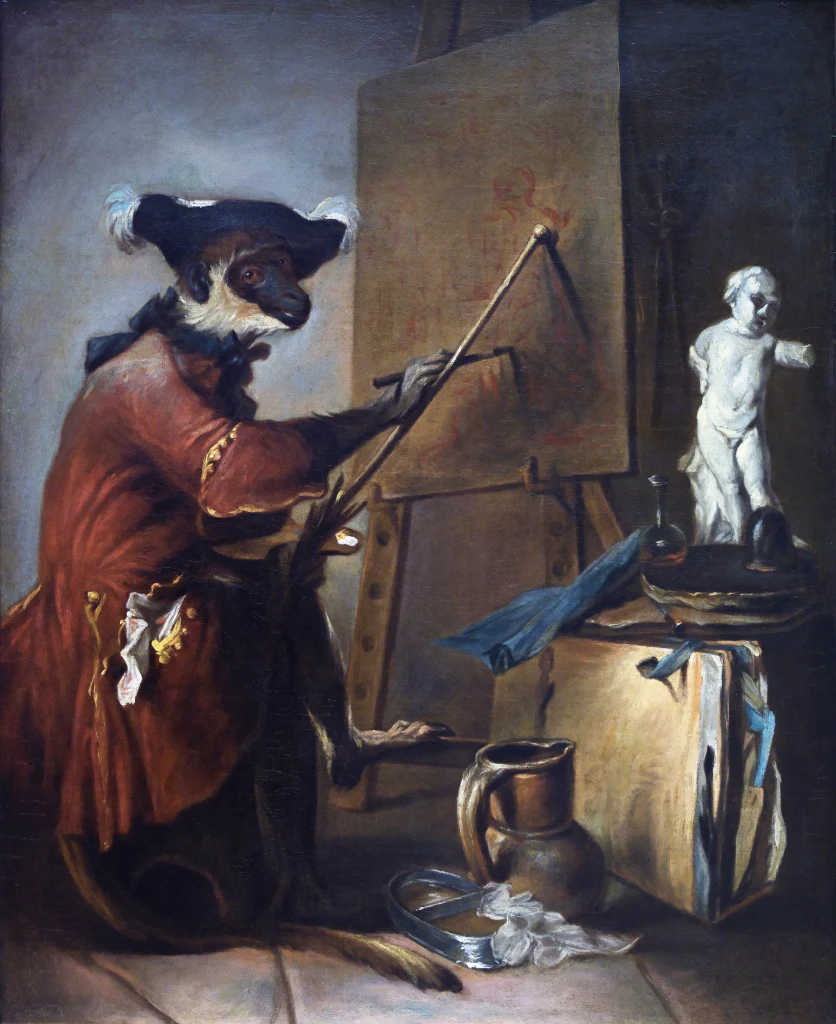
A few months after Chardin's death, in March 1780, his possessions were sold, and this canvas was among them, so he had kept it to the end. A monkey in a red coat and a plumed tricorn hat stands at an easel, steadying his brush on a maulstick, and copies a white plaster statuette of a child. On his canvas there is only a faint red sketch. Painters had long been teased with the old Latin saying that art is the ape of nature, and here the ape is copying a plaster cast.
The booklet of the Salon of 1740 lists a monkey who paints beside a monkey philosopher, and the Louvre thinks this is probably the canvas that was shown. In 1743 the engraver Pierre-Louis Surugue published a print of the composition. The Louvre also owns a Monkey Antiquarian, but the two were not painted as a pair. The antiquarian is larger, sits inside a painted oval and came from the collection of the sculptor Jean-Baptiste Lemoyne, and specialists still disagree about which of the surviving pictures hung together in 1740.