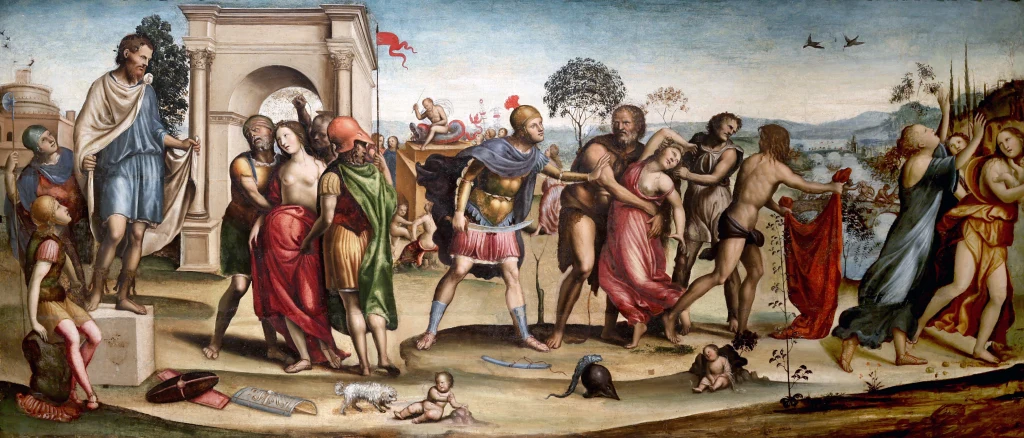
The Rape of the Sabine Women
Details
The story
When Flavio Chigi, a nephew of Pope Alexander VII, bought this long panel in 1660 through the Sienese painter Bernardino Mei, the bill of sale called it the sentence and death of Rhea Silvia, the Vestal who was the mother of Romulus and Remus. A Chigi inventory of 1692 saw women bound between executioners and a man with a sword about to kill one of them. The subject took centuries to settle. In 1884 the historian Jacob Burckhardt called it the Rape of the Sabines, though he thought it was by Baldassarre Peruzzi. The connoisseur Gustavo Frizzoni then gave it to Sodoma, but read it as the punishment of Rhea Silvia. In 1947 Antonino Santangelo showed that it follows Plutarch closely. The first Romans invited their neighbours to games in honour of Neptune, the god of horses, and at an agreed signal seized the Sabine girls. The temple of Neptune stands in the background, and at the left edge Romulus, up on a pedestal, holds his cloak, perhaps the signal itself. The date is argued over too. The museum gives about 1505 to 1508, the end of Sodoma's years around Siena, while other scholars place it in Rome around 1511. The panel was probably the front of a chest, or set into a wall, and the family arms painted on the pedestal, still clear in a photograph of the late 19th century, are now only a faint trace.