The Sacrifice of the Trojan Prisoners (François Tomb)
Details
The story
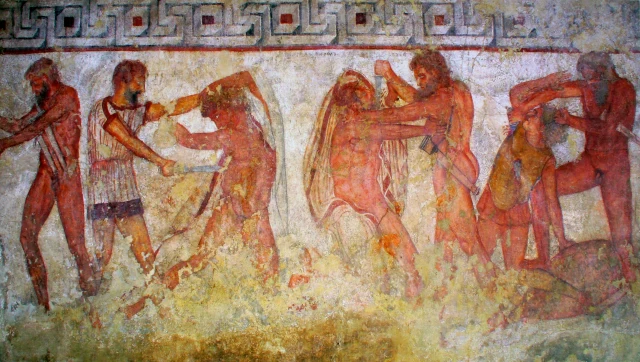
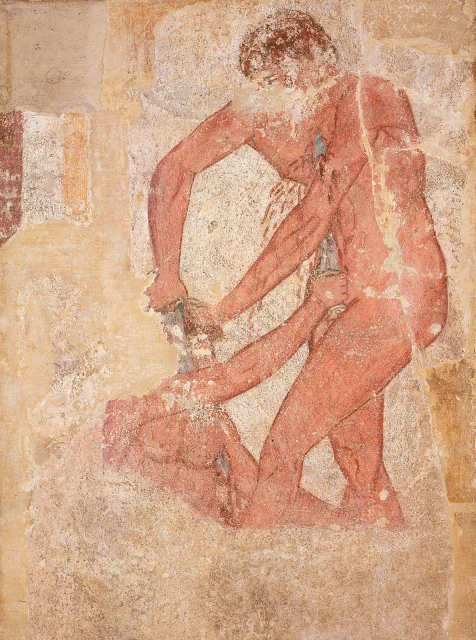
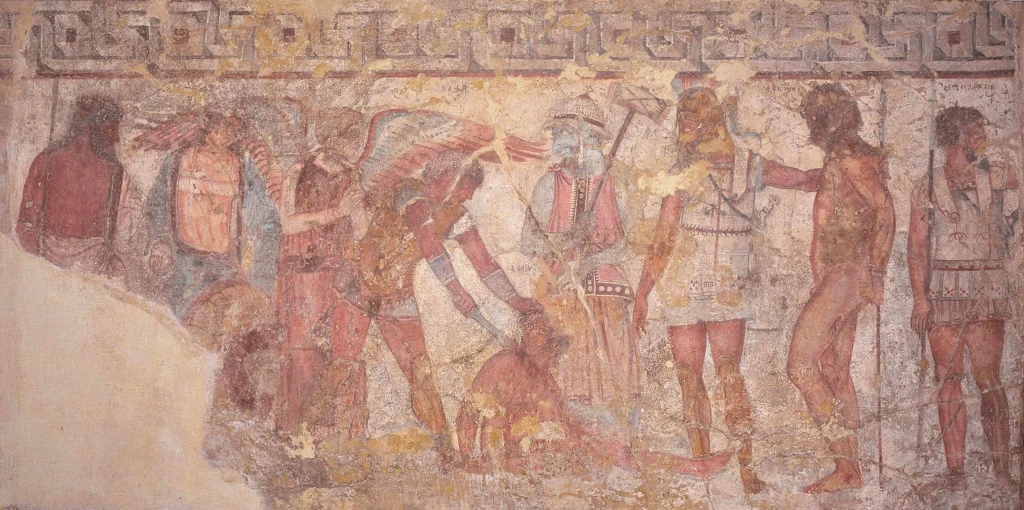
Near the end of Homer's Iliad, Achilles burns the body of his friend Patroclus, killed by Hector, and at the pyre he kills 12 young Trojans he had taken alive. Homer himself calls it an evil deed. Centuries later, a painter at Vulci put the scene on the wall of the Saties family's tomb, and he made it Etruscan.
Achilles, named in Etruscan letters as Achle, drives his sword into the neck of a seated prisoner whose hands are bound. Agamemnon is there too, and the two heroes called Ajax lead in more captives. The shade of Patroclus stands by, labelled with the Etruscan word hinthial, a ghost. On either side of Achilles stand two figures Homer never mentions, both from Etruscan beliefs about death. Vanth, a winged woman, accompanies the dead, and Charun carries a heavy hammer.
Right next to this scene, on the same wall, Etruscan heroes free a captive and kill their enemies, one of them a man from Rome. Some historians read the two pictures as a deliberate pair, since the Romans traced their own origins to Troy.