Vitruvian Man
Details
The story
In 1822 Venice was governed from Vienna, and its Academy of Fine Arts was still, above all, a school. Its president, the art historian Leopoldo Cicognara, pressed the Austrian authorities to secure the drawings of Giuseppe Bossi, a Milanese painter who had died in 1815. There were some 1,500 sheets bound in twelve large volumes, and this was one of them. The point of buying them was that young artists in training should have the best possible models in front of them.
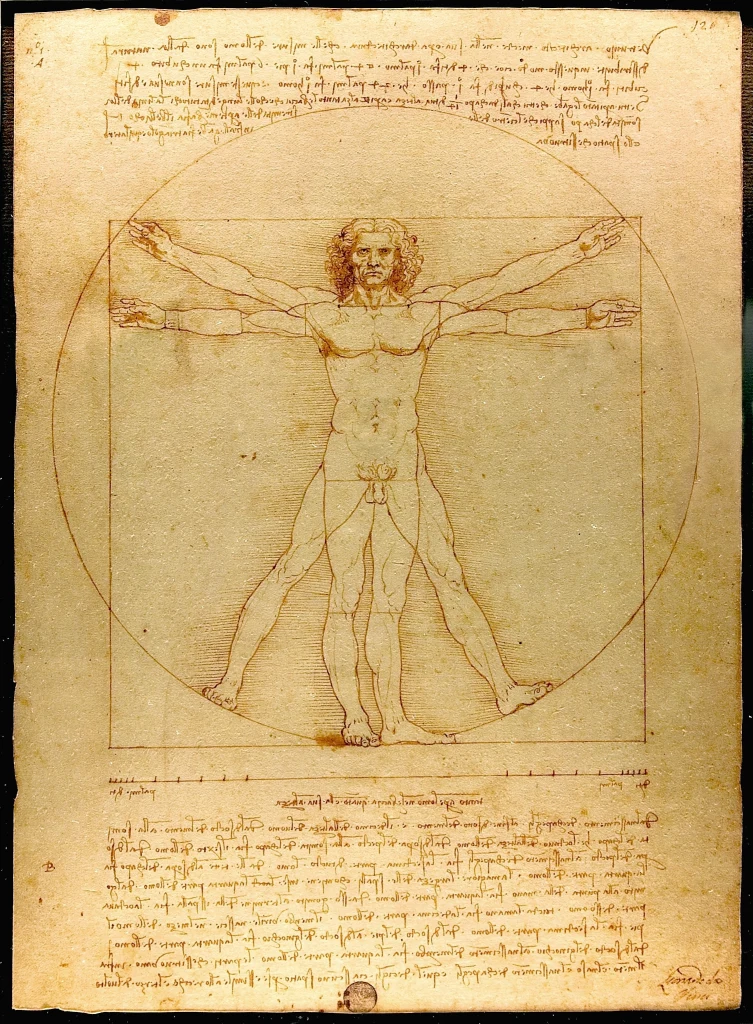
Leonardo had drawn this sheet in Milan around 1490, working through a passage by Vitruvius, an architect of ancient Rome, who wrote that a well-built man with his limbs stretched out fits inside both a circle and a square. Leonardo gives the man two poses on one body. With arms straight out and feet together he fills the square. With arms raised and legs spread, his fingertips and feet touch the circle, which is centred on his navel. The lines of mirror writing above and below set out the measurements, and under the square runs a small ruled scale.
The students' model is now one of the drawings the museum shows least. Light harms the paper, so the sheet is kept in the dark under a controlled climate and comes out only for short spells.