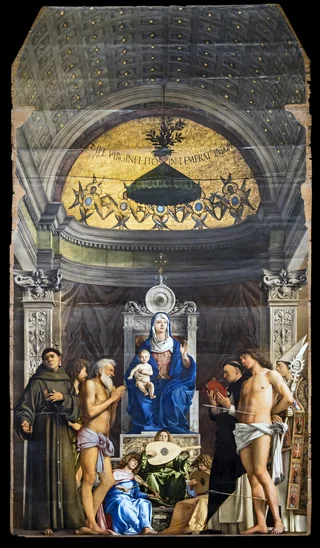
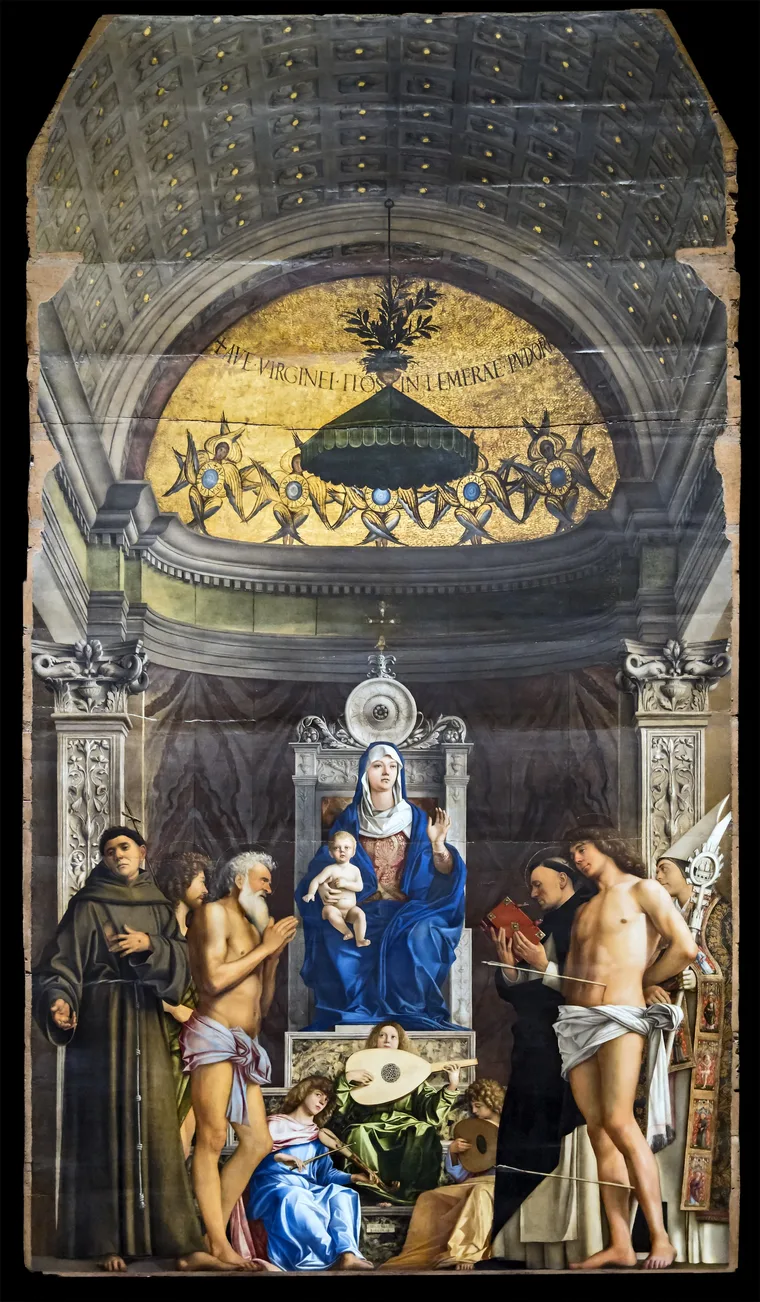
The monastery of San Giobbe in Venice was suppressed on 31 May 1810, and its Franciscan friars were moved to San Francesco della Vigna. Giovanni Bellini's altarpiece stayed behind in the empty church, on the second altar on the right, in a stone frame that is almost unanimously attributed to Pietro Lombardo and his workshop. In 1812 the panel was taken down from the altar for safekeeping, and in 1815 it was moved to the gallery of the Academy of Fine Arts. The frame stayed in the church.
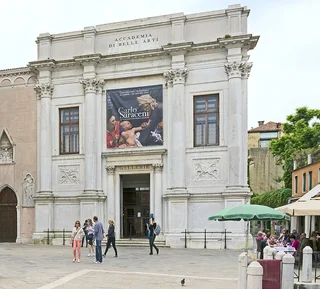
The Academy was founded in 1750, refounded by Napoleonic decree in 1807 and housed in the buildings of the suppressed confraternity of Santa Maria della Carità, in its church and in the neighbouring monastery of the Lateran canons, where Palladio had begun a wing and never finished it. Pictures from closed churches, monasteries and confraternities were brought here, and later patrician families began to give and bequeath their collections to the gallery. It opened to the public in 1817, when Leopoldo Cicognara was president of the Academy.
Altars and Courts of the Republic (14th–15th Centuries)
1. Coronation of the Virgin Polyptych — Paolo Veneziano
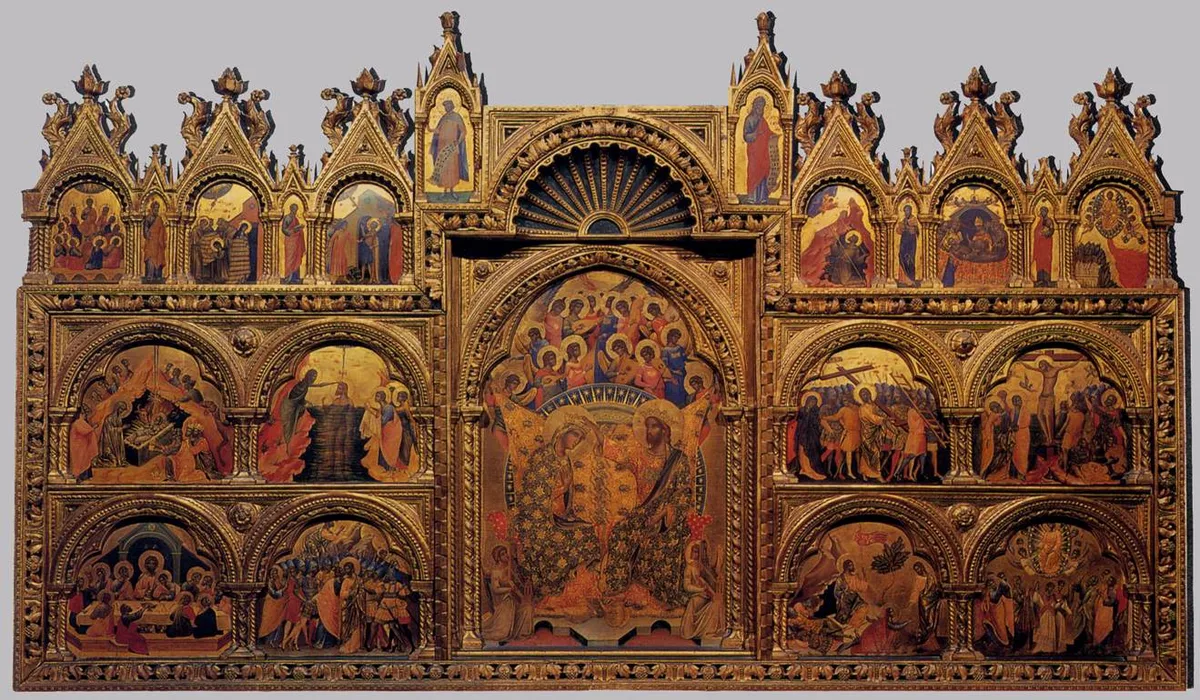
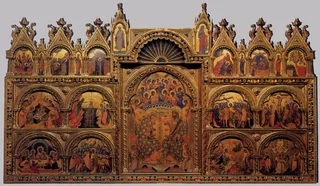
In 1808 the central panel of this polyptych was judged not to belong to it and was sent to Milan, to the Brera gallery. The wings and the frame were brought to the Accademia in 1812, and during the restoration of 1828–1829 a Coronation by another master, Stefano, parish priest of the Venetian church of Sant'Agnese, signed and dated 1381, was set into the empty middle. For more than a century the polyptych was shown with someone else's centre. In 1950 Paolo Veneziano's panel came back from the Brera and the altarpiece was put together again.
The old inventories place it in the Venetian convent of the Poor Clares at Santa Chiara, and the upper row has scenes from the lives of Saint Clare and Saint Francis. The convent was suppressed in 1806. Dates proposed for the polyptych range from the 1330s to the middle of the 14th century. Paolo ran a family workshop in which his sons worked with him, and his first signed and dated work, a polyptych in Vicenza, is from 1333.
In the centre Christ sets the crown on Mary's head with his right hand, and she bows towards him with one palm raised. Both wear dark robes woven all over with gold flowers. Behind the throne runs a blue semicircular band with gold stars, above it angels with lutes and viols crowd the gold ground, and at the foot of the throne are a small gold sun with a face and a crescent moon. The centre is painted severely, after Byzantine models. The small scenes on the wings, from the Nativity and the Baptism to the Crucifixion and the Ascension, are lively and busy with storytelling, and scholars have always remarked on this difference in manner.
In the upper row on the right, in the scene of the death of Saint Francis, a small dark figure kneels at the bottom in the middle. The Italian state catalogue takes her for the nun who commissioned the polyptych, and in 2024 the historian Elena Khalaf suggested that she is a wealthy widow who gave the altarpiece to the convent when her daughter took the veil.
2. Triptych of Justice — Jacobello del Fiore
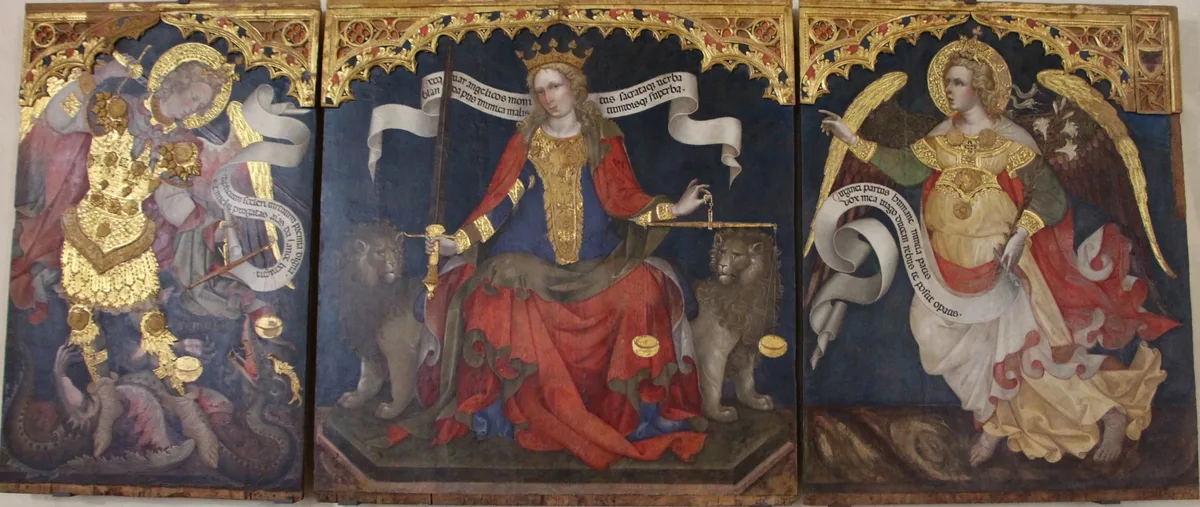
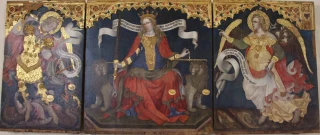
The Magistrato del Proprio, one of the law courts of the Venetian Republic, sat in the Doge's Palace, and in 1421 three panels were painted for its hall at public expense. The painter was Jacobello del Fiore, son of the painter Francesco del Fiore. In those years Jacobello worked a great deal for the Republic, and in 1415 he had been head of the painters' guild.
In the centre sits Justice, crowned, with a sword in her right hand, and in her left she holds a pair of scales whose pans hang level. Two lions sit at the corners of the dais and look straight out at the viewer. A banderole with Latin verses runs above her head, and in them Justice herself speaks: “I shall carry out the counsels of the angels and the holy words, gentle to the pious, hostile to the wicked, haughty to the proud.” On the left the archangel Michael raises his sword over his head and holds a pair of scales with empty pans, and a clawed paw reaches up to their cords from below. On the right Gabriel walks barefoot towards Justice, carrying a lily.
All three panels have a dark blue ground, almost black. Jacobello saved the gold for the armour, the haloes, the crown and the patterns, and laid it in relief, modelling it in gesso and then gilding it, so that on Michael's armour and on Justice's breastplate it stands up above the paint.
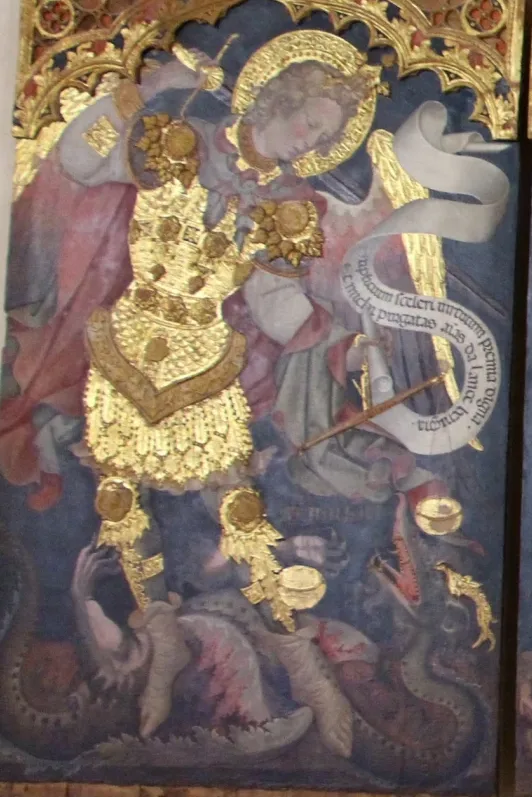
Some scholars explain the presence of Gabriel, the angel of the Annunciation, beside Justice by the date. According to tradition, Venice was founded on 25 March 421, the feast of the Annunciation, and 1421 was the city's thousandth anniversary. The triptych hung in the court's offices for about four and a half centuries and came to the Gallerie dell'Accademia in 1884.
Jacobello's signature is on the left, between the lion and the sword. In old photographs it reads in large capitals, “JACOBELLUS DE FLORE PINXIT 1421”, and Sandra Moschini Marconi, who compiled the Accademia's 1955 catalogue, called it a later repaint. In the museum's photographs taken after the restoration, all that faintly shows in that place is “1421” and “jacobelus”, written in Gothic minuscule.
3. San Giobbe Altarpiece — Giovanni Bellini
On the panel Bellini painted a chapel. A barrel vault with gold rosettes in its coffers runs back to an apse, the half-dome of the apse is laid with gold mosaic as in the basilica of San Marco, and along its edge runs a Latin inscription, “AVE VIRGINEI FLOS INTEMERAE PVDORI…”, the end of which is cut off by the arch. Carved pilasters at the sides repeated the pilasters of the real stone frame, and to the congregation the painted chapel looked like a continuation of the church's stone altar. Bellini set the viewpoint low, and the figures are seen from below, as a worshipper standing before the raised altar saw them.
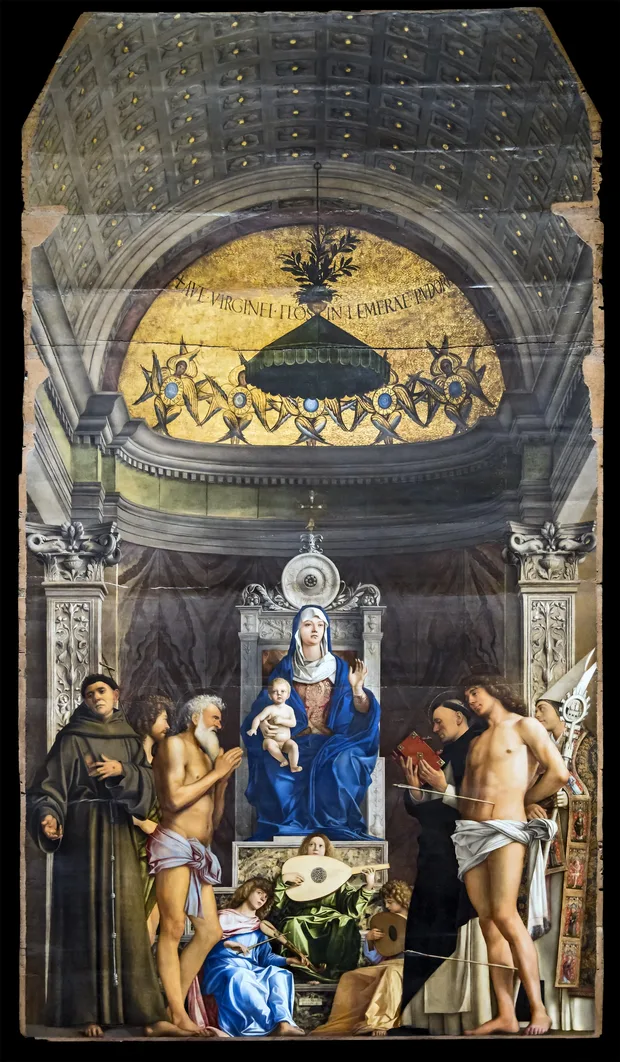
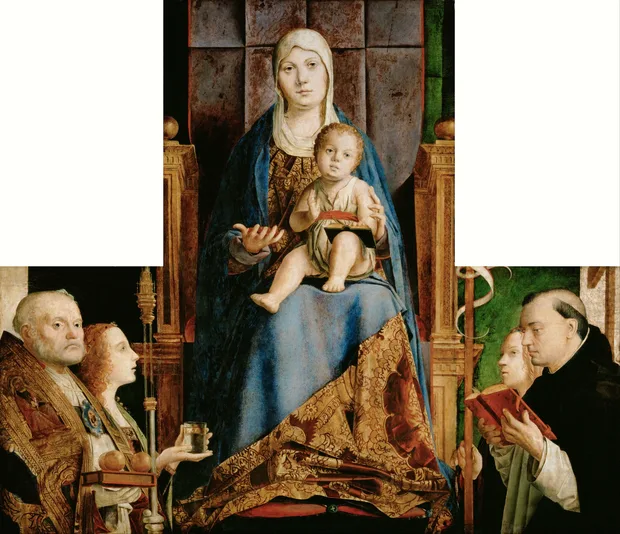
Mary sits high on a white marble throne, the naked Child on her knees. On the left stand Francis in a brown habit, looking straight at the viewer, John the Baptist, almost hidden behind him, and old Job in nothing but a loincloth. On the right Dominic reads a book bound in red, the young Sebastian, pierced by two arrows, bows his head towards the Madonna, and at the very edge stands Bishop Louis of Toulouse in his mitre. On the steps of the throne three angels play two lutes and a lira da braccio, an instrument that looks like a violin. The light falls from the left, and Sebastian and Job are lit down the left side of the body.
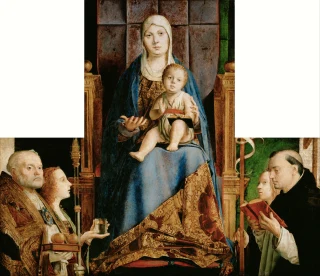
In 1475–1476 the Sicilian painter Antonello da Messina was working in Venice. In his altarpiece for the church of San Cassiano, of which fragments survive in Vienna, the Madonna and the saints stood in a single space and were painted in oil. The San Giobbe altarpiece is taken to be Bellini's answer, and after it Venetian altarpieces were built on the same plan for a long time. Opinions on when he worked on it vary, from 1478 to the late 1480s.
After 1815 the panel was cut down at the top. Measurements taken in 1815, before the cutting, show that it was about half a metre taller, and part of the painted vault was lost. The support is made of 13 horizontal poplar planks, and long cracks run along the joins between them across the whole picture, through the apse mosaic and at the height of Mary's hand.
The Confraternities Commission Their City (1496–1566)
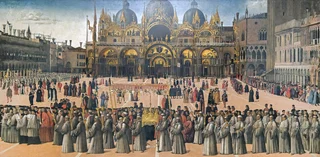
4. Procession in St. Mark's Square — Gentile Bellini
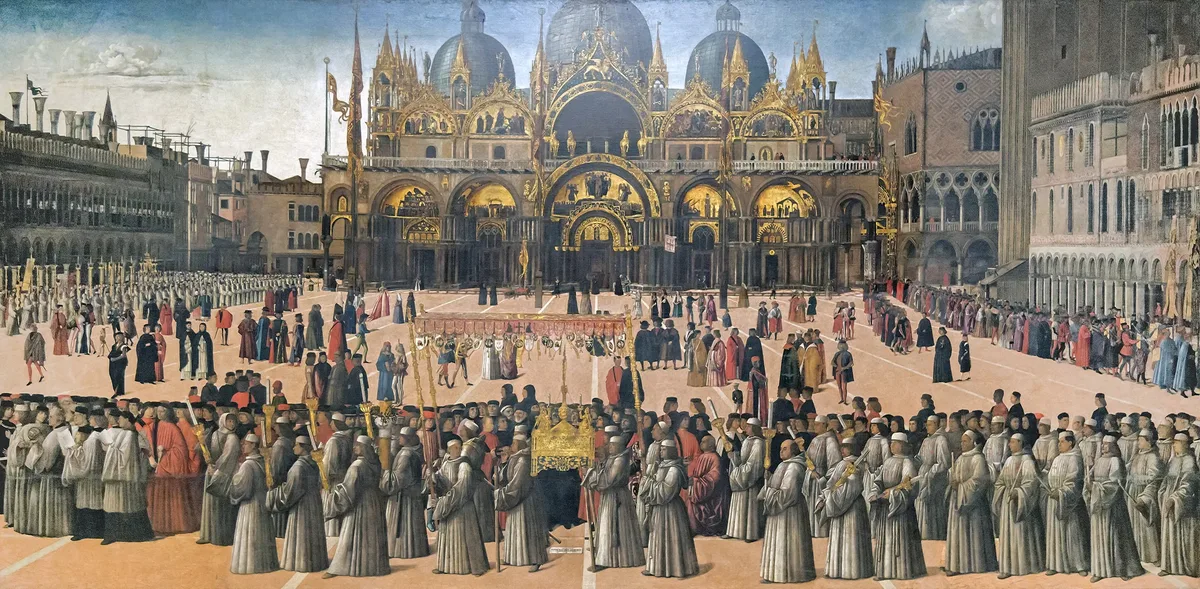
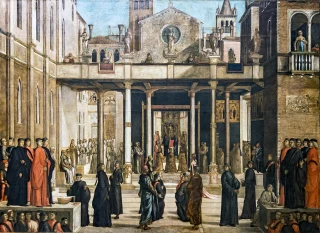
Jacopo de Salis, a merchant from Brescia whose son had been badly injured, came to Piazza San Marco on 25 April 1444, Saint Mark's day, when the Venetian confraternities walked in procession carrying their relics. De Salis knelt before the reliquary holding a fragment of the Cross, which the confraternity of San Giovanni Evangelista was carrying, and prayed, and when he got home he found his son well.
In Venice the confraternities were called scuole. They were lay associations of merchants and craftsmen, and the richest of them had buildings of their own with large halls. The Scuola di San Giovanni Evangelista received its fragment of the Cross in 1369, and in the 1490s it commissioned a cycle of large canvases on the miracles of the relic for the hall where the relic was kept. Of the nine canvases, eight survive, and three of them are by Gentile Bellini. He finished this one in 1496, 52 years after the miracle, and painted the square as it looked in his own day.
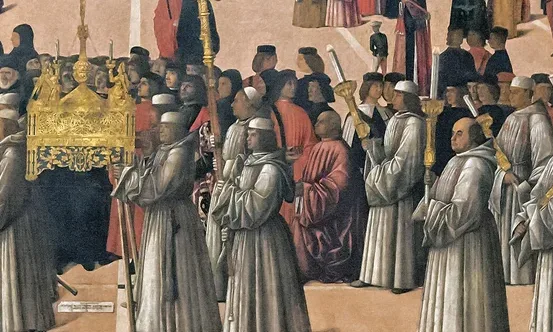
The merchant himself is hard to find on the huge canvas. Brothers in white robes walk across the whole width of the picture with tall candles in gilded candlesticks, left of centre they carry the gilded shrine with the relic on poles, and just to the right of it, behind them, a bald man in red is kneeling. He is the only one on his knees in the front row of the procession.
Gentile was the elder son of the painter Jacopo Bellini and the brother of Giovanni, who painted the San Giobbe altarpiece. In 1469 the Emperor Frederick III knighted him during a visit to Venice, and in 1479–1480 he worked in Constantinople at the court of Sultan Mehmed II. He himself belonged to a different confraternity, the Scuola Grande di San Marco. After the scuole were suppressed in 1806, the canvas entered the Accademia in 1820.
Above the square rises the basilica of San Marco, with five greenish-grey domes and gilded Gothic pinnacles, and over each of its portals is a gold mosaic. On the right is a corner of the Doge's Palace with its pink and white masonry laid in a diamond pattern. Of the mosaics over the basilica's portals only one has survived to this day, over the far left portal, and what the others looked like is known first and foremost from this canvas.
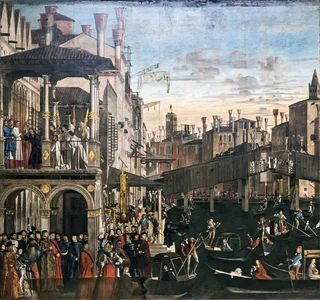
5. Miracle of the Relic of the Cross at the Rialto Bridge — Vittore Carpaccio
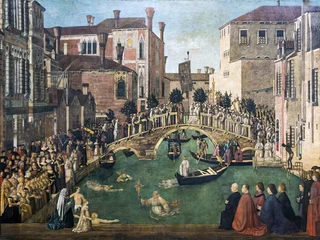
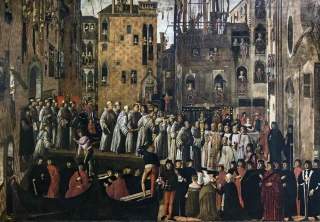
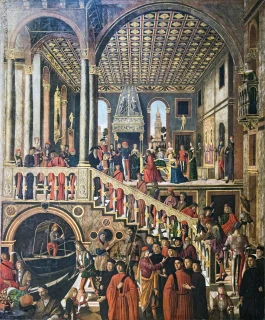
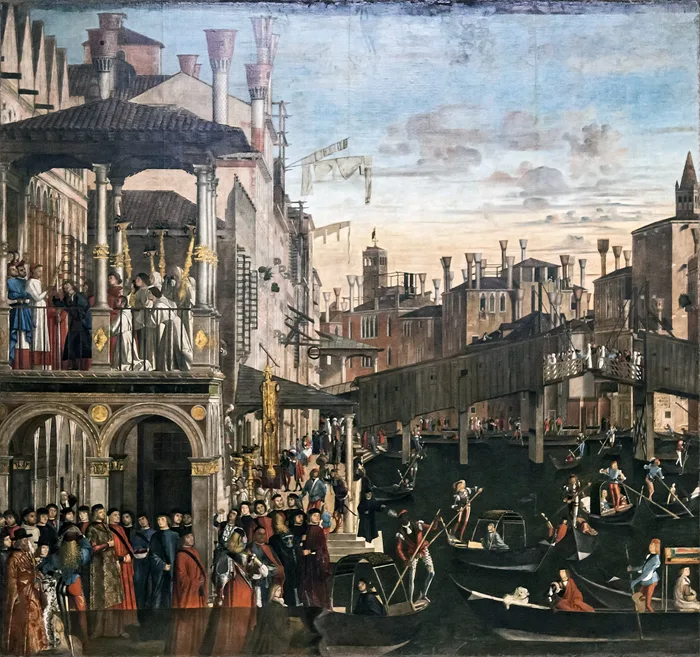
Carpaccio painted the wooden Rialto bridge, then the only crossing over the Grand Canal, in more detail than anyone else who depicted it. In the picture it spans the canal in the distance, with plank-decked spans at either end and, in the middle, a raised drawbridge section with railings, crowded with people. That bridge collapsed in 1524.
The canvas belonged to the same cycle on the miracles of the relic of the Cross for the confraternity of San Giovanni Evangelista, and Carpaccio, then in his thirties, painted for it alongside the older Gentile Bellini. Here the Patriarch Francesco Querini uses the relic to heal a man possessed by a demon. Carpaccio set the miracle in an open loggia on an upper floor in the top left corner, where a priest raises the gilded reliquary and a young man with his head thrown back is held up by the arms. On the quay below the loggia nobody looks up. Patricians in red and blue robes stand there, merchants in white turbans stand under the portico, and a wine barrel lies at their feet.
The canal runs diagonally from the lower right corner to the bridge and is crowded with black gondolas. In the centre, near the bottom edge, a Black gondolier in a red jacket, a red cap with a white feather and checked, particoloured hose stands in a gondola and pushes it along with a long oar. In another gondola at lower right sits a small white dog, funnel-shaped chimneys stick up above the roofs, and washing hangs drying on poles. The canvas came to the Accademia in 1820, together with Gentile's Procession.
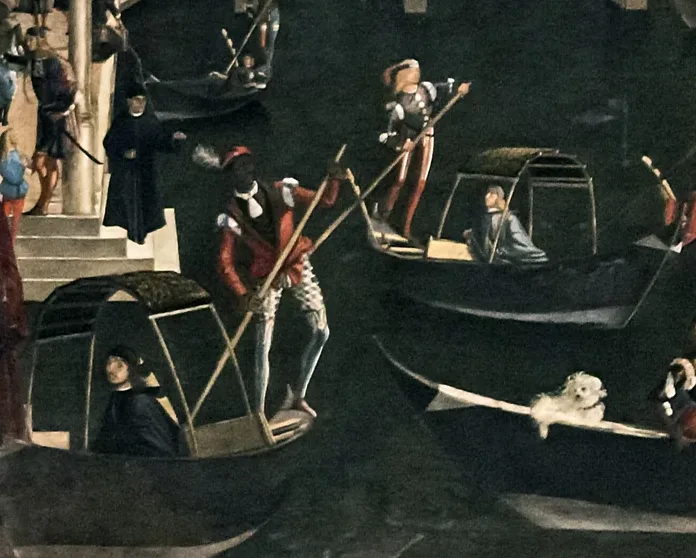
The historian Kate Lowe, who has studied the lives of Black gondoliers in Renaissance Venice, believes that for many of them the trade was a road from slavery to freedom.
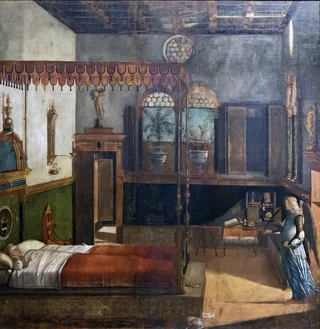
6. The Dream of St. Ursula — Vittore Carpaccio
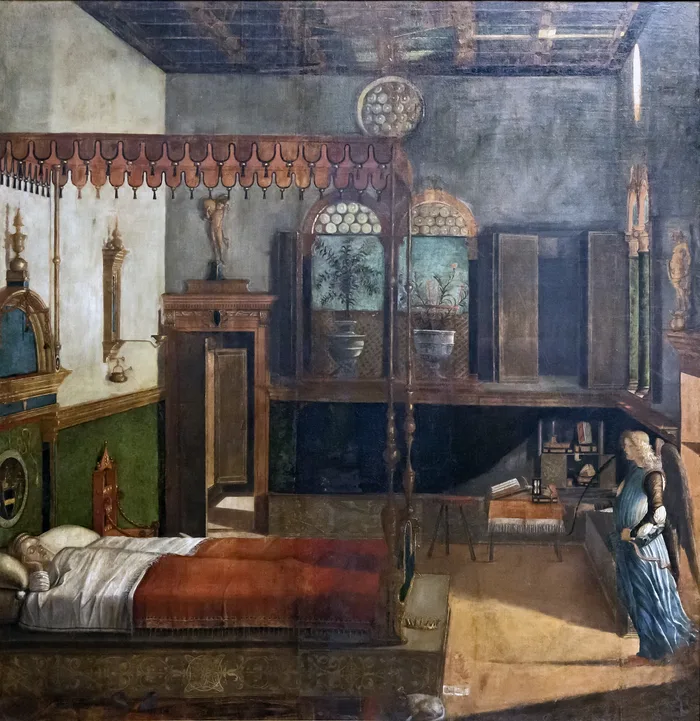
The English critic John Ruskin first saw this picture in 1869, and in July 1872 he described it in one of the letters he published under the collective title Fors Clavigera. He listed the room, the bed, the slippers, “her white dog” and the angel, which he called “very nearly a doll angel”.
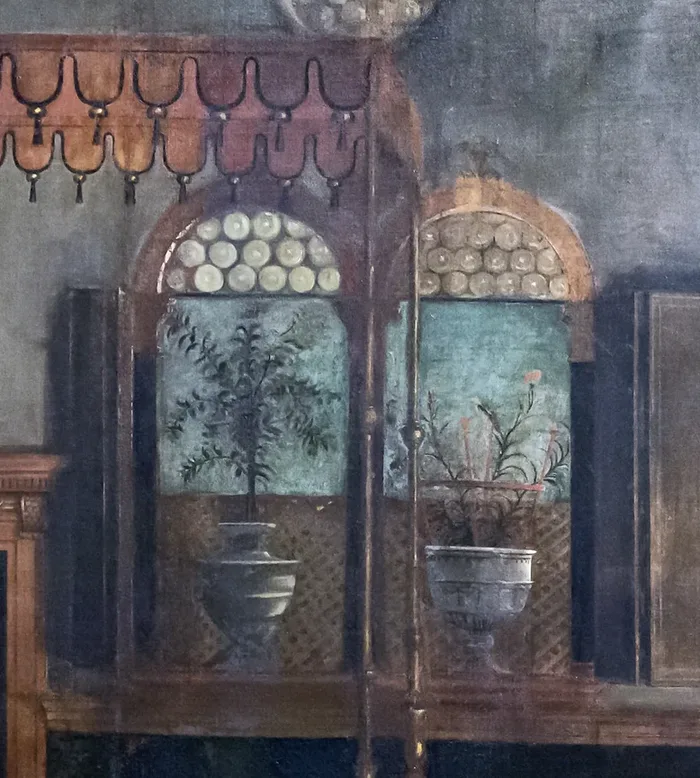
Ursula lies on her back under a red coverlet, her right hand tucked under her cheek, a thin gold circlet on her head. Her crown lies on the step of the dais at the foot of the bed, her blue slippers stand on the floor, and only part of the dog can be seen at the bottom edge. On the right an angel enters with a long palm branch, and the doorway behind him is flooded with light. In the legend, the angel comes to Ursula in her dream to announce her coming martyrdom. On the window sill stand two pots, one of myrtle and one of carnations.
Carpaccio painted nine canvases about Ursula for the Scuola di Sant'Orsola, a small confraternity whose hall adjoined the Dominican church of Santi Giovanni e Paolo. It was his first large commission. After the confraternity was suppressed, the canvases came to the Accademia in 1812, and the Dream, the most damaged of the nine, was not put on show until 1852.
In 1876 Ruskin returned to Venice. According to one account, the Accademia took the picture down from the wall and gave him a room in which to copy it. Close up, he changed his mind about the subject. In a letter of November 1876 he called the angel the Angel of Death, and the thing in his hand that he had taken for a scroll in 1872 he now called a shroud, explaining in a footnote that he had not been able to make out this symbol at the height at which the picture hung.
At Christmas 1876 Lady Castletown sent Ruskin a pot of carnations, “precisely such as Carpaccio has painted on the window-sill of St. Ursula's bedroom”, and he took it as a message from the saint herself.
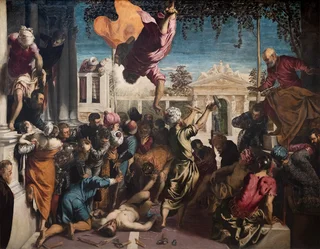
7. Saint Mark Frees a Slave — Jacopo Tintoretto
Saint Mark plunges head first out of the sky, his bare soles at the very top edge, his pink tunic and orange cloak flying, the book pressed to his body, his face in shadow. Below him, across the picture, a naked slave lies on his back. Splintered stakes, an axe, hammers and ropes lie scattered around him, and a man in a white turban and an olive-green robe holds a hammer and a broken shaft up over his head and shows them to the master. The master, grey-bearded and dressed in crimson, leans forward from his platform.
The story comes from the Golden Legend. A nobleman of Provence ordered his slave to be tortured for going to Venice without leave to venerate the relics of Saint Mark, and the saint appeared, and the instruments of torture broke.
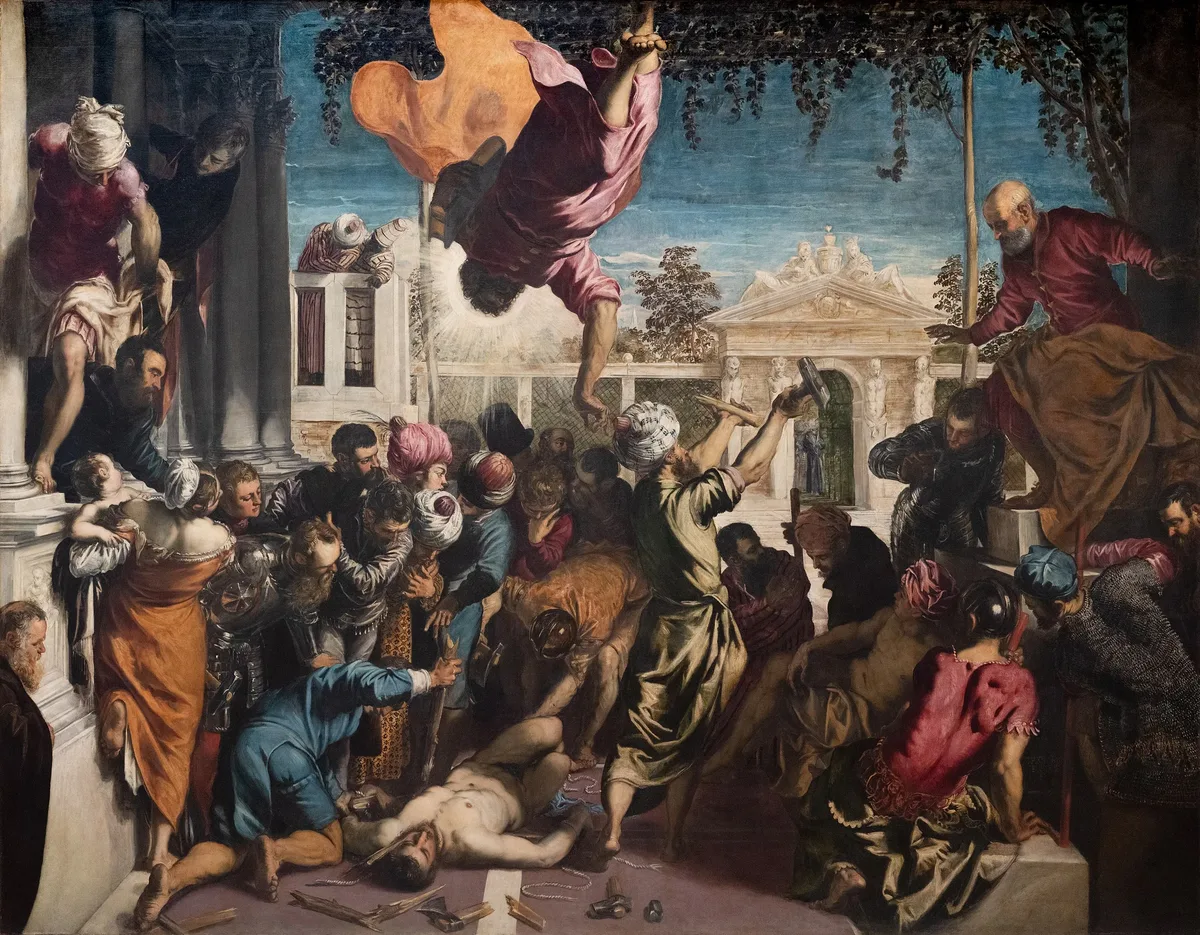
The Scuola Grande di San Marco commissioned the picture for its chapter hall in 1547. Tintoretto was about 30, and it was his first commission from one of the great scuole. That same year Marco Episcopi, the painter's future father-in-law, held office in the confraternity. By April 1548 the writer Pietro Aretino was already writing to him about the new canvas, and what he praised most was the slave, in whom, as he put it, “the colours are flesh, the outline rounded and the body alive”. He finished with a sting: blessed would Tintoretto's name be, Aretino wrote, if he turned the speed of the done into the patience of the doing.
Carlo Ridolfi, the historian of Venetian painting, wrote about this picture in 1648, a century later, and his story is regarded as tradition. According to Ridolfi, the brothers fell out over it, some wanting it and others not, and Tintoretto, offended, had the canvas taken down from the wall and carried off to his own house. Later it was hung back in its place.
In 1797 the French carried the picture off to Paris, and it came back only in 1815. By then the confraternity had been suppressed, so since 1816 the canvas has been in the Accademia, and the confraternity's building was turned into a military hospital.
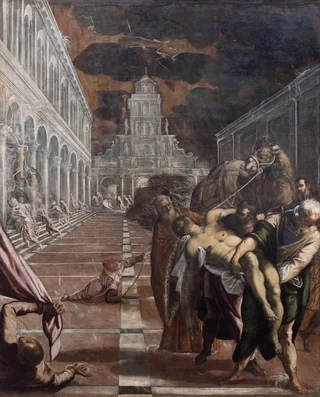
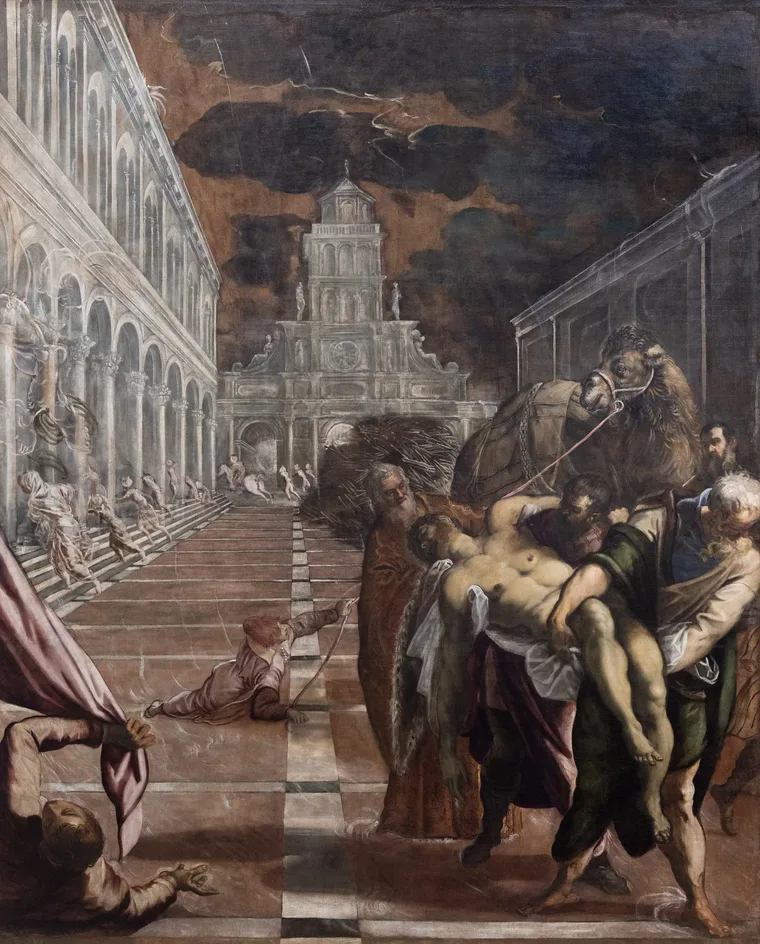
8. The Rescue of the Body of Saint Mark — Jacopo Tintoretto
Tommaso Rangone, a physician and astrologer from Ravenna, was guardian grande of the Scuola Grande di San Marco in 1562. On 21 June he obtained the confraternity's permission to commission three pictures of the miracles of Saint Mark at his own expense. Tintoretto painted them, and all three include a portrait of Rangone. By then a bronze statue of Rangone by Jacopo Sansovino was already seated above the door of the Venetian church of San Giuliano.
Here the Christians of Alexandria carry the evangelist's body away from the pyre on which the pagans meant to burn it, while a sudden storm scatters the persecutors. The body is carried on the right along a steep diagonal, the head pale, the eyes closed. Right behind the saint's head stands an old man with a long white beard, in gold-brown brocade lined with ermine, looking at the viewer. This is Rangone. The left half is taken up by an empty square, its paving stones running back to a distant building, and under the arcade on the left pale, almost transparent figures are running. In the middle is a dark heap of brushwood made ready for the pyre, on the right a camel turns its shaggy head, and thin zigzags of lightning strike across the red-brown sky.
In 1573, under a new guardian, the brothers decided there was too much of Rangone in the pictures and sent the canvases to Tintoretto to have the portrait taken out. It was never done, and Rangone stayed where he was.
The confraternity was closed in 1807, and the picture was moved to the Biblioteca Marciana, into its hall built by Sansovino. There, in the 19th century, the canvas was cut down on the left and the pyre was painted over with arcades, and after that the subject came to be called The Theft of the Body of Saint Mark. In 1920 the picture entered the Accademia. Later the overpaint was removed, and the brushwood can be seen again.
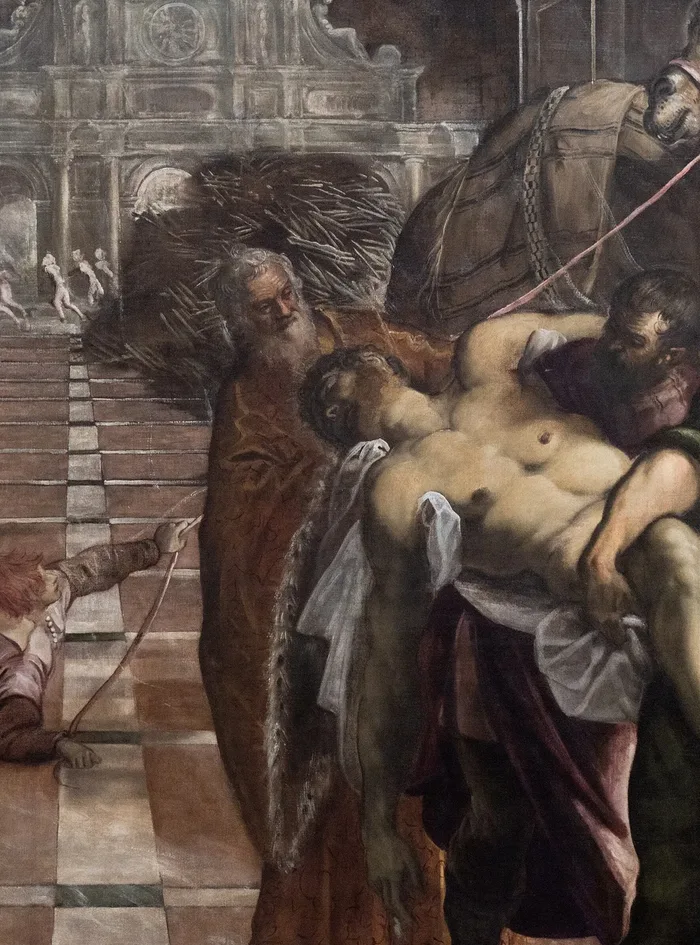
The cut ran along the left edge. In the lower corner a man lies on his back holding the edge of a mauve-pink cloak in his fist, and the person wearing that cloak is no longer on the canvas.
A Refectory and a Tomb (1573–1576)
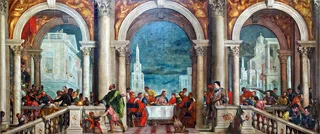
9. The Feast in the House of Levi — Paolo Veronese
On 18 July 1573 the tribunal of the Venetian Inquisition questioned Paolo Veronese and asked him why his Last Supper had buffoons, drunkards, Germans, dwarfs and similar vulgarities in it. The picture had been commissioned by the Dominicans of Santi Giovanni e Paolo for their refectory, to replace Titian's Last Supper, which had burned there in the fire of 1571.
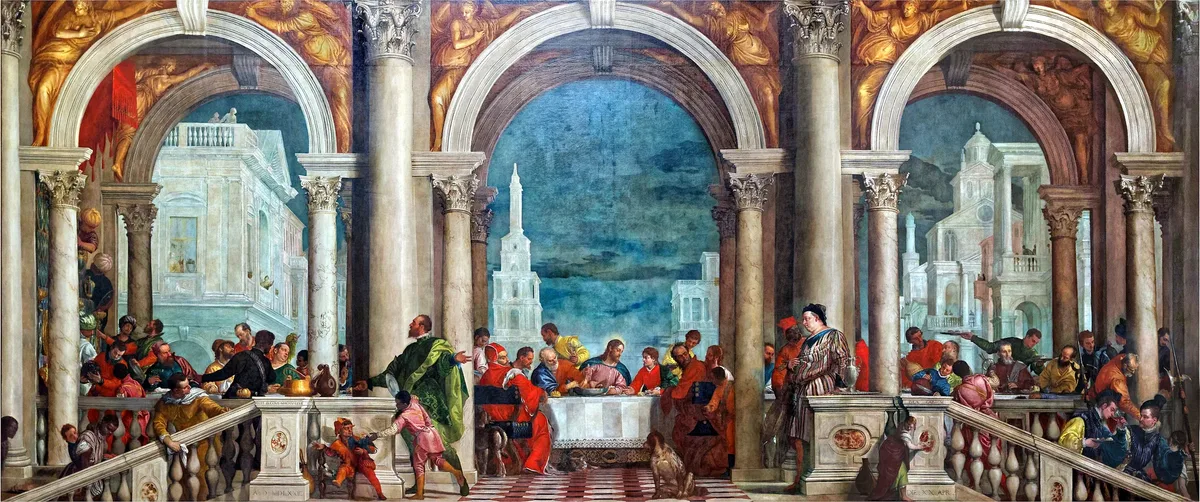
The inquisitors asked about a servant whose nose is bleeding, about halberdiers dressed in the German fashion, about the parrot and the dogs, and reminded him that in Germany and other lands infected with heresy pictures like this were used to mock the Church. Veronese answered that the halberdiers stood outside the room where the supper was taking place, that a rich master's house would have such servants, and that painters take the same licence as poets and madmen. The tribunal ordered him to correct the picture at his own expense within three months.
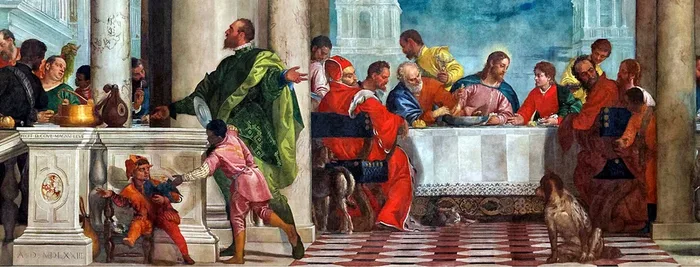
According to the generally accepted account, Veronese repainted nothing and gave the picture a new title. On the two pedestals where the staircases reach the central section are written “FECIT D. COVI. MAGNV. LEVI”, “Levi made a great feast for the Lord”, and “LVCAE CAP. V”, the fifth chapter of the Gospel of Luke, in which Christ dines in the house of Levi the tax collector. On the bases of the same pedestals is the date, 20 April 1573.
Christ sits in the middle of the long table under the central of the three arches, in a pink robe and a blue-green cloak. A striped cat lies under the lace-edged tablecloth, and dogs sit in front of the table. In the foreground a little jester in red-orange, wearing a pointed cap, holds a green parrot, and on the right-hand stairs stand two soldiers in striped doublets, one of them drinking red wine from a glass.
In 1797 the French carried the picture off to Paris. It was returned in 1815, but by then the monastery had been suppressed, and the canvas was given to the Accademia. At the hearing Veronese also said that the prior had earlier asked him to replace a dog with Mary Magdalene, and that he had refused, because, in his words, it would not have looked right “for many reasons”.
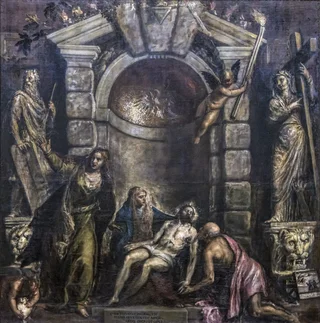
10. Pietà — Titian
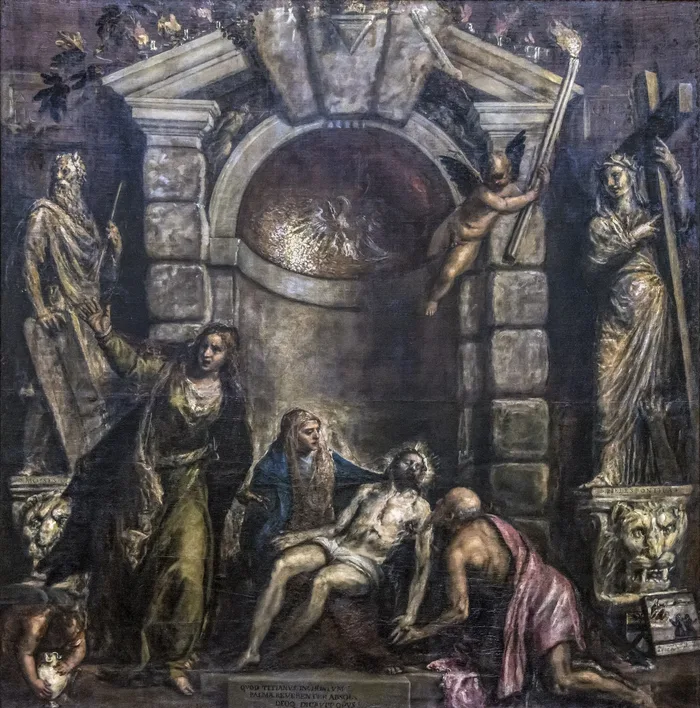
According to Carlo Ridolfi, Titian painted this picture for his own tomb. The painter came to an agreement with the Franciscans of the Venetian church of Santa Maria Gloriosa dei Frari that he would be buried in their Chapel of the Crucifix and would give them a Pietà for its altar. The picture stood in the Frari for a short time in 1575, though not on the altar that had been agreed, and on the orders of the papal nuncio it was returned to Titian.
He was born at Pieve di Cadore, in the mountains north of Venice. The year of his birth is disputed, and by the time of the Pietà he was past 80, and possibly close to 90. For more than half a century he was the leading painter in Venice, he painted for the Emperor Charles V and for King Philip II of Spain, and 40 years before the Pietà he painted the Presentation of the Virgin at the Temple for the confraternity of Santa Maria della Carità, in whose building the Academy was later housed.
Mary sits in a stone niche with the dead Christ across her lap, and in the gold half-dome above them is a pelican, which, according to an old belief, feeds its young on its own blood. On the left the Magdalene strides straight out of the picture with her arm raised and her mouth open. On the right kneels a bald old man with a white beard, almost naked, leaning towards Christ with his hand slipped under Christ's palm. By tradition he is seen as a self-portrait of Titian in the role of Nicodemus or Joseph of Arimathea. The paint is laid on in ragged, rough strokes, and much is only sketched in.
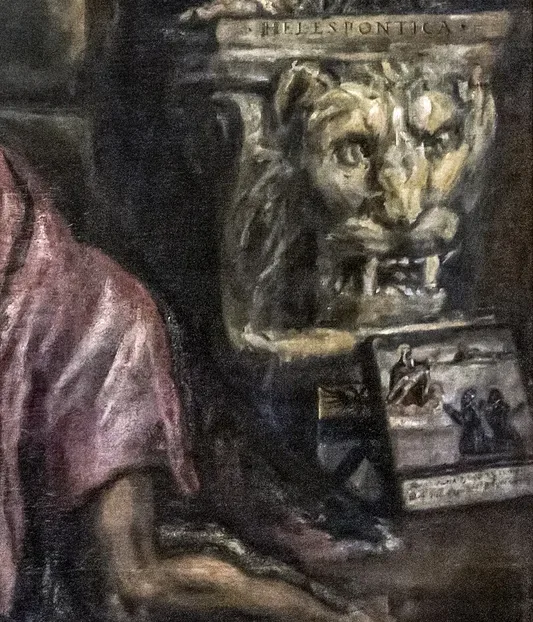
In 1575 plague broke out in Venice, and in 1576 Titian turned the picture into a votive offering. At lower right a small painted tablet leans against the pedestal, showing two people praying before a Pietà in the clouds, and beside it is the coat of arms of the Vecellio, the painter's family. The two are usually taken to be Titian and his son Orazio, asking to be spared the plague. Titian died on 27 August 1576, at the height of the epidemic, without finishing the picture. Orazio died of the plague that same year.
The picture was taken from the studio by Palma il Giovane, a Venetian painter of the next generation. He added the angel with a torch at upper right and left a Latin inscription on the step: “What Titian left unfinished, Palma reverently completed and dedicated to God.”
Titian was buried in the Frari, without the picture. Palma kept it until his death, in 1631 it was placed in the church of Sant'Angelo, and in 1814 it passed to the Accademia.
Out of Patrician Houses (1523–1932)
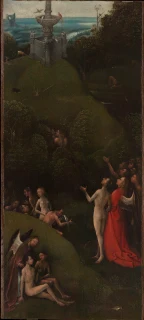
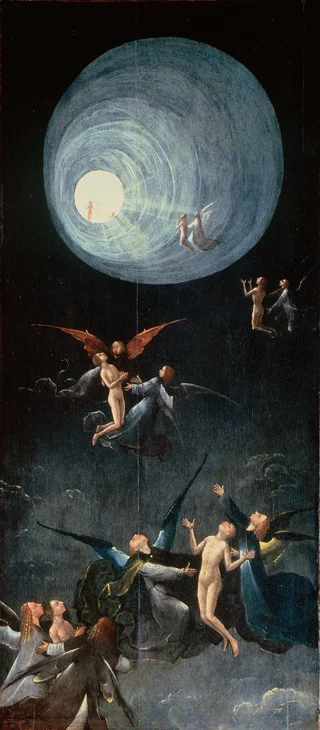
11. Visions of the Hereafter — Hieronymus Bosch
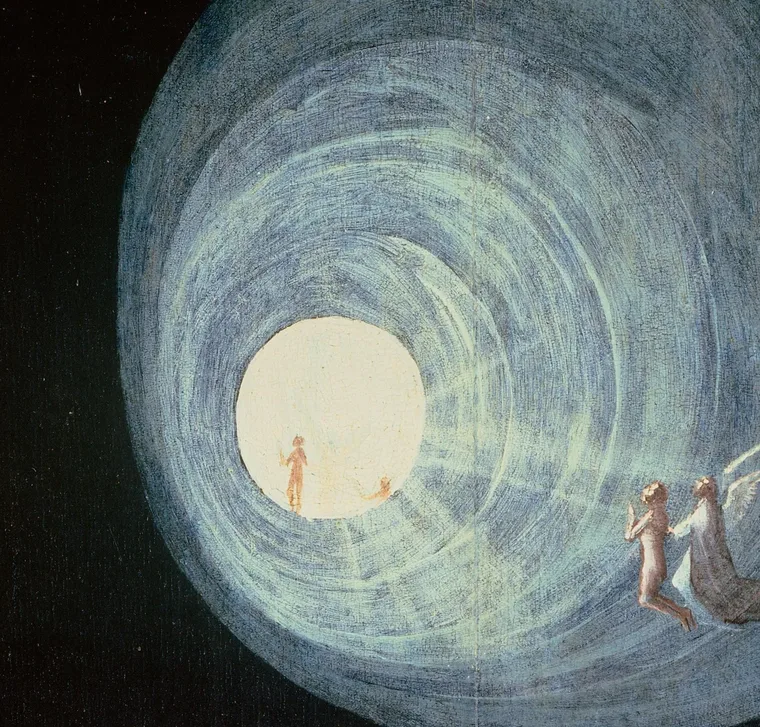
In the Ascent into the Empyrean almost everything is black. Angels carry naked souls upwards and push them on, pair after pair, in a zigzag, and in the upper third of the panel a pale grey-blue circle of offset rings glows, narrowing like a funnel to a small shining opening left of centre. The red wings of the angel in the middle are the brightest colour on the panel. The last pair before the light, a kneeling soul and an angel in white, are already inside the funnel.
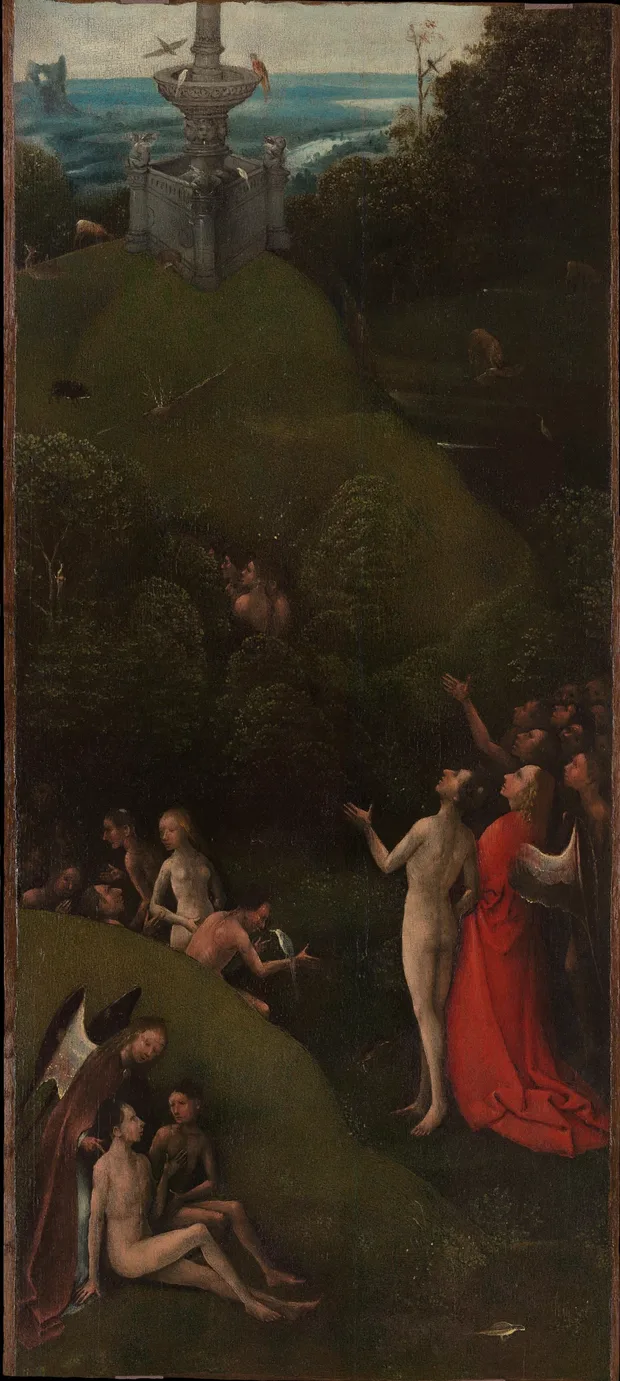
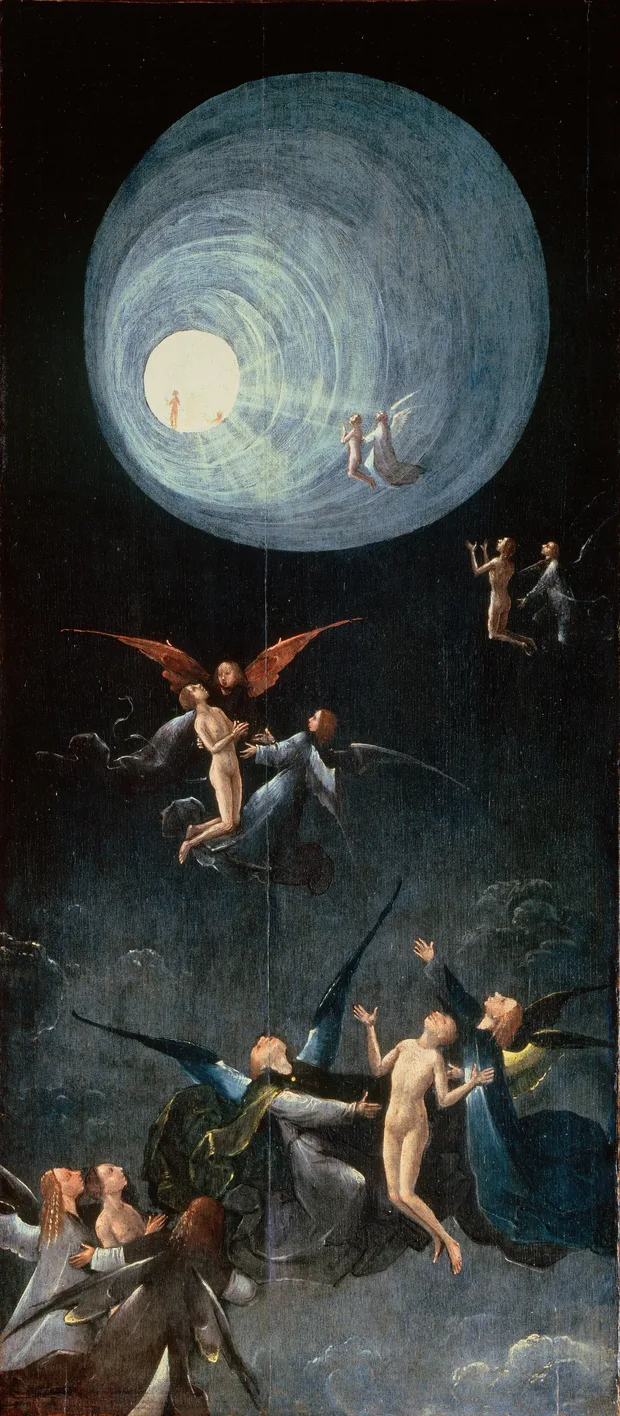
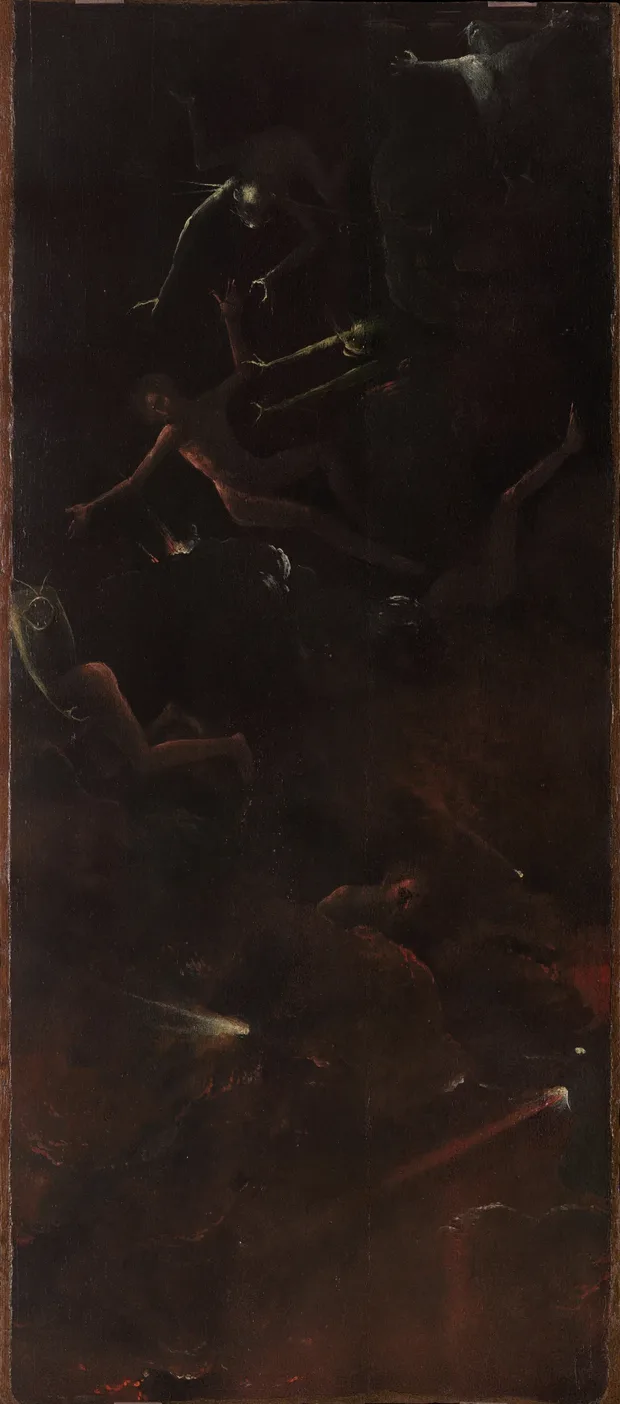
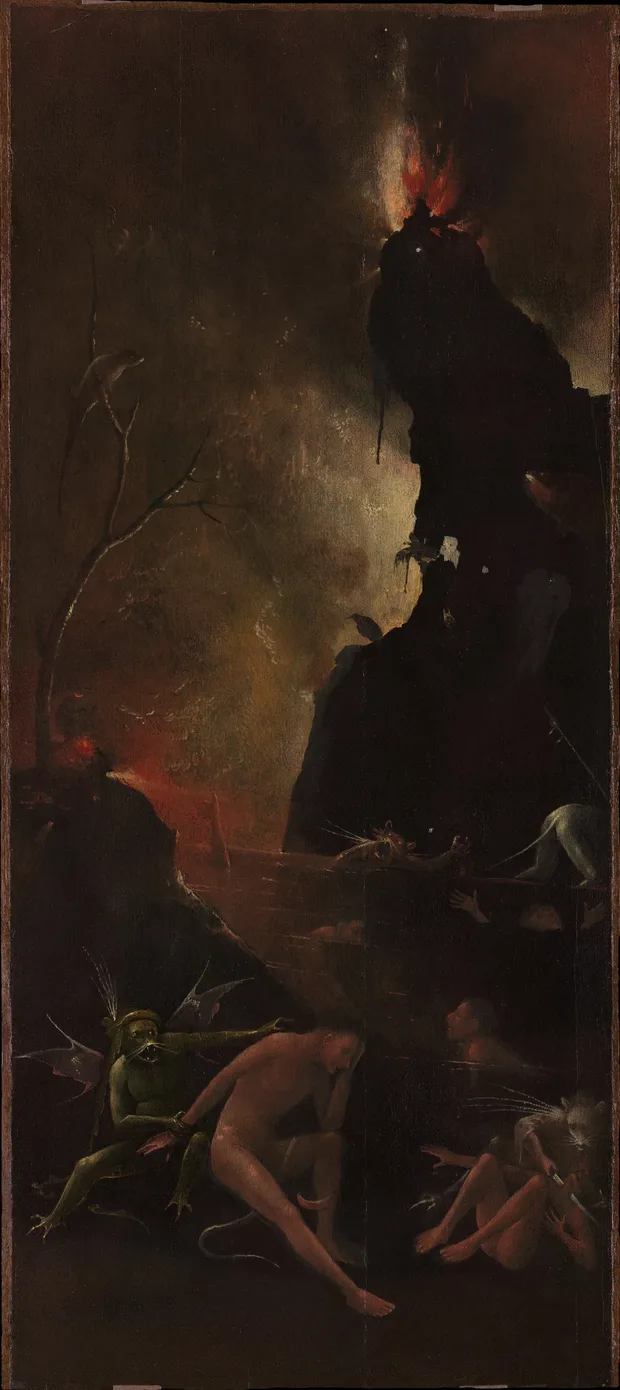
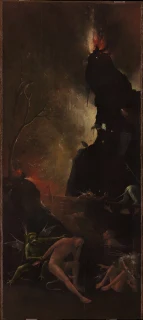
There are four panels, tall and narrow: the earthly paradise, the ascent of the blessed, the fall of the damned and hell. Most likely they are the wings of a large lost altarpiece, possibly with a Last Judgement in the middle. Tree-ring dating of the oak has shown that they were painted no earlier than about 1482, and the museum dates them to 1505–1515. Bosch lived in 's-Hertogenbosch in Brabant and, as far as is known, never went to Venice.
The panels are thought to have belonged to Cardinal Domenico Grimani, a Venetian collector of northern painting, but this is an assumption. In 1521 the connoisseur Marcantonio Michiel, who made notes on the pictures he saw in Venetian houses, recorded works by Bosch in Grimani's collection, among them “the canvas representing Hell with a great variety of monsters in it” and “the canvas representing Dreams”. Michiel calls them canvases, and the Visions are painted on oak panels. In his will of 1523 the cardinal left most of his pictures and ancient statues to the Republic. Bosch's panels were kept in the Doge's Palace for centuries and came to the Gallerie dell'Accademia for good only in 2010. Two Bosch triptychs from the same collection were taken to Vienna in 1838 and returned in 1919, but the Visions never went to Vienna.
In the opening of the funnel itself stands a tiny figure, its back to the viewer and its face to the light, and at the lower edge of the opening another can be seen, with a raised arm.
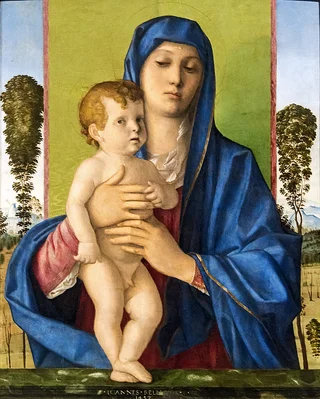
12. Madonna degli Alberetti — Giovanni Bellini
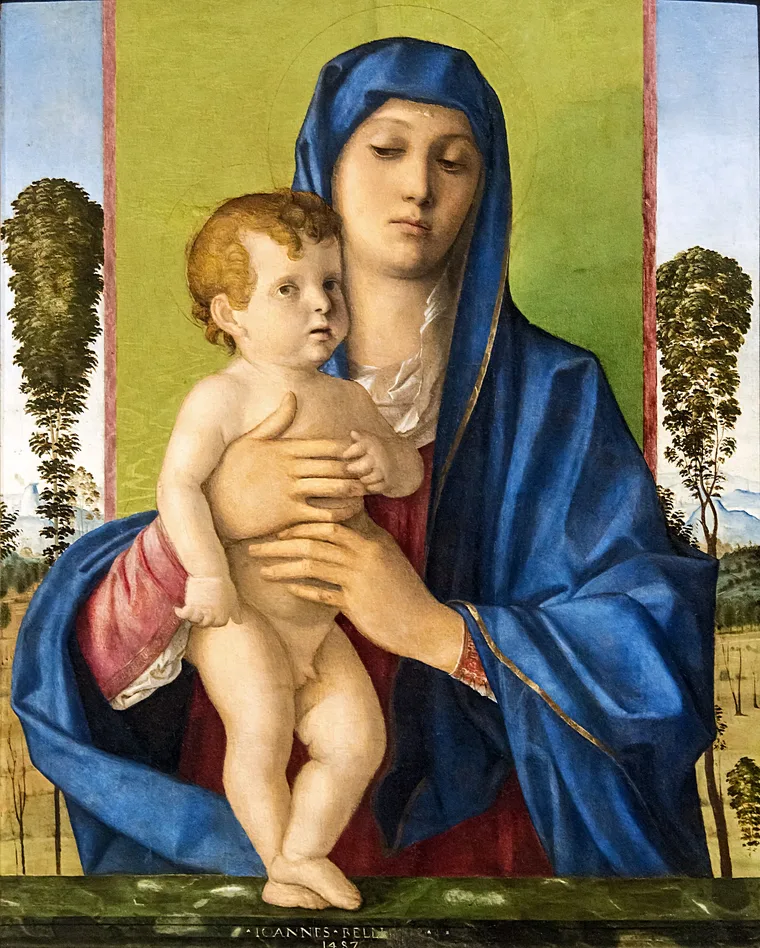
In 1838 Girolamo Contarini gave the gallery 188 paintings, and the Madonna degli Alberetti was one of them. Contarini gave them in his lifetime, and he died in 1843.
The Child stands on a green parapet painted to look like marble, his feet crossed, the right over the left, holding on to his mother's fingers. Mary holds him with both hands, he presses his head to her cheek and looks past the viewer, and her eyes are lowered. Behind them hangs a plain yellow-green curtain, with strips of landscape to its left and right, and in each strip stands a single slender little tree. These little trees, the alberetti, gave the picture its name. Beside them in the fields stand bare, dead saplings, and interpreters see in the living and dead trees either the New and Old Testaments or an allusion to the Song of Songs. The museum draws attention to the shadow Mary casts on the curtain. It is barely visible: to the right of her blue cloak the green is a little darker than on the left, behind the Child's head.
On the front of the parapet, beneath the Child's feet, “IOANNES BELL…” can be read, the remaining letters worn away, and below it “1487”. This is the second known date on a work by Bellini, after the portrait of Jörg Fugger of 1474, on which the date can no longer be seen.
In 1850 the French poet and critic Théophile Gautier spent several hours in front of the picture and called it the jewel, the pearl and the star of the gallery. He bought a copy painted that same year by a young artist, Louis-Marius Garcin. The copy is oval, and in it Garcin cut off both the little trees that gave the picture its name and the Child's crossed feet.
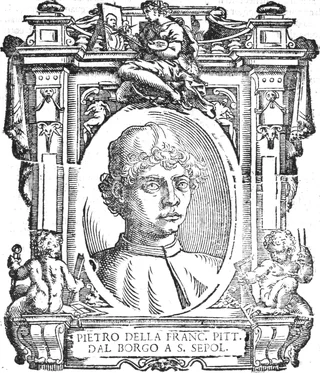
13. Saint Jerome and a Donor — Piero della Francesca
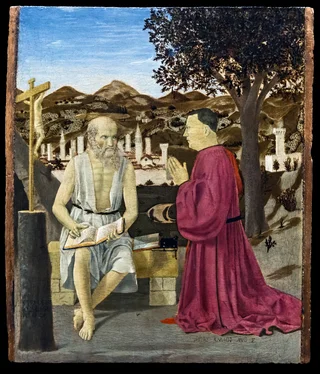
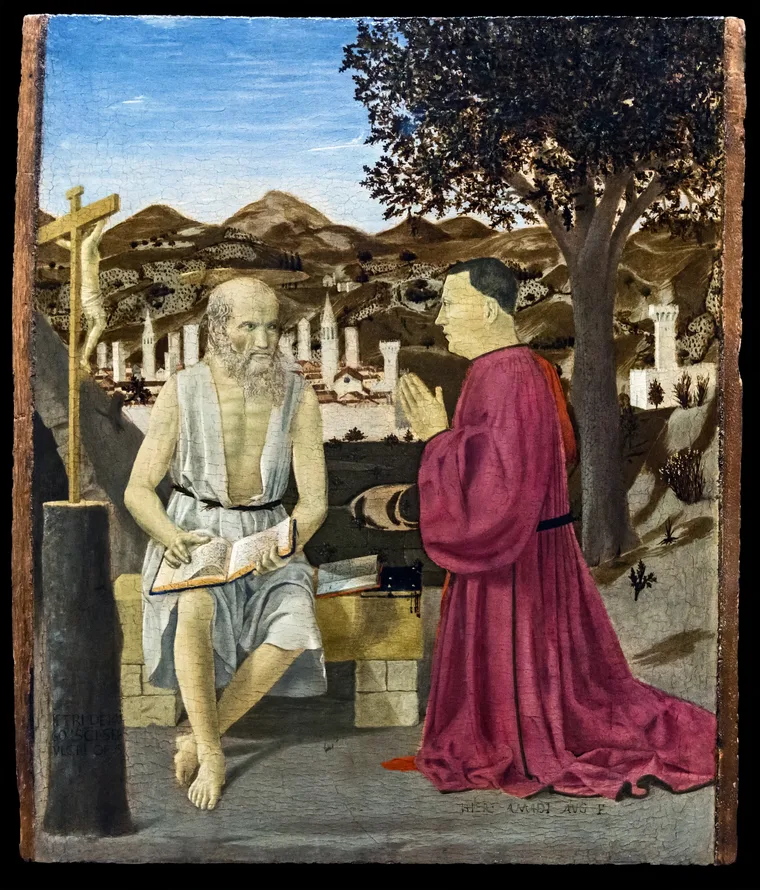
Saint Jerome and the kneeling donor are painted at almost the same scale, which was unusual at the time, since the patron was usually shown as a small figure at the saint's feet. The grey-bearded, bald Jerome, in a thin white-grey shirt, sits on a stone bench with an open book on his knees and frowns sideways at his visitor. The donor kneels motionless before him in strict profile, his hands joined, and his red robe spreads in folds over the ground. Behind them is a white town with towers and bell towers, usually taken to be Sansepolcro.
Who kneels before the saint is not entirely clear. An inscription on the ground by the edge of the red robe, “HIER: AMADI AVG F”, names him as Girolamo Amadi, son of Agostino. Amadi was a Venetian merchant from a family of Lucchese origin, and Jerome, Girolamo in Italian, was his patron saint. The inscription is in a different hand from the painter's signature, and many consider it later. The American historian James Banker has suggested that the kneeling man is the lawyer Jacopo Anastagi of Sansepolcro, but the museum and the Metropolitan Museum of Art in New York keep to Amadi.
Piero della Francesca came from the small town of Borgo Sansepolcro, on the border of Tuscany and Umbria, and he signed the panel with the name of his home town, on the trunk of a felled tree in the lower left corner, where a small gold crucifix is fixed to a thin pole: “PETRI DE BVGO SCI SEPVLCRI OPVS”, the work of Pietro of Borgo San Sepolcro. Few of Piero's works are signed. The museum considers the signature genuine, although in 2022 the historian Massimo Giontella disputed both the signature and the attribution itself. The museum dates the panel to the early 1460s.
In 1850 the panel was left to the museum by Felicita Bertrand Helmann, widow of Count Bernardino Renier. The greens of the landscape have darkened with age, and the hills around the town have turned brown.
14. Old Woman — Giorgione
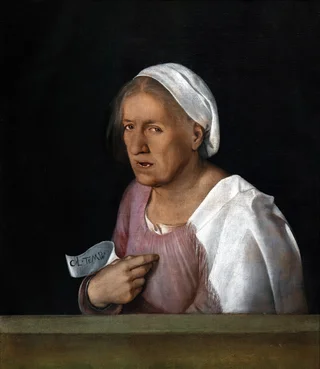
In the inventory of the Vendramin house, drawn up in 1567–1569 after the death of the collector Gabriele Vendramin, the picture appears, in the wording the museum quotes, as “the portrait of Zorzon's mother by Zorzon's hand”, with a frame painted with the Vendramin coats of arms. Zorzon was what Venice called Giorgione, Zorzi of Castelfranco. He died young, of the plague, in 1510, and few pictures can be securely attributed to him. The museum considers the Old Woman his work, although the attribution has been challenged more than once. It is dated to about 1506.
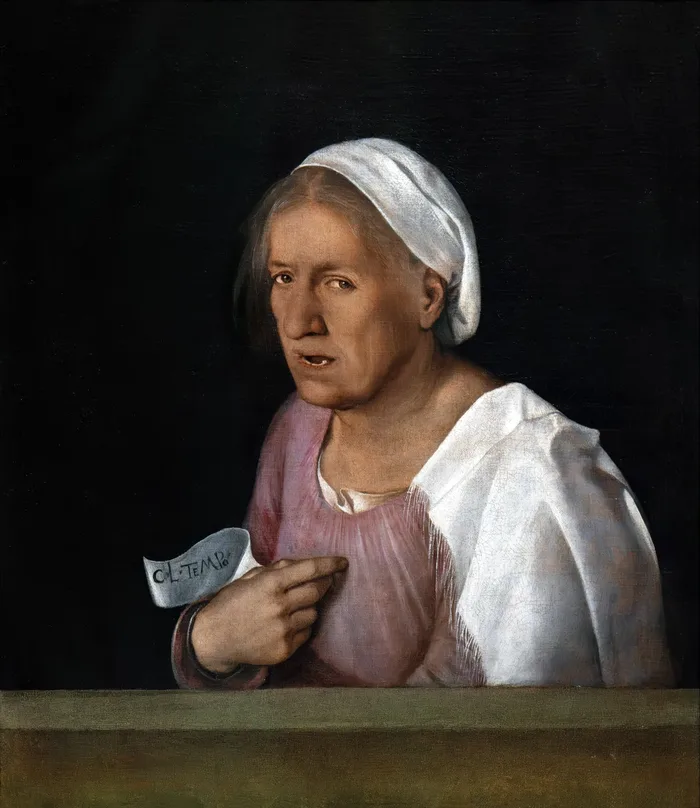
The old woman has turned her body to the right but her head back again, and she looks straight at the viewer. Her mouth is half open, as if she were speaking, one or two teeth show, her forehead is deeply lined, and wisps of grey hair escape from under a soft white cap. With her right hand she points to herself, and from that hand a strip of paper curls out towards the viewer with the words “COL TEMPO”, “with time”. The background is solid black, and the light falls from the left on her face, her hand and the fringed white kerchief on her shoulder.
The museum writes that the picture originally had a cover with a man's portrait on it. In an inventory of 1601 the cover is recorded as showing a man in black furs. The cover itself has either been lost or has yet to be identified.
From the Vendramin family the picture passed to the merchant Cristoforo Orsetti, who mentioned it in his will of 1664, and it later turned up in the Manfrin gallery in Venice. In 1856 it was bought from the Manfrin heirs for the Accademia with Austrian money, because Venice was then part of the Habsburg empire.
15. Portrait of a Young Man in His Study — Lorenzo Lotto
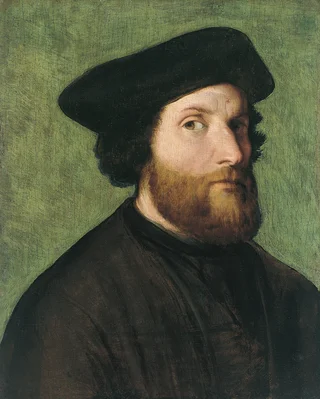
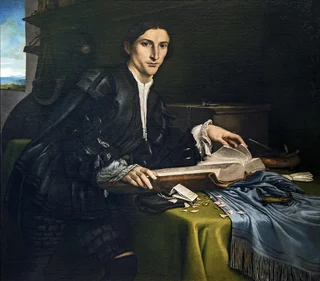
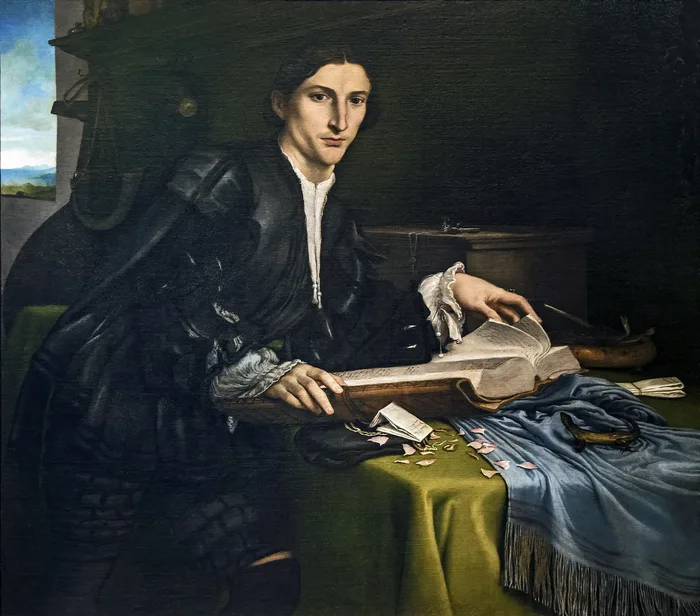
In 1923 the art historian Lucio Coletti saw this portrait in the main reception room of the palazzo of the Counts Rovero in Treviso and recognised it as the work of Lorenzo Lotto. In 1930 the state bought the picture from Edoardo Rovero, the last descendant of the Treviso branch of the family. The museum thinks the sitter is probably one of the Roveros, Cristoforo or his cousin Alvise.
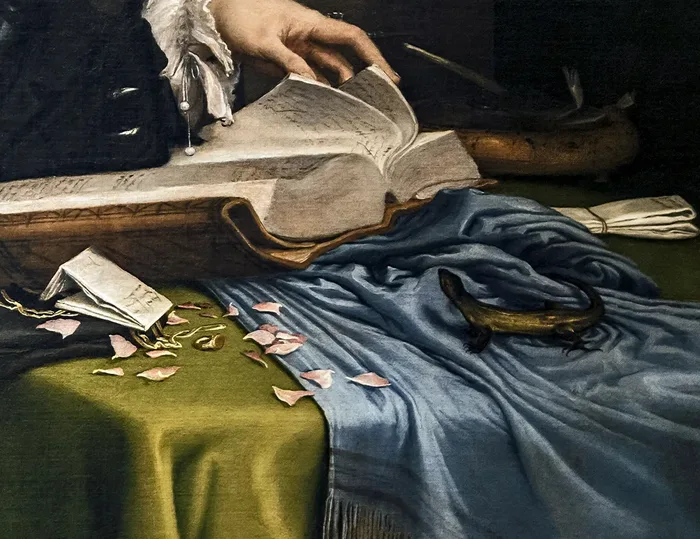
Lotto painted the portrait in the late 1520s, when he was living in Venice and working mainly for private clients. He chose a horizontal canvas, which is unusual among his portraits, and gave the right half of it to the table. The young man, pale and long-faced, dressed in black, is leafing through a thick book in a tooled leather binding, but he looks past it, at the viewer. Rose petals are scattered over the table among an open letter, a gold chain and a ring, keys rest on a casket, and on a fringed pale blue silk shawl lies a small green lizard. Through a narrow window in the upper left corner the sky and distant blue mountains can be seen.
The museum takes the book to be a ledger, an account book, and reads the whole table as the story of a young man giving up the pleasures of youth for the family business. The keys, the ring and the accounts are set against a lute and a hunting horn which, according to the museum's description, hang on the dark wall, and the museum connects the petals, the letters and the woman's shawl with a love that ended or never came to anything. The lizard has been explained in different ways, as a sign of death and rebirth, or as the passions held in check, because a lizard is cold-blooded.
In the medical treatises of the time, rose petals were recommended as a remedy for melancholy.
16. The Tempest — Giorgione
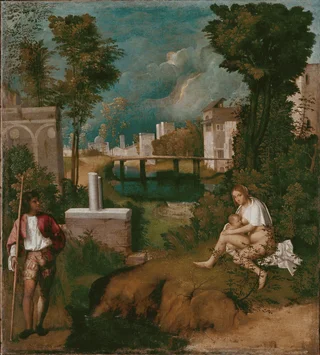
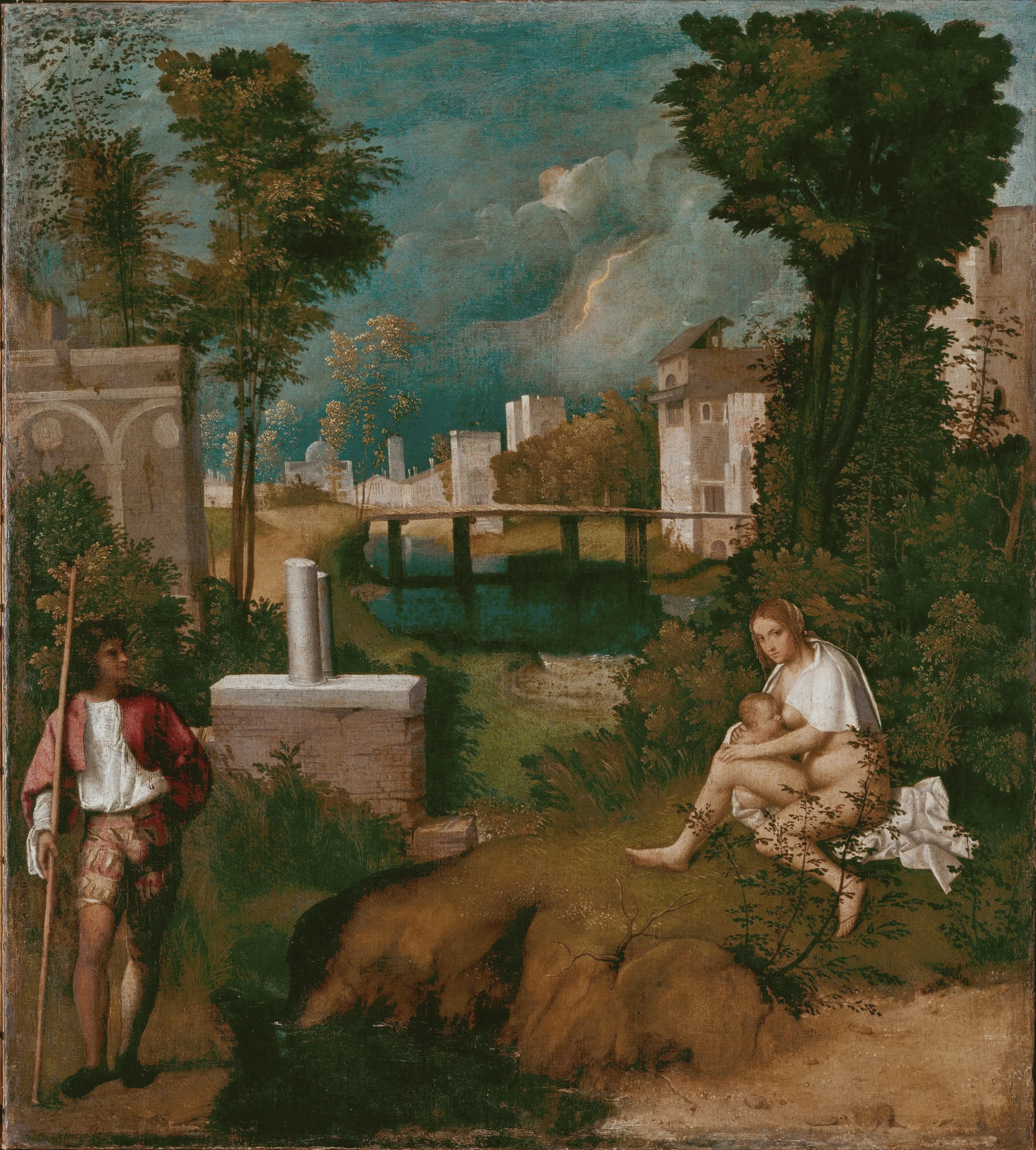
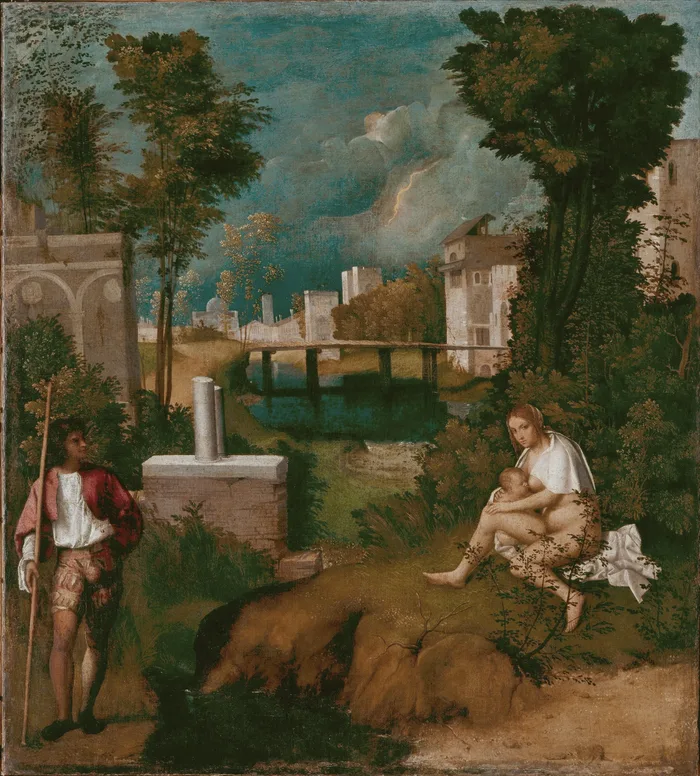
Before the Second World War the picture was X-rayed, and under the young man with the staff another figure was found, a naked woman sitting on the bank with her feet in the water. Giorgione had first placed a second woman on the left and only later painted the man in her place.
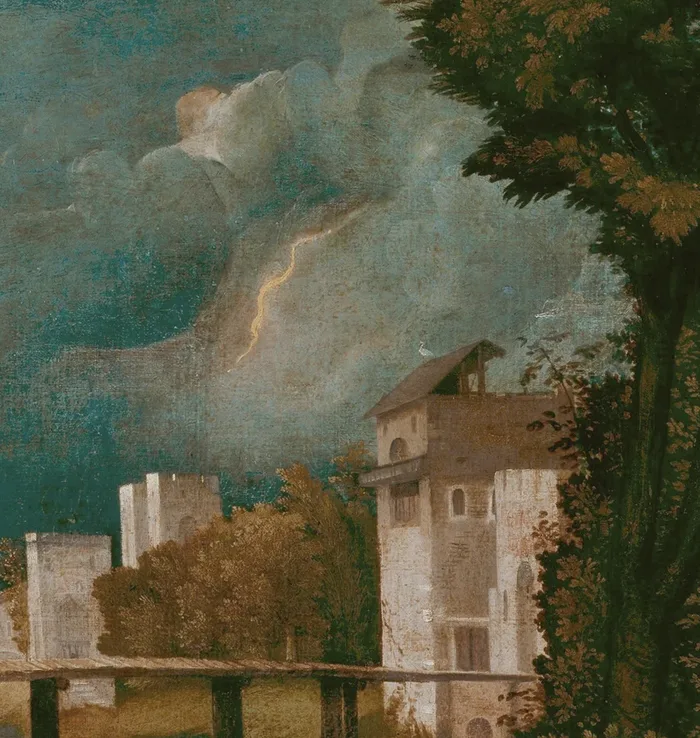
A young man in a red jacket pushed back off his shoulders stands in the lower left corner with a long staff and looks at the woman. In the right corner a naked woman sits on the grass with a white cloth over her shoulders, nursing a baby and looking straight at the viewer. Between them lie an open meadow, a stream and two broken columns on a brick base, and further back a wooden bridge and a pale town with towers and a dome. Above the town a small yellow bolt of lightning flashes in the blue-green sky, and on the ridge of the roof of a tall house right of centre stands a tiny white bird, a stork or a heron.
The first to describe the picture was the Venetian connoisseur Marcantonio Michiel, who saw it in 1530 in Gabriele Vendramin's house: “the little landscape on canvas, representing stormy weather and a gipsy woman with a soldier”. The picture's name goes back to this note. Its subject has never been settled, and there are many interpretations. The art historian Edgar Wind saw it as an allegory of Fortitude and Charity, and in 1978 the Italian art historian Salvatore Settis proposed Adam and Eve after the expulsion from Paradise, with the infant Cain.
From the Vendramin family the Tempest went the same way as the Old Woman, through the Orsetti house into the Manfrin collection. What happened in 1875 is known only from later retellings. That year, the story goes, a Berlin museum wanted to buy the picture, the Italian authorities refused to let it leave the country, and it was bought instead by a Venetian prince, Giuseppe Giovanelli. In 1932 the Italian state bought the Tempest from the Giovanelli family.
During the Second World War the Venetian pictures were evacuated to storehouses in the Marche that were in the charge of Pasquale Rotondi. He later said himself that in September 1943 he took the Tempest and a few other pictures home with him to Urbino and kept them under his bed.
For the Academy's Students (c. 1490–1765)
17. Vitruvian Man — Leonardo da Vinci
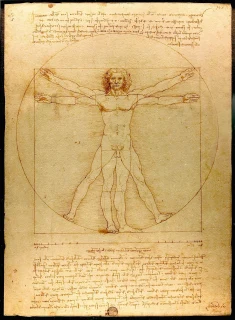
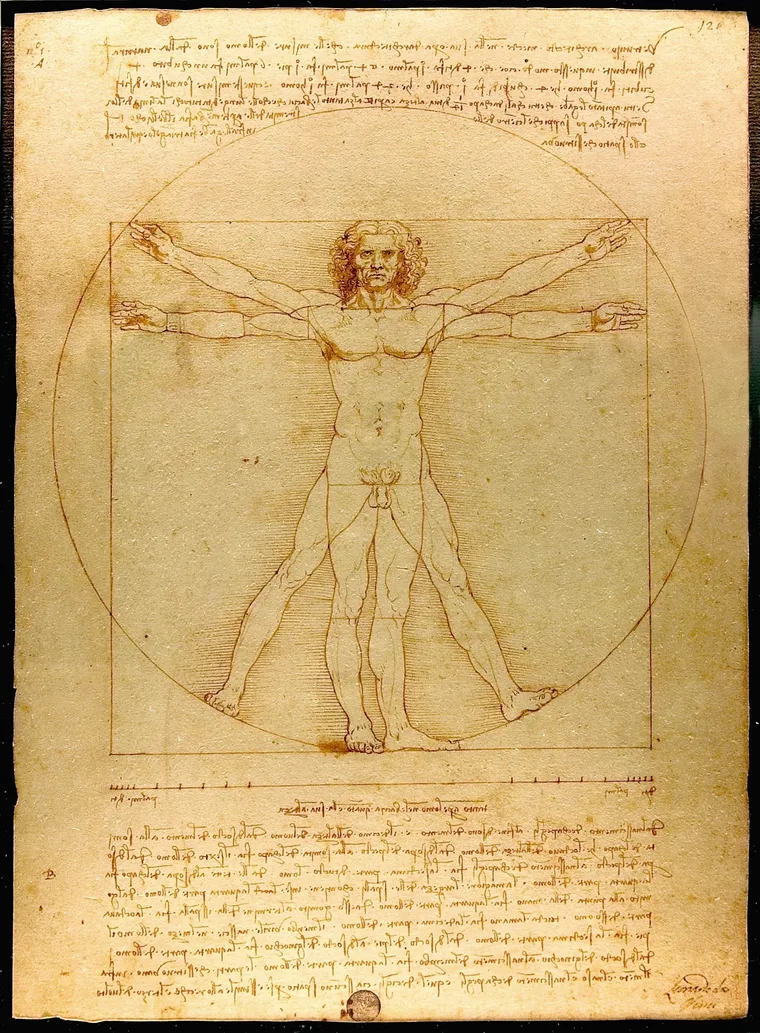
The sheet, which today is almost never shown because light harms paper, was bought for the Venetian Academy precisely so that its students could learn from it. In 1822, after long negotiations, the Austrian government acquired for the Academy the collection of drawings of the Milanese artist Giuseppe Bossi, who had died in 1815. The president of the Academy, Leopoldo Cicognara, had pressed for the purchase. Along with the Vitruvian Man, 25 other sheets by Leonardo came to Venice. Before Bossi the sheet had belonged to Cardinal Cesare Monti, then passed to his heiress, and from her to the De Pagave family, from whom Bossi bought it in 1807.
Leonardo drew it around 1490 in Milan, where he was in the service of the court of Ludovico Sforza. The Roman architect Vitruvius, in his treatise On Architecture, derived the proportions of a temple from the proportions of the human body, and on this sheet Leonardo works through those calculations.
A single naked man is drawn in two poses at once. With his feet together and his arms stretched out to the sides, he fits inside a square, and with his legs apart and his arms raised a little above his shoulders, he touches a circle whose centre falls on his navel. Short lines drawn across the body mark the divisions, a graduated scale lies beneath the square, and above and below the figure runs text in Leonardo's mirror writing. In the pose with the feet together, one foot is turned out and drawn in profile along the bottom side of the square.
The museum keeps the sheet in the dark, in a constant microclimate. In the lower text, among other measurements, Leonardo noted that a man's outstretched arms span as much as his height.
18. Perspective View with Portico — Canaletto
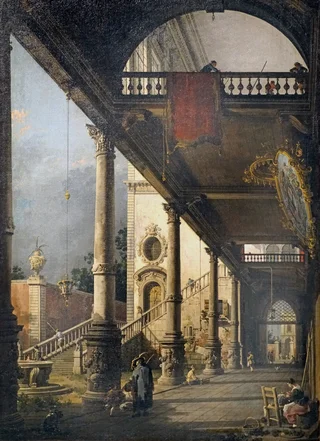
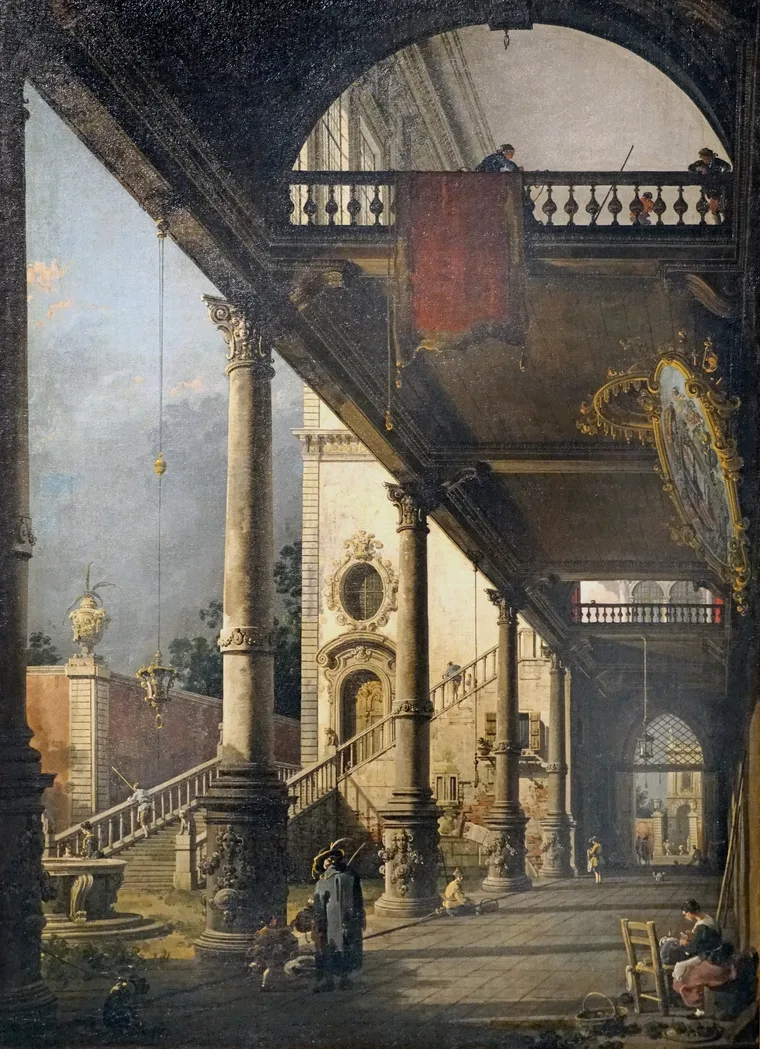
In January 1763 the Venetian Academy refused to admit Canaletto, Giovanni Antonio Canal. Eight months later it changed its mind and elected him professor of architecture and perspective. He was already in his sixties. He painted mostly for foreigners, above all for the English, he had lived in England for about nine years, and few of his pictures remained in Venice.
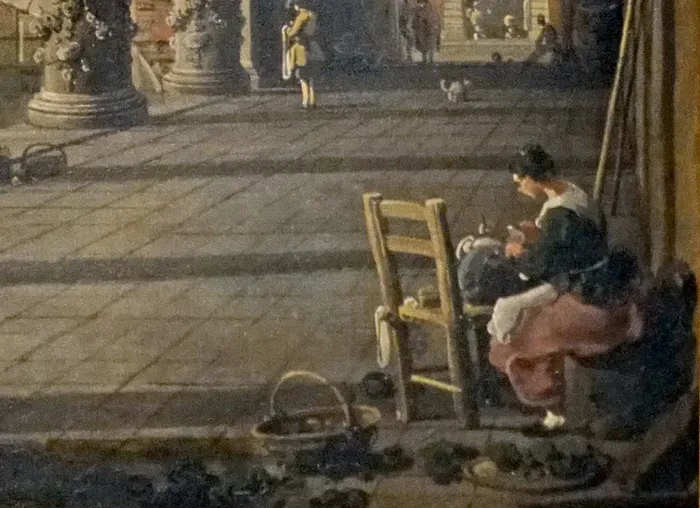
By the Academy's custom a new member presented it with one of his works, and in 1765 Canaletto gave this canvas. For the chair of perspective he painted an imaginary palace courtyard. The canvas is upright, a dark portico with a coffered ceiling runs diagonally from the upper left corner back to the right, and on the left a sunlit courtyard opens out, with a staircase and a palazzo. The columns cast long slanting shadows on the stone floor. Through the large arch at the top a gallery can be seen, where servants have hung a red carpet over the balustrade, and in the lower right corner a woman in a red skirt sits sewing beside an empty rush-seated chair.
The Canaletto scholar William George Constable counted eight replicas of this composition. Canaletto died in April 1768, and in 1777 the picture was exhibited in Piazza San Marco during the Sensa, the feast of the Ascension, when Venice held an open-air exhibition of paintings.
A Lost Ceiling, and the Wall a Picture Was Painted For
19. Transportation of the Holy House of Loreto — Giovanni Battista Tiepolo
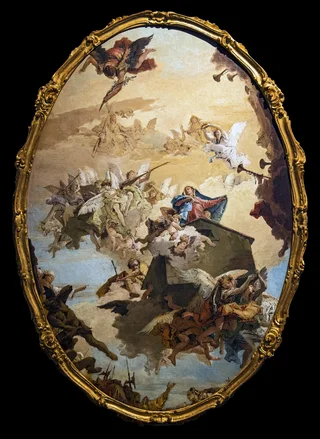
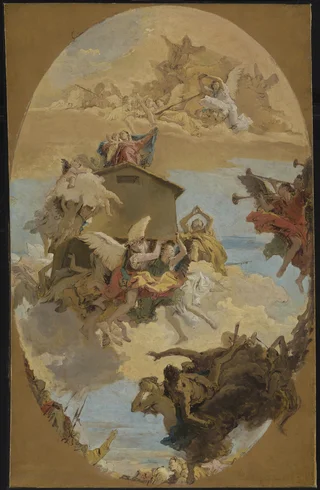
On the night of 24 October 1915 an Austrian bomb meant for the railway station hit the church beside it, Santa Maria di Nazareth, which Venetians call the Scalzi, after its barefoot Carmelites. The bomb exploded between the tiled roof and the thin vault, and the vault, with Tiepolo's fresco on it, fell to pieces.
On this ceiling angels carried the Holy House across the sky, the house in Nazareth where Mary received the Annunciation, which according to legend they brought to Loreto, in the Italian region of the Marche. The Carmelites signed a contract with Tiepolo on 13 September 1743, and on the same day he was paid 100 sequins, probably for this oval sketch. A second sketch, closer to the fresco, is in the Getty Museum in Los Angeles, and pre-war photographs of the ceiling also survive.
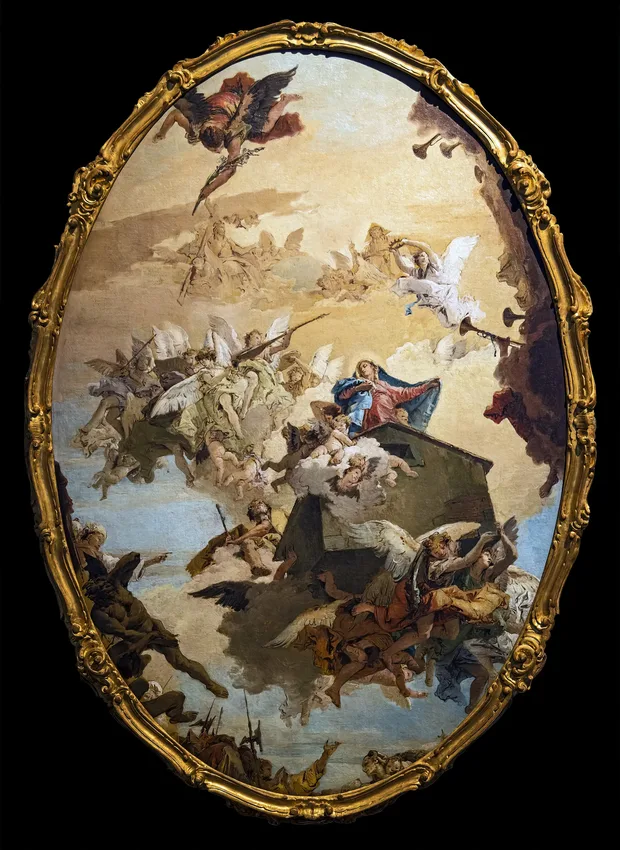
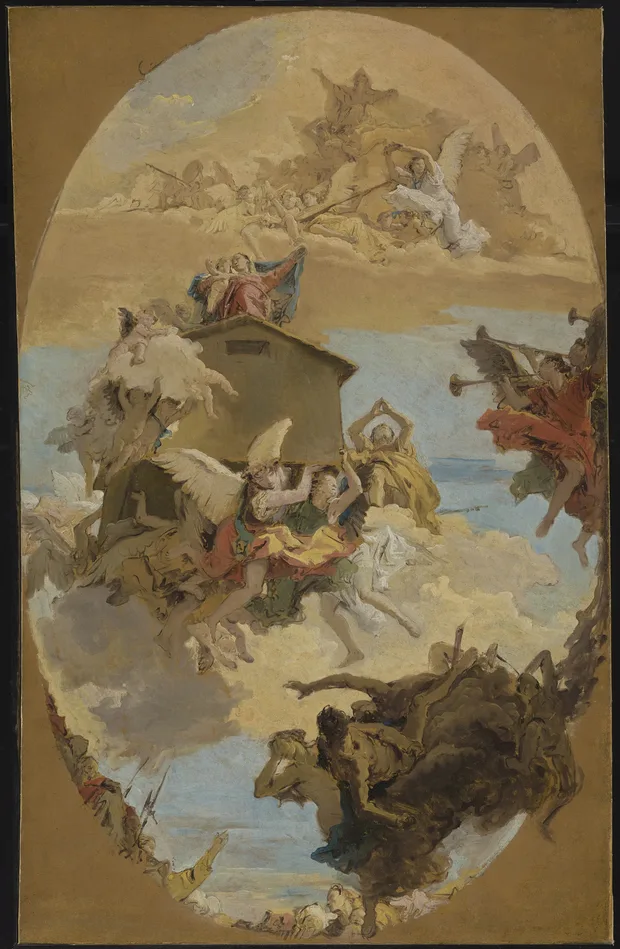
The sky in the sketch is the colour of honey and ochre. The Holy House, a plain grey-green box, is seen from below, and angels in orange-red and grey-blue robes push it upwards from underneath, while Mary sits on the roof in a pinkish-red dress and a blue cloak. At upper left an angel with dark wings and a long stem of white lilies dives downwards, at the left edge dark, muscular naked figures tumble headlong, and along the bottom rim of the oval tiny figures with halberds stand looking up. Many of the figures are sketched in with a few quick strokes over the ground.
In 1930 the gallery bought the sketch from the heirs of the sculptor Antonio Dal Zotto. Fragments of the fresco itself, pieces of the painted parapet with praying onlookers, were gathered up in 1916–1917, and they too are in the Gallerie dell'Accademia.
20. The Presentation of the Virgin at the Temple — Titian
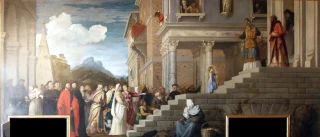
The confraternity of Santa Maria della Carità commissioned this picture from Titian on 21 August 1534 for the Sala dell'Albergo, where the confraternity's governing board met and its documents and relics were kept. Titian delivered it on 6 March 1538. In 1807 the Academy moved into the confraternity's building, and the Sala dell'Albergo became part of the gallery.
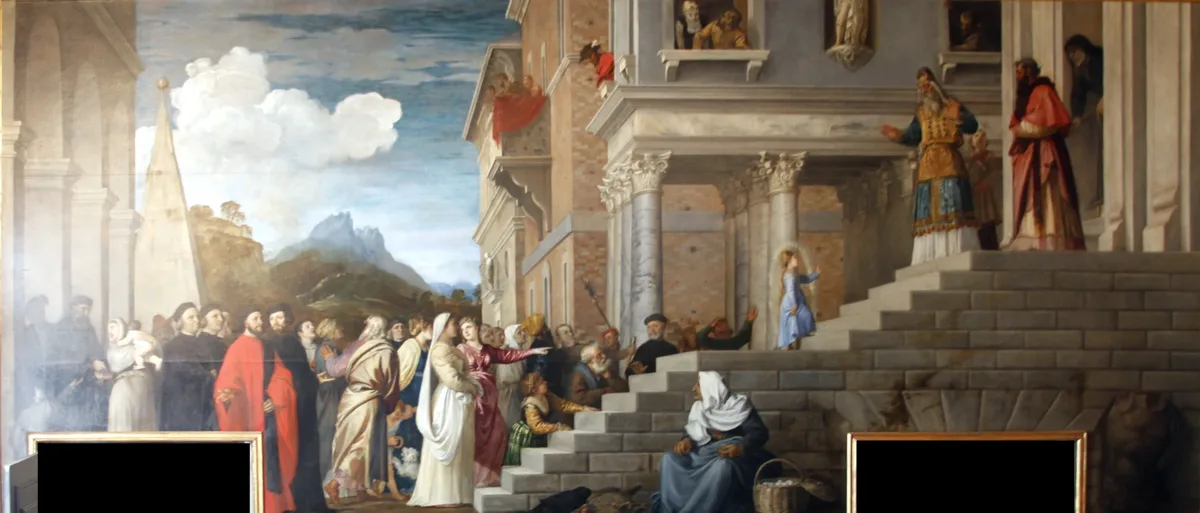
The canvas is low and wide, and its story runs from left to right. On the left a crowd approaches, and on the right the little Mary, in a pale blue dress, climbs the grey stone steps towards the high priest, enclosed in an oval of golden rays. A man in green at the edge of the stairs has raised his hand to his forehead, as if shielding his eyes from her light. At the foot of the stairs, turned away from the procession, sits a large old woman in a blue-grey dress and a white headscarf, with a basket of eggs beside her, and in deep shadow on the right lies a fragment of an ancient torso. The light falls from the left.
Two openings for doors are cut into the bottom edge of the canvas. The right-hand door was in the wall before Titian painted the picture, and he framed it with painted stonework, so that the staircase seems to rise above the real doorway.
The picture was painted for this room, and it hangs again on the wall it was first made for. It has been taken down more than once, for exhibitions and for safekeeping in both world wars, and each time it was put back. The confraternity cut the left-hand door through the canvas on 10 March 1572, destroying part of the crowd, and Titian was still alive at the time.
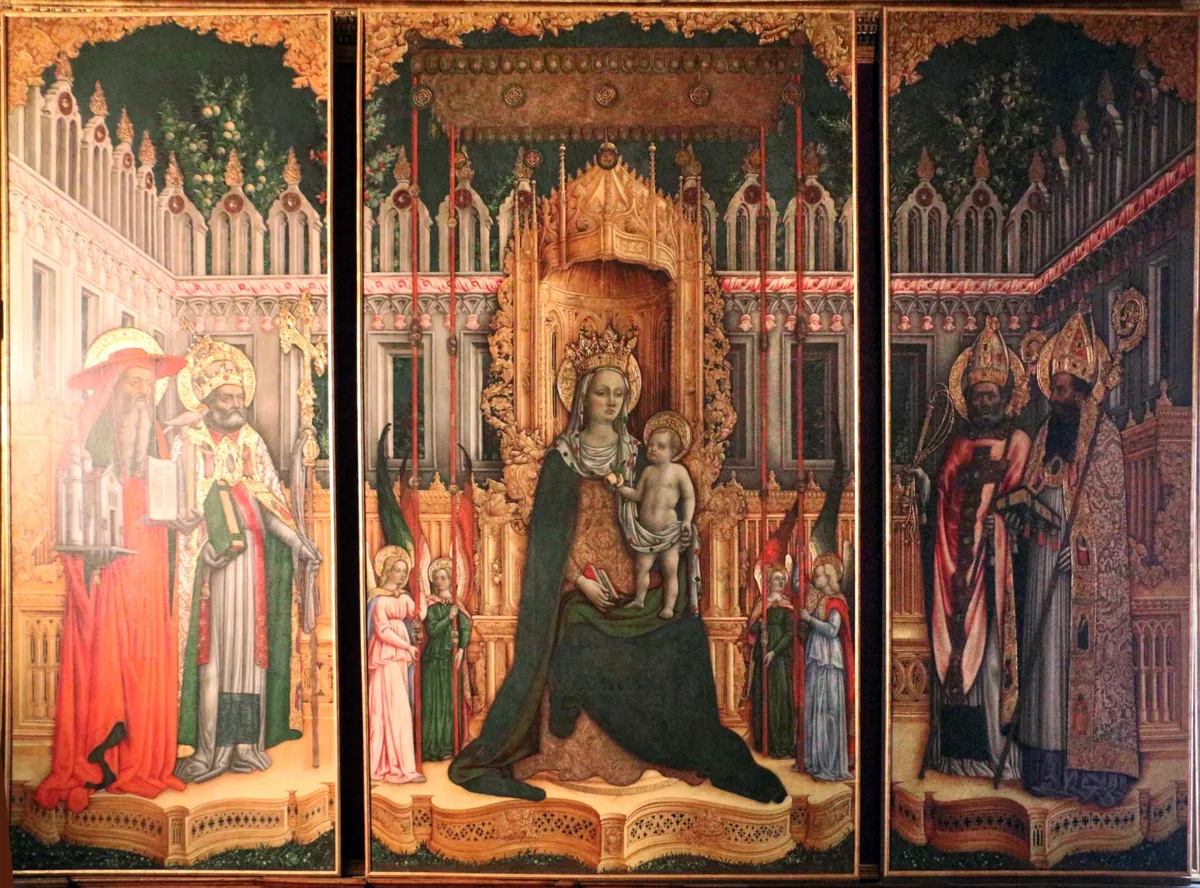
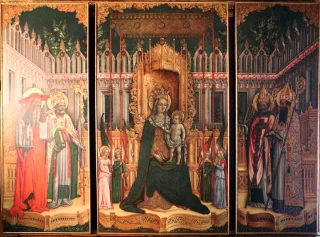
The 1446 triptych by Antonio Vivarini and Giovanni d'Alemagna was also commissioned by the Carità confraternity for the Sala dell'Albergo, and it hangs in the same room, on another wall. Above both pictures survives the gilded and painted 15th-century ceiling, which the museum describes as the only figurative ceiling of that period left in the lagoon.
What Else to See
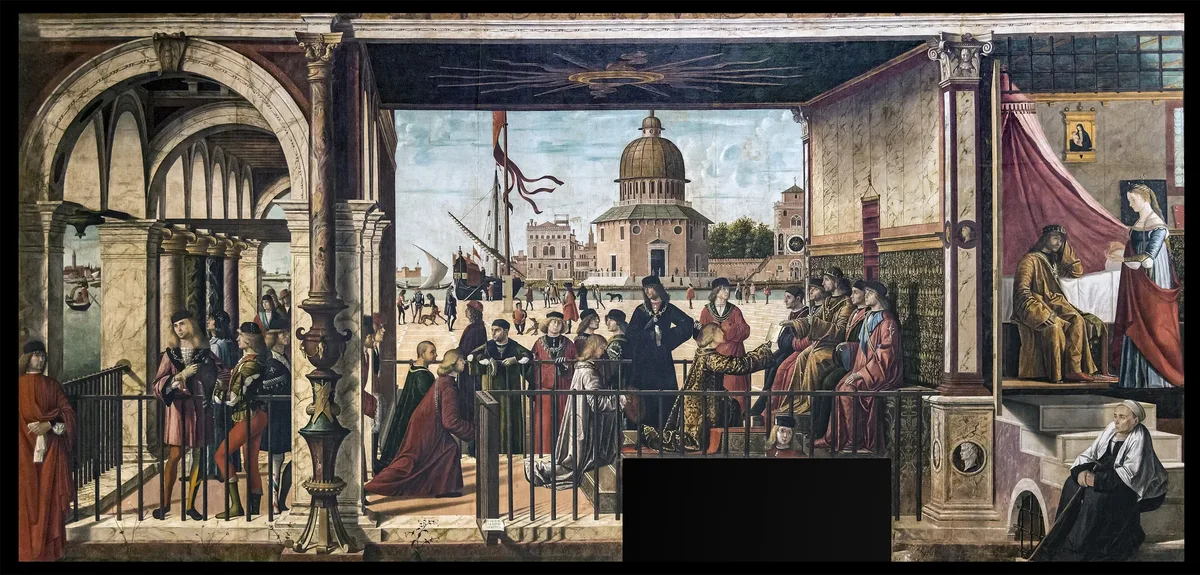
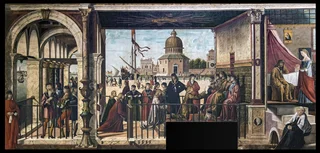
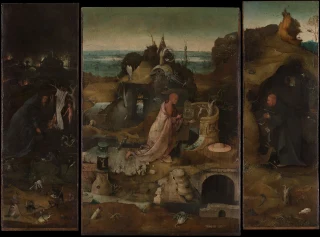
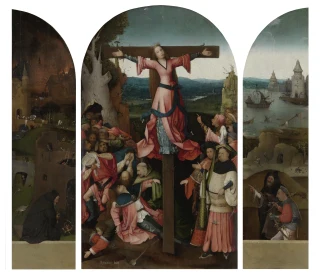
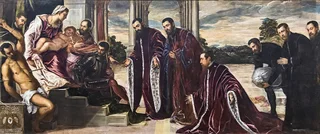
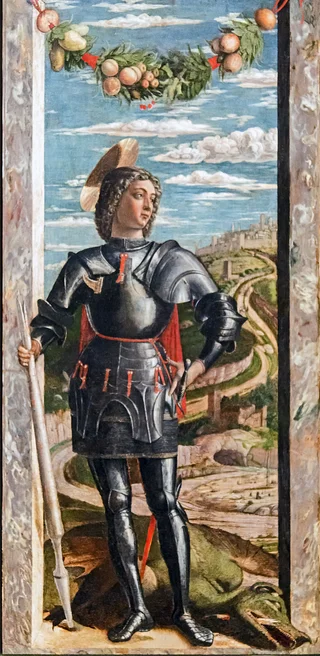
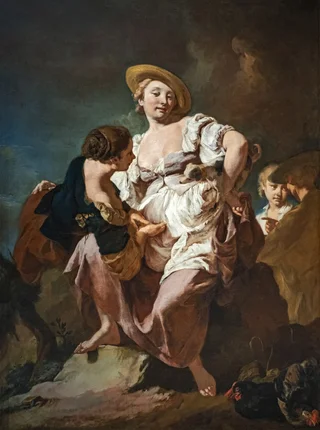
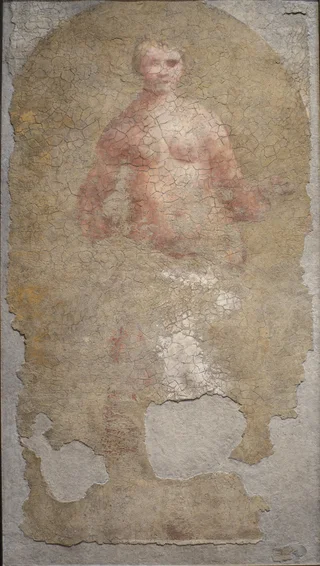
The other eight of Carpaccio's Ursula canvases, among them the Arrival of the Ambassadors, also belong to the Gallerie dell'Accademia, as do the remaining canvases of the cycle of the miracles of the relic of the Cross, painted by Gentile Bellini, Lazzaro Bastiani, Giovanni Mansueti and Benedetto Diana. Two Bosch triptychs from the Grimani collection, the Hermit Saints and Saint Wilgefortis, spent 1838–1919 in Vienna. It is worth seeking out Tintoretto's Madonna dei Camerlenghi, painted for one of the Republic's offices, Andrea Mantegna's Saint George and Giovanni Battista Piazzetta's The Fortune Teller. Of Giorgione's fresco on the façade of the Fondaco dei Tedeschi, the German merchants' trading house by the Rialto, the gallery received the Nude, detached from the wall, and its paint survives only as faint red traces.