![Wreath of Laurel, Palm, and Juniper with a Scroll inscribed Virtutem Forma Decorat [reverse]](https://artgabmlhtb6ca6sy.blob.core.windows.net/artwork-images/a044731d-b9c2-4001-8475-8e7f08d54ee3/1024w.webp)
Leonardo da Vinci, Wreath of Laurel, Palm, and Juniper with a Scroll inscribed Virtutem Forma Decorat [reverse], 1474. Wikimedia Commons. · PD
Wreath of Laurel, Palm, and Juniper with a Scroll inscribed Virtutem Forma Decorat [reverse]
Details
The story
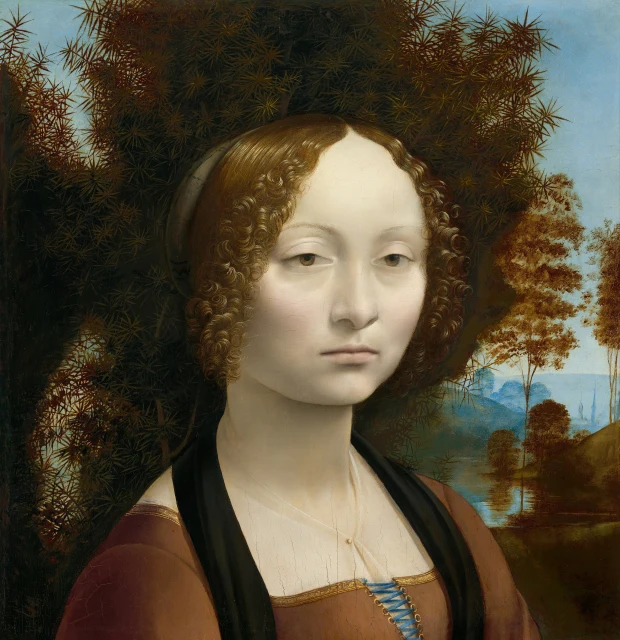
In 1475 Venice sent Bernardo Bembo to Florence as its ambassador, a humanist who soon became the Platonic admirer of Ginevra de' Benci, a young married woman from a banking family. Poets in the Medici circle wrote verses about the pair, and the back of her portrait belongs to that world of courtly devotion. It is painted in tempera on a dark red ground imitating porphyry, a costly red stone. In the middle stands a sprig of juniper, ginepro in Italian, a play on Ginevra's name. A laurel branch and a palm frond curve around it, and those two plants were Bembo's own emblem. Through them winds a scroll with the Latin motto Virtutem forma decorat, beauty adorns virtue. Infrared examination found another motto underneath, Virtus et honor, Bembo's own, which is why the National Gallery thinks he likely commissioned the portrait, though some scholars doubt he used that motto so early. Along the bottom edge the laurel and palm stems run off the panel without meeting, because the panel was cut down at some point, and the wreath lost its base along with the lower part of the portrait.