Hugo van der Goes · PD
ポルティナーリ祭壇画
作品情報
ストーリー
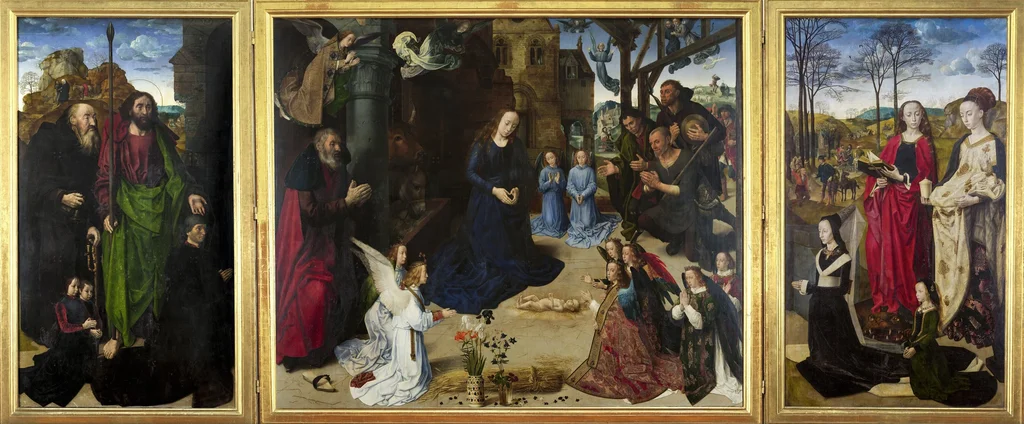
Around 1475, a Florentine banker named Tommaso Portinari, who ran the Medici bank's branch up in Bruges, commissioned this enormous altarpiece from a leading Flemish painter, Hugo van der Goes. Then he had it shipped all the way south to Florence, where it arrived in 1483 for a church attached to a hospital his family had founded. And that journey is why the picture matters beyond its size. Florentine painters had never seen Northern oil painting on this scale, its deep glowing colour, its almost startling realism, the mud and the rough faces of the shepherds who crowd in to see the newborn Christ. Where Italian art tended to idealise, van der Goes gave you real weather-beaten men kneeling in awe. Young Florentine artists went to study it, and you can trace its effect in Nativity scenes painted in the city afterwards. Portinari kneels on the left wing with his sons, his wife and daughter on the right, all much smaller than the saints, as patrons were shown then. In the foreground sits a still-life of flowers in a jar and a glass, each bloom a symbol, the irises and the columbine standing for the sorrows to come.