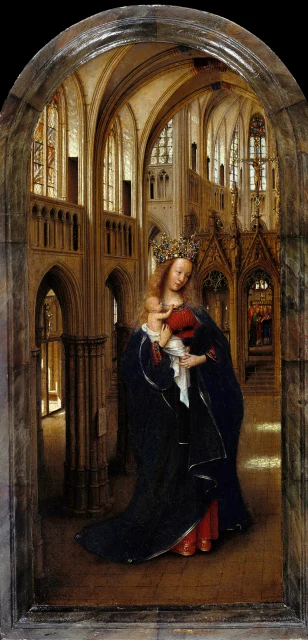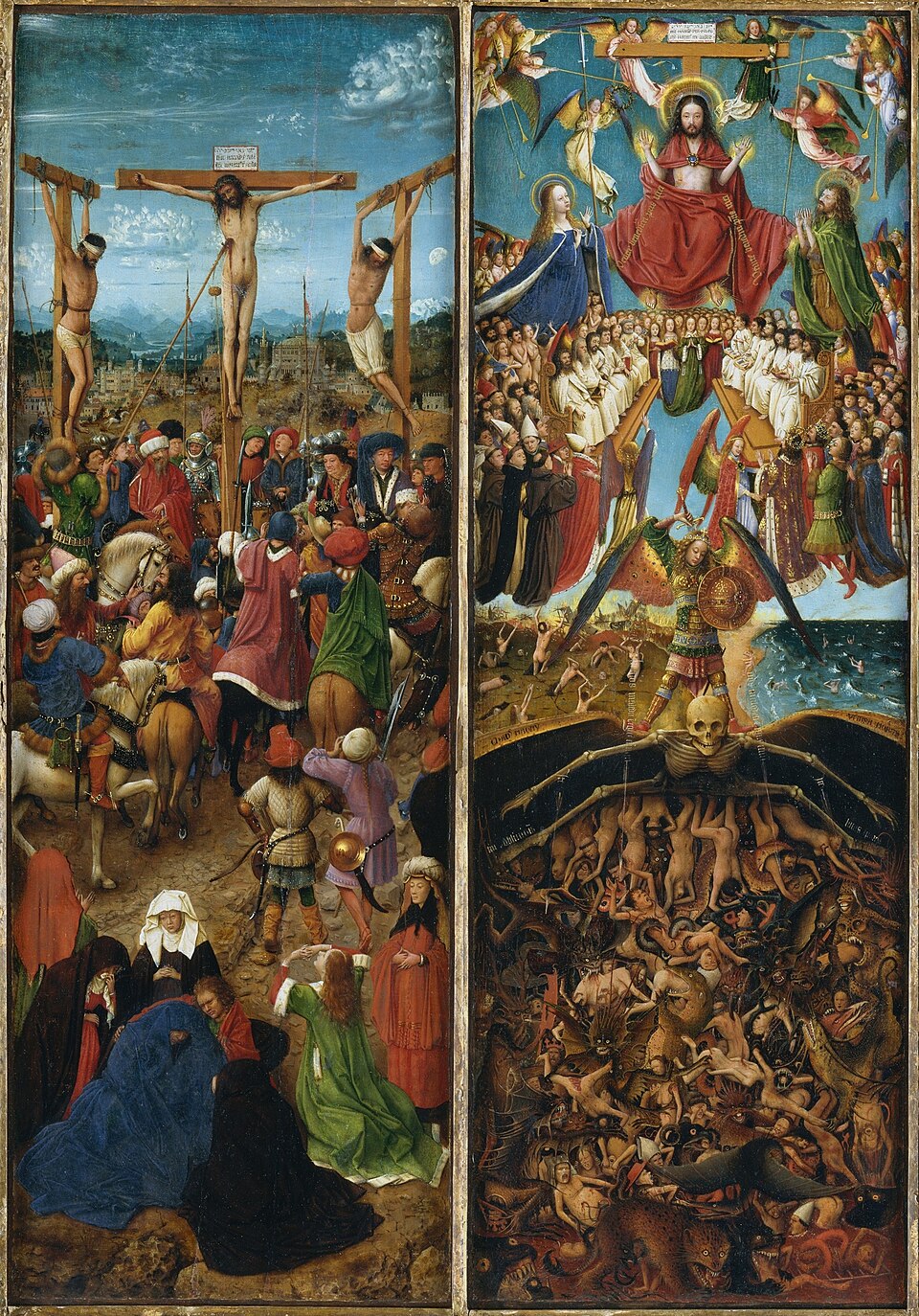
Jan van Eyck, Crucifixion and Last Judgement diptych, 1440. Wikimedia Commons. · PD
십자가 처형과 최후의 심판 두폭화
상세 정보
이야기
These two little panels are barely the size of a spread hand, yet they hold more figures than paintings ten times as large. Van Eyck made them near the very end of his life, around 1440, when oil paint was still a new tool in the North and almost nobody could push it this far. When the Metropolitan acquired them in 1933 they were given to his brother Hubert, because parts of them looked like pages from an older manuscript. Most scholars now read them as Jan's own late work, finished after he died. Technical study has shown they were not always a pair either. They likely began as the wings of a larger structure, perhaps a shrine or the doors of a tabernacle. Look at the Last Judgment and you find a skeleton stretched across the whole width, its wings dividing the saved above from the damned tumbling into the dark below. The original frames survive too, carrying lines of Latin scripture with faded Middle Dutch translations worked into them.