Jacob van Ruisdael
1682 · Dutch Republic · Baroque painting
The story
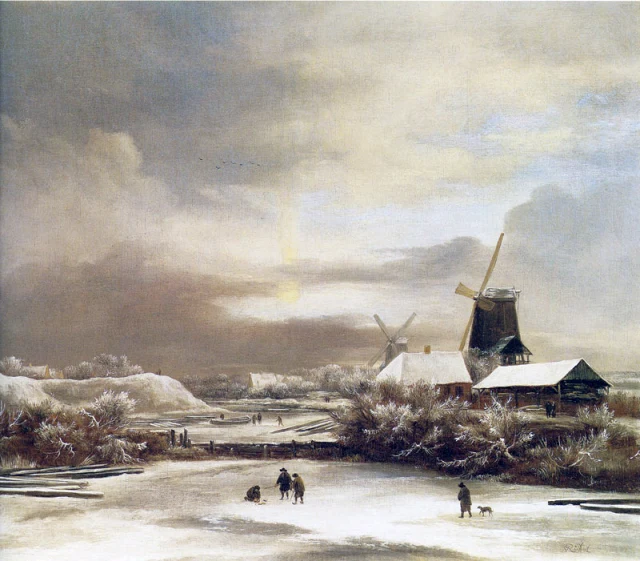
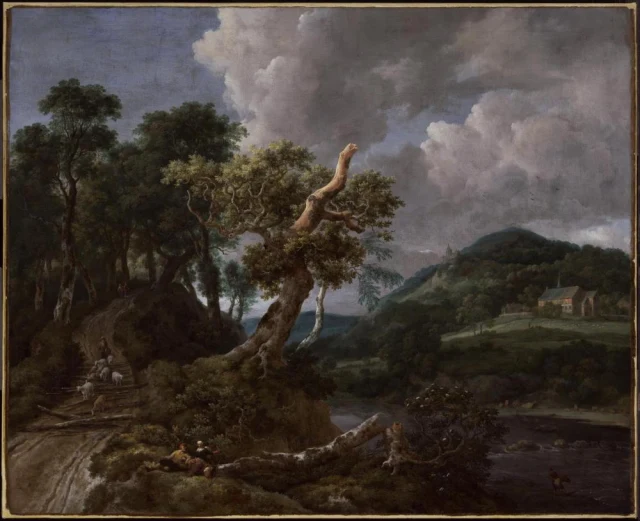
Jacob van Ruisdael turned the flat, damp landscape of the Dutch Republic into high drama, mostly by looking up. In his paintings two-thirds of the canvas is often sky, piled with grey weather moving over a low country of dunes, mills and church towers.
His Windmill at Wijk bij Duurstede, from around 1670, sets a single great mill against towering clouds while a shaft of light catches the brick tower and the water below, a small town made monumental. He could also paint mood as meaning, as in The Jewish Cemetery, where ruined tombs, a broken tree and a rainbow become a study of time and decay.
Ruisdael came from a family of Haarlem painters and probably learned the craft from his father, and perhaps his uncle Salomon, a specialist in river scenes. His only documented pupil was Meindert Hobbema, who often added the small figures Ruisdael left out. Late in life, living in Amsterdam, he is said to have taken a medical degree in 1676, though the record may concern another man, and appears to have worked as a surgeon alongside his painting. He died in 1682 and was buried in Haarlem, and for the next two centuries English landscape painters like Constable and Turner studied his skies closely.