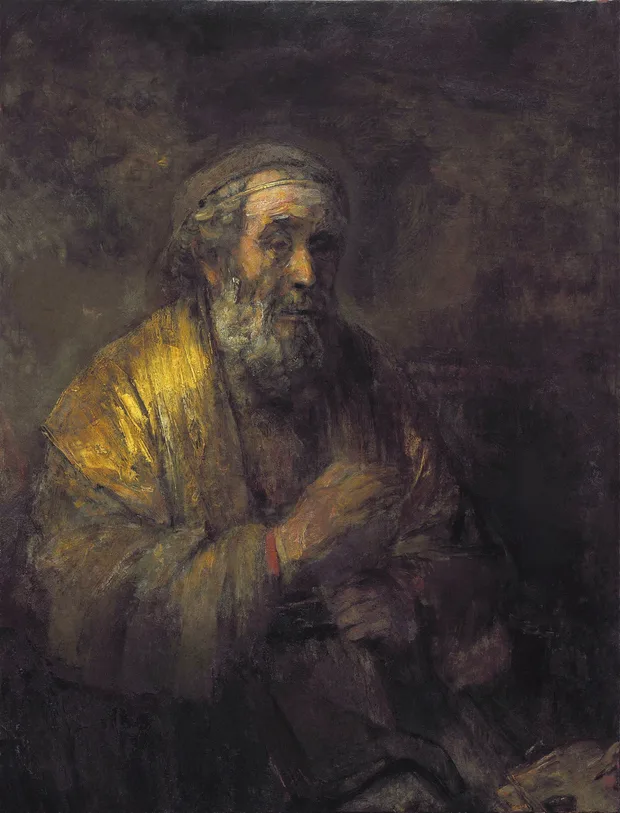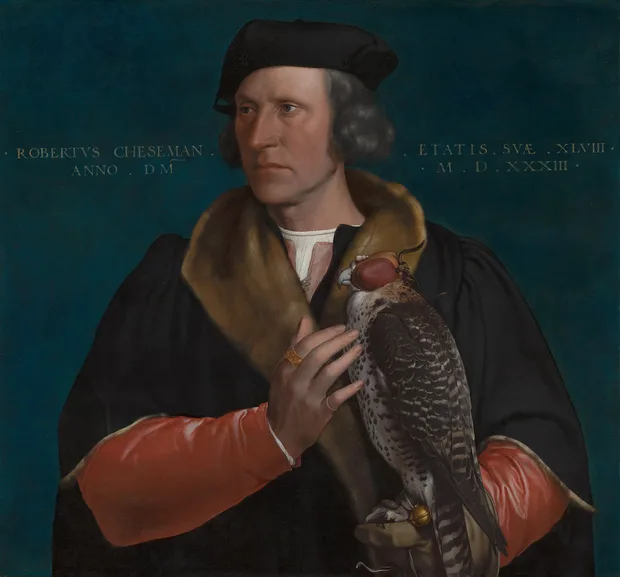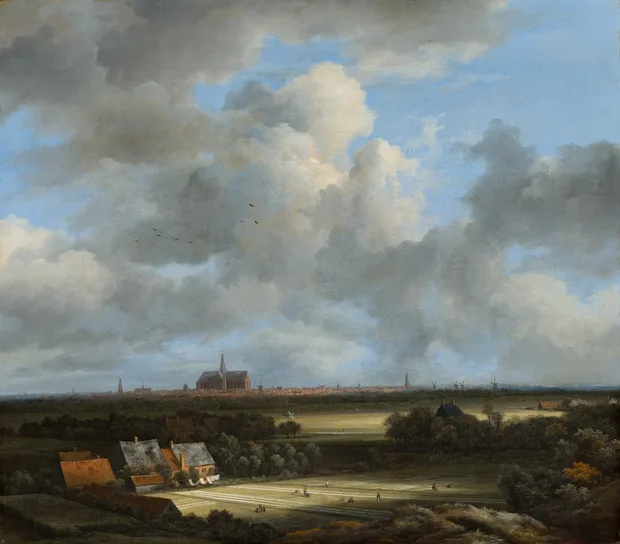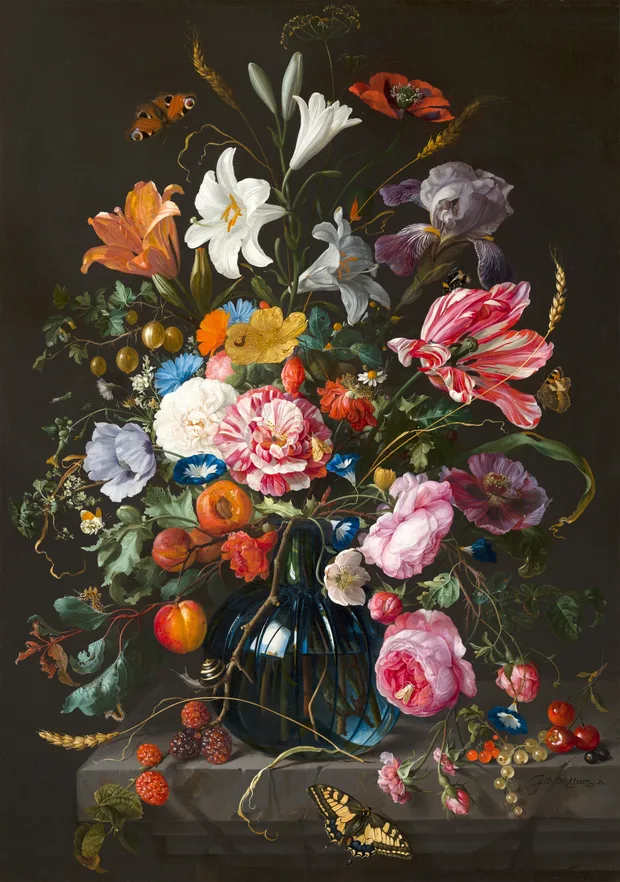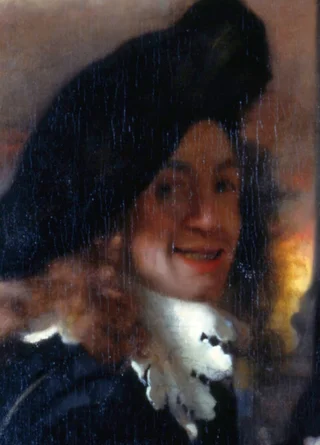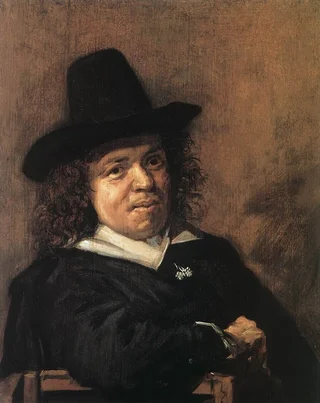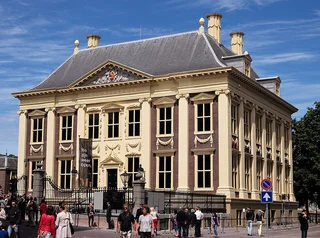
The Mauritshuis was built in the 1630s and 1640s for Johan Maurits of Nassau-Siegen, who governed Dutch Brazil for the West India Company from 1637 to 1644. The house was designed by the architects Jacob van Campen and Pieter Post. Part of the fortune that paid for it was tied to Brazilian sugar and the slave trade, and the museum says so openly. The dispute over Johan Maurits's legacy led to questions in parliament after a 1986 copy of his bust was removed from the foyer in 2017–2018.
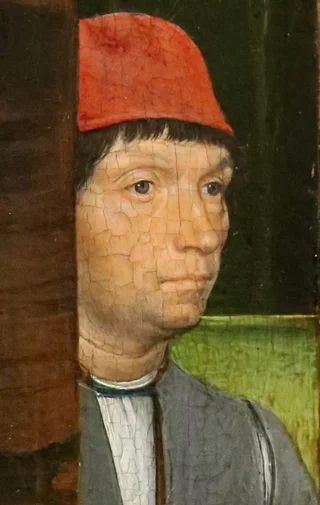
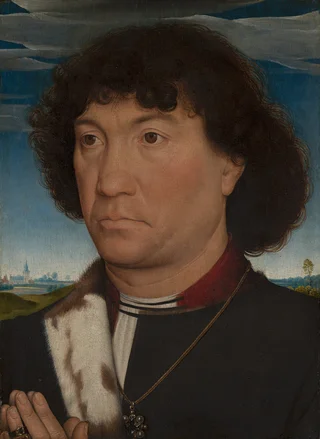
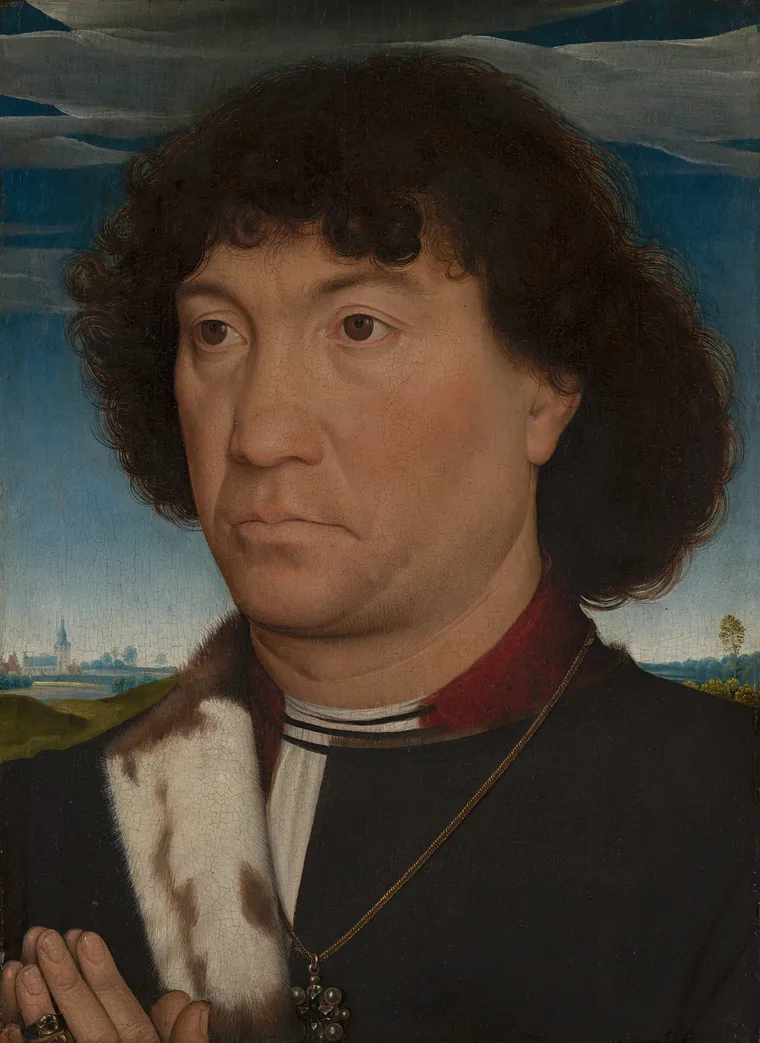
The collection grew out of the paintings of the stadholders, the rulers of the Republic from the House of Orange, above all William V, who opened his gallery on the Buitenhof to the public in 1774. In 1795 French troops took his paintings to Paris, in 1815 most of them were returned, in 1816 King William I founded the Royal Picture Gallery, in 1820 the state bought Johan Maurits's house, and in 1822 the museum opened in it with 305 paintings. After that the buying was done by the king, by the reforming official Victor de Stuers, by the director Abraham Bredius, by private collectors and by the Rembrandt Association, a private society that helps Dutch museums buy art. The association made the first grant in its history in 1894, when Bredius was buying a portrait of a man by Hans Memling for the Mauritshuis. After 1945 the paintings that came here were bought by the state, by foundations and by lotteries.
We will tell you about 20 paintings whose routes into this house show who, at different times, decided what would hang in it. We begin with a Brazilian landscape painted for Johan Maurits himself and end with a merry company bought in 2018 with lottery money.
The house that Brazil paid for
1. View of Itamaracá Island in Brazil — Frans Post, 1637
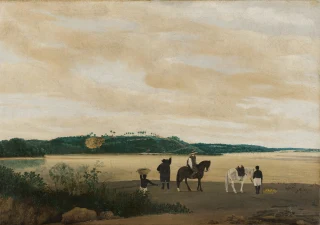
A slip of paper is pasted to the back of the canvas, and on it Frans Post wrote down what the picture shows. It is the island of Itamaracá seen from the south, with the town up on the hill and Fort Orange below, right where the water opens to the sea, and at the end Post added that this is how the Portuguese sit on their horses. He was about 25. He had come to Brazil in 1637 in Johan Maurits's retinue as a topographical artist, and he painted this view the same year. The museum calls it the first painting in which a European artist depicted Brazil, and the earliest known painting by Post. Johan Maurits at first meant to build a new capital for the colony on Itamaracá, and the people on the shore, according to the Rijksmuseum, are most likely surveying the island.
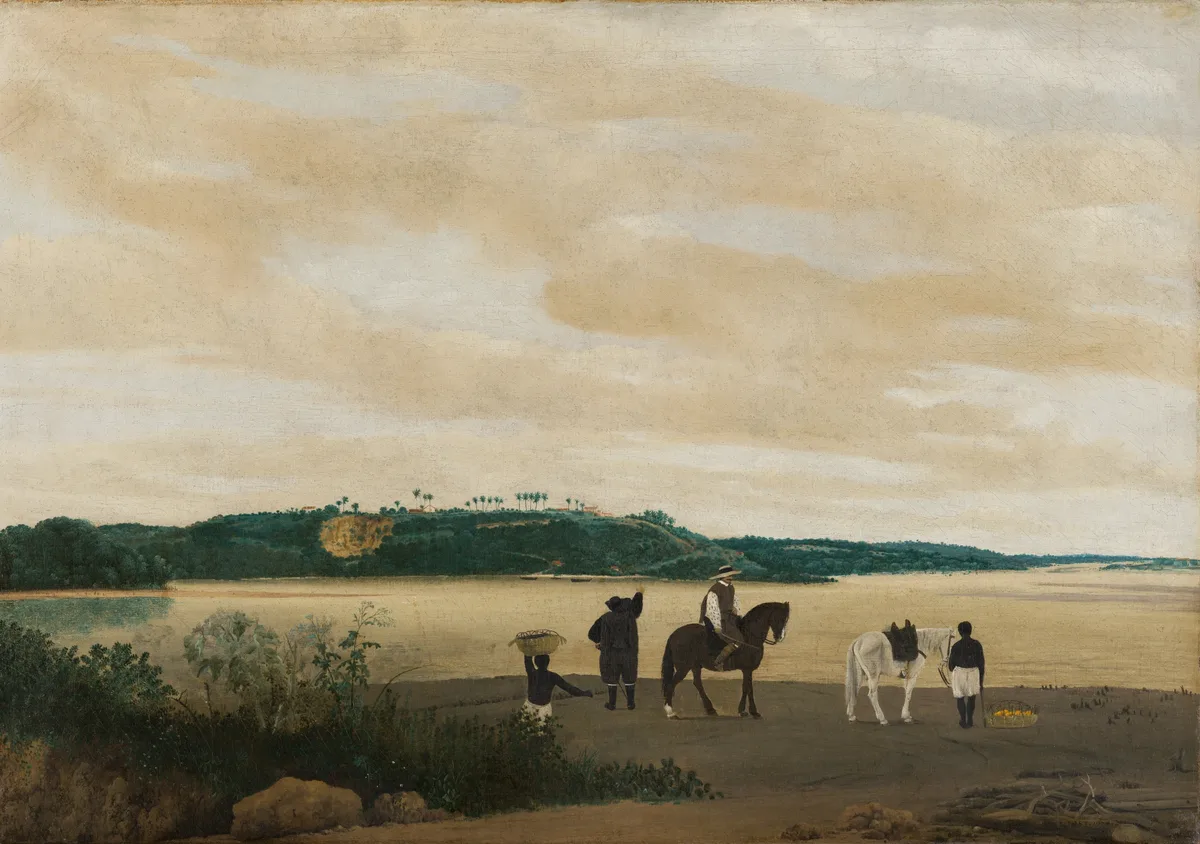
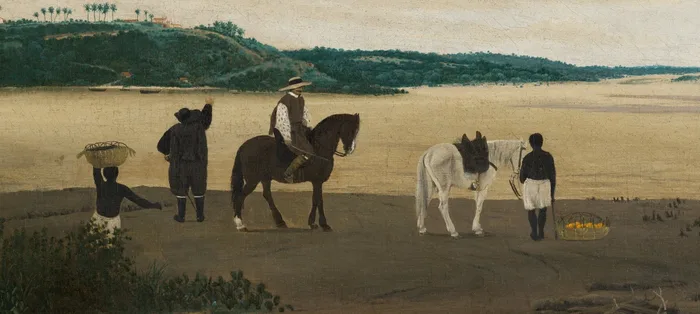
The sky takes up almost two thirds of the canvas, and its flat cream clouds are nearly the same colour as the broad pale ochre water beneath them. Beyond the water stretches a long dark green island, and along its ridge stand slender palms and small white houses with red roofs, all in a row. On the grey sandy shore in front, people and horses are lined up almost in a single line. In the middle, on a dark bay horse, sits a pale-faced rider in a wide light hat with a whip in his hand, the Portuguese of the inscription. Beside him, with his back to us, a stocky man in black clothes and a black hat raises his arm and points to the island. On the left a Black man, bare to the waist, steadies a basket on his head, on the right another holds a white horse by the bridle, and at his feet stands a wicker basket of oranges. The signature “F. POST. 1637”, in dark capitals, is on a fallen log in the lower right corner.
The museum writes that Post, without meaning to, showed inequality by skin colour, although on the whole his paintings present the colony as an idyll. The painter's brother, Pieter Post, was one of the architects of the Mauritshuis. The Rijksmuseum and the Mauritshuis presume that the painting was among those Johan Maurits gave to the French king Louis XIV in 1679. In 1879 the Rijksmuseum bought it from Eugène Odinot of Paris, and in 1953 it lent the picture to the Mauritshuis long-term while keeping ownership.
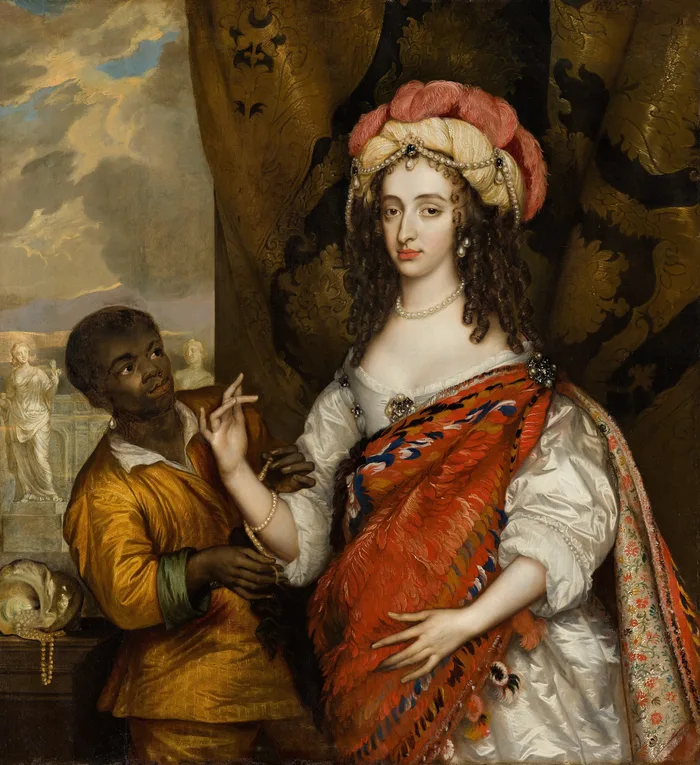
2. Posthumous Portrait of Mary Stuart (1631–1660) with a Servant — Adriaen Hanneman, c. 1664
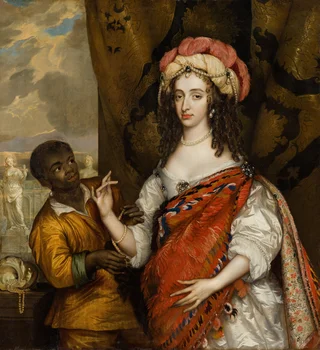
In this posthumous portrait the English princess Mary Stuart stands in white satin and a feather cloak, dressed as a woman of America, and beside her stands a Black boy. Around 1664 the Hague portraitist Adriaen Hanneman painted her for her son, the future stadholder and English king William III, who was then about 14. Mary, the widow of the stadholder William II, had died of smallpox in London on 24 December 1660, at the age of 29. Hanneman had worked in England for many years in the manner of Van Dyck, returned to The Hague around 1638 and became the painter of the English court in exile that gathered around Mary, so he had painted her face from life many times.
The costume, too, came from life. At a masquerade in The Hague in January 1655 an eyewitness described the princess as very finely dressed as an Amazon, meaning in the costume of a woman of America. Hanneman painted her in that costume the same year, and that portrait belongs to the British Royal Collection.
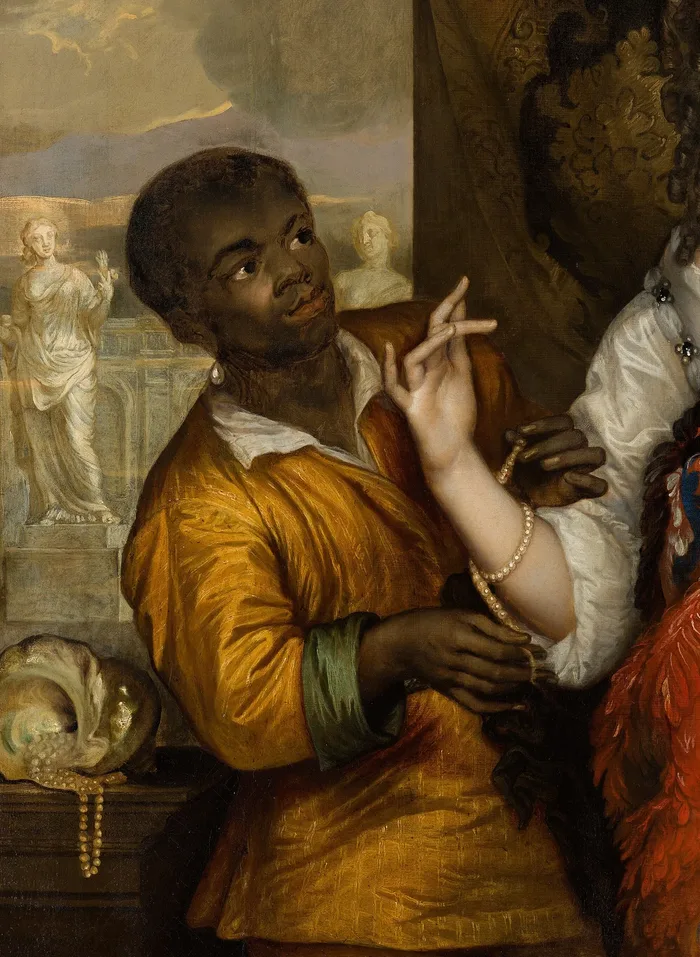
Mary wears a turban striped in cream and gold, with salmon-pink feathers and strings of pearls, and over her shoulder hangs a heavy cloak of red-orange feathers set with patches of blue, yellow and white. Feather cloaks like this were made by the Tupinambá of north-eastern Brazil, which the Dutch held at the time, and a similar red cloak associated with the Dutch court survives in Copenhagen, where it probably arrived through Johan Maurits. On the left, below Mary, stands a Black boy in a mustard-yellow silk jacket, with a pearl in his ear, holding a long string of pearls near her elbow. He has raised his eyes to her, while she looks at the viewer. In the lower left corner lies a large mother-of-pearl shell, and strings of pearls hang from the dark stone ledge beneath it.
How the portrait came to this house the museum itself cannot say. It is an Orange family picture, by 1755 it was in the stadholders' palace at Honselaarsdijk, and the museum's own record says only that it arrived “in or before 1875”. Researchers have not found the boy's name. In 2019–2020, after the exhibition Shifting Image: In Search of Johan Maurits, the museum moved the portrait into a new permanent room on Johan Maurits, Dutch Brazil and slavery, and wrote on the label that the boy is reduced to an “exotic” accessory, which Hanneman uses to set off the whiteness of Mary's skin and her high rank. Before that, the museum's text said only that Mary seems not to notice him.
Collected by stadholders, carried off by the French
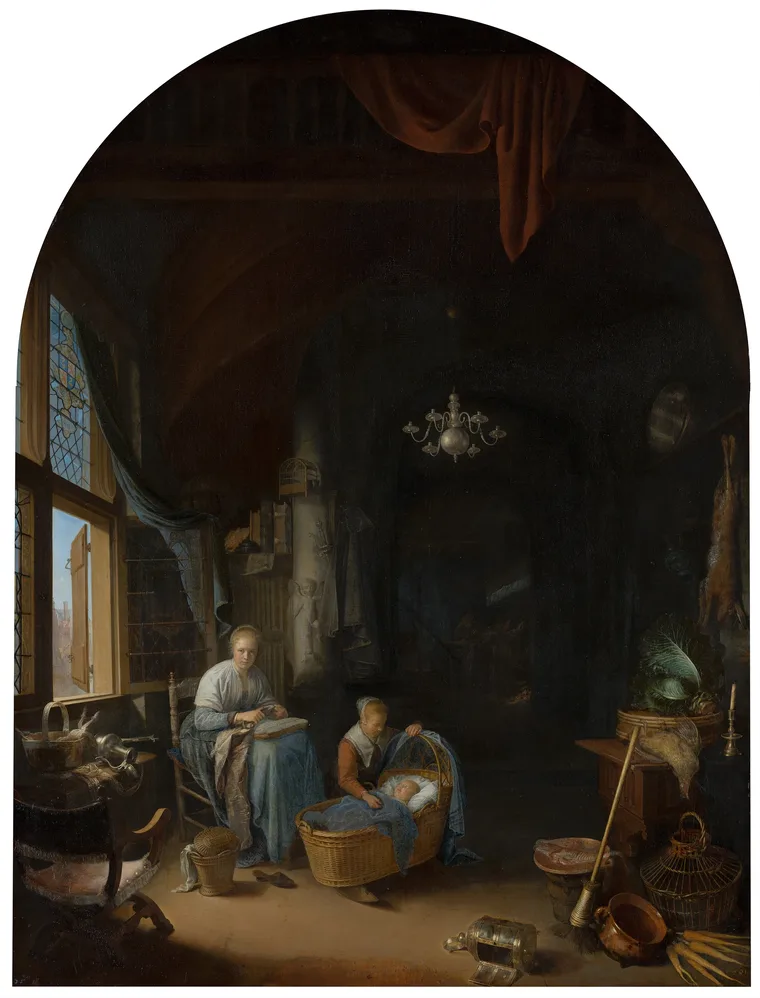
3. The Young Mother — Gerrit Dou, 1658
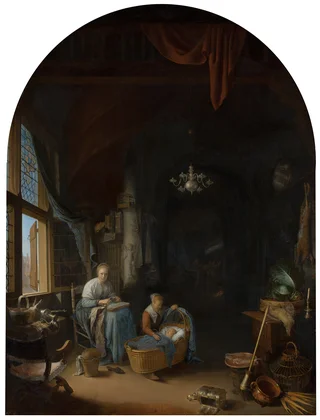
In October 1660 the States of Holland and West Friesland paid the Leiden painter Gerrit Dou 4,000 guilders for this small domestic scene, although, according to the German painter and biographer Joachim von Sandrart, a painting by Dou fetched up to a thousand. It was bought as a present for the English king Charles II, who had been restored to the throne in 1660.
The States put this present together mainly from Italian paintings in the Reynst collection and from ancient statues, and added Dutch masters later. In November the Dutch Gift was presented to the king in London. Charles II said that his favourite pictures were those by Dou and Elsheimer, and he invited Dou to his court, but the painter stayed in Leiden.
Dou was the son of a glazier. He first trained as a glass engraver and glass painter, and in 1628 he became the young Rembrandt's first pupil. The panel is rounded at the top, a tall dark room fills almost all of it, and the figures sit in the lower third. Light falls from a high window on the left with its shutter flung open, and through it a sunlit street can be seen. The young mother sits by the window on a wicker chair with a lacemaker's pillow on her lap and looks straight at us. Next to her a maid in a white cap kneels by a large wicker cradle and lifts a blue cover, and the child underneath lies with its eyes open. On the floor, in a patch of light, a lantern lies on its side with its little door open, on the right a dead hare hangs in the half-dark, and a six-branched chandelier hangs from the ceiling. High up in the stained glass of the window, under a coat of arms, is the inscription “GDOV 1658”, and it looks as though it had been set into the lead along with the panes.
For about 30 years the painting stayed in the English royal collection, with Charles II and then with James II. Then William III, stadholder and English king, took it to the Netherlands together with about 30 other paintings, after which it passed by inheritance through the House of Orange and came into the gallery of William V. In 1795 the French took it to Paris, in 1815 it was returned, and in 1822 it was among the paintings with which the Mauritshuis opened.
Researchers at the Mauritshuis think it possible that the States bought a painting begun several years before the sale. X-rays showed that Dou reworked the figures heavily as he went, and the museum's 2016 catalogue of its genre paintings says that the last digit of the date may originally have been a one, altered to an eight.
4. The Bull — Paulus Potter, 1647
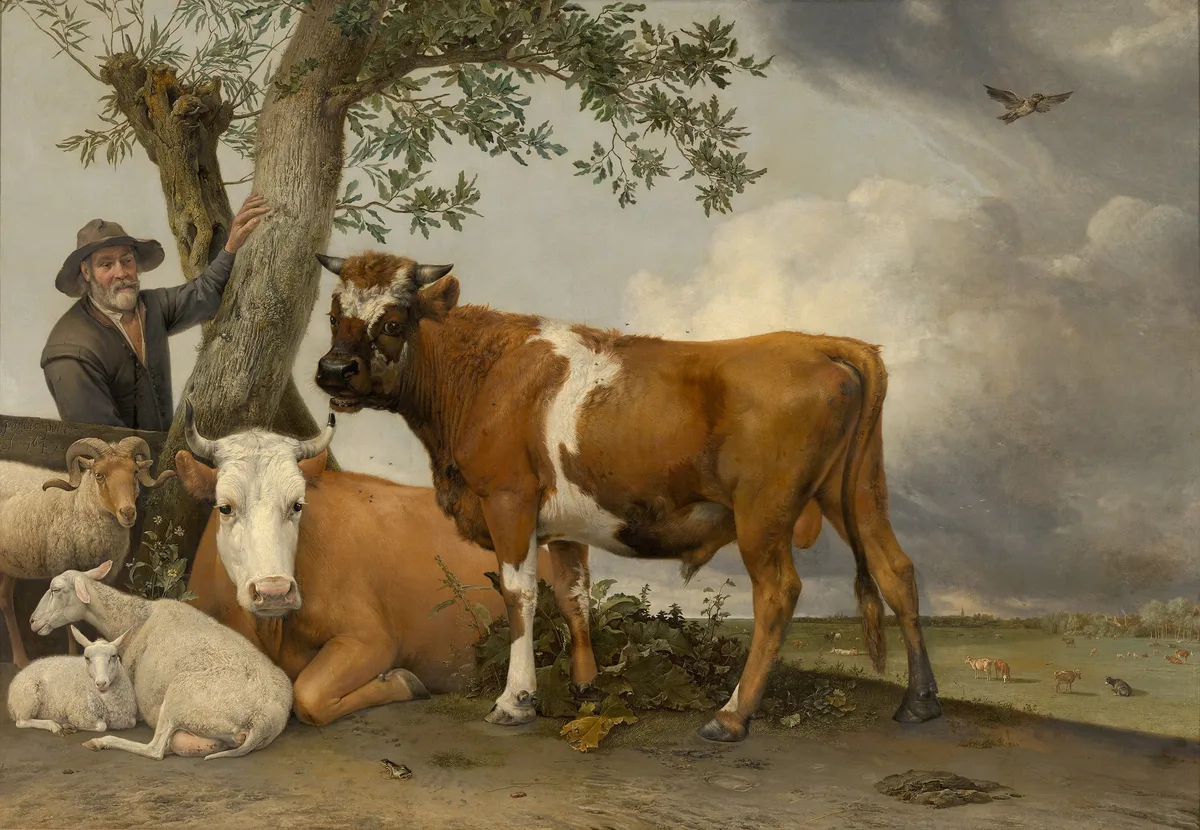
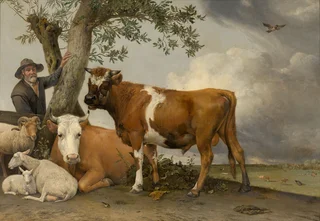
The Mauritshuis conservators Abbie Vandivere and Jolijn Schilder finished work on The Bull in December 2025, coating it with a new synthetic varnish that does not yellow. They had been working since the summer of 2024 in a temporary studio set up inside the museum, in front of visitors, and the studio was nicknamed the cowshed. They took off yellowed varnish and overpaint up to 200 years old, and under the dark storm cloud they found losses in the sky. The sky was reconstructed on the advice of a forensic meteorologist from the Royal Netherlands Meteorological Institute, and it now shows a day in early summer as the last showers move off.
The conservators called the French branch their dilemma. From 1795 to 1815 the painting hung in the Louvre, where damage was found on it and hidden by painting an extra branch onto the tree. The branch was also part of the painting's history, so the conservators covered it with retouching that can be removed again. What is left of it is a thin twig with a few leaves, and more sky has opened up above the bull's back.
This is the largest painting in the Mauritshuis, and the young bull in it is almost life-size, a scale then usually reserved for history painting. He stands in profile with his head turned to the viewer, a white patch runs over the shoulder of his ginger hide, a thread of saliva hangs from his lower lip, and flies sit on his shoulder and flank. On the left lies a cow with a white face, also looking straight at us, behind the fence stands an old herdsman in a brown hat with his hand on a tree trunk, and below, on the bare ground in front of the cow's forelegs, sits a small green frog. On a board of the fence above the ram are the words “paulus potter f. 1647”, as if cut with a knife. Potter was 22, he died in 1654 at the age of 28, and according to the museum he put the bull together from several animals of different ages.
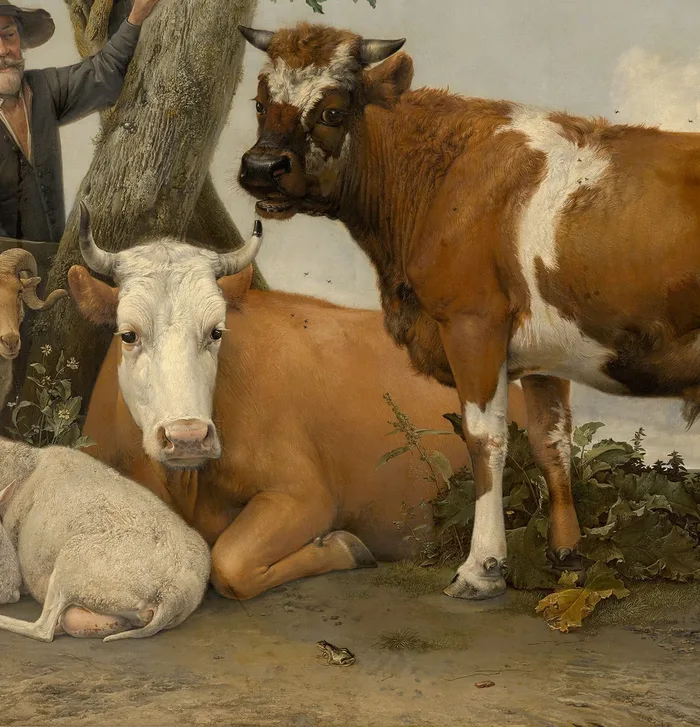
In the first half of the 18th century the painting passed by will from one member to another of a Haarlem burgomaster's family as an heirloom. In 1749, after the last heir died, it was put up as the first lot at an auction in Haarlem, and the auctioneer Frans Dekker bought it for 630 guilders, more than anything else fetched at that sale. A note in the margin of the family's copy of the catalogue records that Dekker was buying on behalf of Admiral Reynst, who presented the painting to the prince at the prince's house, Het Loo. Admiral Jacob Reynst was a supporter of the House of Orange, the prince was the stadholder William IV, and in 1748 and 1750 William IV promoted Reynst in rank.
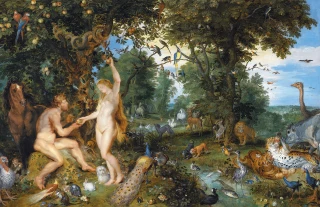
5. The Garden of Eden with the Fall of Man — Jan Brueghel the Elder and Peter Paul Rubens, c. 1615
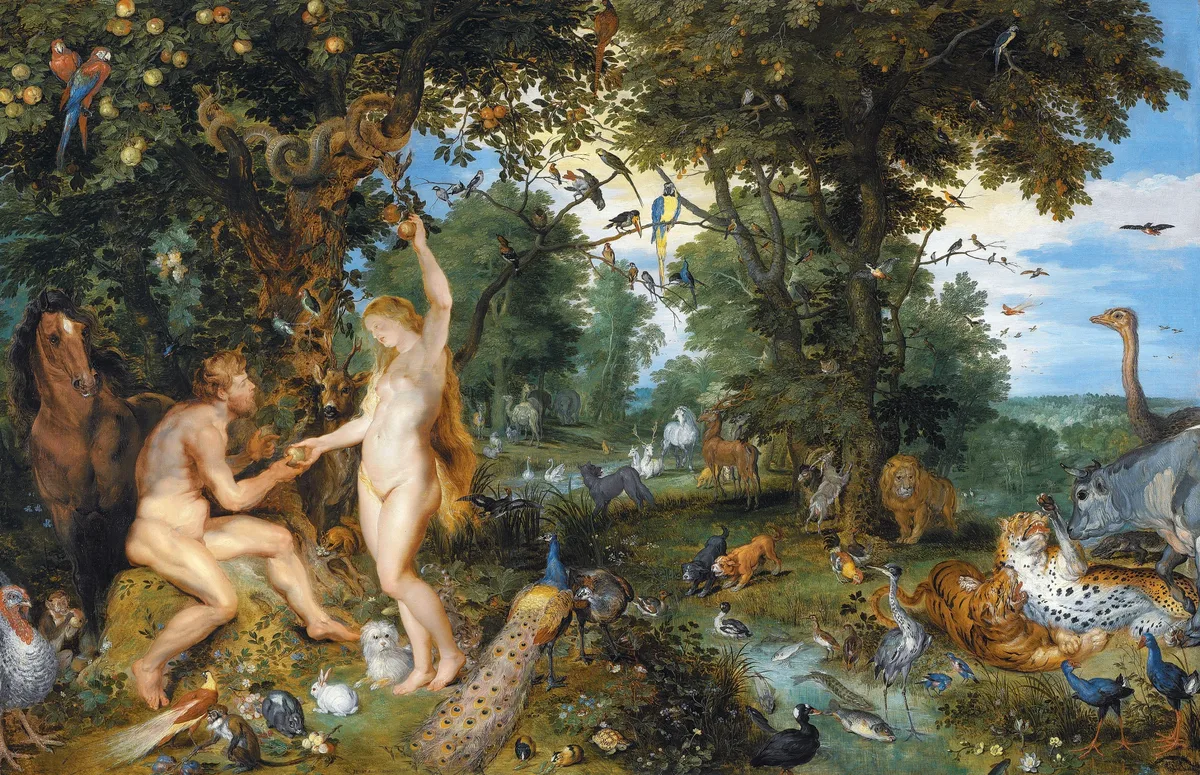
Two signatures run along the bottom edge of the panel. Left of centre, under the peacock's tail, in small capitals, is written “PETRI PAVLI RVBENS FIGR.”, meaning figures by Peter Paul Rubens. On the right, by the water, a second, tiny inscription can barely be made out, and it is read as the signature of Jan Brueghel the Elder. Brueghel, the son of Pieter Bruegel the Elder and court painter to the Archdukes Albert and Isabella, who ruled the Spanish Netherlands, was a friend of Rubens, and together they painted several pictures of this kind. According to the museum's account, Brueghel devised the composition and Rubens began the painting. Rubens painted Adam and Eve, the tree, the horse and the serpent thinly, like a sketch, and then Brueghel added the plants and animals in dense paint with the precision of an encyclopedia.
At the beginning of the 18th century the painting belonged to the Leiden collector Pieter de la Court van der Voort, and the biographer of artists Arnold Houbraken, who saw it in the collector's house, called it the finest Brueghel he had ever come across. On 8 September 1766, at the sale of the De la Court collection, it was bought for the stadholder William V, and, according to the museum, for far more than was paid at the same sale for a Van Dyck or a Jordaens. William V hung it in his gallery, in 1795 it was taken to Paris along with the whole collection, and in 1815 it was returned.
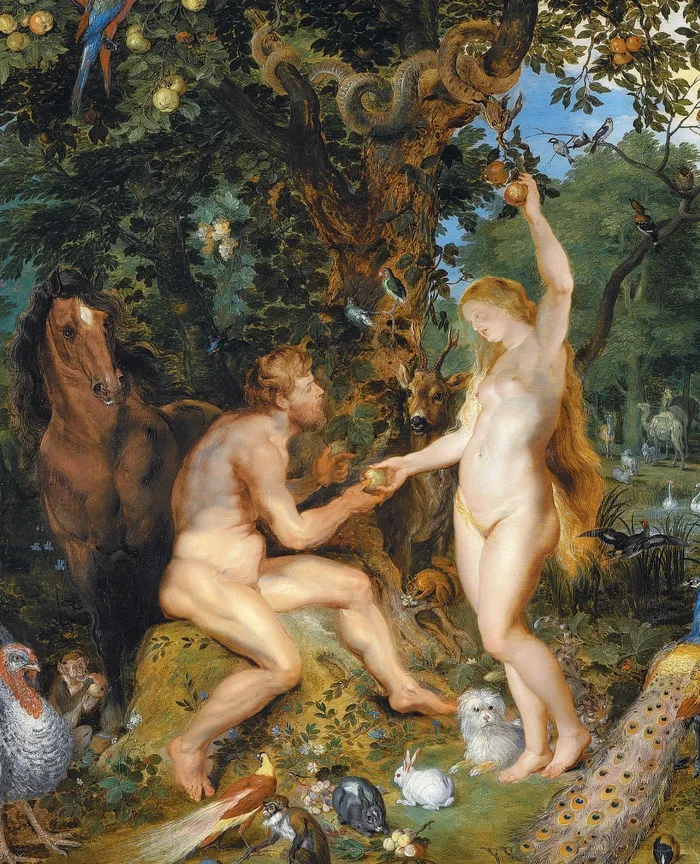
Pale Eve stands on the left, her golden hair falling to her knees. With her right hand she reaches for an apple still hanging on the branch, and with her left she passes another apple to Adam. He sits on a grassy mound, takes the apple with one hand and holds up the other with the index finger extended. The serpent is coiled around the branches of the tree of knowledge, its head lowered towards the very branch from which Eve is picking the apples. At the left edge stands Rubens's bay horse, looking at the viewer. Brueghel filled all the rest with animals. A tiger and a spotted leopard roll on their backs, a heron and blue swamphens stand by the stream, macaws sit in the trees, camels and an elephant can be seen far off under the trees, and a white lapdog sits at Eve's feet. In the lower left corner, behind the turkey, a monkey is already biting into an apple.
A king buys for the nation
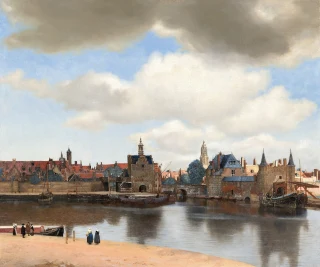
6. View of Delft — Johannes Vermeer, c. 1660–1661
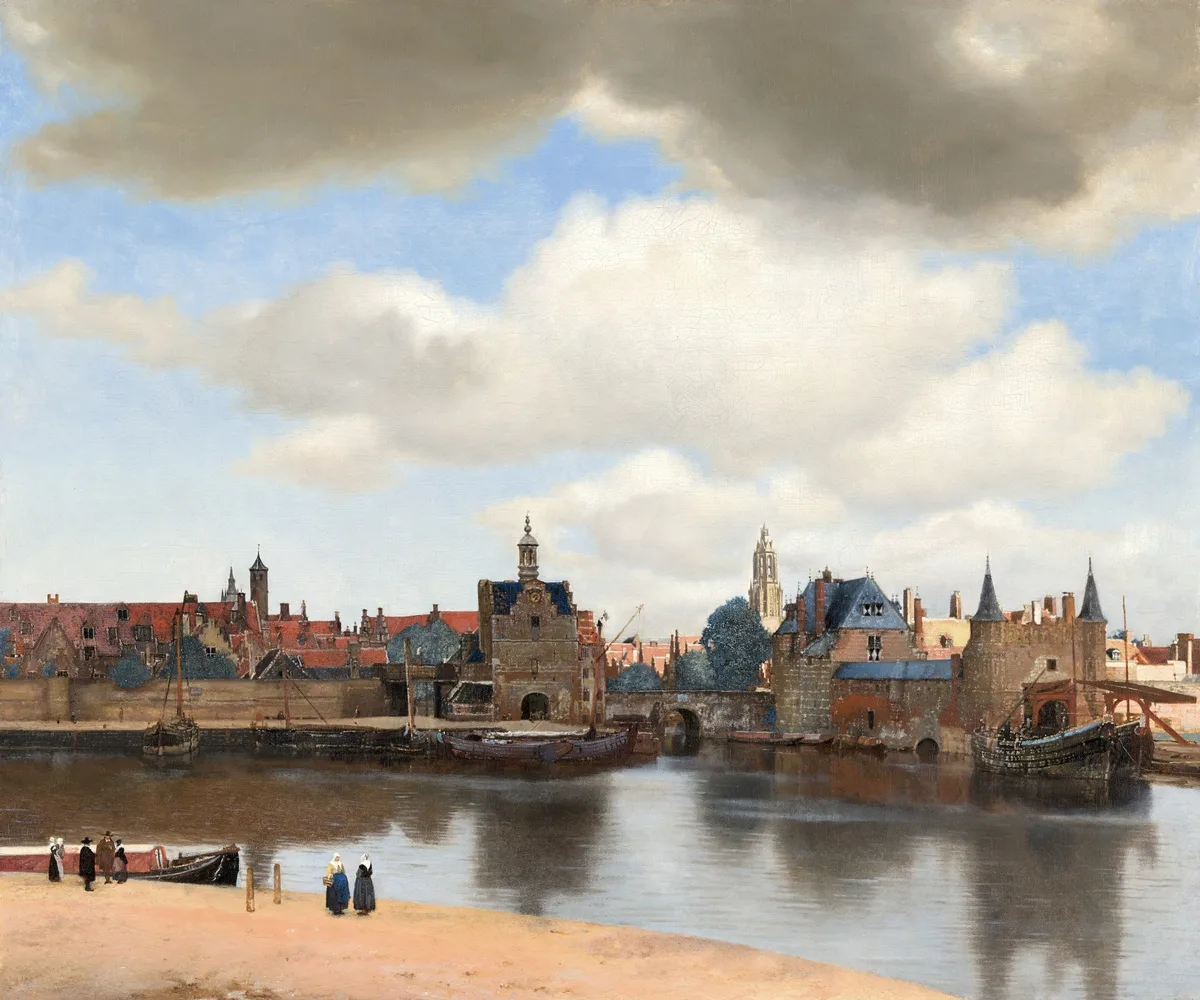
Marcel Proust saw View of Delft in The Hague on 18 October 1902 and called it the most beautiful painting in the world. In May 1921 the painting came to Paris for an exhibition of Dutch art at the Jeu de Paume, and Proust went to see it again. In his novel The Captive the writer Bergotte dies in front of this painting, looking at a little patch of yellow wall.
It was bought for the state on 22 May 1822 in Amsterdam, at the Stinstra sale, for 2,900 guilders, and King William I had it hung in The Hague. It was the first Vermeer in the Mauritshuis. More than a century earlier, in 1696, at the sale of Jacob Dissius's collection, it had fetched 200 guilders, more than any other painting at that sale. Vermeer spent his life in Delft and painted two views of the town, this one and The Little Street.
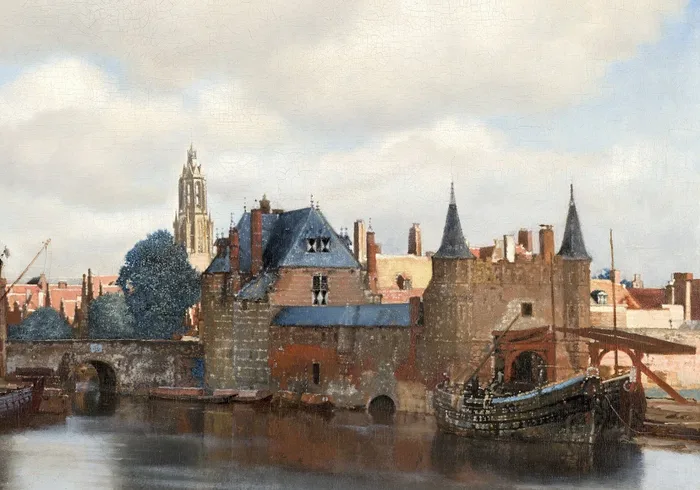
The upper three fifths of the canvas is sky, with a heavy grey-brown cloud along the very top and a band of white clouds beneath it. The town stretches in a narrow strip along the far quay, across the water, and the walls and gates by the water lie in shadow while the roofs behind them catch the sun. Left of centre stands the brick Schiedam Gate with a round gold clock face on its stepped gable, and right of centre the Rotterdam Gate with two pointed turrets and a drawbridge. Behind them rises the pale, sunlit tower of the New Church, and pale sky shows through the openings of its belfry. The old bells were taken down in the spring of 1660, and the new ones, cast by the Amsterdam bell-founders Hemony, were hung between May 1660 and the autumn of 1661, so Vermeer saw the belfry empty. On the hull of the large dark boat on the right, white dots of paint stand out like glints on wet wood.
Scholars disagree about where Proust's little patch of yellow wall is. The spot most often named is a short strip of warm yellow roof in the sun, to the left of the turrets of the Rotterdam Gate.
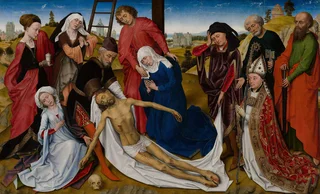
7. Lamentation of Christ — Rogier van der Weyden and workshop, c. 1460–1464
Over two centuries this panel was attributed to Jan van Eyck, to Memling and finally to Rogier van der Weyden. King William I ordered it bought for the Mauritshuis in 1827, still as a Memling, for 3,000 guilders, and it was only in 1847 that the German art historian Gustav Waagen gave it to Rogier, the town painter of Brussels, who had died in 1464. It is the only painting by Rogier in a Dutch museum and the oldest painting in the Mauritshuis.
There are 11 figures, counting Christ, crowded from edge to edge, and the landscape with its bright blue sky shows only above their heads. Christ's body lies diagonally on a white shroud, his head by the fur coat of an old man in a purple cap, his left arm stretched out towards the Virgin. Mary, in dark blue, kneels with her eyes closed and presses her palms to her son's arm, and John, in red, holds her by the shoulders from behind. At the left edge Mary Magdalene, in a black bodice embroidered with pearls, presses a red cloak to her eye. In the lower right corner kneels the patron, a bishop in a white mitre and a red and gold cope, with a gold crozier topped with crystal, and attempts to identify him have named several bishops, among them those of Arras, Tournai and Utrecht. Tears run down the faces of the Magdalene, John, the Virgin and the Mary seated at lower left. Her tear was long hidden under yellowed varnish, and in 1949 the art historian Vogelsang wrote that she was not weeping.
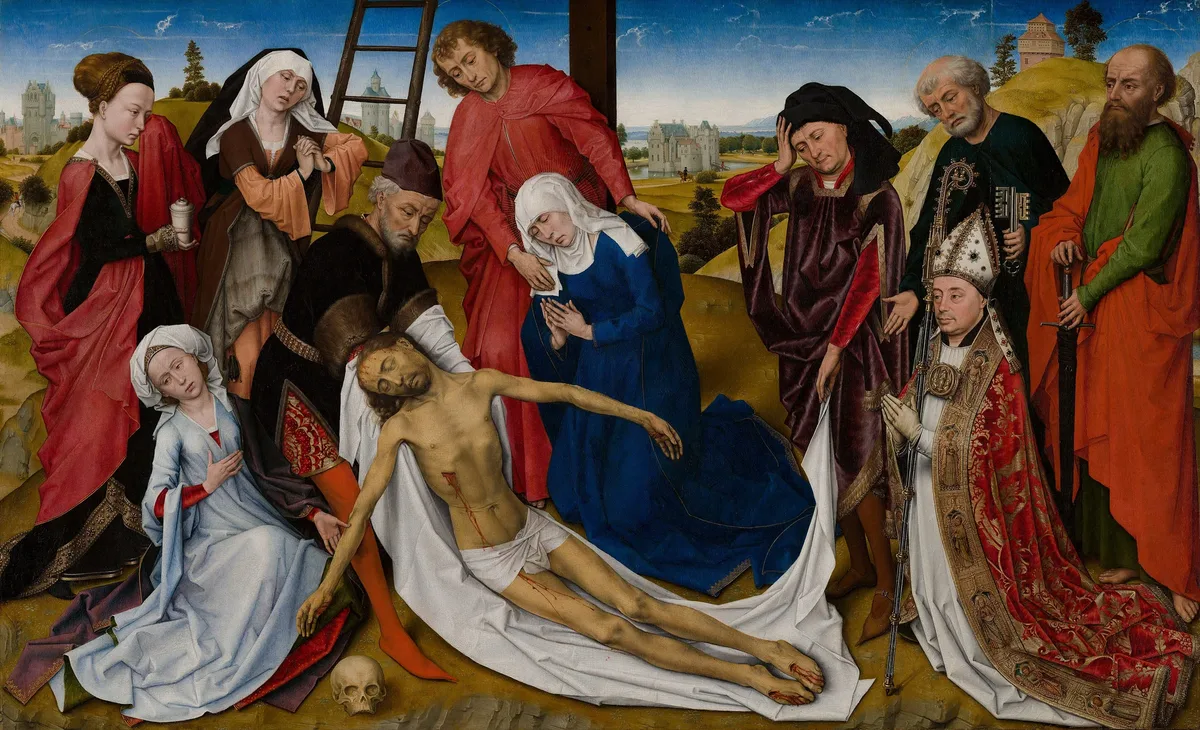
The panel was called a Memling by the Brussels collector Baron Charles-Louis van Keverberg van Kessel, who bought it in 1817 and wrote about it in his book a year later. Before Keverberg it belonged to Joseph Pierre Geedts of Leuven, who took it for a Jan van Eyck, and at the beginning of the 17th century it probably stood in the Atrecht College in Leuven.
In 2009 the painting was lent to a Rogier exhibition in Leuven, and beside his other works its yellow varnish looked poor. The restoration ran from 2016 to 2021, and in the summer of 2018 the varnish was removed in front of visitors, in a studio set up in the gallery itself. Around the heads of John, Peter and the Magdalene thin gold rings of haloes remain, which the conservators consider additions of the 19th century, most likely by the painter Mattheus van Bree, who repaired the painting for Keverberg. Their diameters are exactly nine and a half and ten centimetres, and that is why they are assigned to the 19th century. In a 2025 article the Mauritshuis conservators dated the painting to 1440–1450, the middle of Rogier's life, whereas the museum dates it to the painter's last years.
On the left and on the right, at the same height, the conservators found two burns with soot and drops of wax from the candles that had stood burning on the altar in front of the panel. These burns had been filled and touched up twice, as early as the 16th or 17th century.
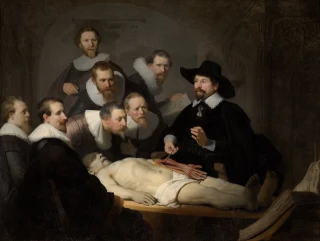
8. The Anatomy Lesson of Dr. Nicolaes Tulp — Rembrandt, 1632
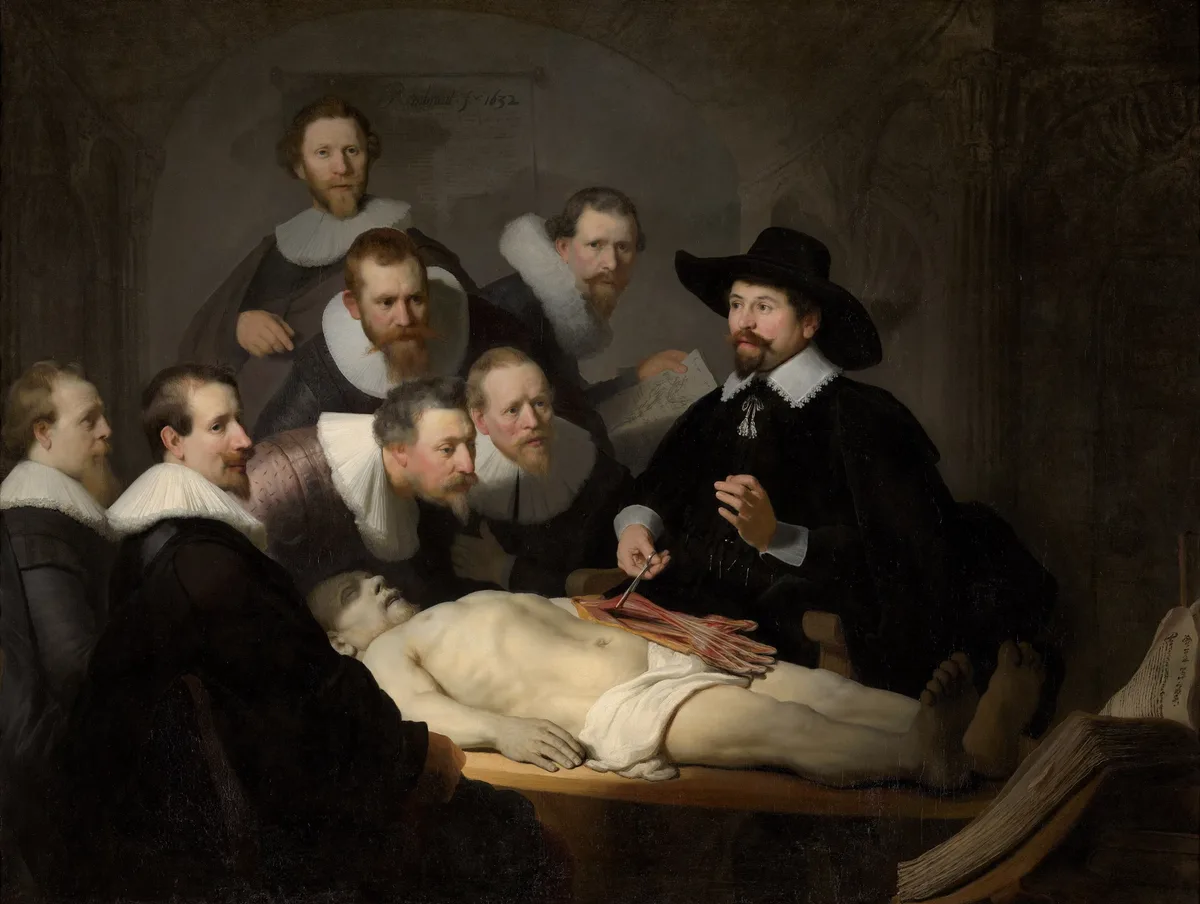
The body on the table is that of Adriaen Adriaensz, known as Aris Kindt, a native of Leiden who was hanged for robbery in January 1632. On 31 January Dr Nicolaes Tulp, praelector of anatomy to the Amsterdam surgeons' guild, carried out his first public dissection on it. Such dissections were held once a year, in winter, on the body of an executed criminal, and spectators paid to get in. Rembrandt was 25 or 26 and had recently moved from his native Leiden to Amsterdam, and this group portrait, his first, made his name in the city.
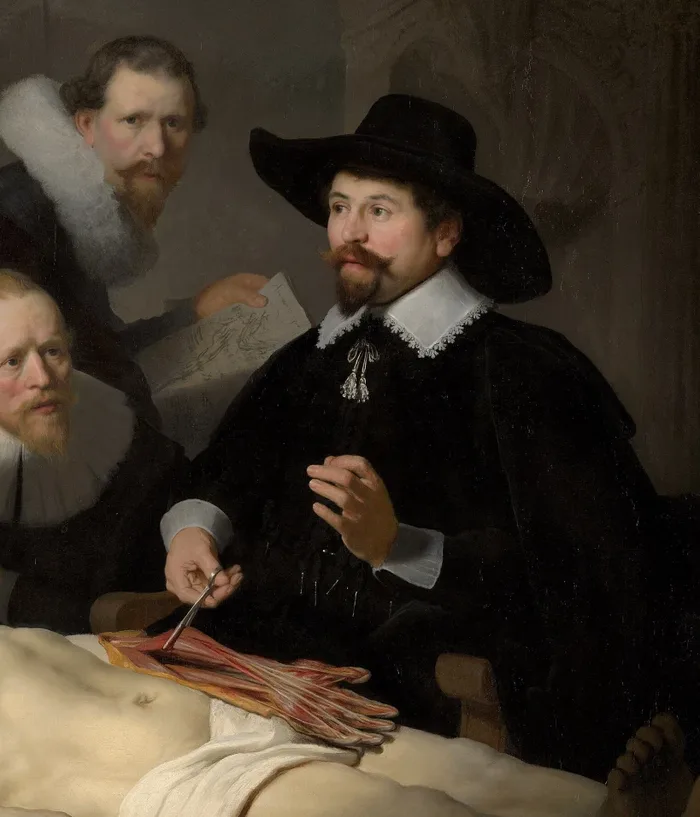
The body lies almost horizontally across the whole lower half of the canvas, pale grey, its face half in shadow. The left forearm has been opened down to the fingers, and Tulp lifts the red muscles with forceps while holding his own left hand by his chest with the fingers bent, as if showing how these muscles bend the fingers. He is the only one in the picture wearing a hat. Seven surgeons in black with white collars stand at the left in a pyramid, two of them bending towards the arm, and the one at the top looks straight at us. An X-ray shows that he too had a hat at first, which Rembrandt painted out, probably because a hat was the praelector's alone. The surgeon behind Tulp's shoulder holds a sheet with a drawing of an arm, over which the names of everyone portrayed were later written, and in the restoration of 1996–1998 this inscription was partly removed. Above, on a sheet of paper on the back wall, is the signature “Rembrant. f: 1632”, still without the d.
A real dissection began with the abdomen, because the internal organs decayed first, and the arms and hands came last. Rembrandt showed an opened arm on a body otherwise untouched, and scholars see this as staged after a woodcut in Vesalius's anatomical treatise of 1543, in which Vesalius himself demonstrates the muscles of the forearm.
The painting belonged to the guild, and from 1798 to the surgeons' widows' fund. When the fund was wound up, the painting was put up for auction on 4 August 1828. By a decree of 19 July King William I stopped the sale, the state bought the painting for 32,000 guilders, and the king sent it to the Mauritshuis. Most of that money was raised by auctioning “surplus” paintings from the Rijksmuseum and the Mauritshuis, and the Rijksmuseum's paintings brought in the most. Its director, Cornelis Apostool, had asked as early as 1817 for the Anatomy Lesson to be given to his museum, because where it hung it was being damaged by smoke from a kitchen.
Connoisseurs beat the market
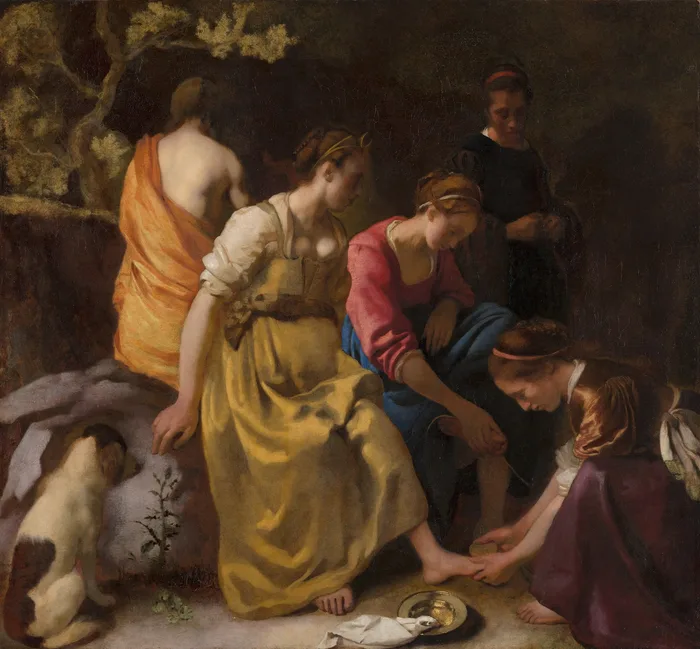
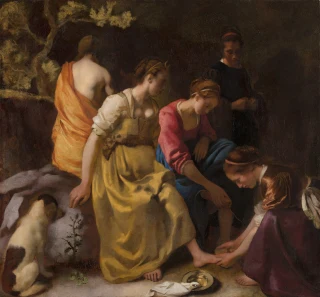
9. Diana and her Nymphs — Johannes Vermeer, c. 1653–1654
Victor de Stuers, adviser on the arts at the Ministry of the Interior, bought this painting for the state on 4 May 1876 in Paris, at the sale of Neville Goldsmid's collection, as a work by the Dutch painter Nicolaes Maes, and paid 10,000 francs for it. The director of the Mauritshuis, J. K. J. de Jonge, objected that this was too expensive. In 1885 the painting was restored, and De Stuers looked closely at the signature “NMaes”. He saw that the letters NM had been made over from the remains of another signature, and beneath them he read “J VMeer”, a reading that was later confirmed.
In 1876 Vermeer had only just been rediscovered, after the French critic Théophile Thoré-Bürger published his articles in 1866, and he was known for his interiors and views of the town. By all appearances he started out as a history painter, and Diana is possibly the earliest of his surviving paintings, made around the time he was admitted to the Delft guild at the end of 1653. Bredius, director of the Mauritshuis from 1889, gave it in 1892 to a different Vermeer, the little-known Johannes van der Meer of Utrecht.
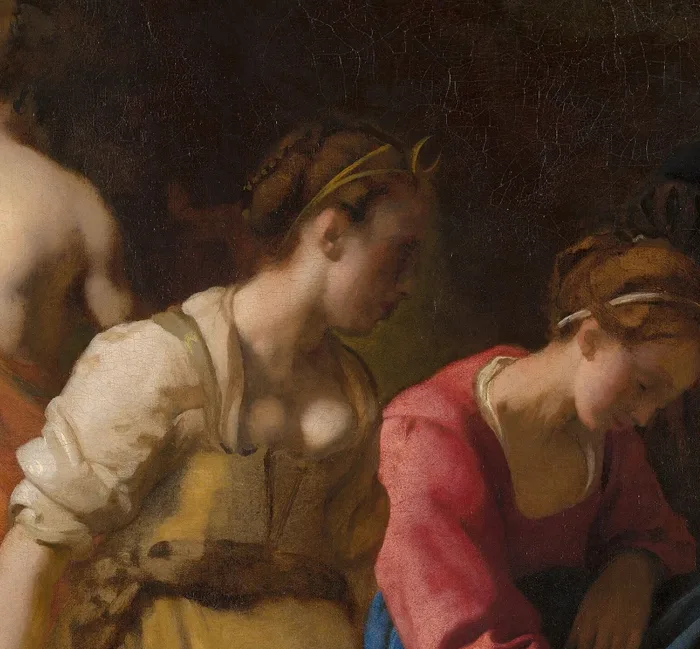
Diana sits on a rock in a golden-yellow dress, her eyes lowered and her face half in shadow. She can be recognised as the goddess by the small gold crescent on the thin band in her hair and by the white dog with brown patches. A nymph in a copper-brown satin bodice kneels and washes her foot with a yellow sponge, and the right edge of the canvas cuts across her back, because a strip of the canvas was cut away on the right at some point. Behind stands a woman in black with her head bowed, and a prickly thistle sticks up beside the dog. Rijksmuseum researchers scanning the canvas found that Vermeer first painted a quiver of arrows on the rock beside Diana and then painted it out.
Old reproductions show a blue, cloudy sky in the upper right corner. The restoration of 1999–2000 found that it had been painted in the 19th century with Prussian blue, invented in 1704, and chrome green, which came into use around 1840. The paint beneath this sky proved too fragile for it to be taken off, so the conservators covered it with a thin dark layer matching the trees, and the museum stresses that this layer can be removed.
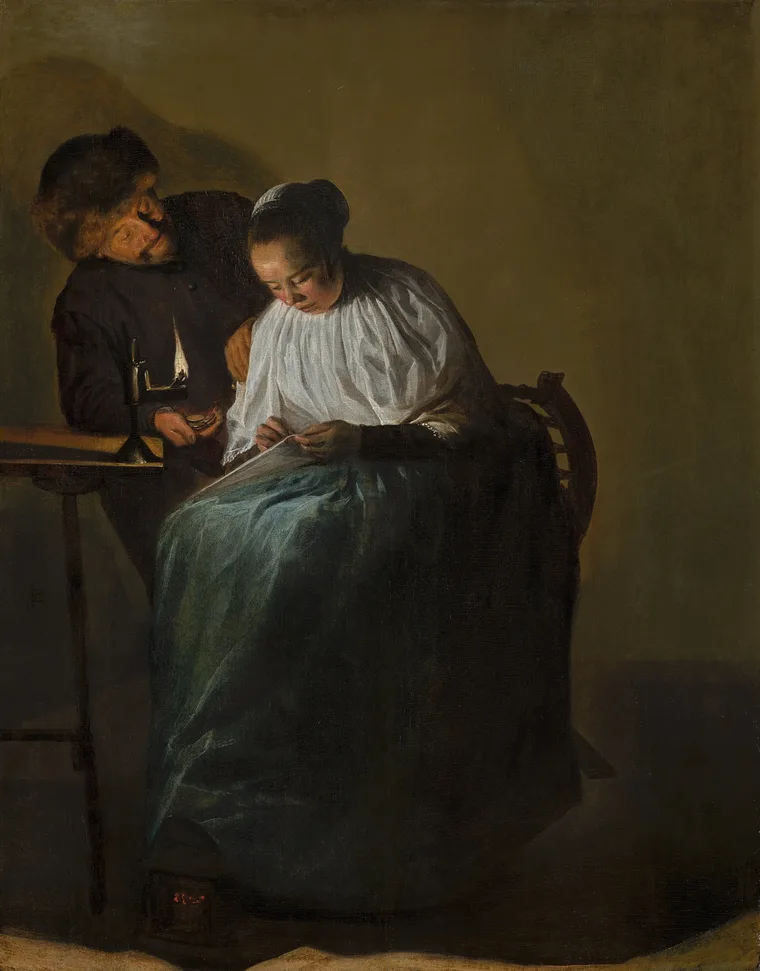
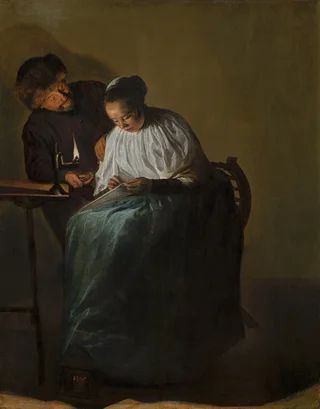
10. A Young Woman Being Harassed by a Man — Judith Leyster, 1631
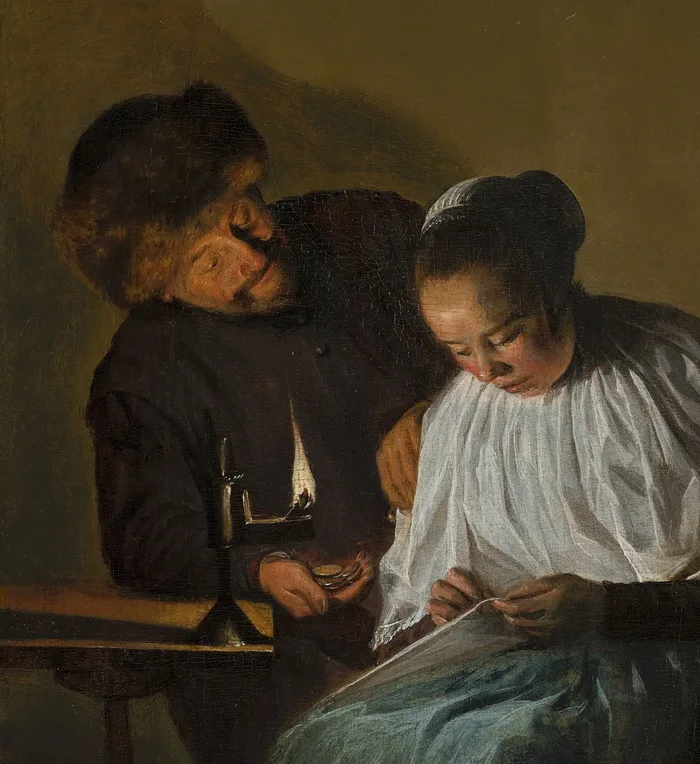
A young woman sits over her sewing with her eyes lowered, holding white cloth and a needle in her lap. A man in a shaggy fur cap leans over her from behind, smiling with his eyes half closed. He has put one hand on her shoulder, and on the palm of the other he holds out a few gold coins. A small oil lamp burns on a tall stand, its flame standing out brightly against his dark coat, and the light lies in long folds across her wide blue-green skirt. By her hem stands a foot warmer, with red coals glowing through its holes. Infrared shows that Leyster first placed the man's hand almost on the woman's neck and then moved it lower.
For a long time the painting was called The Proposition or Man Offering Money to a Young Woman. In 1975 the scholar Frima Fox Hofrichter was the first to write about it as a sympathetic picture of a woman being harassed, and she saw it as the artist's answer to the familiar scenes in which a woman willingly takes the money. The historian Wayne Franits saw honest courtship in it, the museum explained the painting as an example of female virtue, and later the Mauritshuis gave it a new title.
In 1892 Abraham Bredius bought this panel for the Mauritshuis for 1,500 guilders, and it was entered in the inventory book as “Dutch school, around 1660”. A year later the deputy director, Cornelis Hofstede de Groot, found on it a monogram, the letters J and L intertwined with a star, and the date 1631. The monogram is at the left edge, halfway up, to the left of the table leg. The star was Judith Leyster's play on her surname, which in Dutch sounds almost like the word for a lodestar. She worked in Haarlem alongside Frans Hals, was about 22 in 1631, and after her marriage in 1636 painted less and less.
In that same year, 1893, a case came before the Queen's Bench in London over a painting sold as a work by Frans Hals, and the dispute turned on the same star monogram. The parties settled the same day, and Leyster's name was never spoken in court. Hofstede de Groot gave her name back to both paintings, and on 1 July 1893 the London journal The Athenaeum printed his letter about her. The London picture is now known as Leyster's The Carousing Couple.
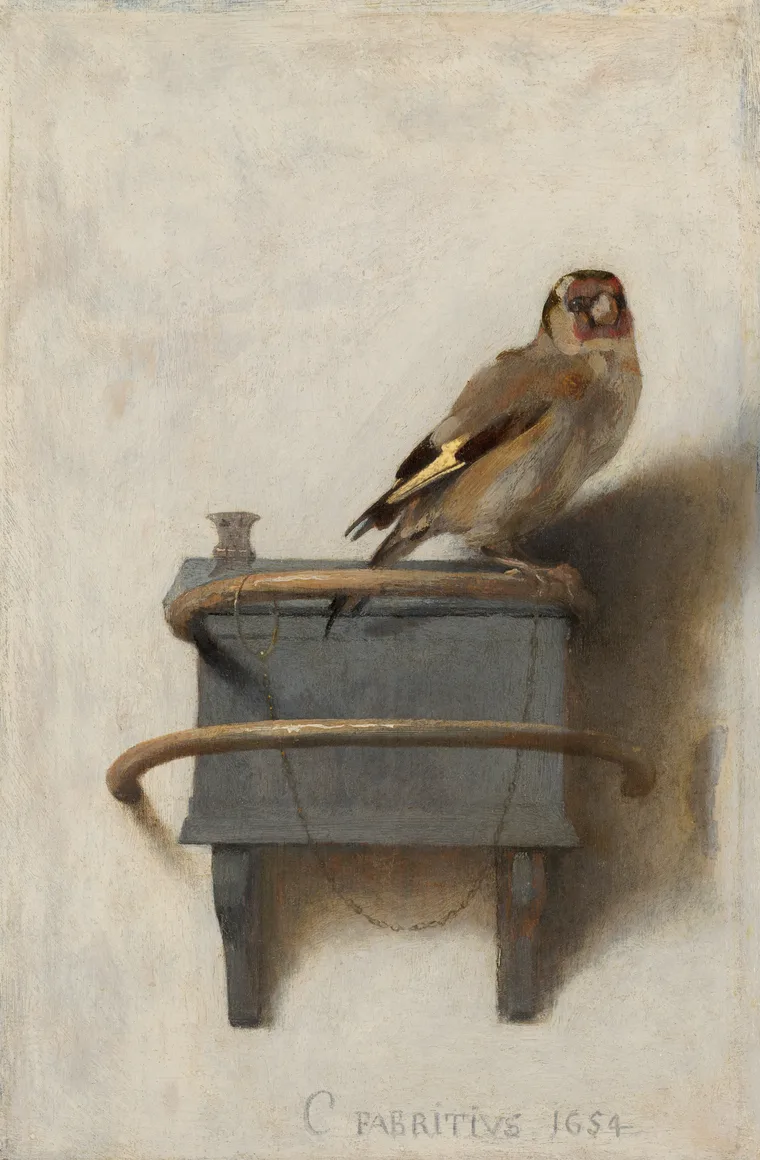
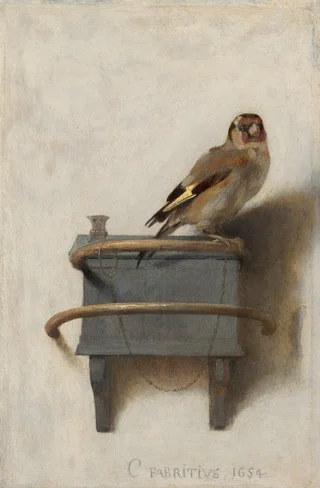
11. The Goldfinch — Carel Fabritius, 1654
The gunpowder magazine in Delft blew up on 12 October 1654, and Carel Fabritius, who was 32, was killed in his house. He had studied with Rembrandt in Amsterdam in the early 1640s and moved to Delft around 1650, and about a dozen of his paintings survive. The Goldfinch is signed with that same year, 1654. Small dents without cracks are scattered over the whole painted surface of the panel, as if something had struck it while the paint was still soft, and the museum considers it likely that they were left by debris from that explosion.
The goldfinch, life-size, perches on the upper of two wooden half-hoops nailed to a pale plastered wall above a grey feeding box. His back and folded wing are turned to us, and he looks back over his shoulder straight at the viewer, with a red mask around his beak and a white cheek. Fabritius laid the yellow bar on the black wing in thick paint and scratched into it with the end of his brush handle before it dried. Below the feeder hangs a loop of the chain on which pet birds were kept. The light comes from the left, a soft brown shadow falls on the wall to the right, and below the feeder, in thin grey capitals, as if in pencil, is written “C FABRITIVS 1654”.
In 2003 the panel was examined in a CT scanner, because lead white blocks ordinary X-rays. It turned out that Fabritius had first painted the bird against a dark background, and that a gilded frame had been fixed to the panel with ten nails. Later the frame was taken off, the background was repainted as a pale wall, and the lower perch was added. Scholars disagree about what the panel was made for, and it has been taken for the door of a small cupboard or of a case for another painting, for part of a window frame, and for a sign.
After 1654 the painting vanishes from the records for almost 200 years. By 1859 it was with a Brussels collector, and there it was seen by Théophile Thoré-Bürger, the same critic who rediscovered Vermeer (no. 9). In 1865 the collector's heirs gave it to Thoré. After his death it was sold at auction in 1892, and later it came to the Paris collector Émile Martinet. At the sale of his collection at the Hôtel Drouot in Paris on 27 February 1896, Bredius bought it for the Mauritshuis for 6,200 francs. In the museum's account, he sent someone else to do the bidding so that the price would not go up.
In 2012–2014, while the Mauritshuis was being rebuilt, The Goldfinch was taken to Tokyo, San Francisco, Atlanta and New York, where people queued around the block to see it at the Frick Collection. In October 2013, while the painting was in New York, Donna Tartt's novel The Goldfinch came out with the picture on its cover, and in 2014 the novel won the Pulitzer Prize.
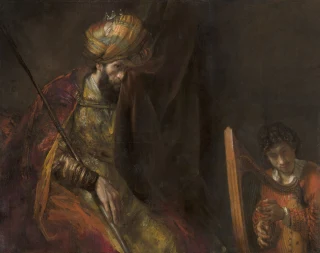
12. Saul and David — Rembrandt, c. 1651–1658
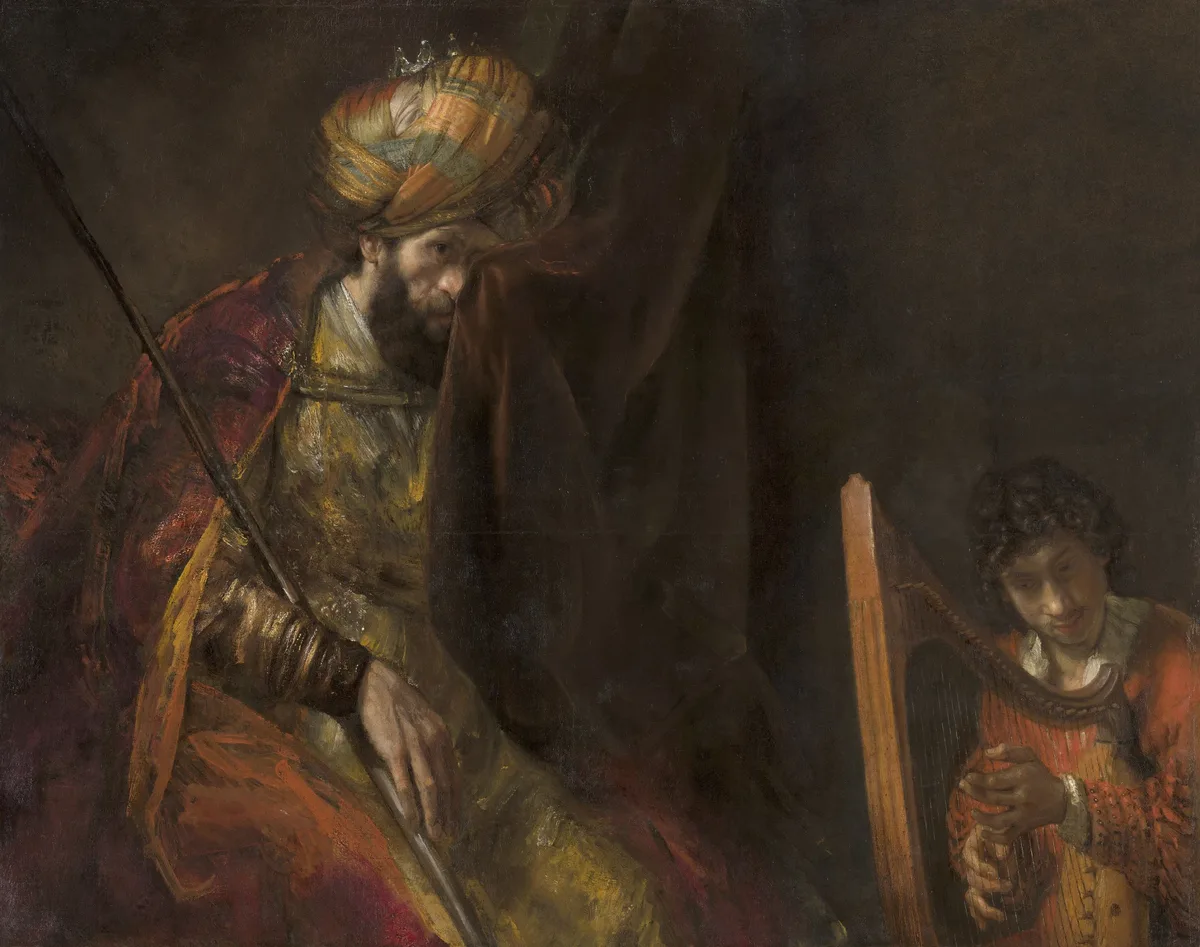
Abraham Bredius considered Saul and David one of Rembrandt's greatest and most personal biblical paintings. Over two decades after Bredius's death, in 1969, another of the foremost Rembrandt scholars, Horst Gerson, brought out a revised edition of Bredius's catalogue of Rembrandt's paintings and struck this painting out of it. He wrote that the enthusiasm for it owed more to a taste for biblical painting than to its quality, and he singled out for criticism the empty curtain between the figures. Bredius had bought it with his own money in 1898, after the Rembrandt exhibition in Amsterdam, and deposited it with the Mauritshuis, of which he was then director. Some of the folds of that same curtain had been repainted in 1899–1900 by the Berlin restorer Alois Hauser, whom Bredius trusted more than anyone else.
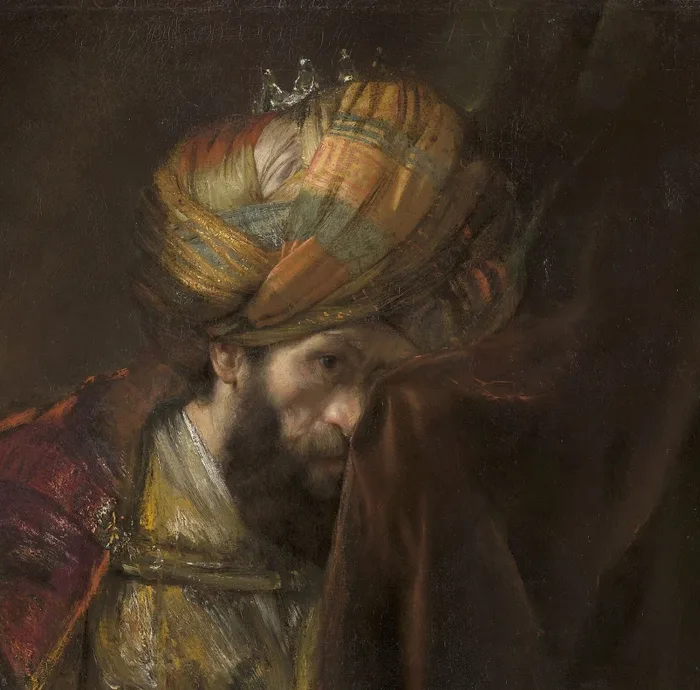
According to the First Book of Samuel, the young David played the harp before King Saul to drive away the evil spirit that tormented the king, and once, in a fit of jealousy, Saul hurled a spear at him. Painters usually showed the throw itself, while Rembrandt chose the moment before it, when Saul is still listening. The king sits on the left in a huge striped turban of orange-gold, pink and blue-green, and on top of the turban sits a small silver crown that is easy to miss. A fold of the dark red curtain is pressed to one of his eyes, with the other he looks at us, and his right hand hangs loosely over the shaft of a spear. In the museum's description it is as if Saul, in his grief, had seized the first thing within reach. At lower right is David, of whom only the head, shoulders and hands are visible. He has lowered his eyes to the strings and plays with a faint smile, and above him lies an almost empty dark background.
From 2007 to 2015 the painting was studied and restored at the Mauritshuis. The research showed that at some point between 1830 and 1869 the canvas had been cut between Saul and David and joined again with a jagged seam, and a strip was lost in the process. A piece of another canvas had been inserted above David, an early copy of Van Dyck's portrait of the Archduchess Isabella turned upside down, and narrow strips had been sewn on along the edges. Altogether the painting is assembled from 15 pieces. The conservator Carol Pottasch said of Gerson that he could not see Rembrandt's painting because the later overpaint hid it. In 2015 the museum announced that Saul and David was painted by Rembrandt in two campaigns, around 1651–1654 and around 1655–1658, although other scholars' datings range from 1646 to 1660.
The paintings of the Mauritshuis belong to the state, and since 1995 the museum has managed them as an independent foundation. In 1946 Bredius left 25 paintings to the museum in his will, this one among them, and the will, written in French, says that they must remain on display exclusively in that museum. He did not allow them to be lent to temporary exhibitions either. The heirs of Joseph Kronig, Bredius's sole heir, sued the state, arguing that the paintings had to hang permanently, although about 20 of the 25 were not on show. On 10 June 2026 the District Court of The Hague ruled that there is no unconditional duty to show them and that the state does not have to return them, and Saul and David became one of the 25 paintings that the court allowed the state to keep. The heirs announced that they would appeal.
Private collectors decide for the nation
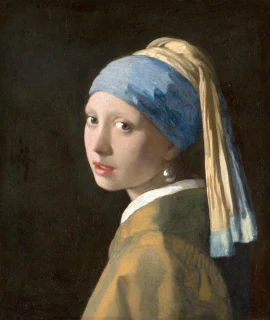
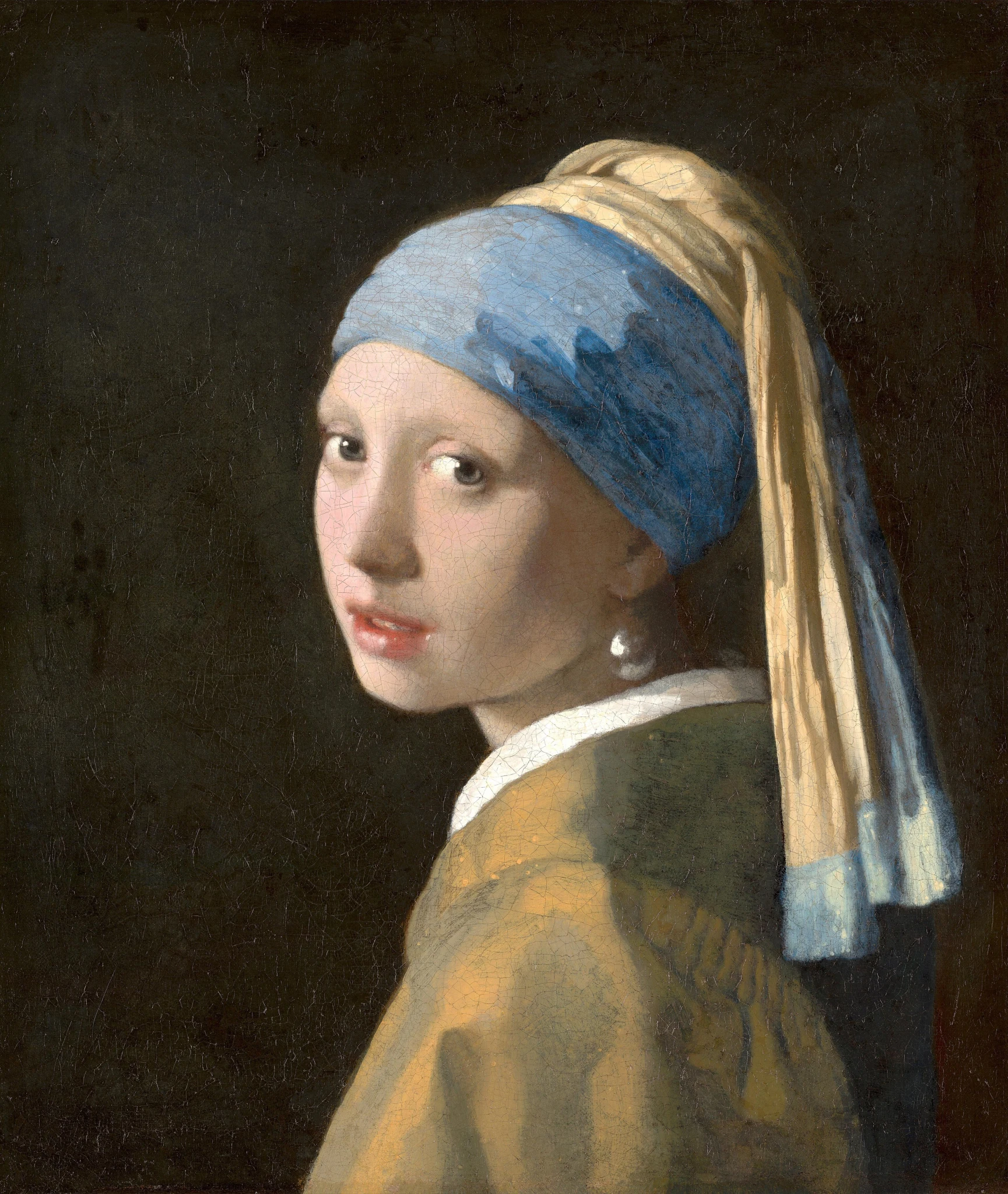
13. Girl with a Pearl Earring — Johannes Vermeer, c. 1665
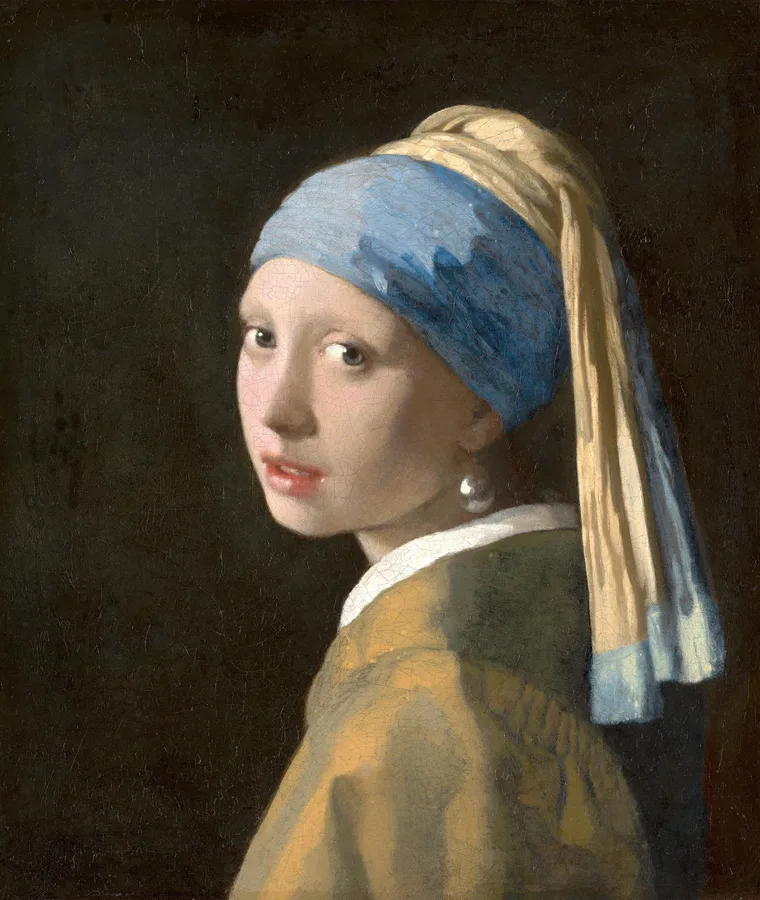
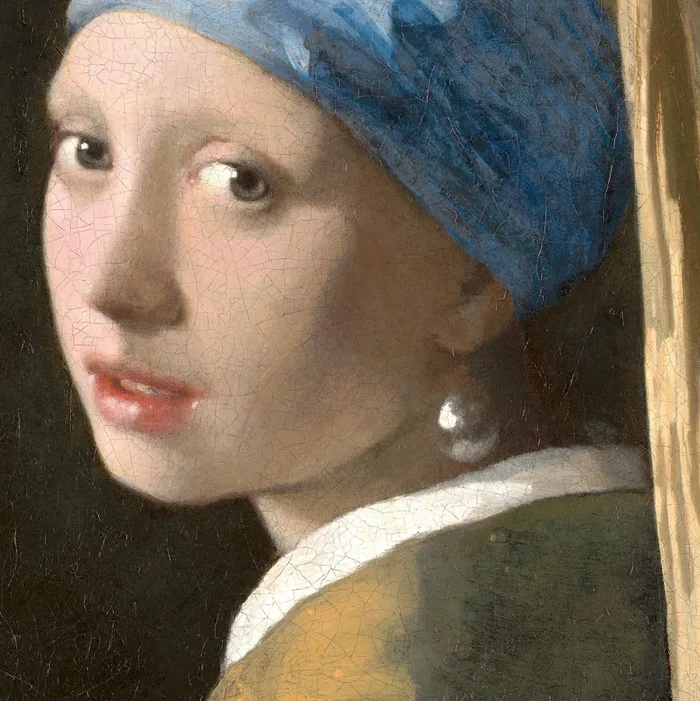
For two guilders plus a premium of 30 cents, the retired army officer, genealogist and collector Arnoldus Andries des Tombe bought a dirty, neglected painting of a girl's head in a turban at an auction in The Hague in 1881. He sent it to Antwerp, where it was cleaned and relined. Des Tombe died in The Hague on 16 December 1902, leaving no heirs, and it turned out that he had made a secret will under which 12 of his paintings, the Vermeer among them, went to the Mauritshuis.
Vermeer painted it in the mid-1660s, in his most productive years. The museum calls it a tronie, the word used at the time for a head of a particular type in unusual costume, painted without a commission, and considers that there was most likely no specific model. On a head of this kind Vermeer spent ultramarine, the most expensive blue paint, made from lapis lazuli mined in north-eastern Afghanistan.
The girl has turned to us over her left shoulder, her lips parted, a highlight in each eye. A blue band is wound around her head, from its top a yellow cloth falls down her back, and she wears a yellow jacket and a thick white collar. The pearl hangs below her ear in the shadow of her neck and is painted with two touches of the brush, a bright highlight at upper left and a soft grey-white reflection below, where the collar is mirrored in it. In 2018 researchers found no hook or loop by which it could have hung. In the caption to the painting the museum calls the pearl implausibly large.
That year, 2018, the painting was examined for two weeks in the gallery itself, in front of visitors, and under the microscope tiny brown eyelashes were found around the eyes, invisible to the naked eye. The flat, almost black background behind the girl was once a dark green curtain with diagonal folds, but over time the green paint changed and darkened.
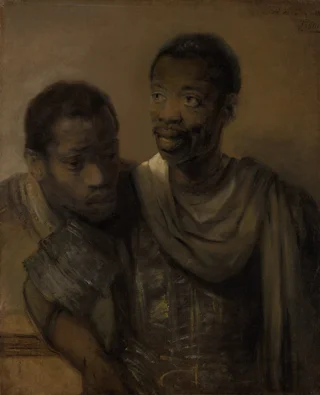
14. Two African men — Rembrandt, 1661
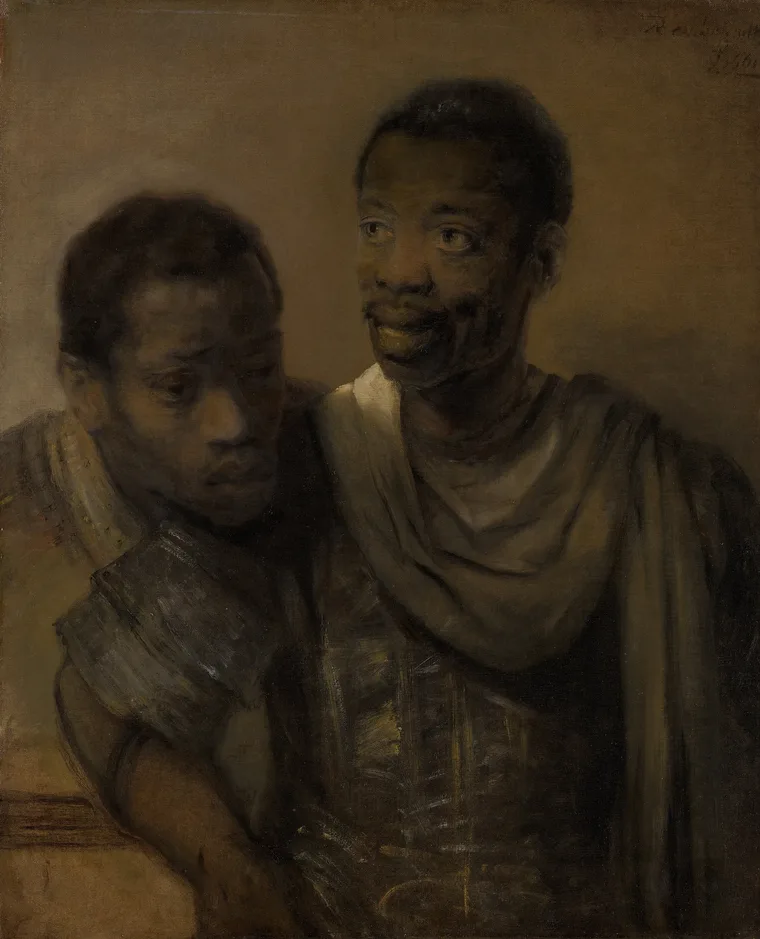
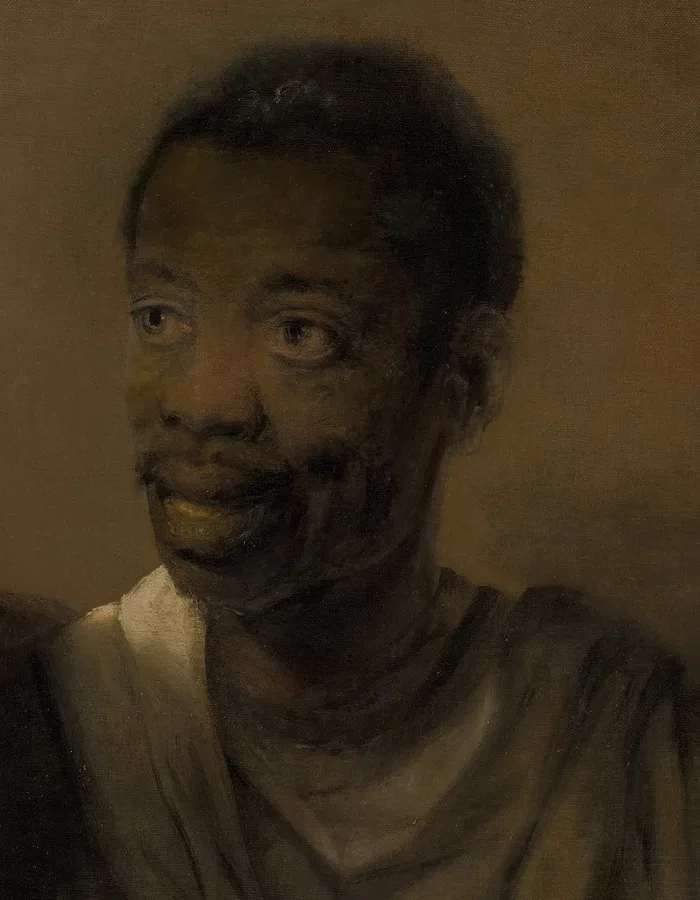
In 1656, when the artist's possessions were inventoried for his debts, the list of paintings in his large studio included two Moors in one picture by Rembrandt. The Mauritshuis painting is signed and dated 1661. The historian Mark Ponte, who has studied the Black Amsterdammers of the 17th century, thinks it possible that this is the same painting, begun by 1656 and finished later, although the inventory may have meant another one, since lost. In records of marriages, baptisms and burials Ponte found about 100 Black residents of the city, and many of them lived in the neighbourhood around Rembrandt's house on the Jodenbreestraat. He has suggested possible names for the models, the brothers Manuel and Bastiaen Fernando from the island of São Tomé, who lived not far from Rembrandt, and he himself stresses that this is only a hypothesis. The Mauritshuis keeps to a more cautious conclusion, that the men are probably free Black residents of Amsterdam.
The man on the right, the taller of the two, holds himself upright, has turned his head to the left and is laughing, showing his teeth, his wide-open eyes glancing sideways. A pale grey-white cloth is thrown over his shoulder, and where it touches his neck is the lightest spot in the painting. In the inner corner of his eye Rembrandt put a tiny orange-red stroke, which the museum says is the only fleck of red in the whole painting. The man on the left has lowered his head and his eyes, his lips closed, his face in soft half-shadow. The paint of the background is so thin that the weave of the canvas shows through, and the lower third is only sketched in with quick strokes. Rembrandt placed his signature and the date in the upper right corner.
Bredius bought the painting in 1902 or 1903 from a London dealer and from 1903 kept it in the Mauritshuis, which he ran, as his own property, lent to the museum. In 1946 it passed to the museum under his will, and it is one of the 25 paintings over which the heirs took the state to court (no. 12). For a long time it was called Two Moors, and later the museum gave it its present title. In 2020 the Rembrandt House Museum in Amsterdam devoted an exhibition to the Black Amsterdammers of Rembrandt's time, and this painting stood at the centre of its conception and its catalogue.
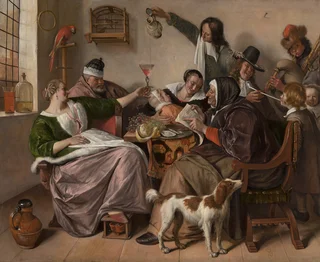
15. ‘As the Old Sing, So Pipe the Young’ — Jan Steen, c. 1668–1670
Until 1912 the Steengracht collection hung in The Hague, in a house on the Lange Vijverberg, a few steps from the Mauritshuis. The last owner directed in his will that it be sold so that the money could be shared among relatives, and on 9 June 1913 the collection went under the hammer in Paris, at the Galerie Georges Petit. Two Hague members of the board of the Rembrandt Association raised the alarm, the association launched its first large public fundraising campaign for the Mauritshuis, the state agreed to add its own share, and for 375,000 francs this painting by Jan Steen was kept in the country. Along with it the museum bought five more paintings at that sale, while Rembrandt's Bathsheba from the same collection went through the dealer Duveen to the New York collector Benjamin Altman, and the same year it ended up in the Metropolitan Museum.
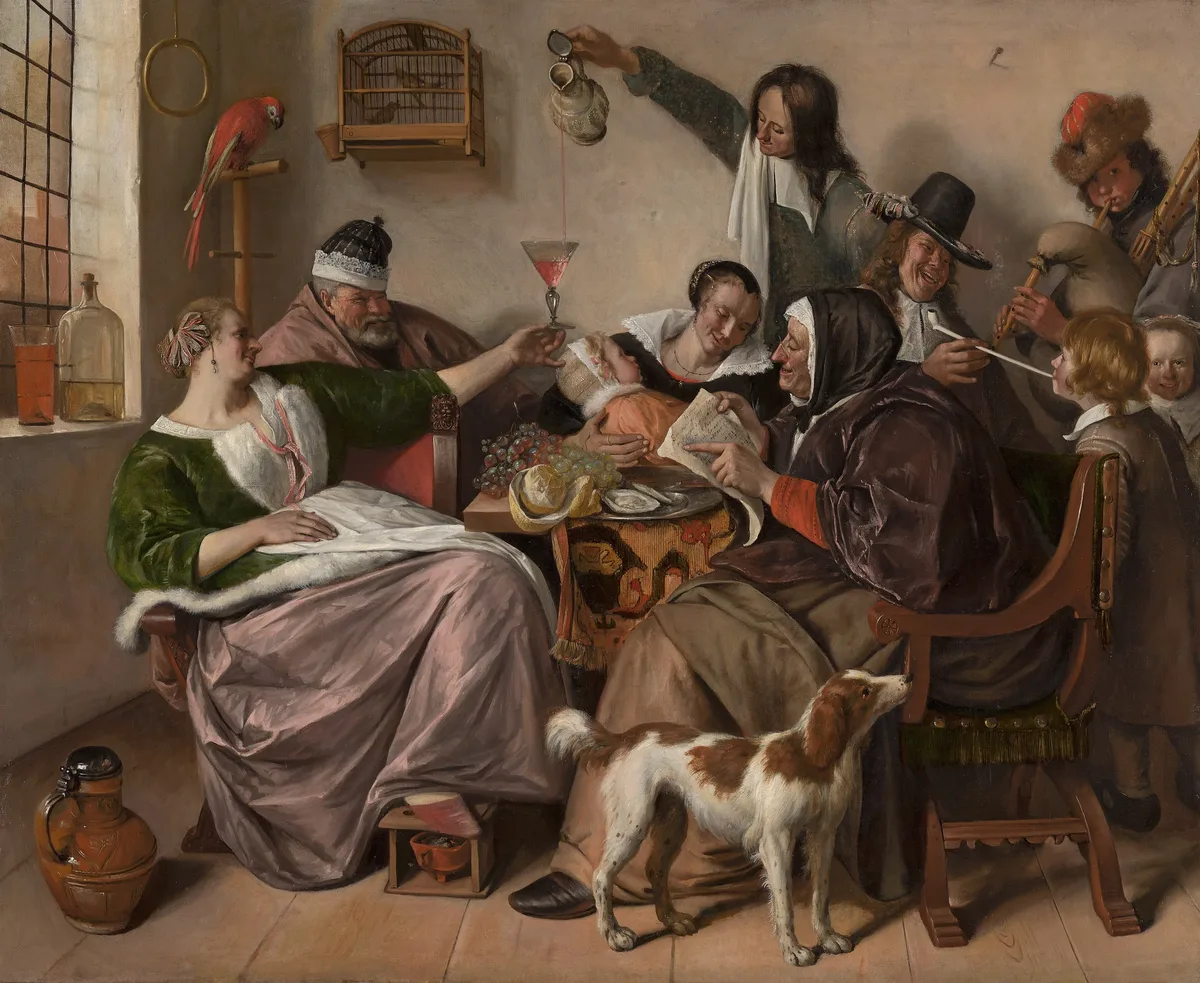
The collection had been started by Johan Steengracht van Oostkapelle, the first director of the Mauritshuis. He bought this Steen for himself in 1816 at the sale of Baroness van Leyden's collection at Warmond Castle for 1,260 guilders, and for almost a century it stayed with his descendants.
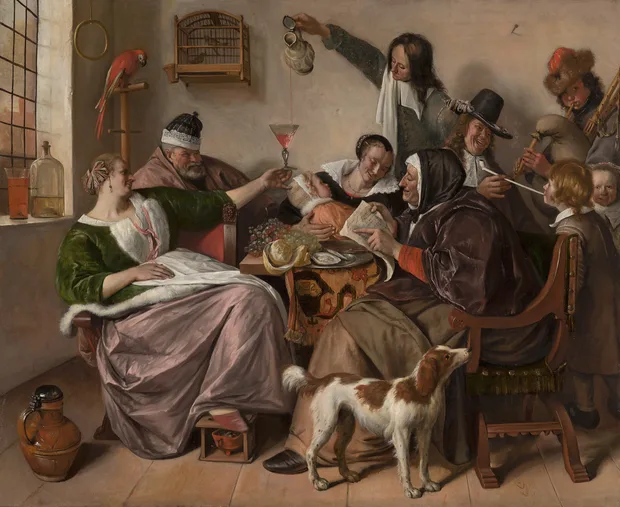
Jan Steen, a native of Leiden, painted this proverb, about children taking up the bad example of their elders, more than once, and he nearly always put himself into such scenes. Here he is on the right, the laughing man in a tall black hat with a pink and white ribbon, and he himself is holding a long clay pipe to the mouth of a curly-haired, reddish-blond boy. At the table a grandmother in a black hood, spectacles on her nose, sings from a sheet, following the lines with her finger, and on the sheet the beginning of the proverb can be read, “Soo voer g'songen soo na gepepen”, with a few bars of music. On the left a woman in a green velvet jacket trimmed with white fur and in lilac-pink satin holds up a tall glass, and a youth with a napkin over his shoulder pours a thin red stream into it from above. At the top a teenager in a fur cap blows a bagpipe, a red parrot sits on a perch by the window, and on the table lie grapes, a cut lemon and oysters on a pewter dish.
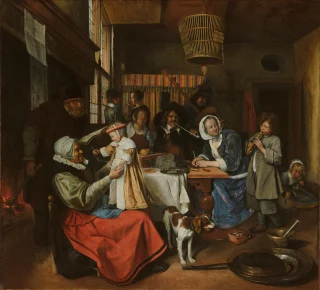
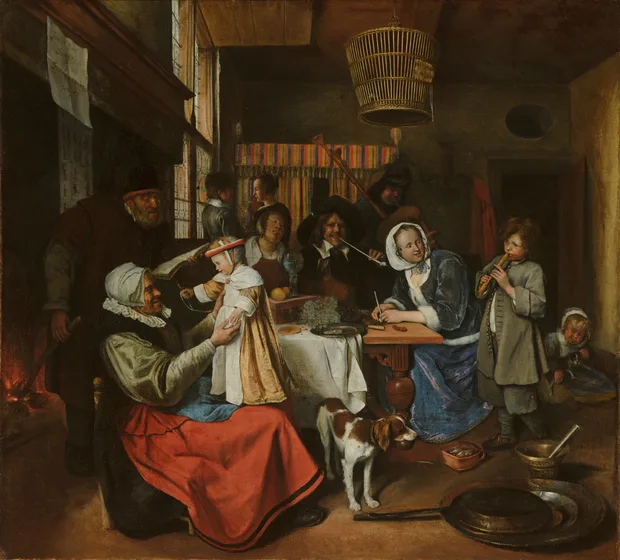
The Mauritshuis has another painting by Steen with the same title, smaller, painted a few years earlier and composed differently. It belonged to William V, in 1795 the French took it to Paris along with the rest of his collection, and in 1815 it came back.
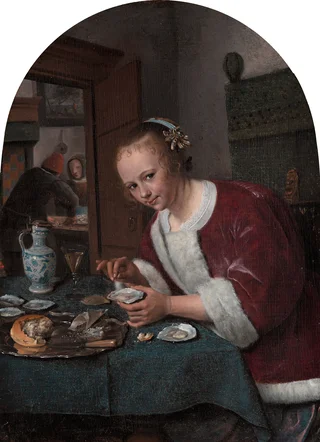
16. Girl eating oysters — Jan Steen, c. 1658–1660
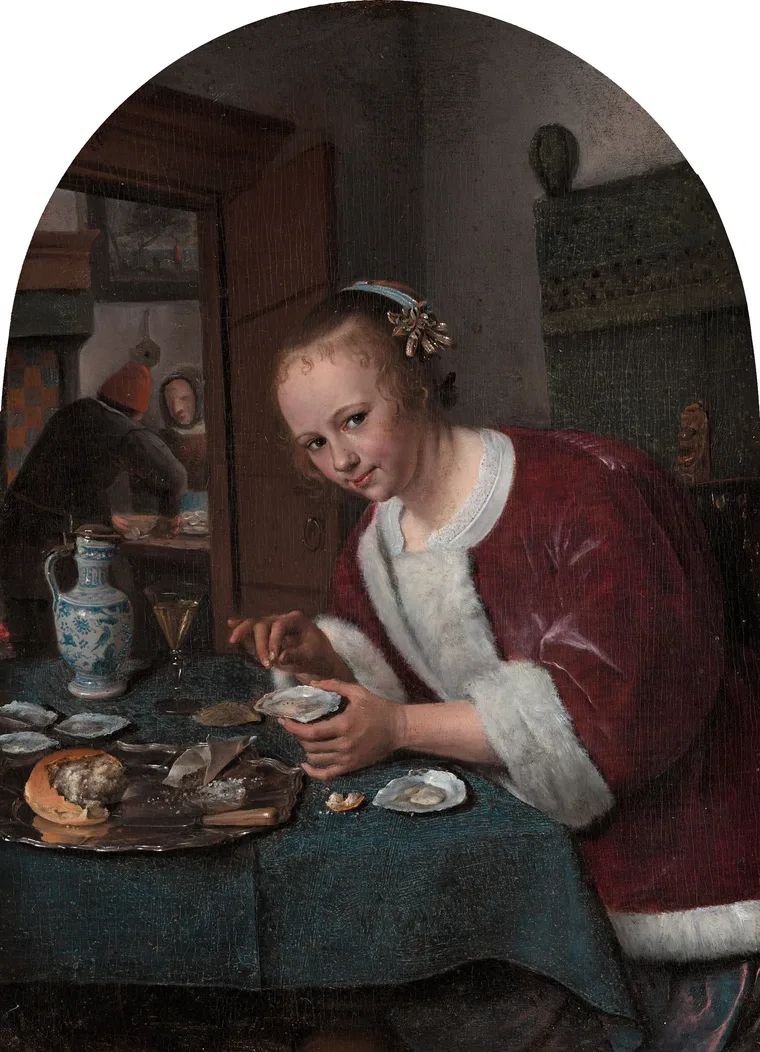
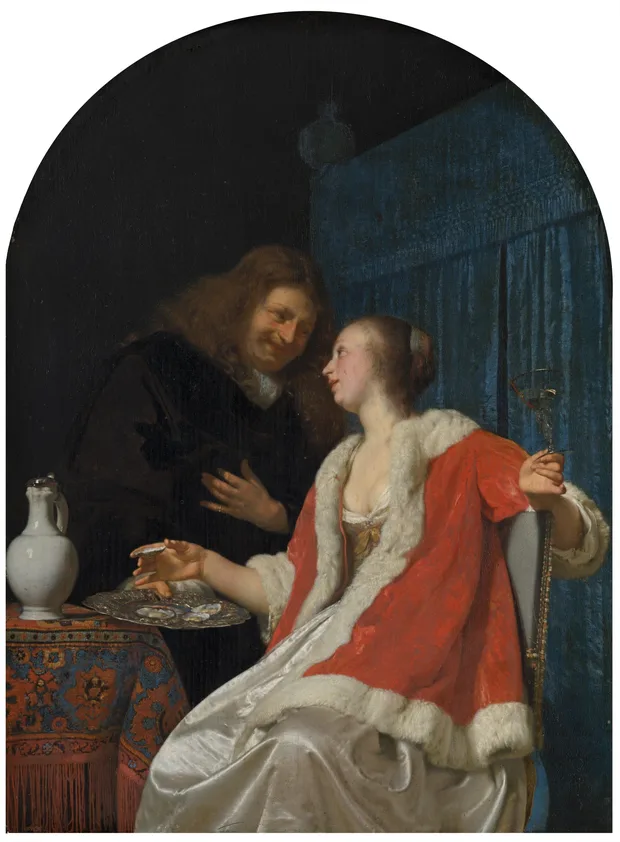
The panel, rounded at the top, is only a little larger than a postcard, and the museum stresses that it was painted to be looked at up close. A girl in a red velvet jacket with a broad trim of white fur leans over the table, looks at us with a crooked smile and sprinkles something onto an open oyster that she holds in her left hand. On the tray beside her are a broken roll, a paper twist of dark grains, a little heap of salt and a knife, and on the table stand a Delft jug painted with birds and a glass of pale wine. Behind her hangs the green curtain of a bed, and in the doorway of the back room a man in a red cap is opening more oysters, watched by a woman in a white hood. For 17th-century viewers, oysters with salt, wine and a bed added up to an amorous proposal.
Painting this fine and smooth was the manner of the Leiden masters, Gerrit Dou (no. 3) and his pupil Frans van Mieris the Elder, and Steen, who usually painted crowded, noisy scenes, here matched his brushwork to the small size.
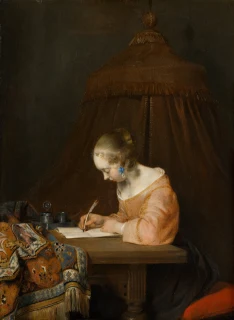
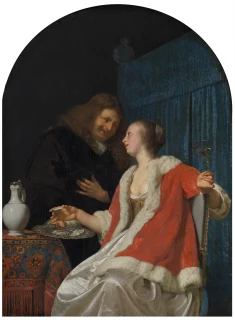
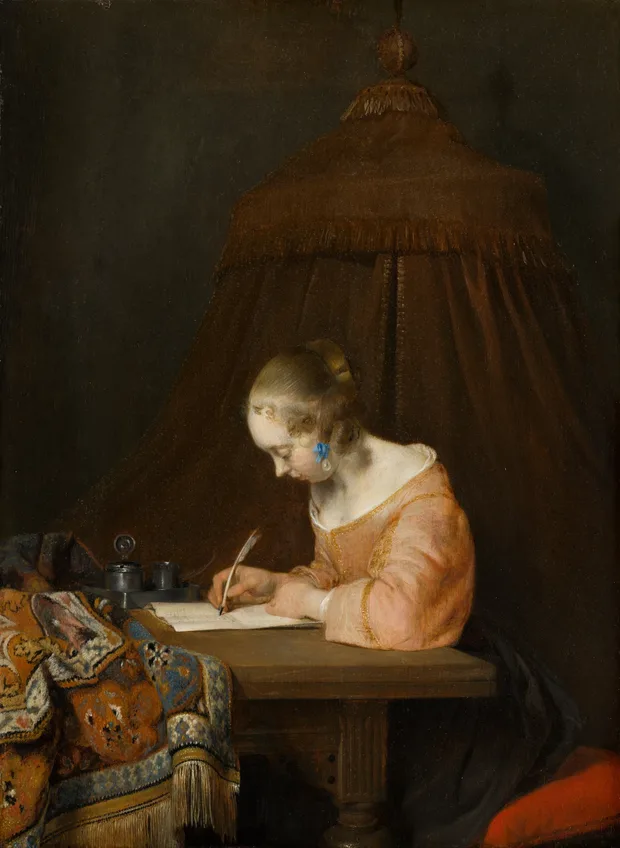
Henri Deterding, who ran the Royal Dutch company from 1900 and then headed Royal Dutch Shell, gave famous paintings to the Dutch state when he retired in 1936. The Mauritshuis received five of them, this panel by Jan Steen among them. Deterding had bought it in 1928 at the sale of the Six family collection in Amsterdam for 190,000 guilders, and at the same sale he paid 319,000 guilders for Gerard ter Borch's Woman Writing a Letter, which also went to the Mauritshuis as part of the gift. The same gift included Frans van Mieris's The Oyster Meal, of 1661.
In the last years of his life Deterding admired Hitler's Germany and paid for propaganda urging friendship with it, including the weekly De Waag. He died in St Moritz in February 1939, before the war began.
After the war the state, foundations and lotteries pay
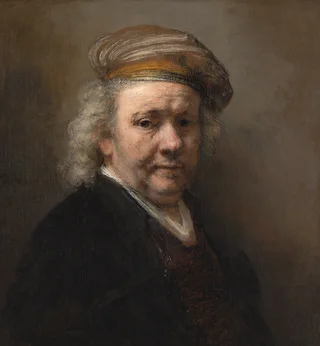
17. Self-portrait — Rembrandt, 1669
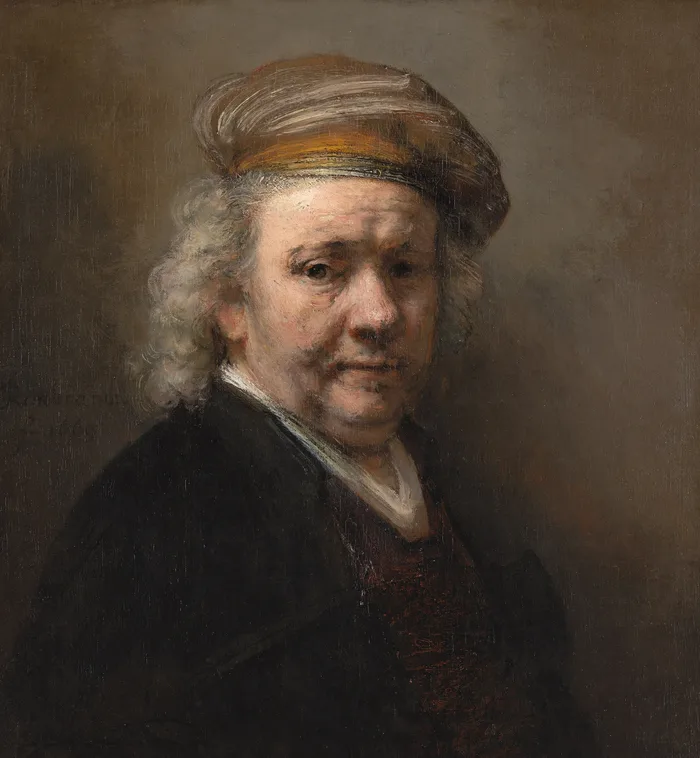
A special flight carrying 26 paintings landed at Schiphol on 8 October 1945, the first official return of art taken out of the Netherlands. This self-portrait by Rembrandt was among them. It had belonged to the Berlin collector Marcus Kappel, who first promised it to the Kaiser-Friedrich-Museum in Berlin and then, short of money, changed his mind, and by inheritance it passed to his grandchildren Ernest and Ellen Rathenau, of a German Jewish family. In 1925 the Rathenaus lent it to the Rijksmuseum. After the invasion of 1940 the Germans took the portrait, on the grounds that the Kappel collection was on a list of protected “German heritage” and should not have left Germany even for a time. The painting was earmarked for the museum Hitler meant to build in Linz, and it was stored in the salt mine at Altaussee in Austria together with the Ghent Altarpiece and Vermeer's The Astronomer.
The portrait was returned to the Rathenaus, and in 1947 the Mauritshuis bought it from their inheritance for 300,000 guilders. The Rembrandt Association gave 60,000 and another 150,000 as an interest-free loan, and private individuals made up the rest.
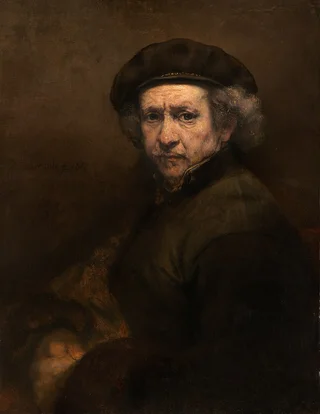
Rembrandt died in October 1669, and this is one of three self-portraits by him dated that year. In the museum's view he looks older in this one than in the other two, and for that reason the museum calls it possibly his last. Rembrandt has turned three-quarters to the right and looks at the viewer from under heavy lids. The forehead, nose and cheeks are modelled in thick paint, and grey curls escape from under a soft beige-brown beret with a broad ochre-gold band. An X-ray shows a plain white linen cap under the beret, of the kind men wore at home, and the museum believes that Rembrandt first quickly set down what he saw in the mirror and only later decided which headgear to wear in the portrait.
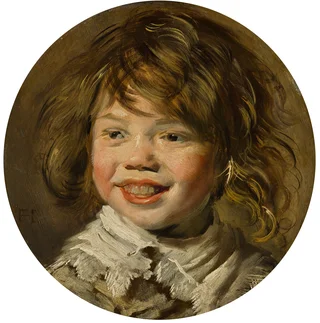
18. Laughing boy — Frans Hals, c. 1625
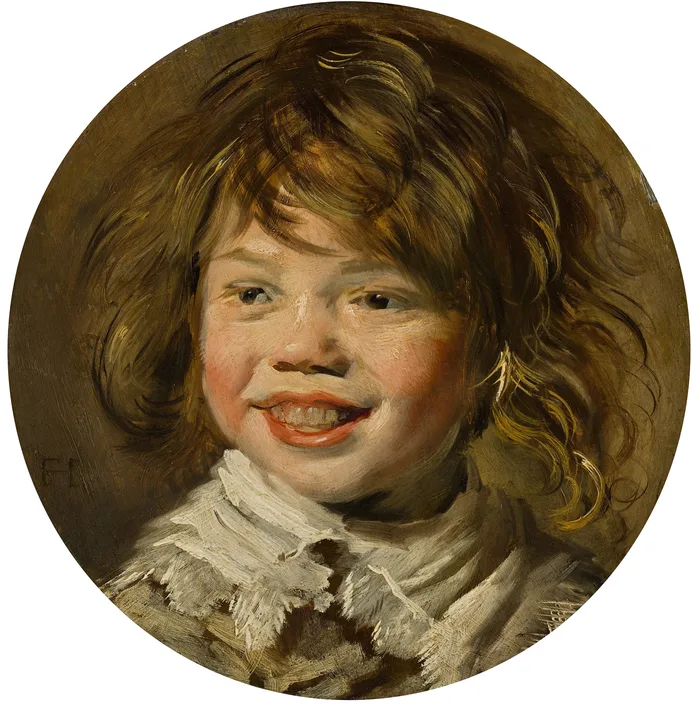
For nine months of every year, until the end of its former owner's life, Laughing Boy was to stay with her in Paris. On that condition, and at a friendly price, Marie-Anne von Goldschmidt-Rothschild, daughter of the Silesian coal magnate Fritz von Friedländer-Fuld, sold it to the Mauritshuis in 1968. For five years the round panel travelled between Paris and The Hague, and it stayed in The Hague for good when she died in November 1973. The money for the purchase came from the Rembrandt Association, the Prince Bernhard Fund and the Friends of the Mauritshuis. Until then the museum had owned only portraits by Hals, and this is a head painted without a commission, as a study of expression.
Before that the panel had belonged to the Cologne collector Albert von Oppenheim. The sale of his collection in Berlin was set for October 1914, put off because of the war until March 1918, and it was then that the boy was bought for the Friedländer-Fuld family.
The boy laughs with his mouth wide open, showing a few teeth painted in pale strokes, his cheeks are pink, and his eyes glance to the right, past the viewer. His tousled reddish-gold hair is laid in with sweeping strokes, Hals drew a single light line down the bridge of the nose, and he marked the nostrils with two quick dark touches. The crumpled white collar is painted in flat, blunt strokes, noticeably coarser than the face. On the background at the left is the monogram FH.
The Hals scholar Claus Grimm, in a study published in 2023–2024, takes the view that Hals painted the face and one of the assistants in his workshop painted the collar. The museum attributes the whole panel to Hals.
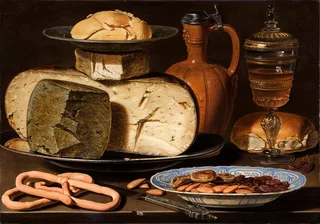
19. Still Life with Cheeses, Almonds and Pretzels — Clara Peeters, c. 1615
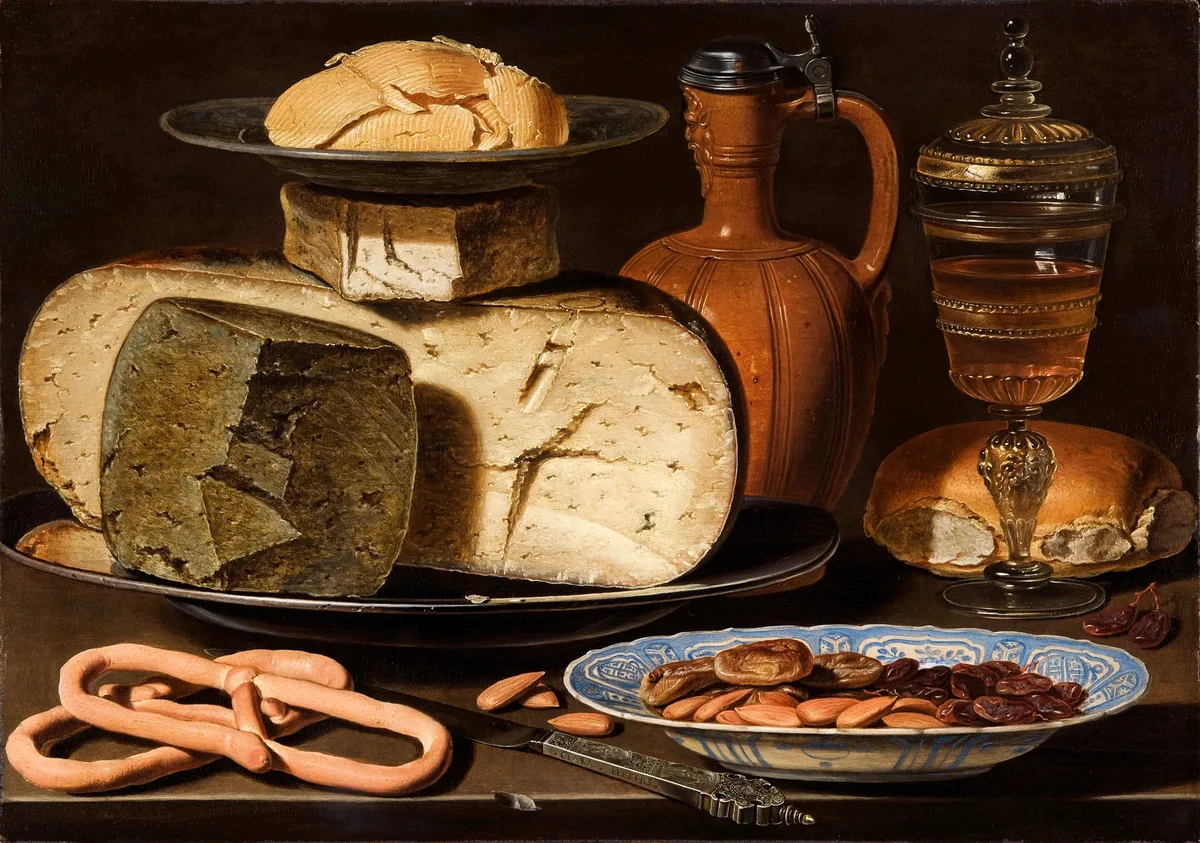
A knife with a silver handle lies at an angle along the edge of the table, its carved end jutting out over the edge, and on the side of the handle the name “CLARA PEETERS” is written in capitals. According to the museum, the painter also left a self-portrait here, a tiny reflection in the pewter lid of the jug.
The table is seen slightly from above, against an almost black background. On the left a stack of cheeses stands on a pewter plate. A large pale round has been cut into, and a long narrow groove runs along the cut face with cracks spreading out from it. In front of it lies a greenish-grey wedge of aged cheese, and on top are a small cheese and a dish heaped with ridged curls of butter. In the middle stands a brown stoneware jug with a pewter lid and a bearded mask in relief on its neck, and on the right a covered goblet with gilded bands and amber-red wine. Dried figs, almonds and raisins lie in a blue and white porcelain bowl, and two pretzels lie on the bare table at the left.
Little is known about Clara Peeters herself. She worked from about 1607 to 1621, probably in Antwerp, painted only still lifes, and was one of the first to depict a laid table with simple food and costly tableware. She was also one of the first painters in the North to show her own reflection in goblets and pewter, following the convex mirror of Jan van Eyck.
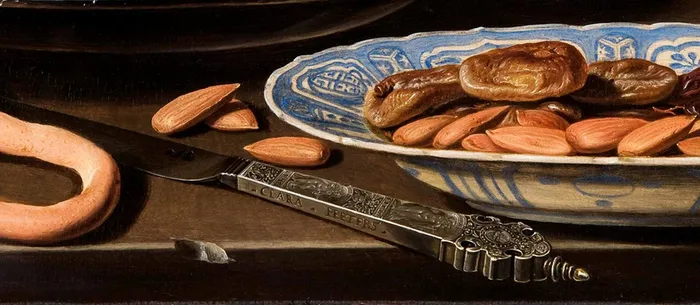
From 1920 the still life was in a French private collection, in 1998 it sold at auction in Paris for a record price for Peeters, and in June 2012 the Mauritshuis bought it from a private owner in the United States. The museum's director, Emilie Gordenker, called it a rare painting by a 17th-century woman artist. By the museum's own count, among the more than 300 artists in its collection there are five women: Collot, Leyster (no. 10), van Oosterwijck, Peeters and Ruysch.
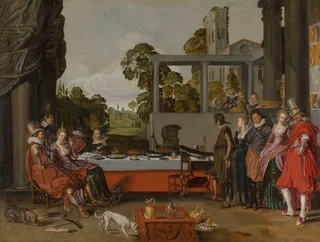
20. Merry Company on a Terrace — Willem Buytewech, c. 1616–1617
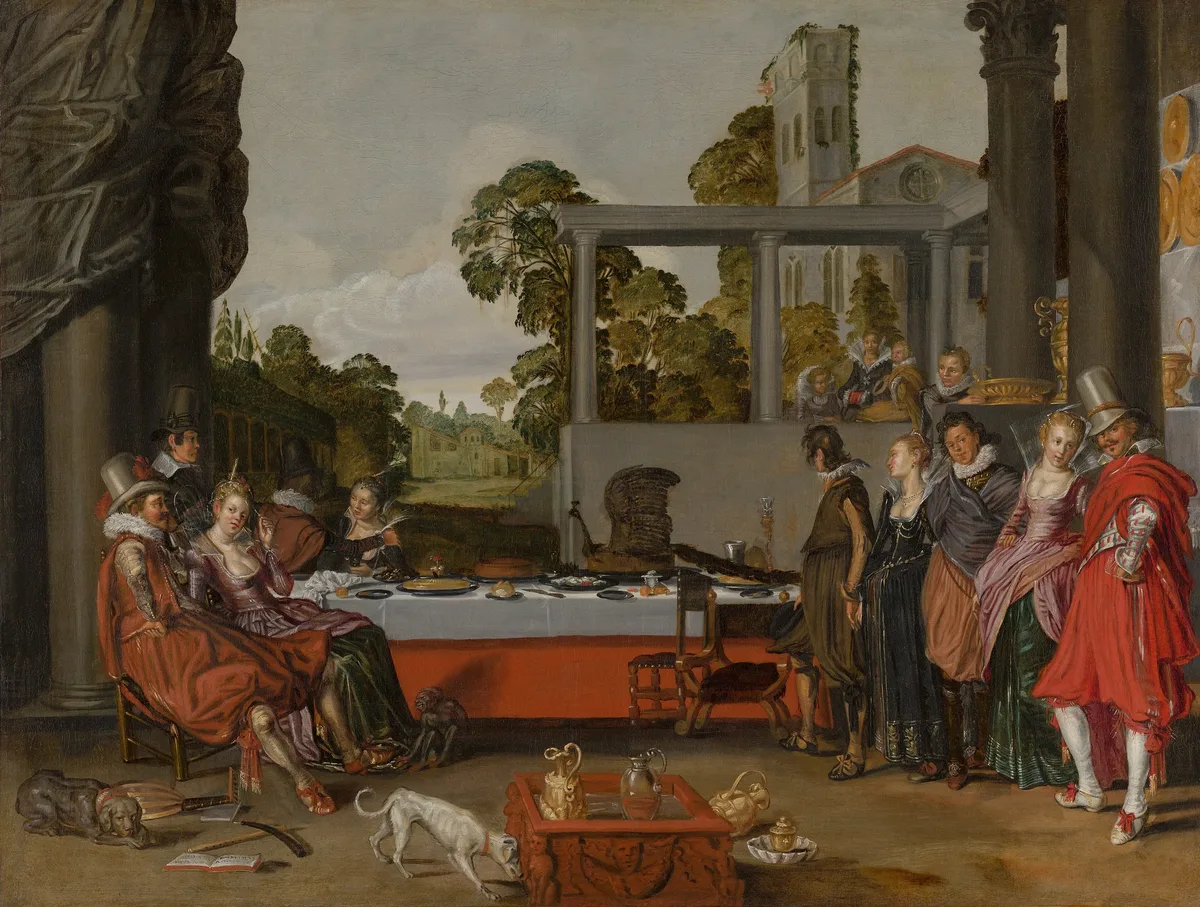
Kurt Rohde, a former career officer, left the army in 1920 and opened an art dealership in Berlin, with his neighbour, the art historian Wilhelm von Bode, as his adviser. In 1926 Bode published a painting of a smiling girl that belonged to Rohde as a Vermeer. It was sold to the United States, and with his commission of 350,000 Reichsmarks Rohde bought paintings at auctions in Germany, Austria, The Hague and Amsterdam. This “Vermeer” has been doubted since 1970, and since 2008 it has been regarded as the work of the forger Han van Meegeren. In November 1930, at Paul Graupe's auction house in Berlin, Rohde bought Willem Buytewech's Merry Company.
Rohde died in 1950, and from 1958 to 2016 his heirs kept the painting on long-term loan at the Gemäldegalerie in Berlin. In 2018 the Mauritshuis bought it from the heirs with money from the BankGiro Loterij, and, according to the museum, until this purchase it had not owned a single characteristic genre painting of the early 17th century.
Buytewech was born in Rotterdam, joined the Haarlem painters' guild in 1612, made drawings after paintings by Frans Hals, and lived only a little past 30. His contemporaries called him Witty Willem. The museum counts only six paintings by him (in Berlin they speak of eight), against some 125 drawings and 32 etchings, and calls this painting a key work for early Dutch genre painting and Buytewech himself one of those who started painting merry companies.
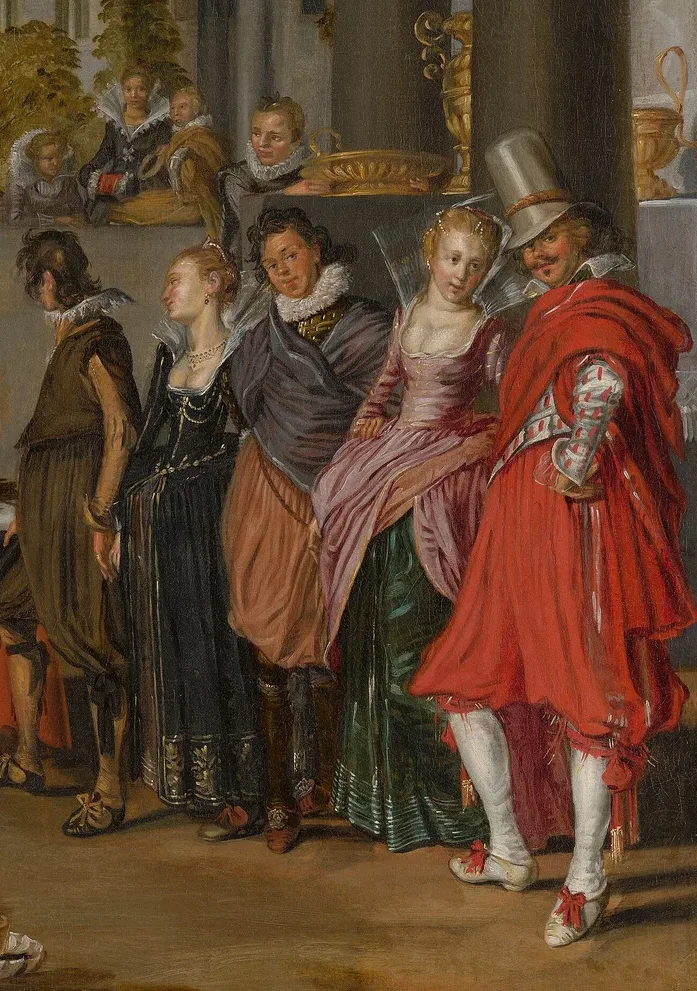
The scene is set up like a stage. On the left a huge grey-brown curtain is gathered around a column, on the right stands a column with a Corinthian capital, and between them a loggia, a garden and a distant church open up. A long table under a white cloth runs across the whole picture, and from under the white cloth a bright red one hangs down to the floor. On the left a man with a moustache, in a tall grey hat with a red feather, sprawls in a wicker chair, and beside him a woman in pinkish-lilac silk leans back and looks at us. In the middle of the table stands a pie decorated with a peacock with its tail raised, a lute and open sheet music lie dropped on the floor, and at the right edge a dandy in a scarlet cloak, a slashed red and white doublet and shoes with red bows grins, looking straight at the viewer.
After the twenty
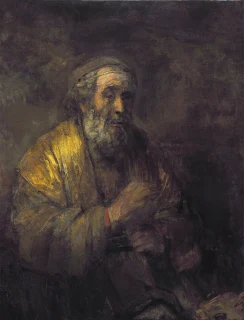
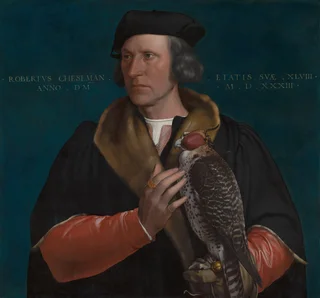
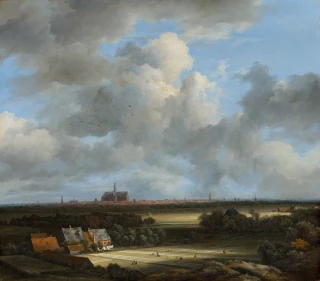
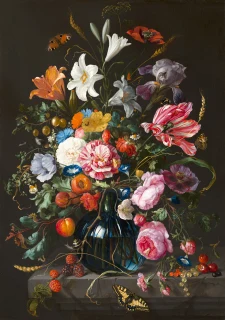
We chose paintings that show who decided, and when, what would hang in this house, so many of the public's favourite pictures were left out of the list. On a second visit it is worth starting with the Prince William V Gallery on the Buitenhof, the very gallery the stadholder opened to the public in 1774. In the Mauritshuis itself, look for Rembrandt's Homer from the Bredius bequest, Hans Holbein the Younger's Portrait of Robert Cheseman, Jacob van Ruisdael's View of Haarlem with Bleaching Grounds and Jan Davidsz. de Heem's Vase of Flowers. In September 2026 the Mauritshuis and the Rijksmuseum jointly bought Hendrick Avercamp's Golf Players on the Ice, painted around 1625, and agreed to show it in Amsterdam and The Hague in turn.