Apollo of Scasato
Details
The story
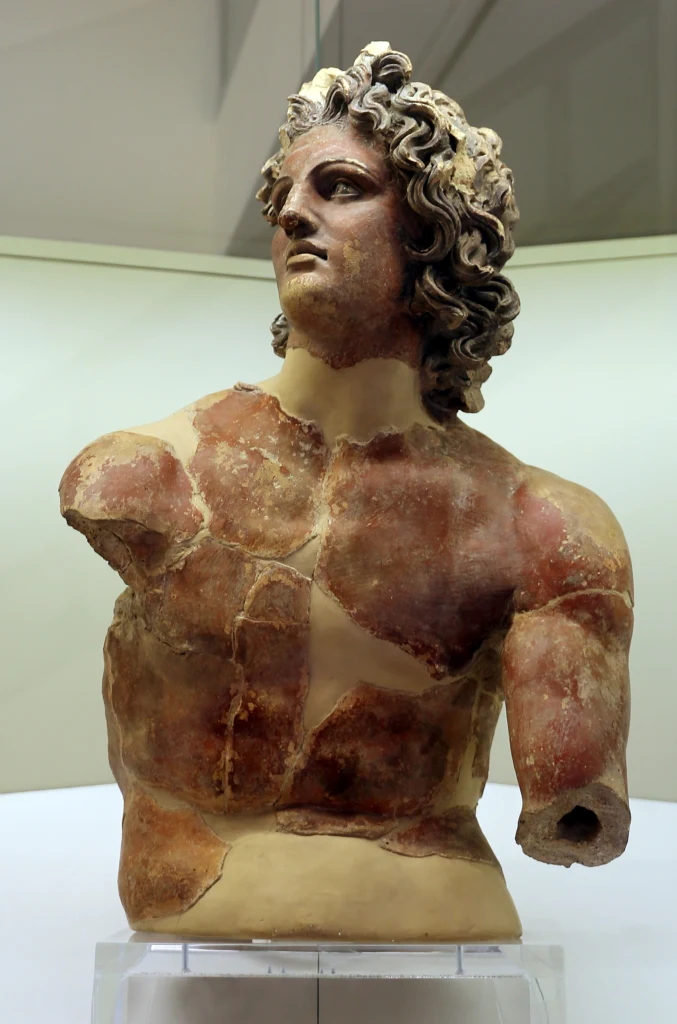
Alexander the Great died in Babylon in 323 BC, and within a generation his portraits had begun to shape how sculptors across the Mediterranean imagined young gods and heroes. The signature was the hair, a thick mass swept up above the forehead and falling loose to the shoulders.
This Apollo has that hair. He was modelled in clay around the end of the 4th century BC for the pediment of a temple at Lo Scasato, on the plateau of Falerii, the chief town of the Faliscans north of Rome. Scholars compare his face with portraits of Alexander, and it is not easy to say whether the sculptor meant the god, the king, or simply the heroic type made fashionable by Lysippos, Alexander's own court sculptor.
The temple was excavated in the 1880s, when digging at Falerii was producing so much that the Villa Giulia was turned into a museum in 1889 largely to hold those finds. For decades this bust was one of its best-known images.