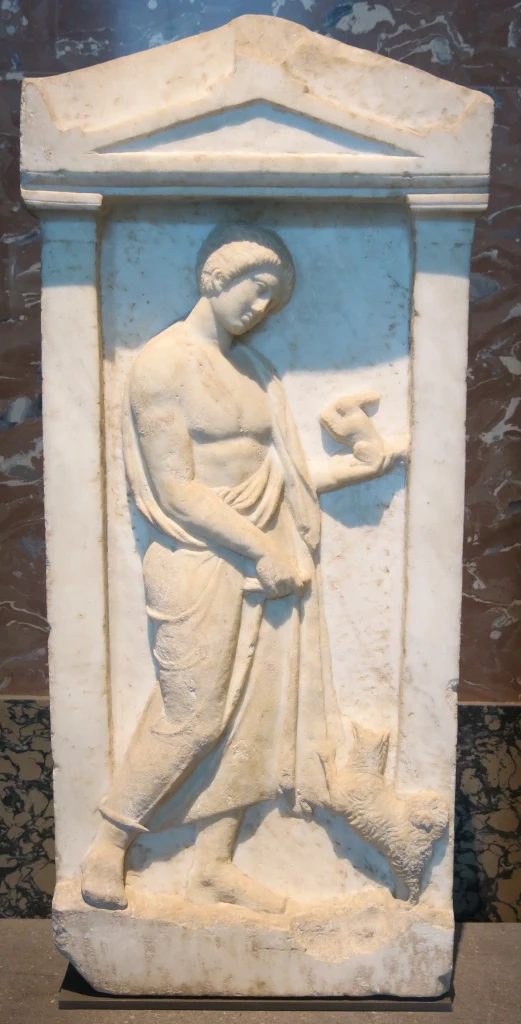
Funerary Stele of a Boy with a Dog
Details
The story
Where this gravestone was carved is still an open question. The Louvre suggests Rhodes, with a question mark, and the stone appears both in a standard corpus of grave reliefs from the eastern Greek world and in a catalogue of Classical tombstones from Athens. It dates from around 360 BC.
Under a little pediment stands a youth, his cloak slipping from one shoulder. On the palm of his left hand sits a small hare, and a dog leaps up towards it. Traces of red paint survive on that hand and on the dog, a reminder that reliefs like this were once coloured. In Greek art a hare often appears as a gift to a boy from an admirer, and hunting with dogs was part of the life of a well-born youth.
The back of the slab has been sawn off entirely. The stele reached the Louvre in 1855, and the museum's records link it, again with a question mark, to William Henry Waddington, a young scholar who travelled in Asia Minor collecting inscriptions and who later became prime minister of France.