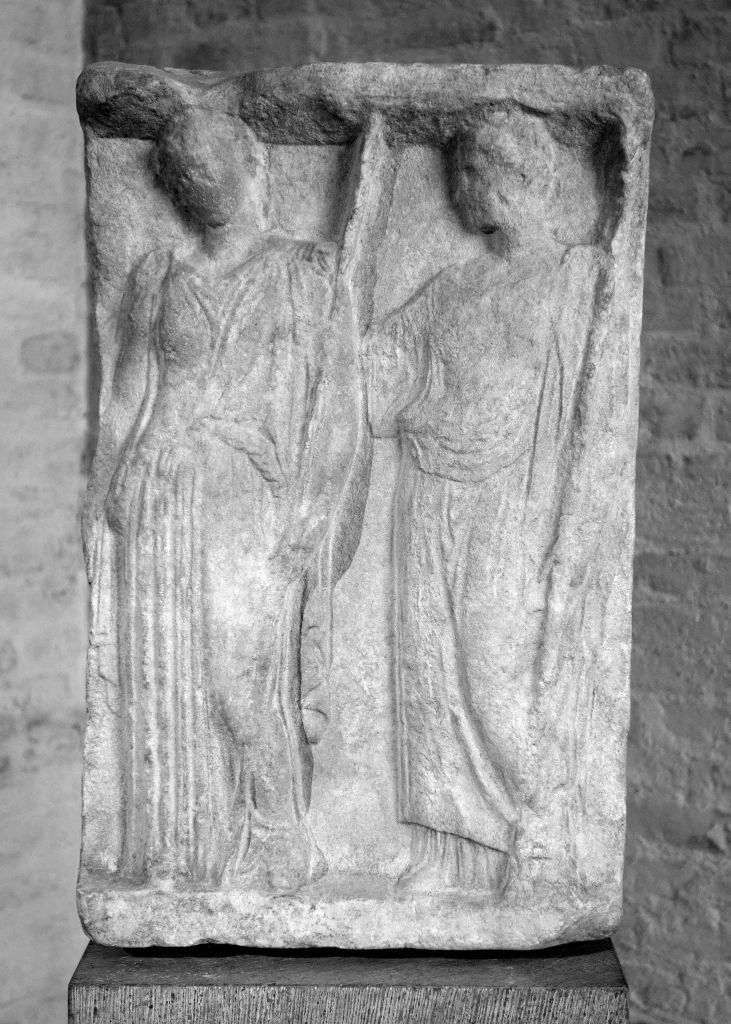
Votive Relief of Demeter and Kore
Details
The story
Two goddesses stand side by side on this fragment, one holding a sceptre, the other a torch. They are probably Demeter, goddess of grain, and her daughter Kore, also called Persephone, and the stone was a votive offering, set up by a worshipper in thanks or in hope. On the lost left half, the Glyptothek's guide of 1922 suggested, the worshippers themselves would have been shown approaching. The relief probably comes from Rhamnous, a town on the north-east coast of Attica.
When it was carved is disputed. Some date it to the last quarter of the 6th century BC, still within the Archaic period. The museum's own catalogue of Classical votive reliefs, published in 1988, lists it as number one, and the 1922 guide called it a fine work from the school of Phidias, the sculptor of the Parthenon, which would place it more than half a century later. The question has not been settled.
The Glyptothek bought the relief in 1853 from the Austrian diplomat Anton Prokesch von Osten, who had spent many years as his country's envoy in Athens.