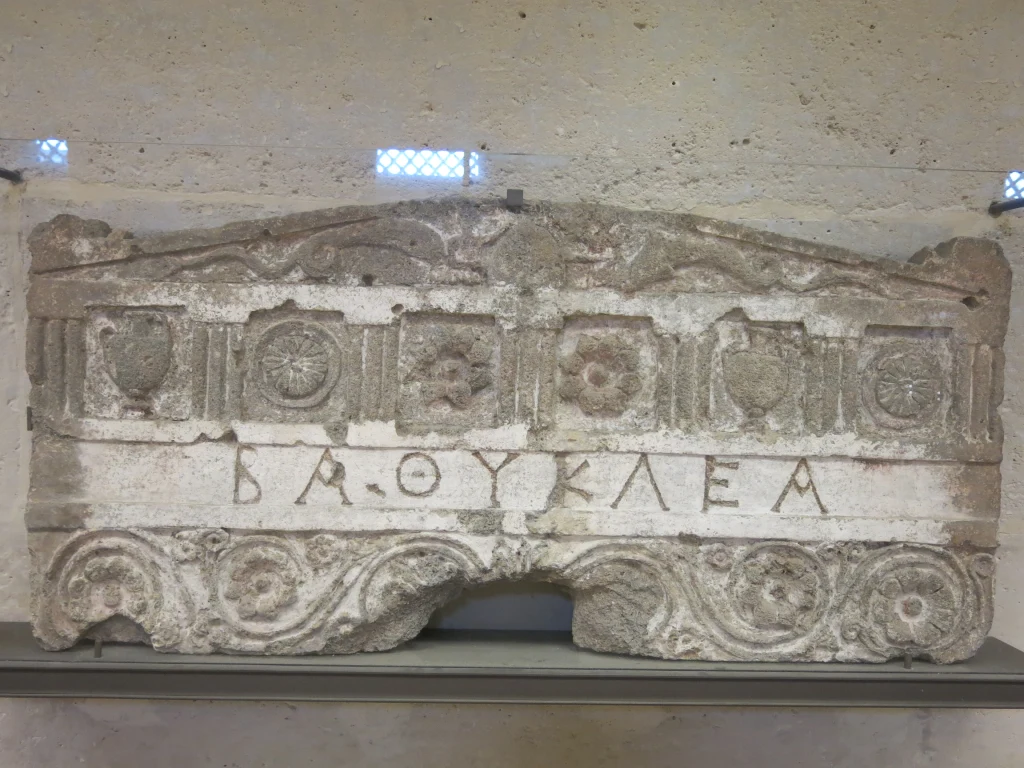
Funerary Stele of Bathyclea
Details
The story
Tanagra, a small town in Boeotia north of Athens, became famous in the 1870s, when local farmers digging in its ancient cemeteries began pulling out painted clay figurines by the thousand and dealers sold them all over Europe. Gravestones came out of the same ground. This is the top of one, found at Tanagra and bought by the Louvre in 1900. Only the crowning piece survives, a slab of limestone more than a metre wide. In its low pediment two tritons, sea creatures half man and half fish, flank a burial mound. Beneath them runs a Doric frieze of six panels with water jars, libation bowls and rosettes, and lower down a scroll of leaves and flowers. Traces of white plaster and of blue and red paint remain on the tritons and the flowers.
Under the frieze a single name is cut in large Greek letters, Bathyklea. Boeotian tombstones of this period often gave just that, the name of the dead in the nominative, with no father's name and no verse. The stone dates from between about 225 and 150 BC, and in 2003 it went on show in the Louvre's Tanagra exhibition, beside the figurines.
More works by Unknown Greek sculptor (Hellenistic)
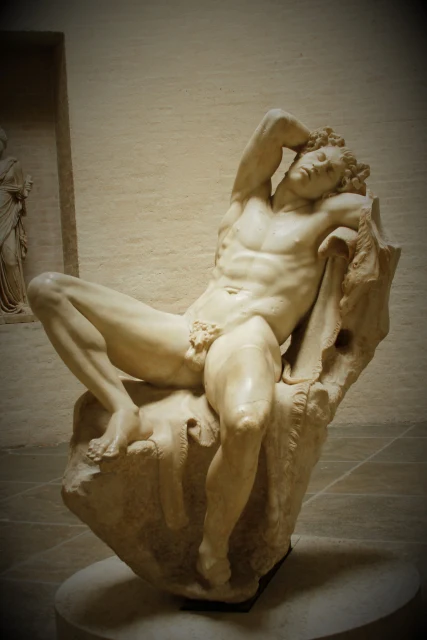 Barberini FaunUnknown Greek sculptor (Hellenistic), -220
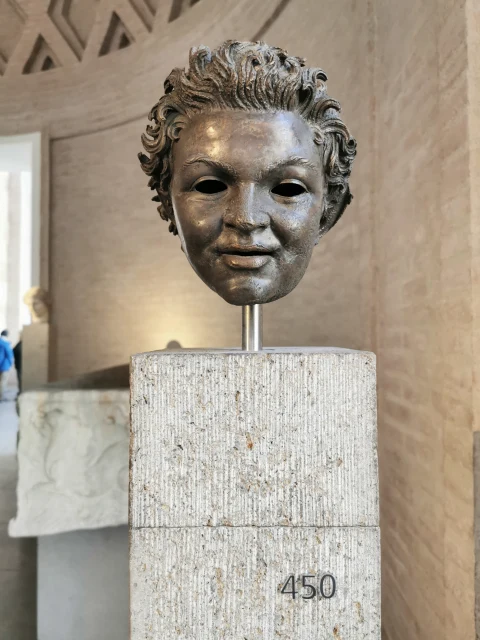 Bronze Head of a Young SatyrUnknown Greek sculptor (Hellenistic), -100
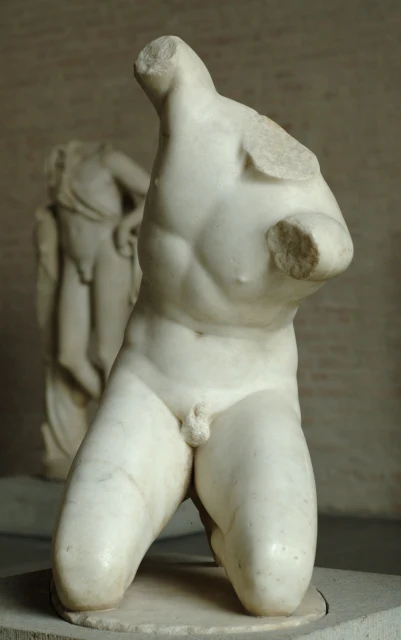 Ilioneus (Kneeling Son of Niobe)Unknown Greek sculptor (Hellenistic)
 Lion Attacking a HorseUnknown Greek sculptor (Hellenistic), -312
 Votive Statue of a Girl with a DoveUnknown Greek sculptor (Hellenistic), -310