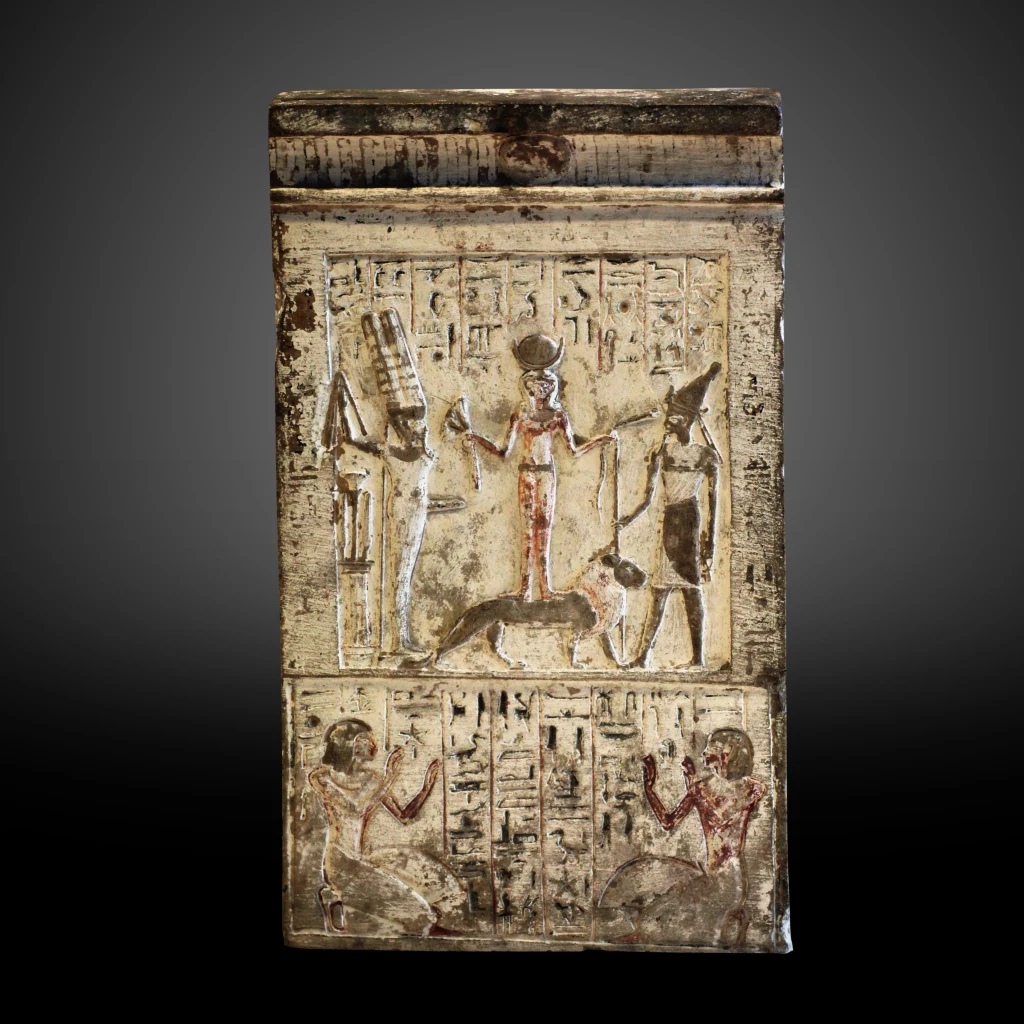
Stela of Huy with Qadesh, Min and Reshep
Details
The story
The naked goddess standing on a lion at the top of this stela came to Egypt from abroad. She is Qadesh, a goddess from Syria and Canaan, and she faces straight out at us, which Egyptian art rarely allowed a figure to do. She wears the curled wig of the Egyptian goddess Hathor with a crescent and disc above it, and holds flowers in one hand and a snake in the other. Her name comes from a Semitic word meaning holy, and has nothing to do with Kadesh, the Syrian town where Ramesses II fought the Hittites. Beside her stand Min, the Egyptian god of fertility, and Reshep, a Syrian god of war and plague who had been taken into Egyptian worship, here wearing the white crown of Upper Egypt.
Below, two men kneel in prayer. The owner, Huy, calls himself a servant in the Place of Truth, the title of the workmen who cut and painted the royal tombs in the Valley of the Kings and lived in the village now called Deir el-Medina. The relatives named on the stone place it in the reigns of Sety I and Ramesses II, when Egyptian armies and officials were campaigning and governing far into Syria and Canaan. On the back the women of his household kneel in rows with vases and sistrums, among them his wife, Takharu.
It came to the Louvre in 1826 with the collection of Henry Salt, the British consul general in Egypt.
More works by Unknown Egyptian artist (Ramesside period)
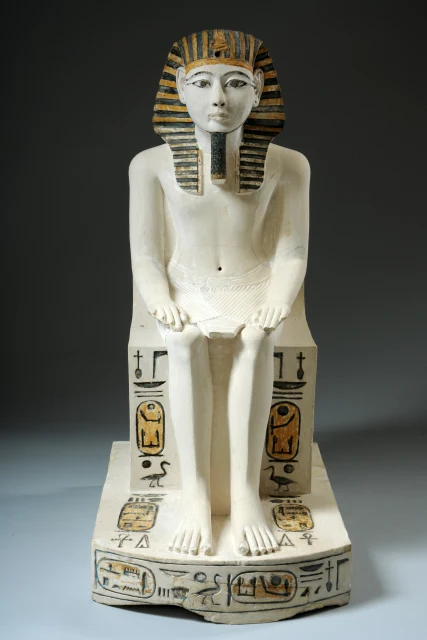 Cult Statue of Amenhotep IUnknown Egyptian artist (Ramesside period), -1242
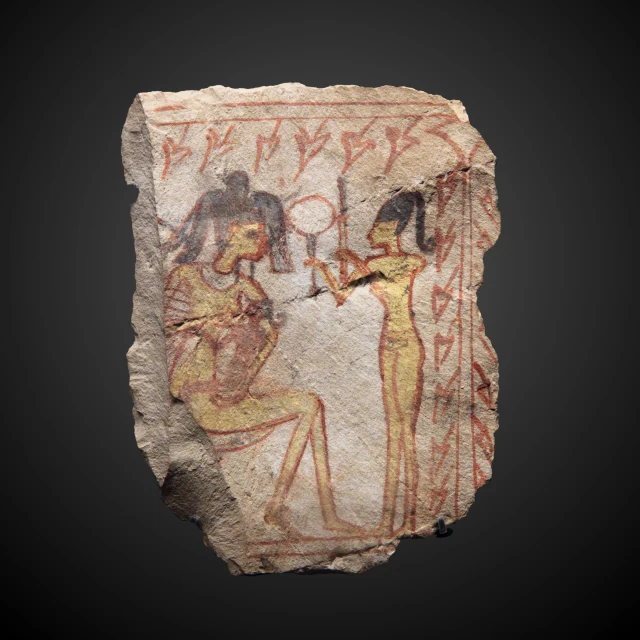 Figured Ostracon: Servant Presenting a Mirror to Her MistressUnknown Egyptian artist (Ramesside period), -1182
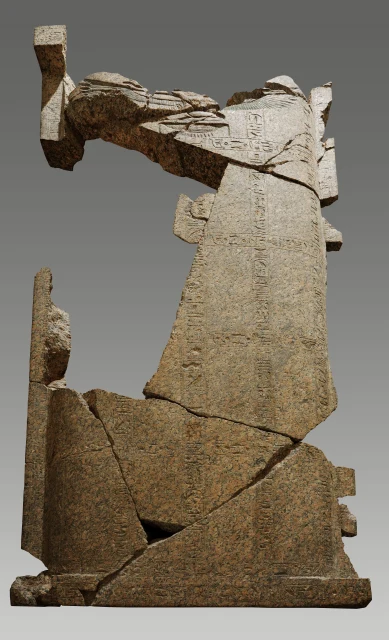 Lid of the Sarcophagus of Queen NefertariUnknown Egyptian artist (Ramesside period), -1246
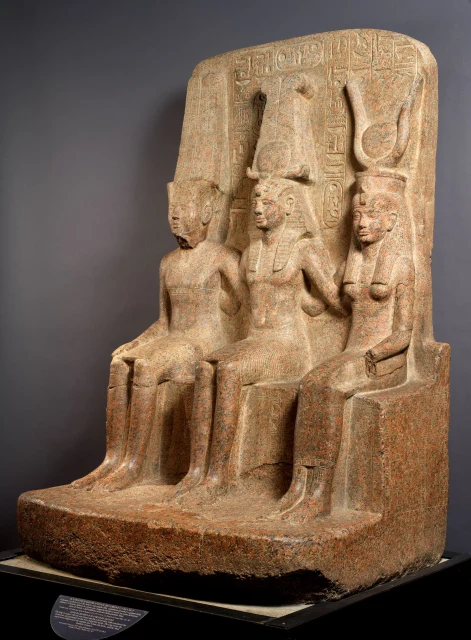 Ramesses II Seated between Amun and MutUnknown Egyptian artist (Ramesside period), -1246
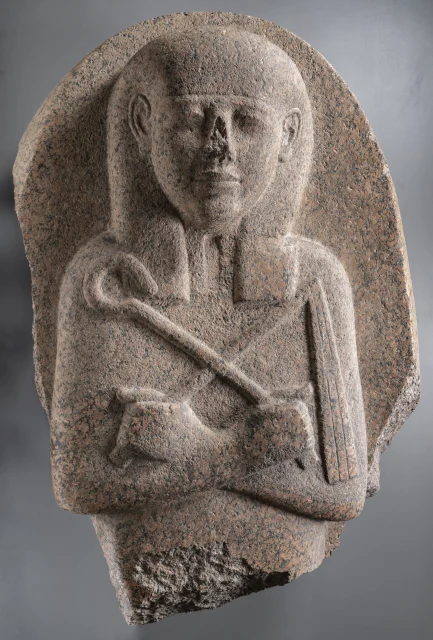 Sarcophagus Lid of Prince KhaemwasetUnknown Egyptian artist (Ramesside period), -1168