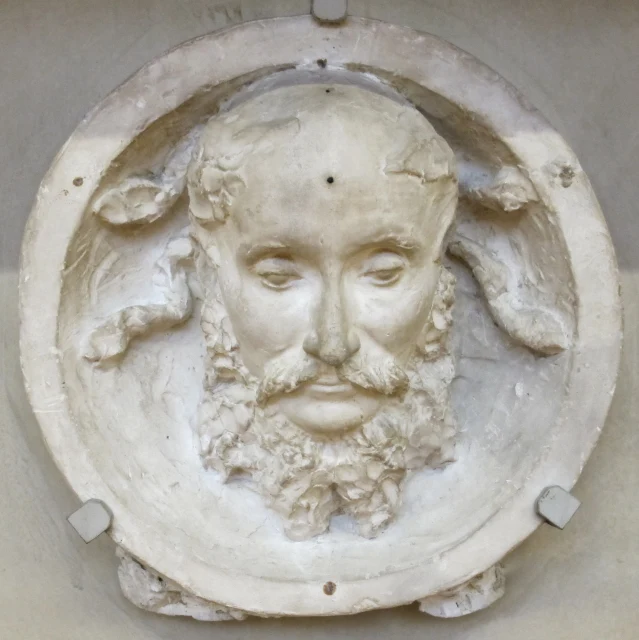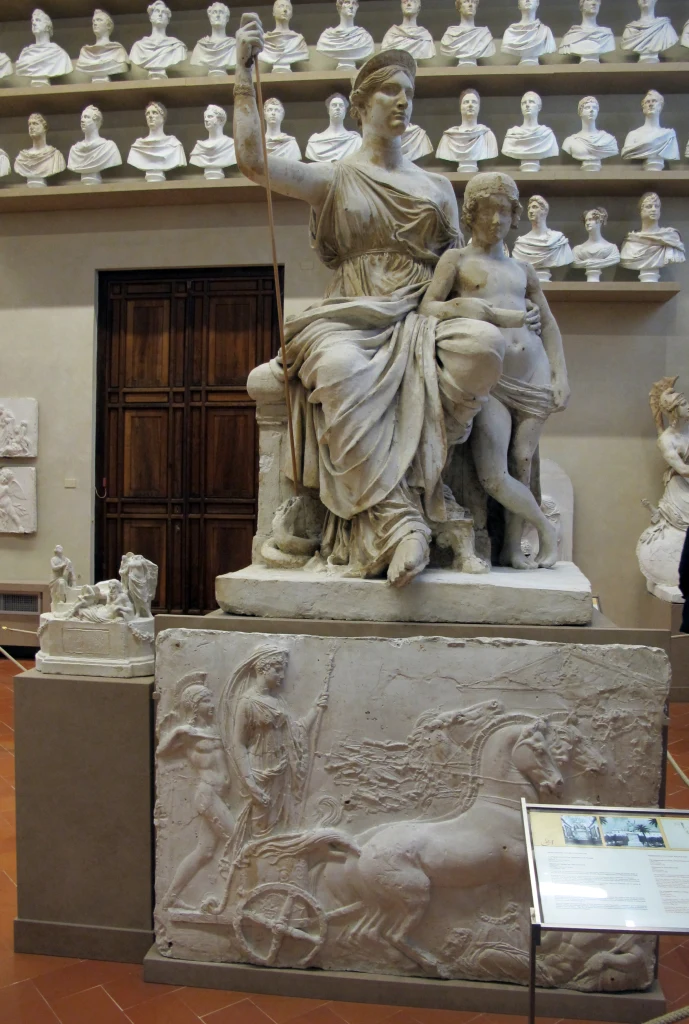
The Magnanimity of Elisa, Monument to Elisa Baciocchi (plaster model)
Details
The story
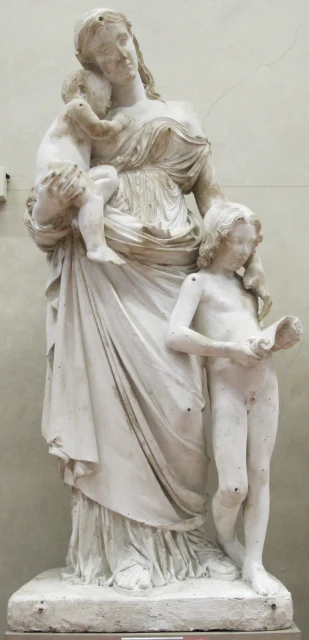
Bartolini began this group in 1808, when Napoleon's sister Elisa Baciocchi ruled Lucca and was about to become grand duchess of all Tuscany. She sits as Minerva, with a diadem, a sceptre and the goddess's serpent at her feet, and her arm encircles a Genius, a guardian spirit, who holds a scroll that probably stands for her new laws. The name on the plaster is the Magnanimity of Elisa. The monument was probably meant for a square in Carrara, and the fall of the empire in 1814 stopped it. When Elisa died in Trieste in 1820, her husband Felice asked Bartolini to turn the group into her tomb, intended for the church of San Petronio in Bologna. The marble never reached the church. The family sold it to a Bolognese nobleman, Massimiliano Malvezzi Angelelli, who set it up as his own family's tomb in the Certosa cemetery of Bologna, where the seated woman is simply a Minerva. Which of these lives the plaster records is still argued. The museum and the national catalogue date it between 1808 and about 1813, as the monument to a living ruler, while older studies took it for the funerary version made after 1820.