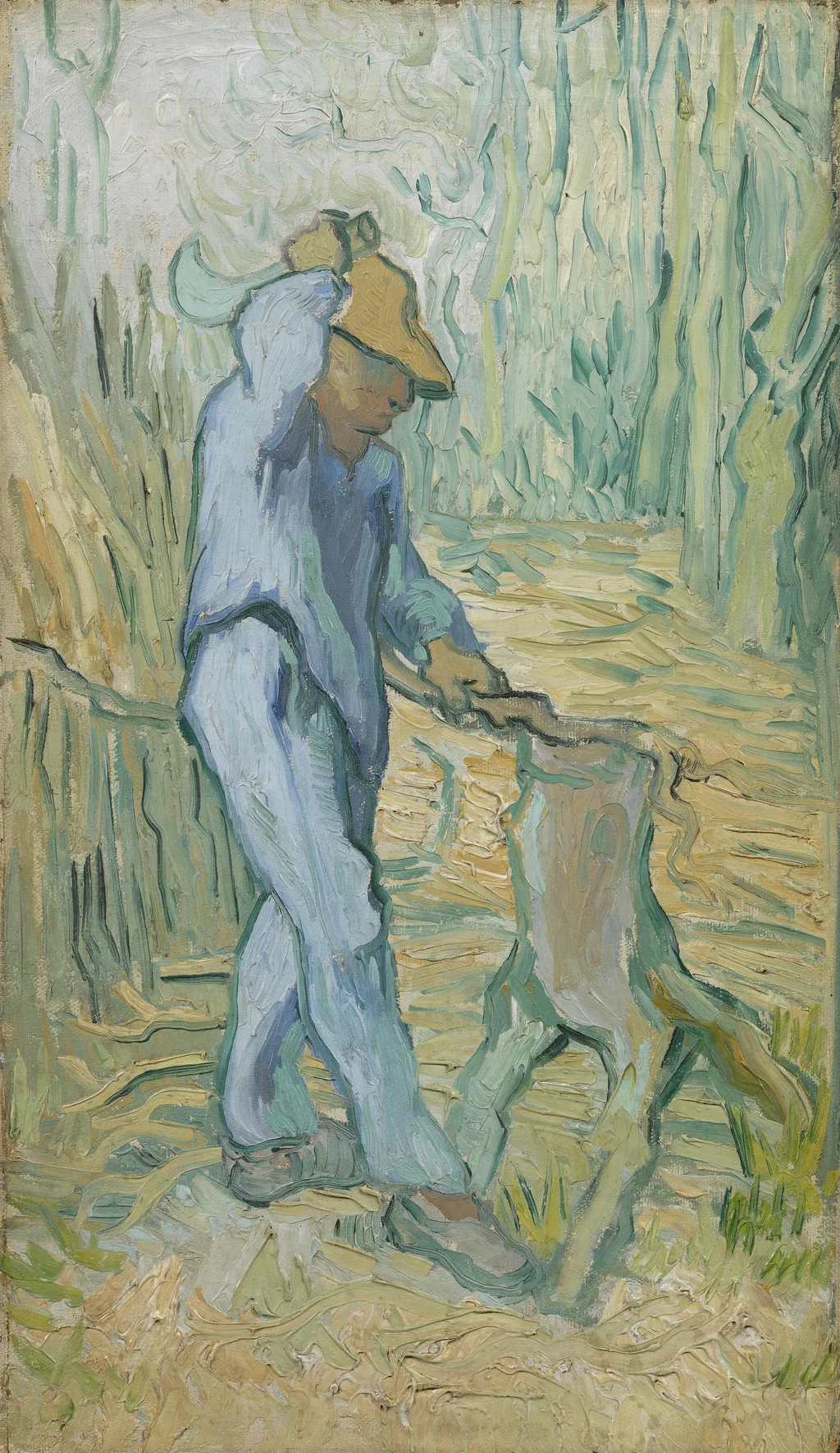
Vincent van Gogh, The Woodcutter (after Millet), 1889. Wikimedia Commons. · PD
The Woodcutter (after Millet)
Details
The story
In September 1889 Van Gogh was a patient in the asylum at Saint-Remy-de-Provence, working indoors in a ground-floor room the institution let him use as a studio, with no models and no way of simply walking out to a field. He asked Theo for prints. What arrived was a set of small wood engravings after ten paintings by Jean-Francois Millet, the French painter of peasant labour whose figures Van Gogh had been copying since he first taught himself to draw, and he went through the whole set fast.
This woodcutter is one of the ten. The sheet in front of him was black and white, and he was firm with Theo that what he was doing was not copying. He called it translating, choosing the colour himself the way a musician performs another composer's score.
The canvas is narrow, 43 by 25 centimetres, cut to the standing figure. Millet's series ran through the tasks of the farming year, and the engravings were cut by Adrien Lavieille, so the image reached Saint-Remy two hands away from Millet's own.