Theseus and the Centaur
Details
The story
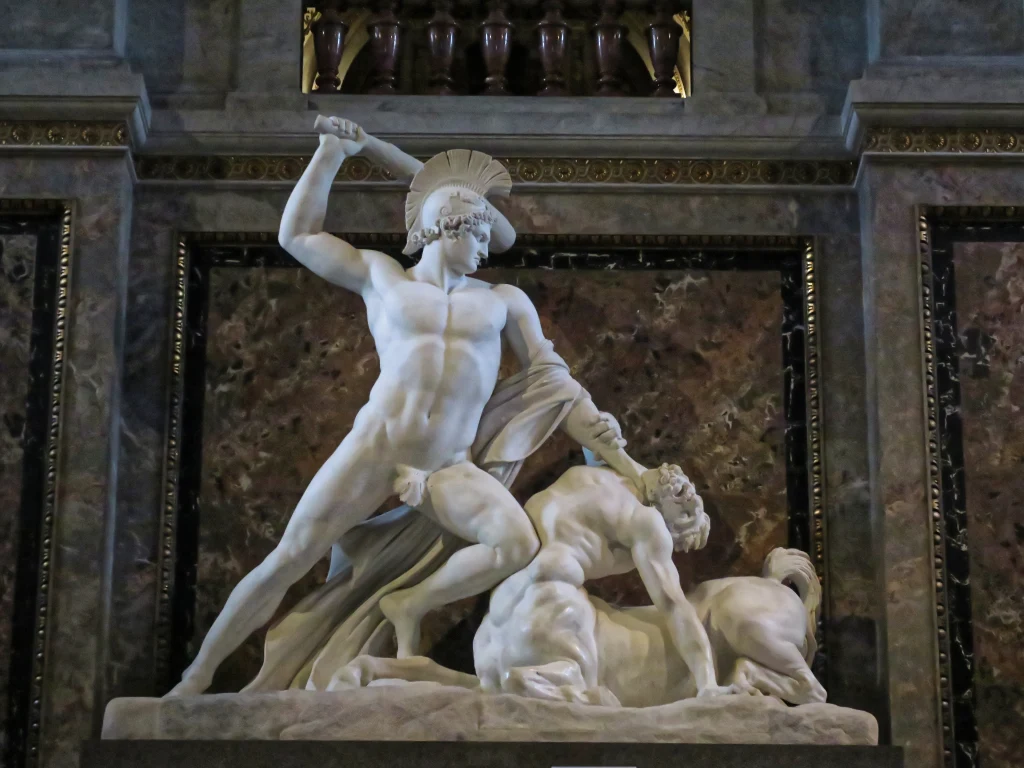
This marble was ordered in 1804 to celebrate Napoleon. The government of his Italian republic commissioned it from Antonio Canova for Milan, as a monument to Napoleon's victory over the Austrians at Marengo in 1800. In the myth, Theseus, the hero of Athens, fights the centaurs who ran riot at the wedding of his friend Pirithous, and Canova shows him pinning one down and raising his club. The carving in Rome went slowly. When the group was nearly finished, in 1814, Napoleon had fallen, and the buyer who came forward was the emperor of Austria, Francis I. A victory over Austria became an Austrian monument. Francis had a small Doric temple built for it in the palace gardens, today's Volksgarten, a copy of the Theseion in Athens designed by the architect Peter Nobile and put up between 1820 and 1823. The marble reached Vienna in 1822, and in its new home Theseus was read as lawful order overcoming revolution. It stood in the temple until 1890, when it was moved here, to the Grand Staircase of the newly built Kunsthistorisches Museum. The temple in the Volksgarten still stands, and in recent years the museum has used it to show single works of contemporary art.