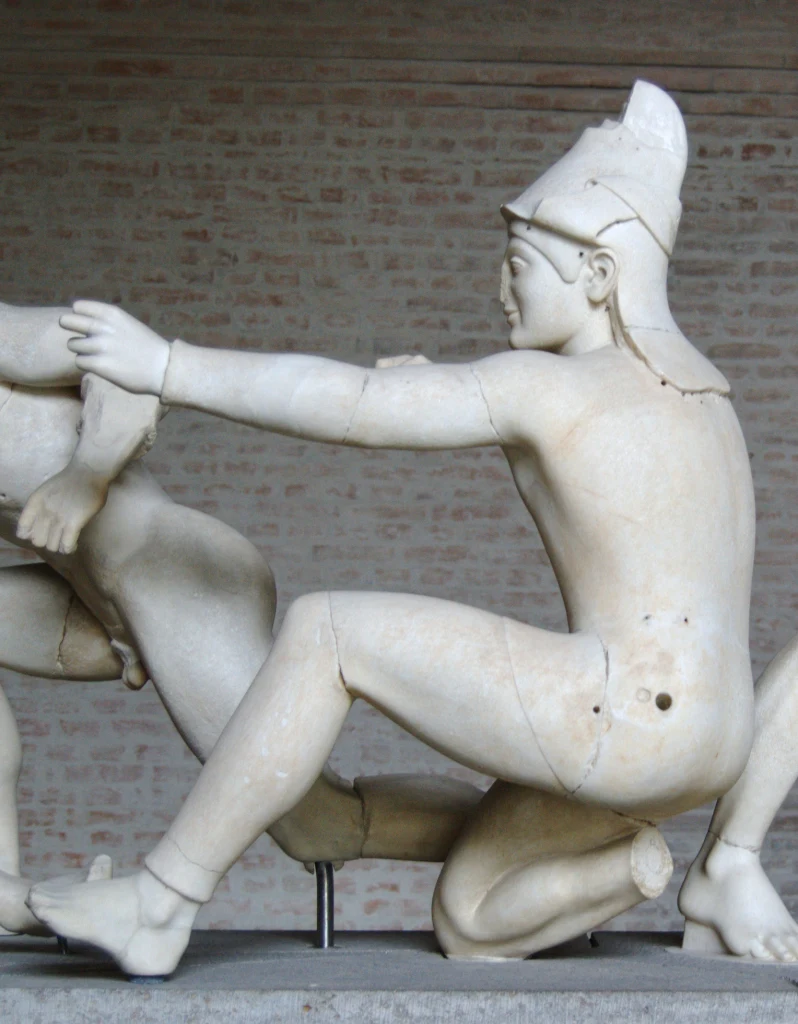
Trojan Archer ("Paris") from the West Pediment of the Temple of Aphaia
Details
The story
Around 500 BC, when this archer was carved, the Persian empire already ruled the Greek cities on the far shore of the Aegean, and Greeks knew the horsemen of the north and east, Scythians and Persians, by their dress. That is how the sculptor clothed this Trojan. He kneels to shoot, a soft pointed cap on his head and a close-fitting suit covering him to the wrists and ankles. He is usually called Paris, the Trojan prince who carried off Helen, though nothing on the statue gives his name.
Today the marble looks plain. Under ultraviolet light, and in light raking across the surface, faint traces of the painted patterns come back. The archaeologists Vinzenz Brinkmann and Ulrike Koch-Brinkmann used them to rebuild the figure in colour, with zigzag trousers, a long-sleeved top covered in diamonds, and over it a vest with a broad border and small griffins and lions. Their painted copy was first shown here at the Glyptothek in 2003, in the exhibition Bunte Götter, Colourful Gods, and it has travelled to many museums since.
More works by Unknown Greek sculptor (Archaic)
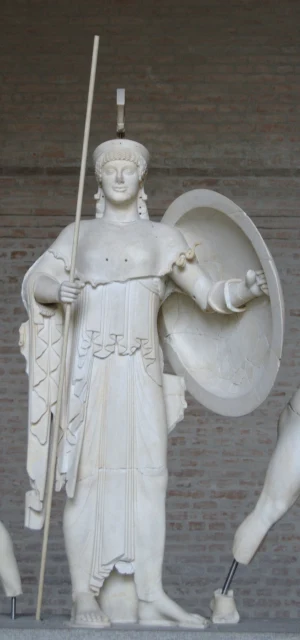 Athena from the West Pediment of the Temple of AphaiaUnknown Greek sculptor (Archaic), -500
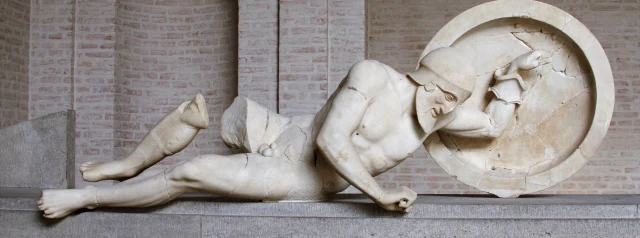 Dying Warrior ("Laomedon") from the East Pediment of the Temple of AphaiaUnknown Greek sculptor (Archaic), -490
 East Pediment of the Temple of Aphaia, AeginaUnknown Greek sculptor (Archaic), -490
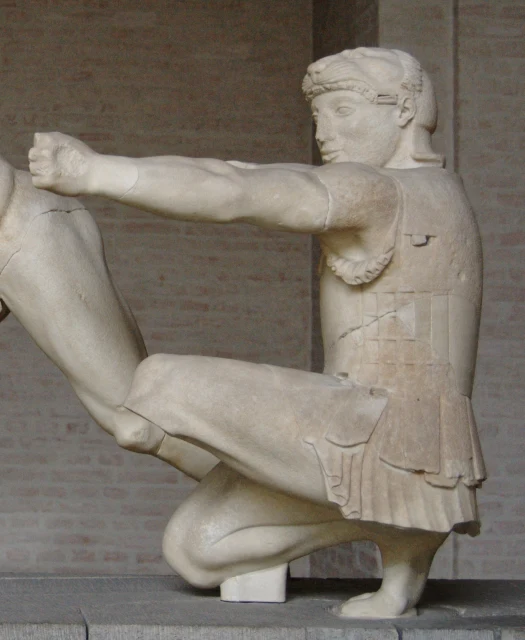 Herakles the Archer from the East Pediment of the Temple of AphaiaUnknown Greek sculptor (Archaic), -490
 Kouros of TeneaUnknown Greek sculptor (Archaic), -560