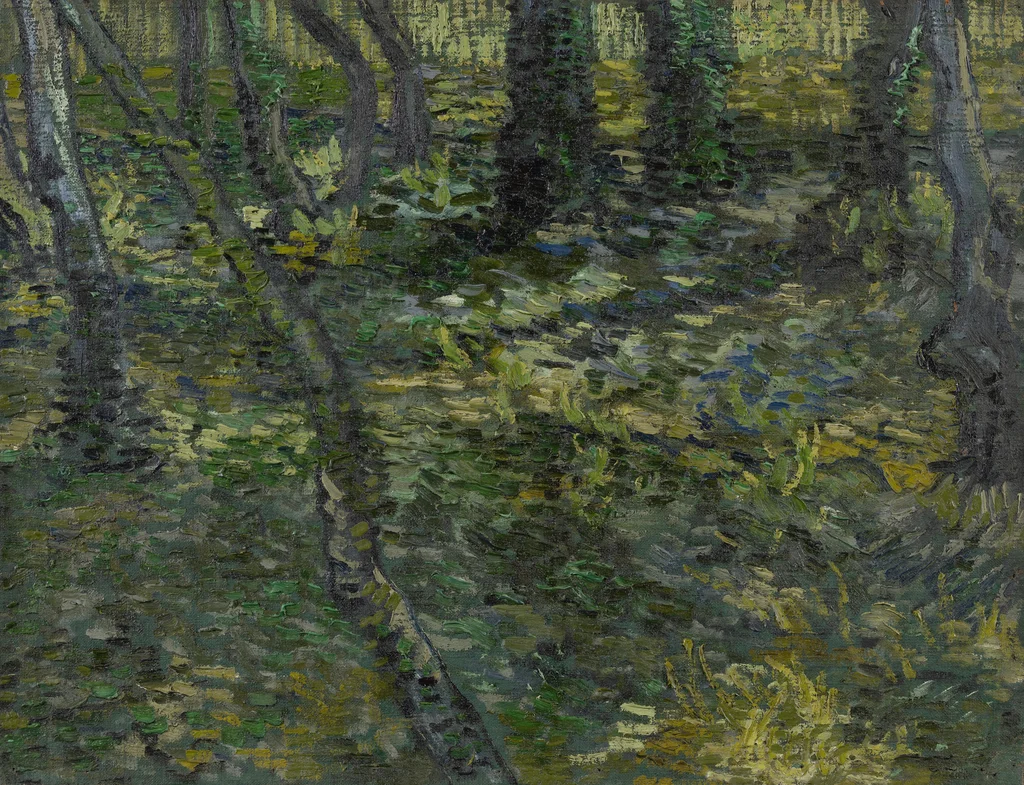
Vincent van Gogh, Undergrowth, 1889. Wikimedia Commons. · PD
Undergrowth
Details
The story
Van Gogh painted this in July 1889, a few weeks into his year at the asylum of Saint-Paul in Saint-Rémy, where he had checked himself in that spring after the breakdown in Arles. His world had shrunk to the walled garden and, when he was well enough, the fields just outside. So he turned to what was close: the shaded undergrowth between the trees. There is no sky here and no horizon, no path leading out, only trunks and the tangle of plants at their feet, filling the canvas edge to edge. This kind of view, called sous-bois, was a favorite of the Barbizon painters and the early Impressionists he admired. What is his own is the restlessness: every leaf and stem carries its own stroke, so the ground itself seems to shift. These are the trees he could actually reach, inside the walls.