Venus Italica
Details
The story
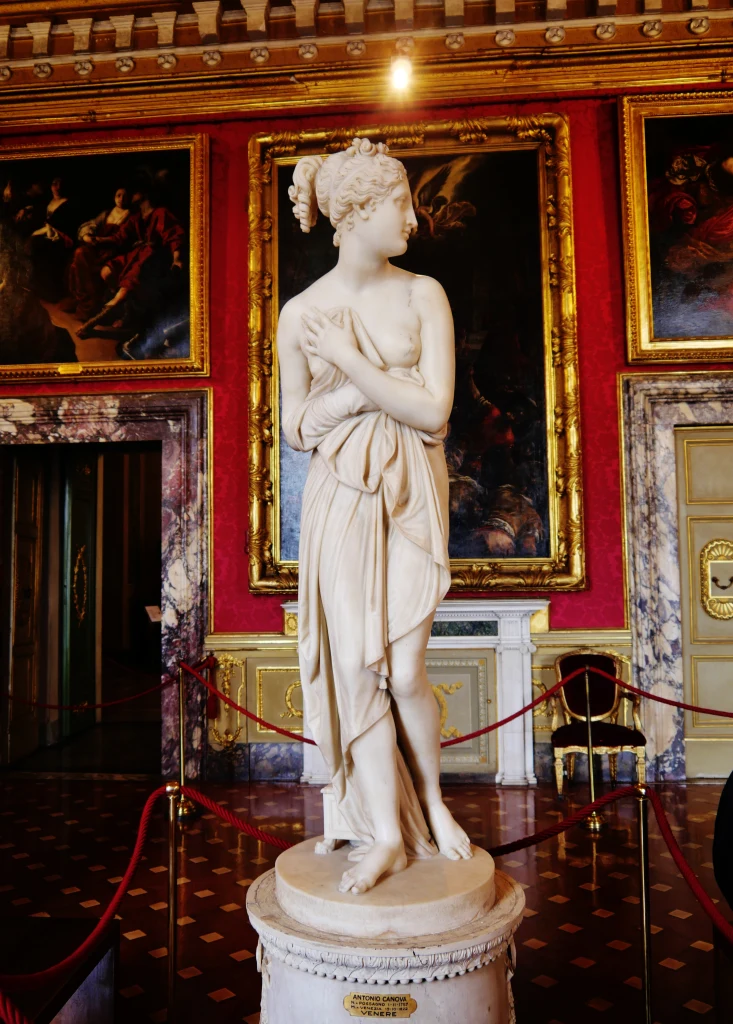
On 11 September 1802 the French authorities requisitioned the Venus de' Medici, Florence's most famous ancient statue, for the Louvre. Tuscany was then the Kingdom of Etruria, a small state created under Napoleon's control, and its Bourbon king, Ludovico, asked Antonio Canova for a copy to fill her empty place in the Tribuna, the octagonal room of the Uffizi built for the gallery's greatest treasures.
Canova was reluctant to copy. What he carved instead, over the next ten years, was a Venus of his own, standing and pressing a cloth to her body as if caught just after a bath. Meanwhile Tuscany passed from the Bourbons to Napoleon's own family, and it was his sister Elisa Baciocchi, now grand duchess, who secured the statue in 1809. She was set up in the Tribuna on 29 April 1812. The poet Ugo Foscolo went back to her again and again that year, and wrote to a friend in Venice that the Medici Venus was a most beautiful goddess, and this one a most beautiful woman.
When the ancient statue came home after Napoleon's fall, Canova's Venus was moved here to Palazzo Pitti, into a room that already carried the goddess's name from Pietro da Cortona's ceiling frescoes of the 1640s.