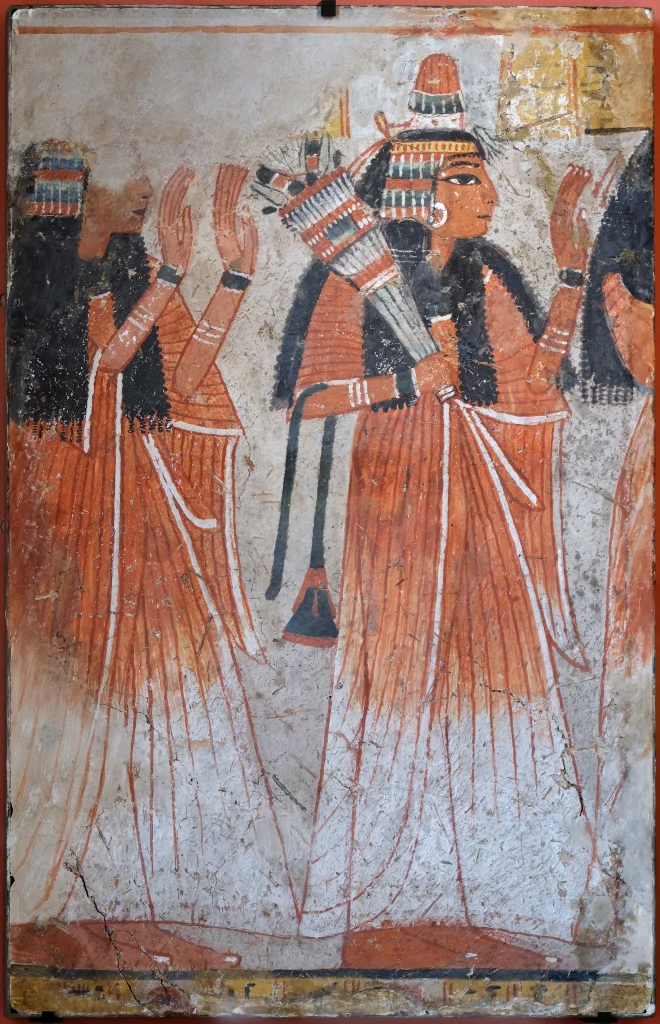
Wall Painting Fragment with Two Women in Ceremonial Dress
Details
The story
The wall this piece was cut from may still be standing in Egypt. The Louvre connects the fragment to a tomb on the west bank at Thebes, numbered TT 286 by Egyptologists, which belonged to a man named Niay, a scribe of the table, an official who saw to food and provisions. The tomb, on the hillside of Dra Abu el-Naga, has rich wall paintings, and between 2015 and 2017 conservators from the American Research Center in Egypt worked there and managed to fix some loose painted fragments back into their places on the walls.
This one went much farther. It belongs to the second collection of Frédéric Cailliaud, a French mineralogist and traveller who explored Egypt and the Sudan, and in 1824 his finds were bought for the Cabinet des médailles of the royal library in Paris. Only in 1907 was it transferred to the Louvre.
The painting is laid on mud plaster. It shows part of a procession of relatives, two women standing in pleated robes with long wigs, a lotus flower tied at the brow and a cone of perfumed fat on top of the head, earrings and bracelets, holding bouquets with their hands raised in worship. It dates from the Ramesside period, the 13th to the 11th century BC.
More works by Unknown Egyptian artist (Ramesside period)
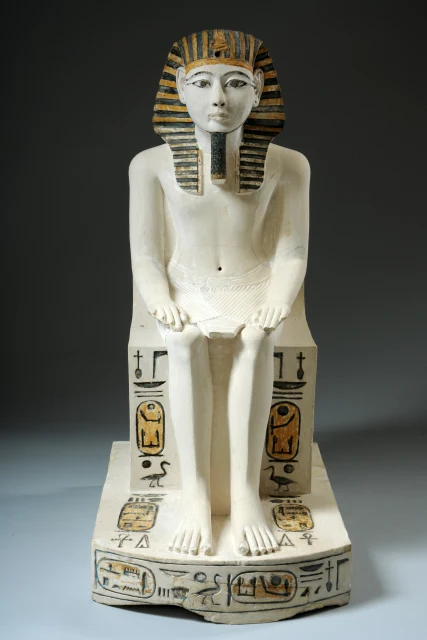 Cult Statue of Amenhotep IUnknown Egyptian artist (Ramesside period), -1242
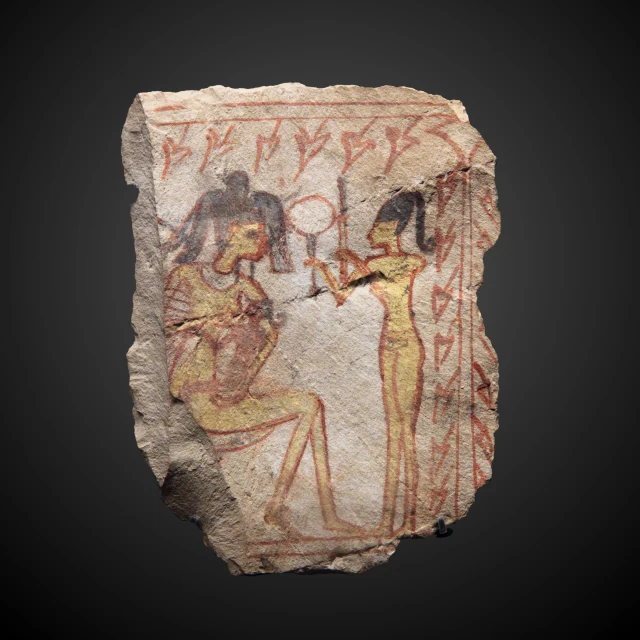 Figured Ostracon: Servant Presenting a Mirror to Her MistressUnknown Egyptian artist (Ramesside period), -1182
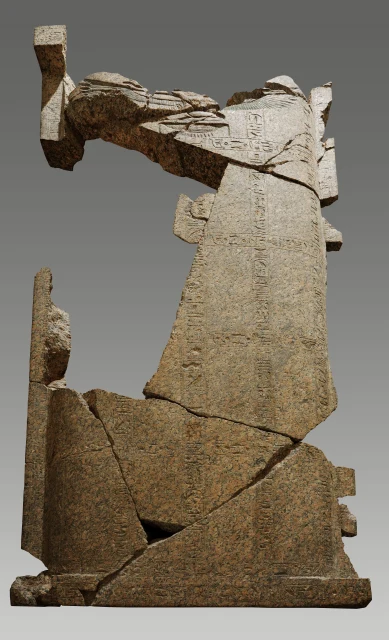 Lid of the Sarcophagus of Queen NefertariUnknown Egyptian artist (Ramesside period), -1246
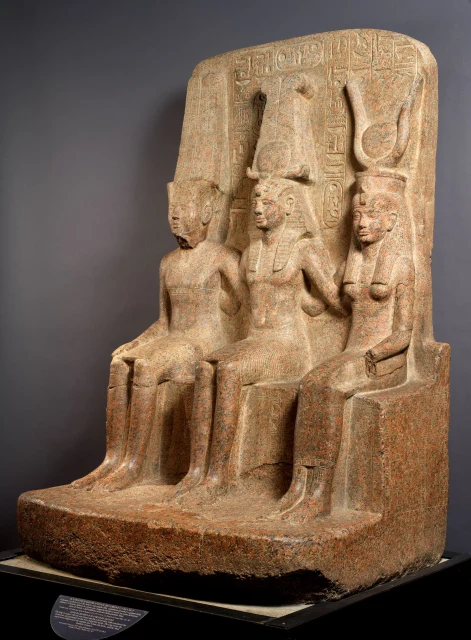 Ramesses II Seated between Amun and MutUnknown Egyptian artist (Ramesside period), -1246
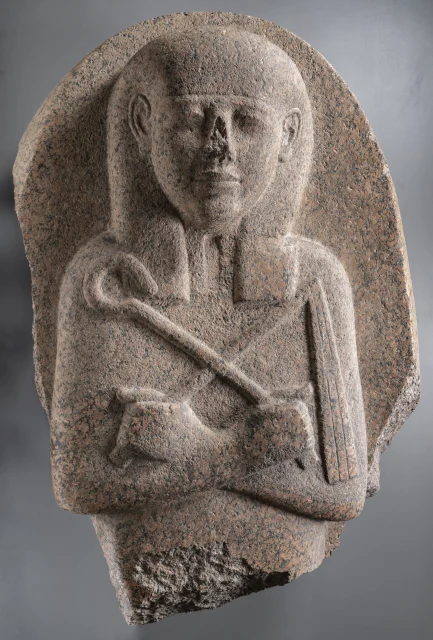 Sarcophagus Lid of Prince KhaemwasetUnknown Egyptian artist (Ramesside period), -1168