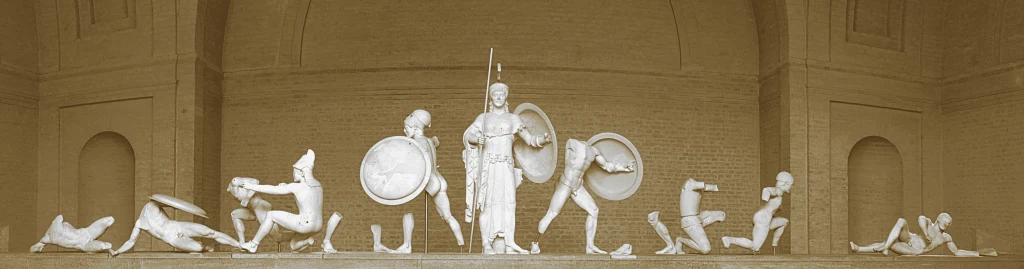
West Pediment of the Temple of Aphaia, Aegina
Details
The story
In April 1811 a small party of German and English travellers dug among the ruins of the temple of Aphaia on the island of Aegina, a short sail from Athens, in a Greece still ruled by the Ottoman Sultan. They found the marble warriors that had once filled the temple's two gables. On 1 November 1812 the sculptures were auctioned on Zakynthos, in the Ionian Sea, and Martin von Wagner, an agent buying for Crown Prince Ludwig of Bavaria, came away with them.
This is the west gable, which the museum dates to around 500 BC. It shows Greeks fighting before Troy, the war Homer sings in the Iliad, and the choice was local pride. Achilles and Ajax, the greatest Greek heroes of that war, descended from the royal house of Aegina. Athena stands at the centre, 1.68 metres tall with the crest of her helmet.
Before the figures went on show, the Danish sculptor Bertel Thorvaldsen spent the years 1816 to 1818 in Rome completing them, adding the heads and limbs they had lost. They stood like that in the Glyptothek from 1827. In the 1960s, as the war-damaged building was being restored, the museum took his additions off again, and the warriors now show their ancient breaks.
More works by Unknown Greek sculptor (Archaic)
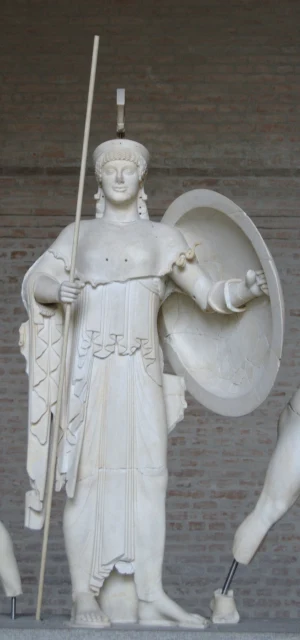 Athena from the West Pediment of the Temple of AphaiaUnknown Greek sculptor (Archaic), -500
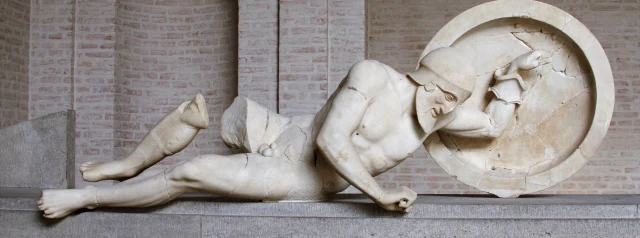 Dying Warrior ("Laomedon") from the East Pediment of the Temple of AphaiaUnknown Greek sculptor (Archaic), -490
 East Pediment of the Temple of Aphaia, AeginaUnknown Greek sculptor (Archaic), -490
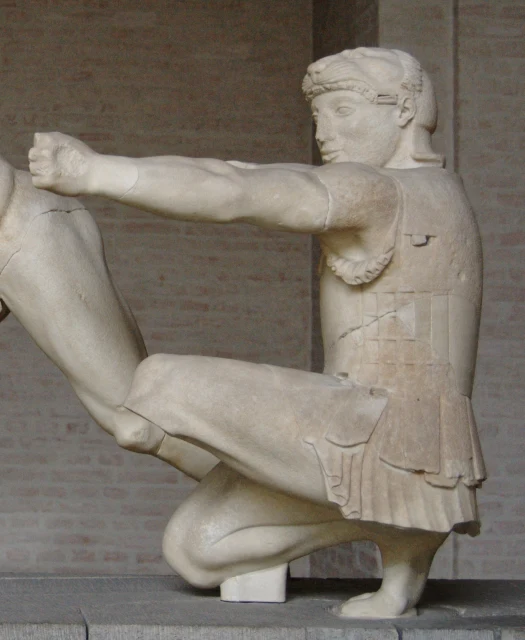 Herakles the Archer from the East Pediment of the Temple of AphaiaUnknown Greek sculptor (Archaic), -490
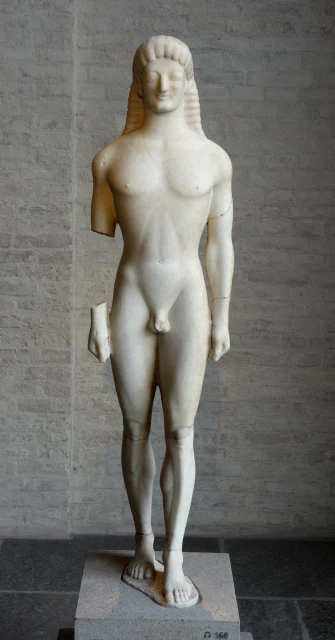 Kouros of TeneaUnknown Greek sculptor (Archaic), -560