The story
In 1859, with the war for Italian unification still on, Tuscany's provisional government ran a competition for paintings of its battles. Giovanni Fattori, then barely known, won the Magenta subject and delivered it in 1862: a wide, low canvas of the Italian camp after the fighting, a cart of wounded men crossing an empty field. It hangs on the second floor of Palazzo Pitti, rooms away from the small panels the same painter made later, where a sunlit wall, a shadow and a strip of sky do nearly all the work.
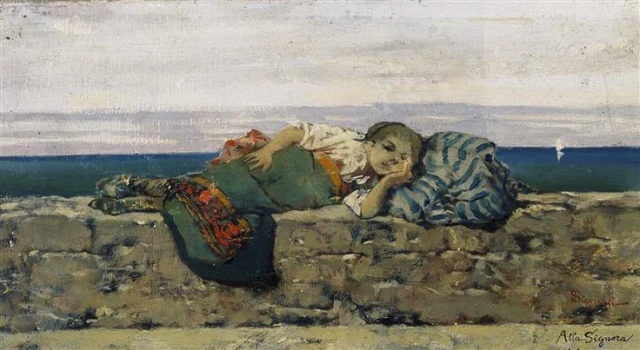
Those small pictures gave the group its name. In November 1862 a Florentine paper mocked painters showing studies built from patches of light and dark, macchie, and called them macchiaioli. They kept the jibe as a label, and this gallery has the largest collection of their painting anywhere, Fattori and Silvestro Lega, Telemaco Signorini, Giuseppe Abbati. The same rooms hold the academic history painting they were arguing with, so both sides of the quarrel hang under one set of ceilings.
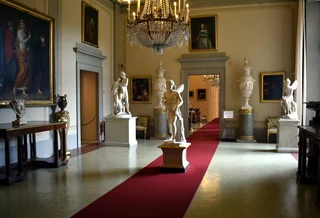
Much of the macchia came from Diego Martelli, the critic who defended them and put them up at his estate on the Tuscan coast. He died in 1896 and left his pictures to Florence, among them two landscapes by Camille Pissarro that reached him in 1878, when almost no one in Italy bought the French Impressionists. The state and the city agreed in 1914 to give the collection this floor, the old apartments of the Habsburg-Lorraine grand dukes, and it opened in 1924. Some 30 rooms run from late eighteenth-century neoclassicism into the early twentieth, and the Palazzo Pitti ticket for the Palatine Gallery downstairs covers this floor too. Only the Boboli Gardens need a separate one.