Vincent van Gogh · PD
Sunflowers
Details
The story
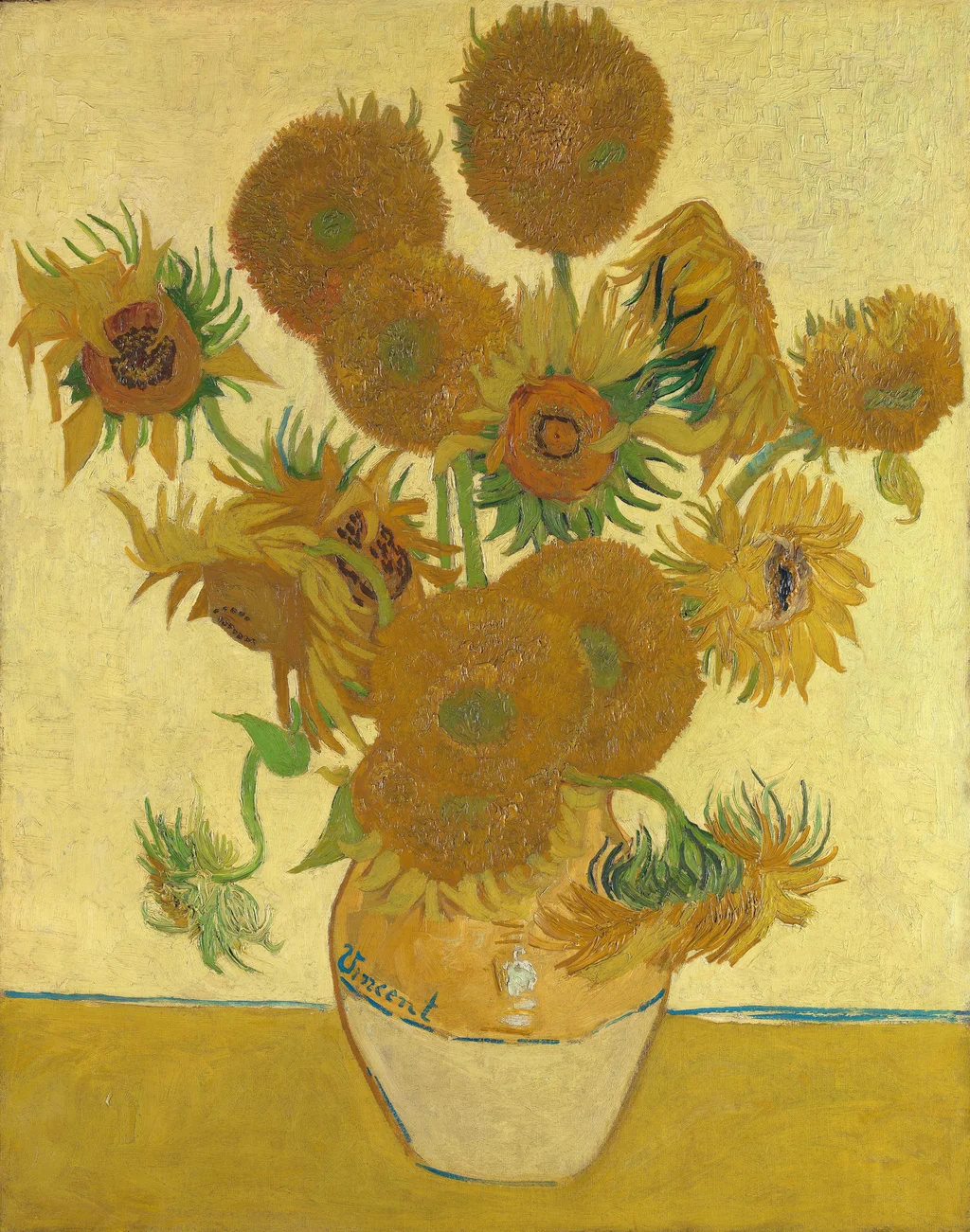
In late August 1888 Van Gogh was in Arles, painting sunflowers for the spare room of his Yellow House, where the painter Paul Gauguin was coming to stay. Around the 26th he wrote to his brother Theo about a new bouquet of 14 flowers on a green-yellow background. This is that canvas, though the gallery that owns it counts 15, from tight buds to heads gone to seed and shedding their petals.
Flowers, pot and wall are all yellow, from deep orange ochre down to a pale, greenish tone. A few thin lines of blue keep them apart. One runs between the two bands of the vase, and the same blue writes his name on it, simply Vincent.
When Gauguin arrived in October, this was one of two sunflower pictures hanging in his room. After he left Arles at the end of December, he wrote asking for this one, and called the sunflowers on a yellow ground a perfect page of the essential Vincent style. Van Gogh offered to paint it again for him and advised Theo to keep the sunflowers for himself and his wife.
That is where it stayed. Within two years both brothers were dead, and the canvas hung in the home of Theo's widow, Johanna van Gogh-Bonger, for more than 30 years. In 1924 the National Gallery in London asked for it. She had offered a loan, and wrote that she could hardly bear to part with a picture she had looked at every day. She sold it all the same, calling it a sacrifice for the sake of Vincent's glory. Bought with the Courtauld Fund, money given for modern pictures, it hung first at Millbank, in the building now called Tate Britain, and moved to Trafalgar Square in 1961.