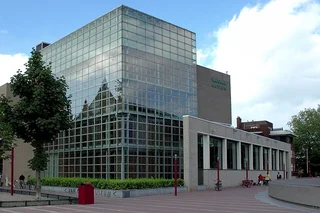
Vincent van Gogh sold almost nothing in his lifetime. When he died on 29 July 1890, his paintings passed to his brother Theo, an art dealer in Paris, and when Theo died too, in January 1891, the collection went to his widow, Johanna van Gogh-Bonger. Jo, as the family called her, sold works selectively, published Vincent's letters in 1914 and did more than anyone for his fame. In 1962 her son with Theo, Vincent Willem, transferred the collection to the Vincent van Gogh Foundation, and the Dutch state built a museum for it, which opened in 1973. The museum and the Foundation have remained separate bodies, and all 20 works in this article belong to the Foundation, which has placed them with the museum on permanent loan.
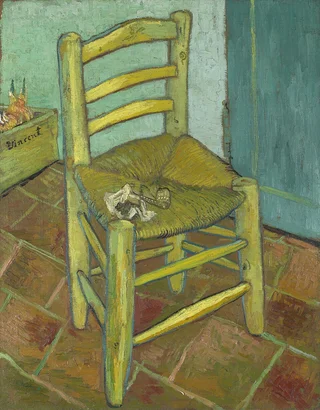
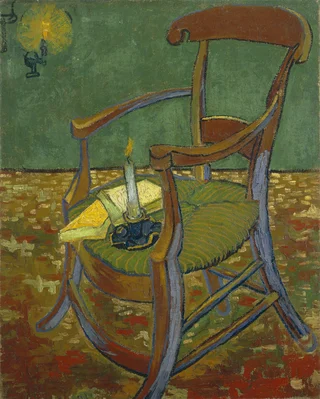
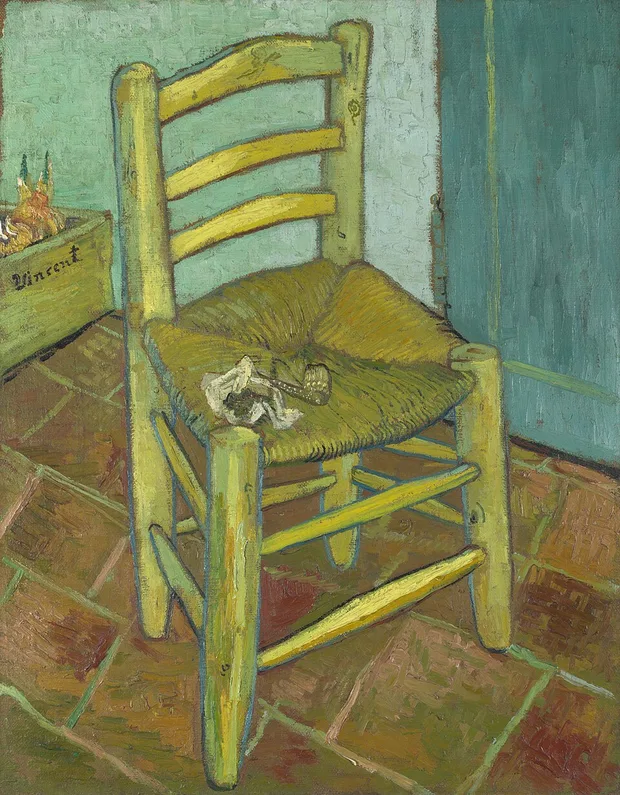
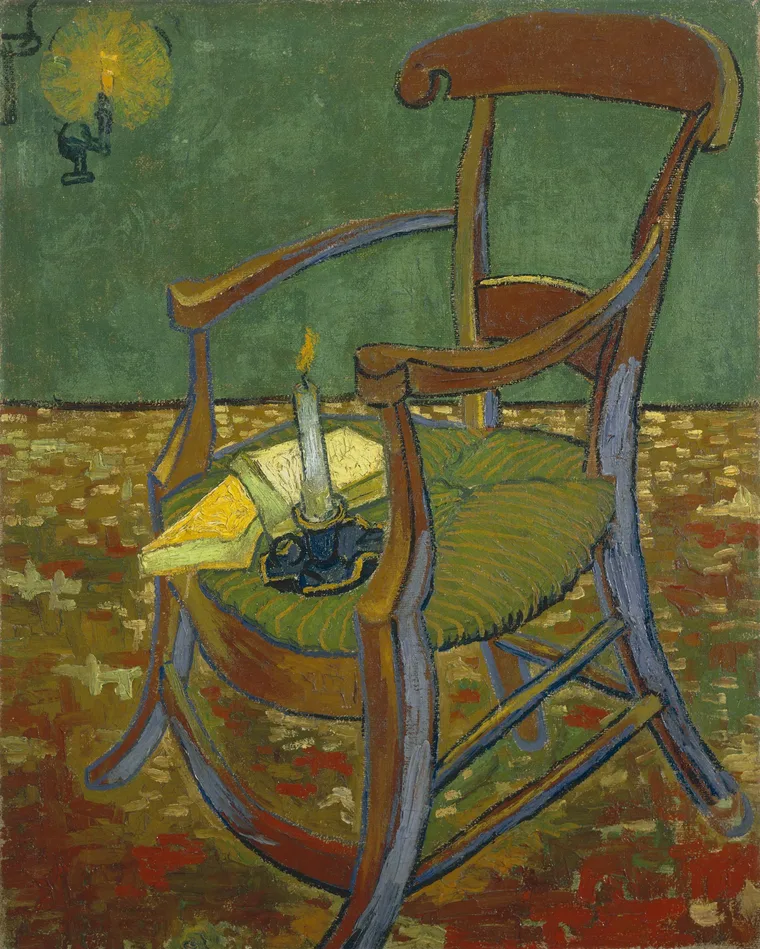
The family decided what to keep. In the 1920s it sold Van Gogh's Chair, a plain rush-seated chair by daylight with a pipe and tobacco on the seat, to the National Gallery in London, and kept its pendant, Gauguin's Chair, a night scene with a candle and two novels.
The people of Vincent's life keep appearing in these 20 works: the person he painted for, worked beside or portrayed, or the one to whom he later described a painting in a letter. We begin with the church he painted for his mother when she had broken her leg, and end with the tree roots on a bank at Auvers now thought to be probably his last work.
Nuenen, 1884–1885
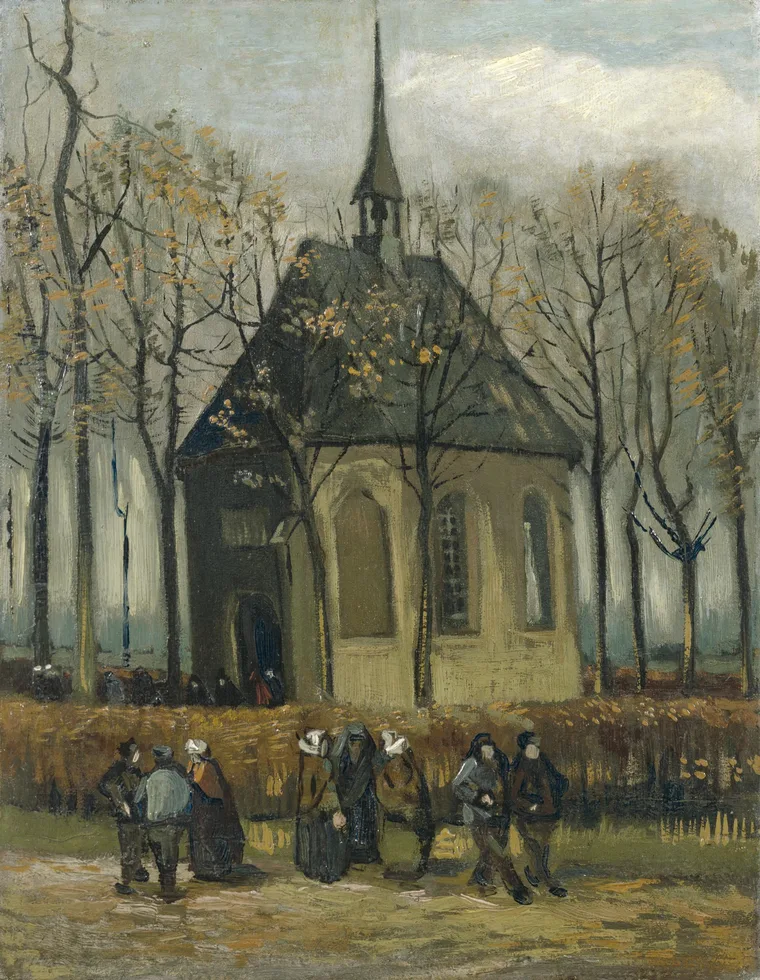
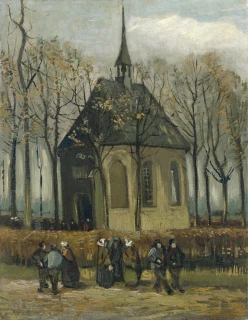
1. Congregation Leaving the Reformed Church in Nuenen — Vincent van Gogh, 1884–1885
On 17 January 1884 Vincent's mother, Anna van Gogh-Carbentus, broke her thighbone getting off a train. Vincent had been living in his parents' parsonage at Nuenen since December and was at odds with his father. He was there when the fracture was set and promised Theo he would write to him about her every day, and at the beginning of February he told his brother that he had recently painted “the little church with the hedge and the trees” for her, and enclosed a sketch. It was the church of his father, the pastor Theodorus van Gogh, a small Protestant church in a Catholic village.
In March 1885 Theodorus died suddenly. That autumn, 20 months after the first version, Vincent took the picture up again. In the sketch in the letter a peasant with a spade stands in front of the church, and now Vincent painted him out, brought a congregation out onto the path, put leaves on the bare branches and made the colours warmer. Nothing in his letters explains the reworking, and the historians who call it a memorial to his father, painted for his widow, are going by the dates.
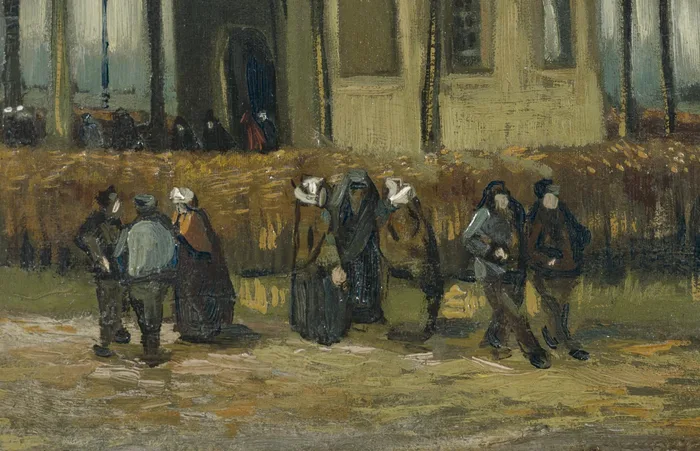
The churchgoers in the foreground have already left the church and are walking along the sandy path in front of the hedge: eight figures in three groups, the women in white caps and brown shawls, and the middle one of the three women at the centre wrapped in a dark hooded cloak. Those just coming out of the door show as tiny dark figures by the porch, and one of them has a fleck of red. The leaves on the thin trees are laid on in sparse strokes of orange and ochre, and the branches, bare in 1884, show through them.
His mother kept the painting until her death in 1907. It then passed to Vincent's sister Anna, and after Anna died in 1930, to her daughter, Sara de Jong-van Houten. In August 1958 Sara sold it to the first Vincent van Gogh Foundation at Laren, and so the painting came back to the branch of the family descended from Theo. In December 2002 two thieves climbed a ladder onto the museum roof, smashed a window with a sledgehammer and carried it off together with the early View of the Sea at Scheveningen. Both paintings were found in 2016 near Naples, in the house of a drug dealer linked to the Camorra, and the museum's restorer, Kathrin Pilz, found the church in surprisingly good condition.
In the restoration of 2017–2019 the yellowed varnish applied in 1961 was taken off the canvas, and the thin layer of egg white with which Vincent had coated the first, winter version was left in place, between the two layers of his paint.
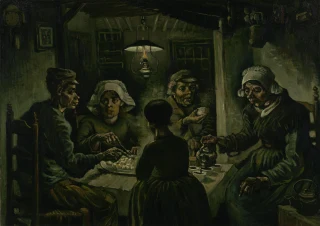
2. The Potato Eaters — Vincent van Gogh, 1885
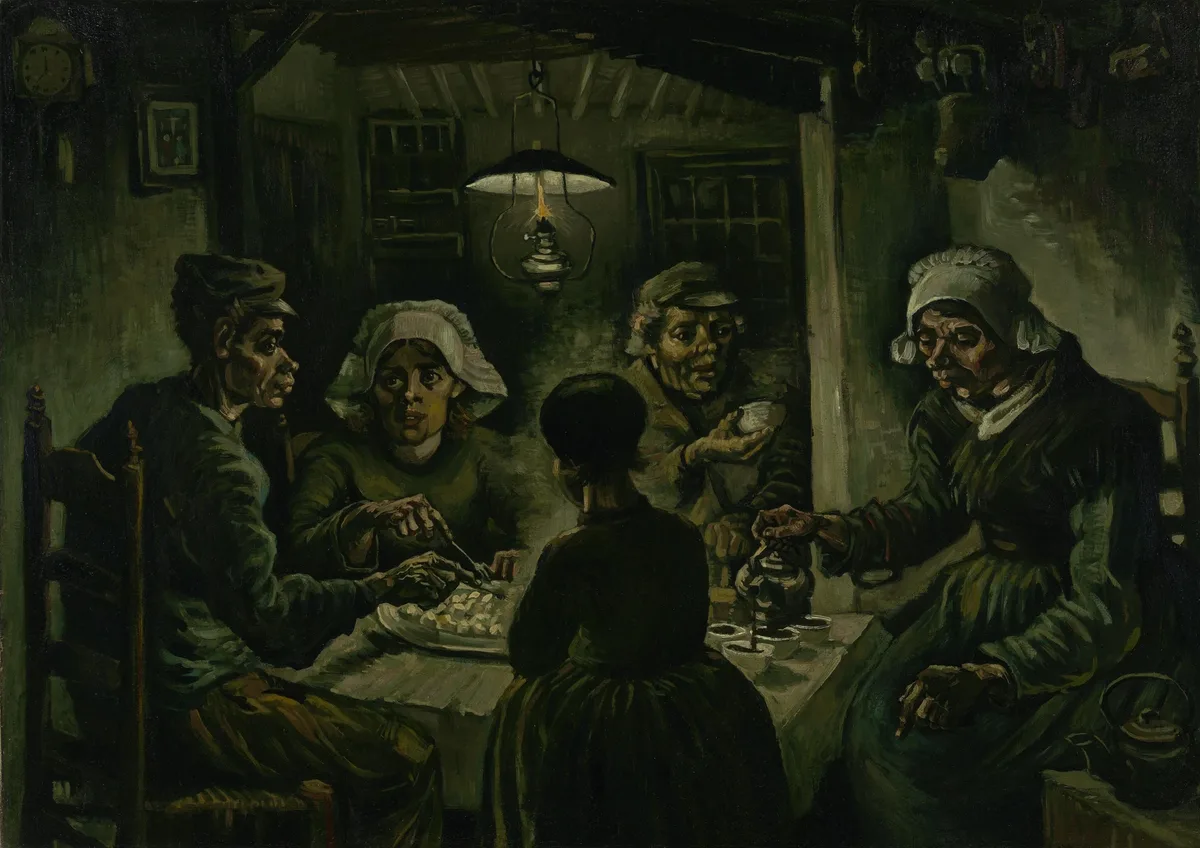
Anthon van Rappard, a painter who had been Vincent's friend for several years, received a lithograph of The Potato Eaters in the spring of 1885 and replied from Utrecht on 24 May. “You can do better than this, fortunately,” he wrote, “but why, then, observe and treat everything so superficially?” Then came a list. Of the coquettish little hand of the woman at the back he wrote “how untrue!”, the man on the right lacked “a knee or a belly or lungs” and had an arm a metre too short, and the woman on the left had “a sort of little pipe stem with a cube on it” for a nose. The next day Vincent sent the letter back, writing on it that he had just received it, to his surprise, and was returning it. Several more angry letters followed, and by the end of the summer the correspondence had broken off for good.
Vincent painted the picture in Nuenen in the spring of 1885 to prove to Theo, who was supporting him, that he could manage a composition with several figures. All the winter before, he had painted peasants' heads and hands, several dozen heads, and at the beginning of May he confessed to his brother that he had finished all the heads with great care and then quickly repainted them without mercy, in the colour of “a really dusty potato, unpeeled of course”. Gordina de Groot and probably her family posed for him, in their own cottage in Nuenen. Vincent wanted people to see that “these folk, who are eating their potatoes by the light of their little lamp, have tilled the earth themselves with these hands they are putting in the dish”.
The only light in the room comes from a small lamp with a flat shade hanging from the ceiling, and in its light only the faces, hands, white caps and potatoes show. The young man and young woman on the left reach with their forks into the shared dish, the old man holds a cup on his open palm, the old woman on the right pours from a pot into a row of cups, and in the middle, with her back to us, sits a girl, almost a black silhouette against the lit table. On the wall at the left hang a pendulum clock and a small picture of the Crucifixion.
Vincent went on defending the painting. In October 1887, by then in Paris, he wrote to his sister Wil that the painting of the peasants eating potatoes was “after all the best thing I did”. Theo hung it over the fireplace in his Paris flat, and after his death Jo kept it in her dining room.
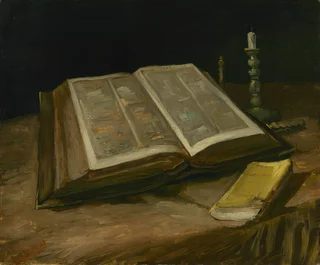
3. Still Life with Bible — Vincent van Gogh, 1885
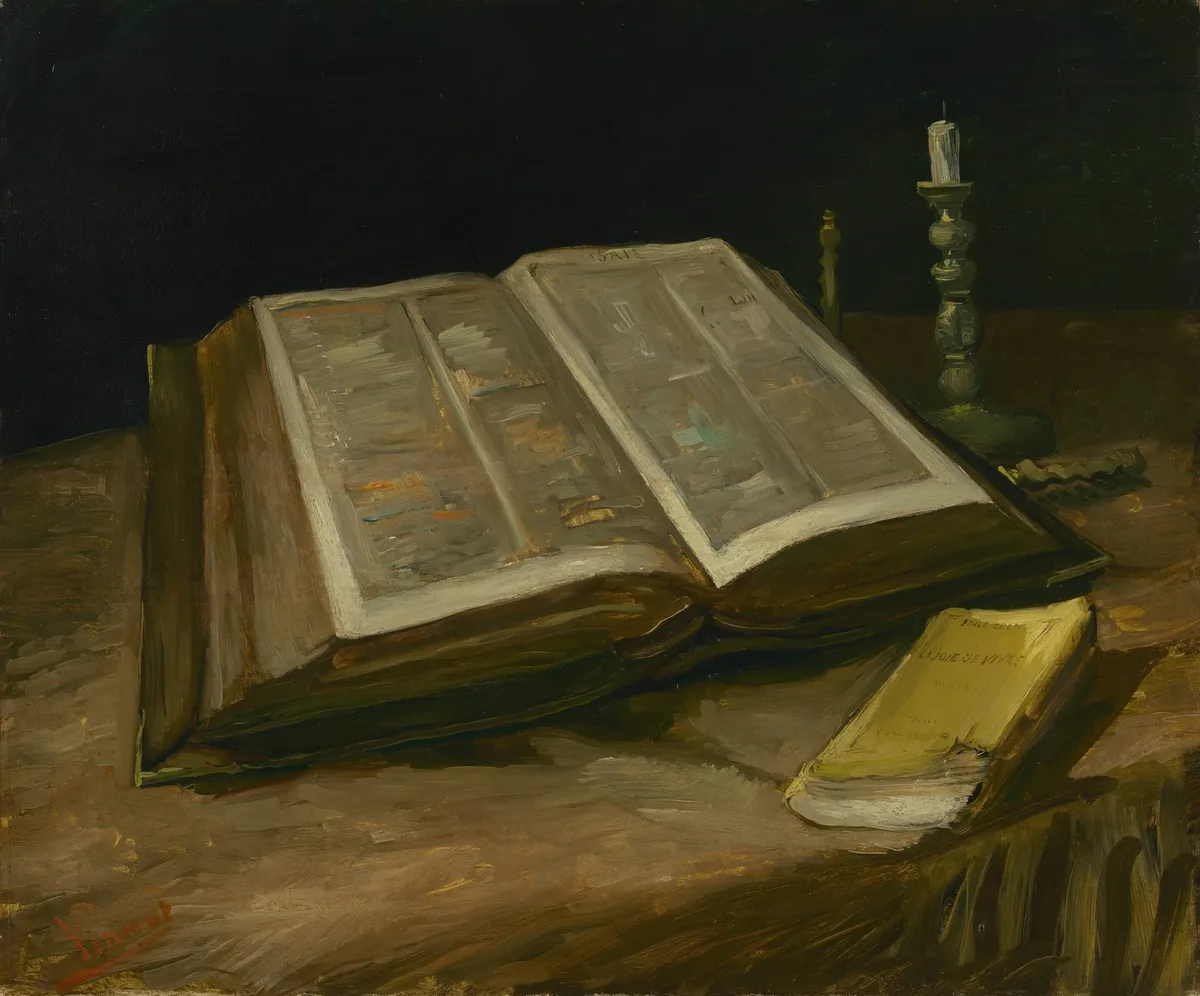
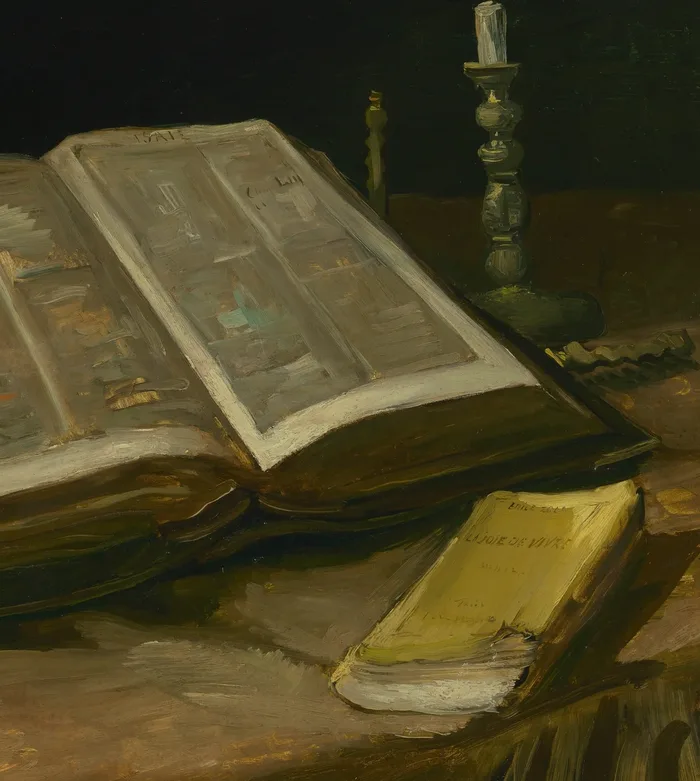
On the right-hand page of the open Bible, above lines that Vincent indicated with grey strokes, two inscriptions in French can be read, “ISAIE” and “Chap. LIII”. This is chapter 53 of the Book of Isaiah, about the servant of God who was despised and rejected of men. The Bible lies on the table, a heavy leather-bound volume, with a candlestick and an unlit candle behind it, and propped against it in front is a small, battered book in a lemon-yellow cover with dog-eared pages. On the cover one can read “EMILE ZOLA” and “LA JOIE DE VIVRE”, Zola's novel The Joy of Life.
Vincent's father, the pastor Theodorus van Gogh, had died suddenly in March 1885. At the end of October Vincent sent the still life to Theo and described in a letter “an open, hence an off-white Bible, bound in leather, against a black background with a yellow-brown foreground, with an additional note of lemon yellow”. He had painted it, he said, in one go, in a single day. The letter was part of the brothers' long argument about black, in which Theo, describing a study by Manet, had urged him to lighten his palette in the Paris manner. Vincent replied that it now came readily to him to paint any object without hesitation, whatever its shape or colour, but in that letter he says nothing about his father or about what the Bible and Zola's novel mean side by side.
Historians work out the rest from the objects themselves. The museum reads the painting as two views of the world side by side, the father's inherited faith and the son's modern naturalism, and takes the extinguished candle as a sign of death. The historians Cliff Edwards and Kathleen Powers Erickson have pointed out that the suffering servant of chapter 53 and Zola's heroine resemble each other. Pauline Quenu, an orphan exploited by the family that has taken her in, devotes herself to caring for that family all the same.
Paris, 1886–1888
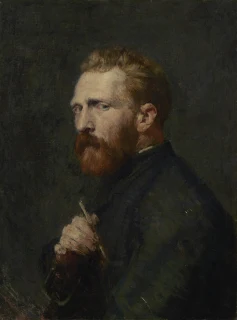
4. Portrait of Vincent van Gogh — John Peter Russell, 1886
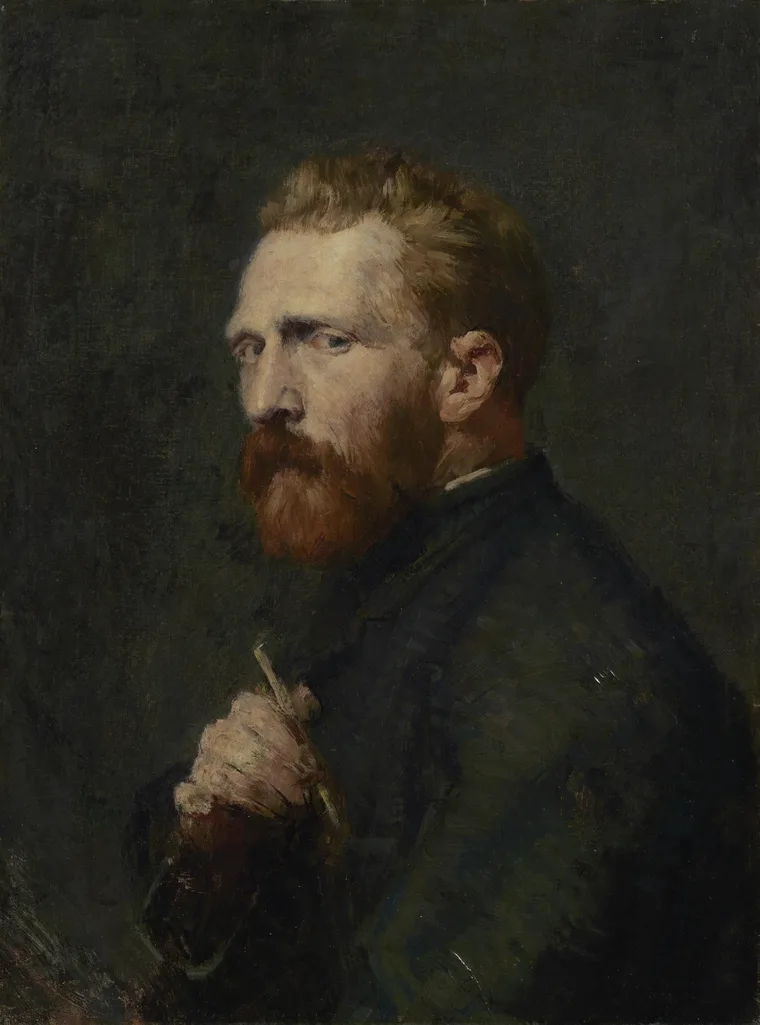
John Peter Russell, who was born in Sydney, lived on an inheritance from his family's engineering business and could afford to buy other painters' pictures. He studied for three terms at the Slade School in London, and at the beginning of 1885 he joined Fernand Cormon's studio in Paris on the boulevard de Clichy. Vincent arrived there as a newcomer a year later. Both were foreigners and both were students, and in 1886 Russell painted Vincent in his own studio in Montmartre.
Vincent sits almost with his back to us: the dark jacket and the shoulder fill the right half of the canvas, and he has turned his head to look back over his shoulder, his eyes slanting sideways. The red-brown beard is the warmest patch of colour. At his chest, in his raised hand, he holds a thin stick, a pencil or a brush, and the hand is painted more freely than the face, in ragged strokes of pink and white.
Above his head, on the dark ground, “VINCENT” is written large in pale reddish paint, with “PICTOR”, Latin for painter, beneath it, “J. P. RUSSELL” and “PARIS 1886” at the upper left and “AMITIE”, French for friendship, at the right. The letters have faded almost to the colour of the background, and they have to be looked for just above the hair.
Vincent left the portrait with Theo in Paris. In September 1889, from the asylum at Saint-Rémy, he urged his brother to go on collecting portraits, “above all of artists”, and to “take good care of my portrait by Russell, which means a lot to me”.
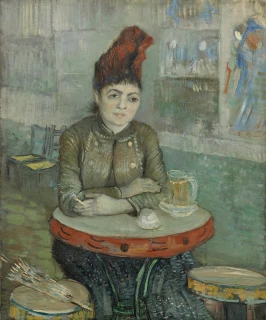
5. Agostina Segatori in the Café du Tambourin — Vincent van Gogh, 1887
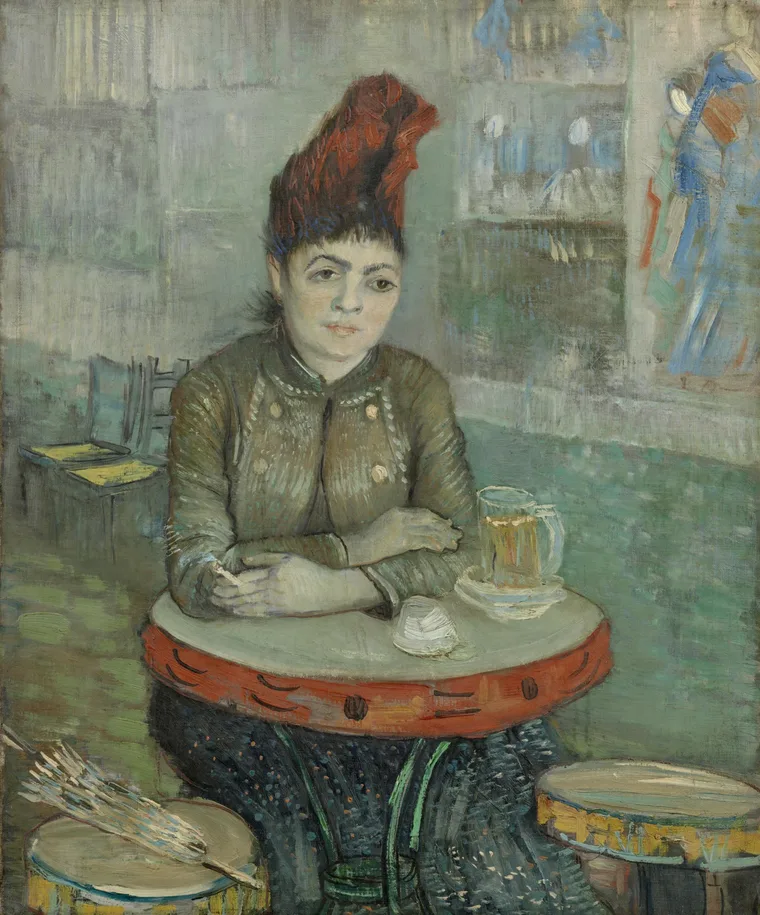
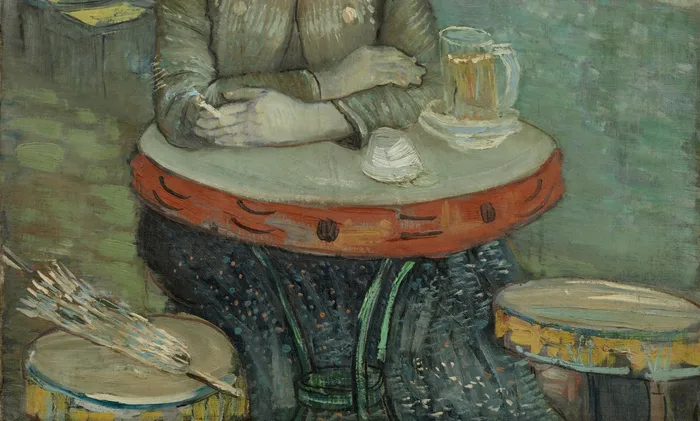
The tables at the Tambourin, a café-cabaret on the boulevard de Clichy, were made in the shape of tambourines, and the museum's catalogue notes that this is known only from this painting, because no photographs of the room survive. Here the tabletop is round, with a thick red-orange rim and dark circles around the edge like a tambourine's little bells, and the two stools in the foreground have the same shape, with a folded umbrella lying on the left one. Alone at the table sits the café's owner, Agostina Segatori, her arms crossed on the tabletop. She wears a tall red-brown hat and holds a thin cigarette in her fingers, a glass of beer stands on a pile of saucers to her right, and on the wall behind her hangs a Japanese print of a figure in a long blue robe.
Agostina was Italian, from Naples according to the museum, and had worked as an artist's model since about 1860. In 1866 Corot painted her. In the first half of 1887 Vincent was her lover. He paid for his meals with paintings, hung flower still lifes in the Tambourin in the hope that customers would buy them, and at the end of the winter put on a selling exhibition of Japanese prints there, which he himself later called a failure.
In July 1887, while Theo was away in the Netherlands, Vincent went to the café, because otherwise, as he wrote to his brother, people would have thought he didn't dare. Segatori was “as pale as wax”. She told him the paintings were at his disposal and warned him that someone at the café was trying to pick a fight with him. He decided not to take them straight away and to wait for Theo, because the paintings belonged to them both, and in his next letter he added that he still felt affection for her. The café was heading for bankruptcy and changing hands.
What became of the paintings left there is known only from the account of Émile Bernard, a young painter who was Vincent's friend in Paris, written down many years later, and the museum accepts it with a “probably”. According to Bernard, the paintings were seized against debts and sold off for next to nothing.
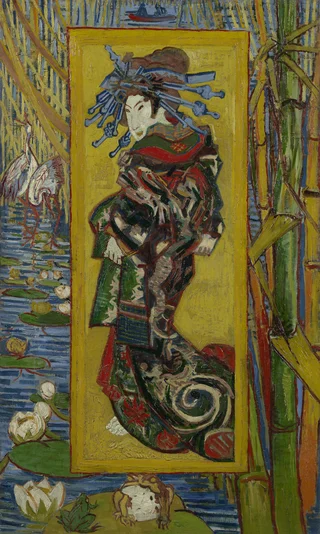
6. Courtesan (after Eisen) — Vincent van Gogh, 1887
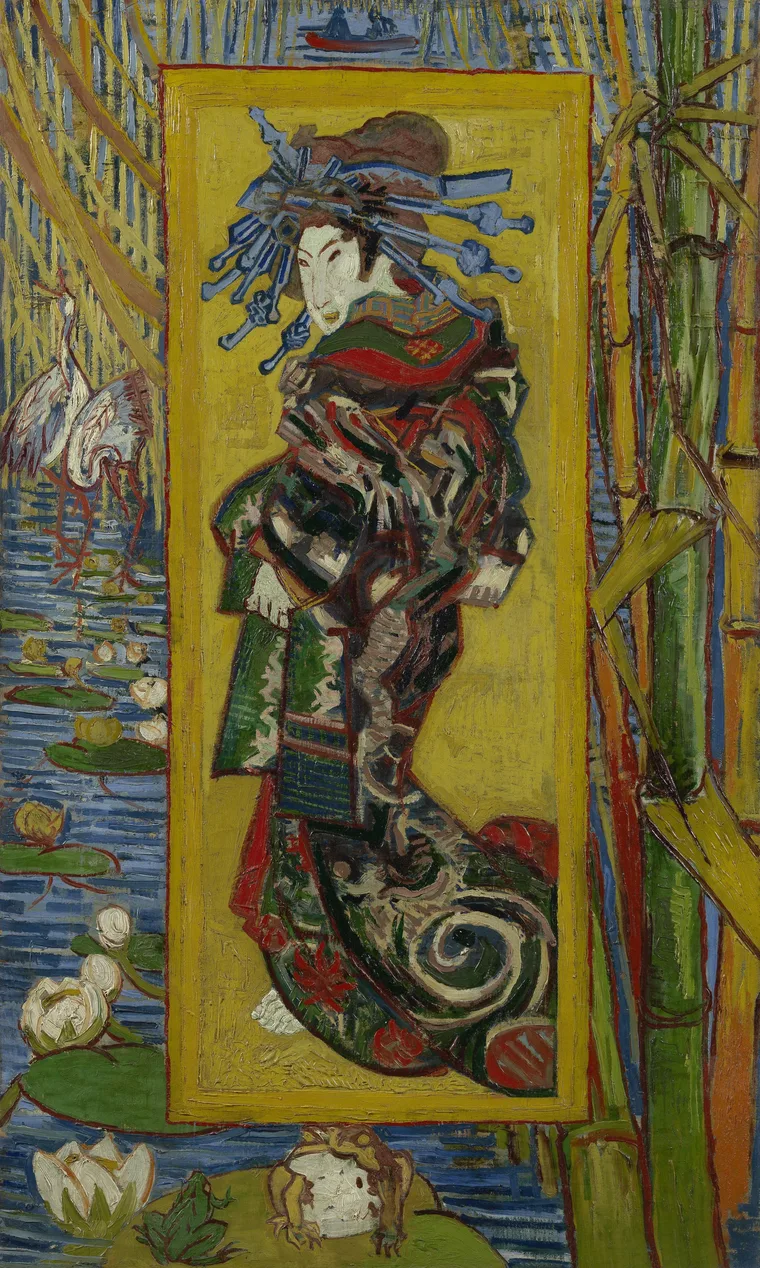
The cover of the May 1886 issue of the Paris magazine Paris Illustré, which was devoted to Japan, carried a colour reproduction of a print by Keisai Eisen showing a courtesan of the highest rank. In the autumn of 1887 Vincent traced her figure, ruled a grid over the tracing and used the grid to transfer the figure to canvas at twice the size, and the gridded tracing survives.
The courtesan stands on a flat mustard-yellow field set into a tall, narrow rectangle, turned to the right and looking back over her shoulder. Her hair is piled high and stuck with long blue pins that radiate around her head, and her heavy outer kimono, patched with green, red and black, swirls into a spiral at the hem. Her blue striped sash is tied in front, and the museum explains that this was how a courtesan tied her sash, whereas a respectable woman tied it at the back.
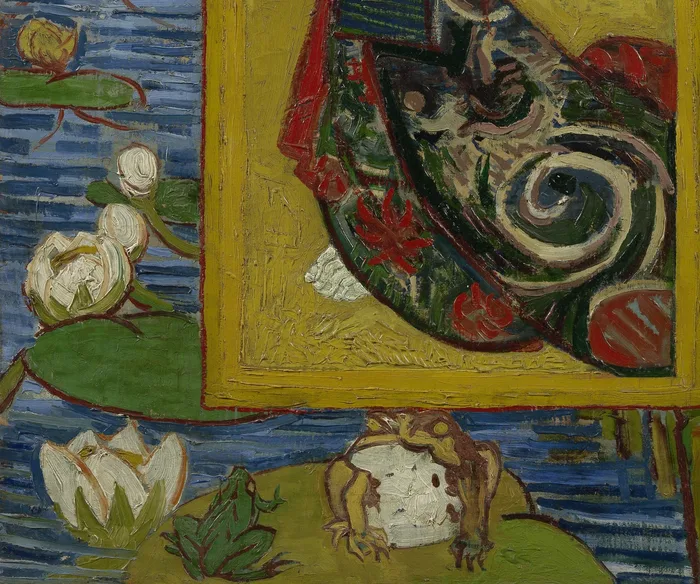
The pond with water lilies, the bamboo, the two white cranes with red legs at the upper left, the large toad and the small frog on the leaves at the bottom and the red boat with two figures at the top were Vincent's own additions, taken from other Japanese prints. The prints belonged to both brothers. In the winter of 1886–1887 they bought them up from the Paris dealer Siegfried Bing, at first intending to sell them on, and in March 1888 Vincent wrote to his sister, “Theo and I have hundreds of these Japanese prints.”
The painting stayed with Theo. The museum points out that in the French slang of the time “crane” and “frog” were both words for a prostitute, and reads the border of them around the courtesan as Vincent's joke.
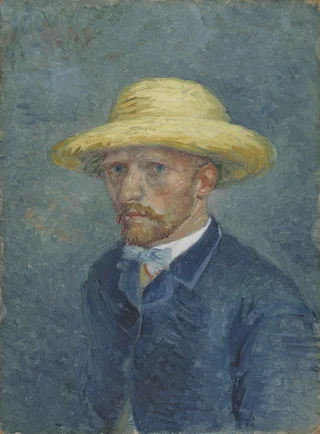
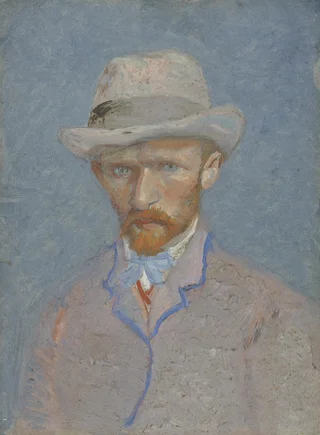
7. Self-Portrait or Portrait of Theo van Gogh — Vincent van Gogh, 1887
In 1943 the Swedish art historian Carl Nordenfalk suggested that two small portraits in Jo's collection, one in a straw hat and one in a felt hat, showed Theo. Theo's son Vincent Willem, known in the family as the Engineer, replied that no one in the family had ever said so. In 1958 J.-B. de la Faille, who compiled the catalogue of Van Gogh's work, declared the panel in the felt hat a portrait of Theo, and the Engineer objected sharply: “Mother said it was Vincent.” In 1960 he told the art historian A. M. Hammacher that his mother had always regretted that there was no portrait of Theo.
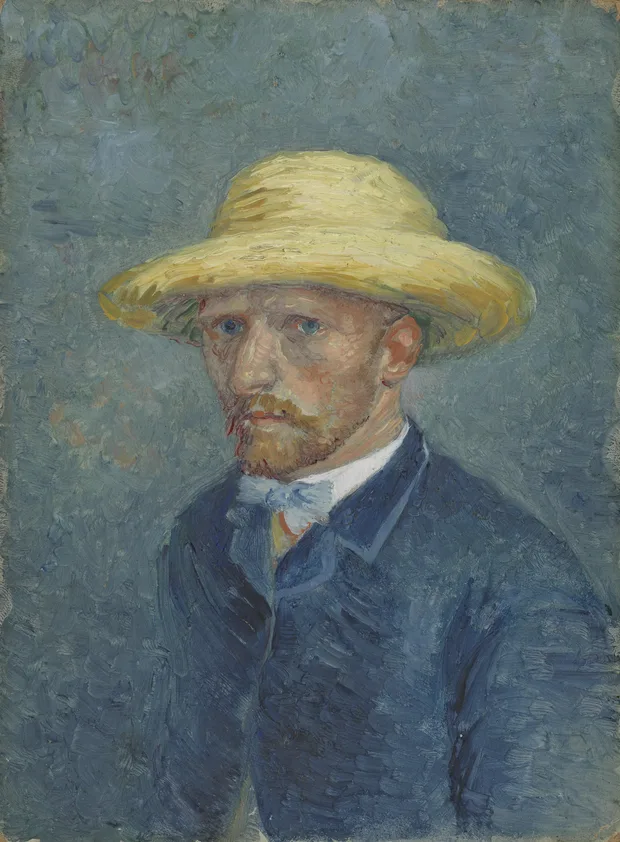
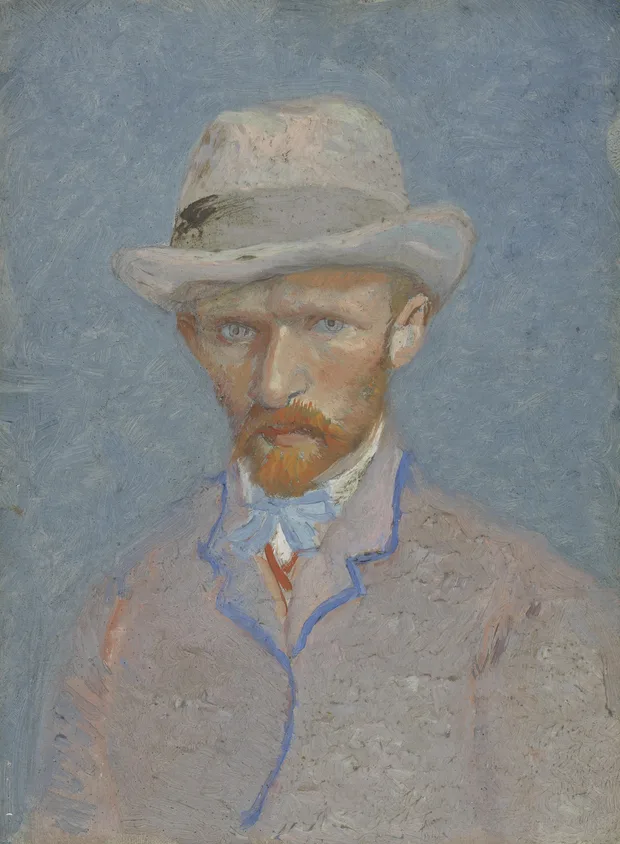
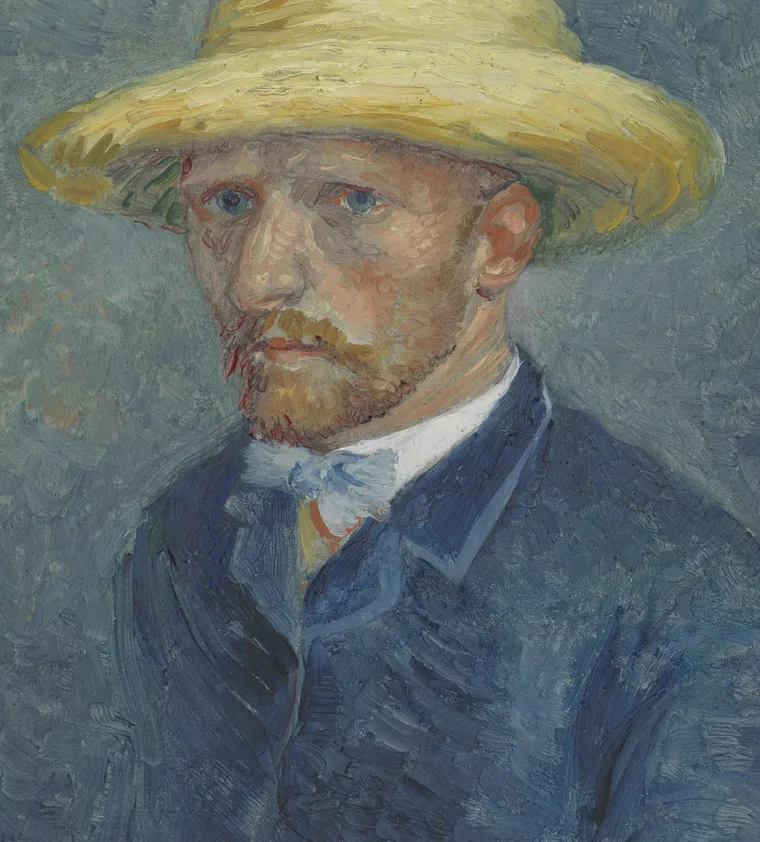
In 2011 the museum's researcher Louis van Tilborgh nevertheless identified the man in the straw hat as Theo. His beard is ochre and neatly trimmed, whereas Vincent's was red and unkempt, and his ear is rounded, while Vincent had “fleshy” ears. The portrait was retitled, and newspapers around the world wrote about the only painting of Theo. In 2019 Sjraar van Heugten, the museum's former head of collections, argued the opposite. The man in the straw hat has blue-green eyes, like Vincent's, while Theo's were pale grey-blue, and, as he put it, it is hard to believe that Vincent would have dressed his brother in casual summer clothes and painted himself as a solid gentleman.
The portrait is small, on cardboard, and its corners are worn. The broad straw hat is built up from short lemon and cream strokes, the eyes are bright blue with red-tinged lids, a pale blue bow is tied at the throat, and to the right of the face is that rounded ear, pinkish orange. The face is painted in small, precise touches, far finer than the jacket and the grey-blue background of short curls.
In July 2019 the museum acknowledged that the sitter could not be identified and gave the painting a double title. The museum still regards its pendant in the felt hat as a self-portrait.
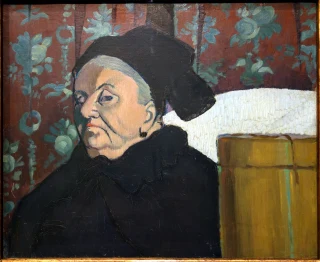
8. The Grandmother — Émile Bernard, 1887
Émile Bernard and Vincent swapped paintings in Paris in the winter of 1887–1888, before Vincent left for the south. Bernard received one of his self-portraits, in all probability the Self-Portrait with Straw Hat now in Detroit, and Vincent received this portrait. In the autumn of 1888 he reminded Theo from Arles that Bernard already had a self-portrait of his, “which I exchanged with him at the time for the portrait of his Grandmother”.
In the autumn of 1887 Bernard painted his grandmother, Sophie Albertine Bodin-Lallement, recently widowed and newly moved to Asnières outside Paris, three times, in the wooden studio his parents had built for him in the garden. Bernard was 19, and that same year, together with Louis Anquetin, he devised what was later called Cloisonnism, flat areas of colour enclosed by dark outlines, as in stained glass. The Amsterdam version is the most fully worked of the three.
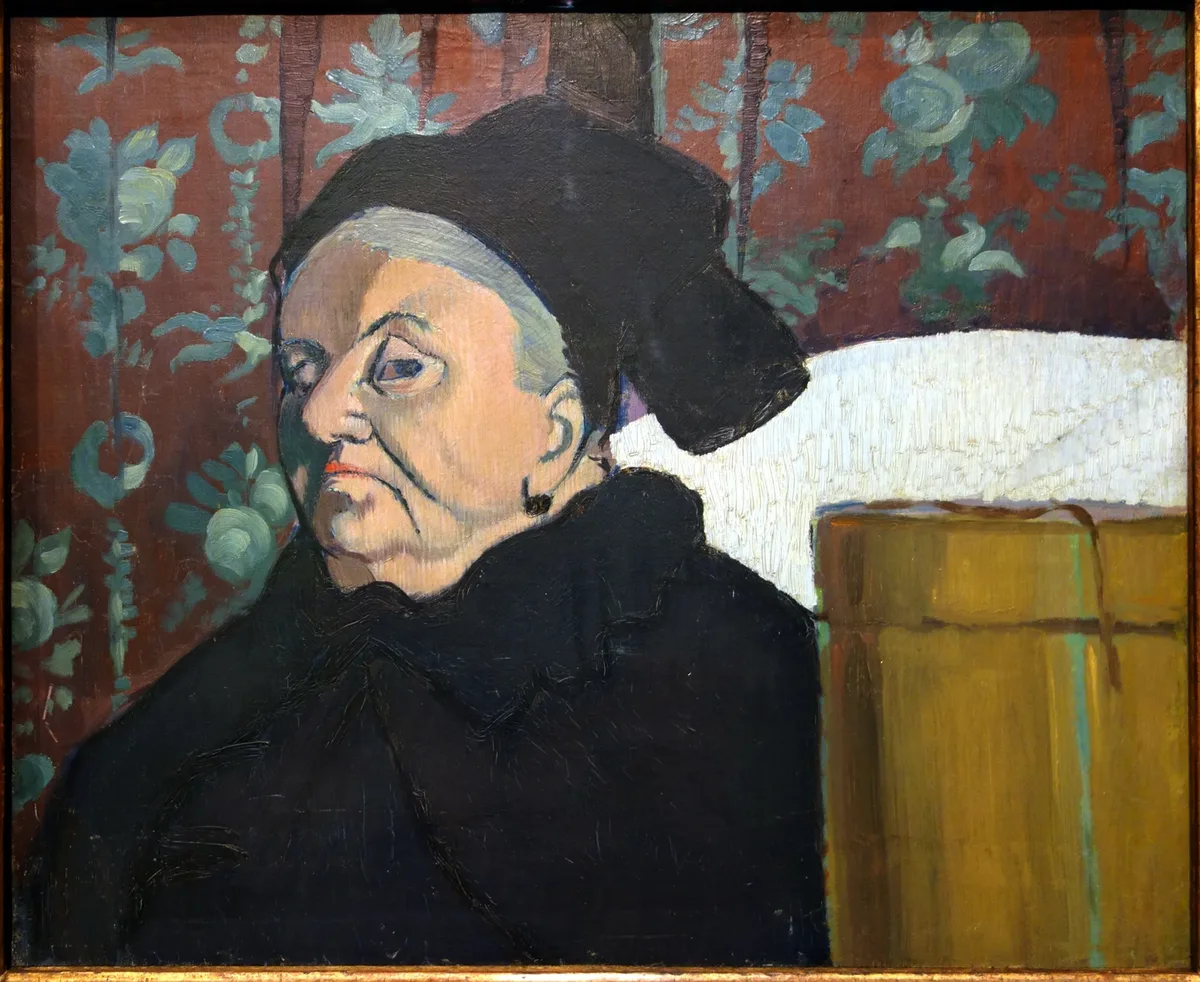
The grandmother has turned to the left and looks at the viewer sidelong from under heavy lids, the corners of her mouth turned down. She wears a black cap with a long lappet hanging down her back and a flat black dress with a frill up to the chin, and the dress runs on past the bottom edge, so her hands are out of the picture. The face is covered with fine vertical hatching, the nose and eyebrows are drawn in dark blue lines, and the lips are a single stroke of vermilion. Behind her hangs a brick-red cloth with large sea-green roses. To the right lies a white pillow, painted in thick vertical strokes and pressed right up against the black dress, the lightest place on the canvas, and in front of it stands a tall hatbox tied with string.
In the summer of 1888 Vincent wrote to Bernard from Arles about “the two portraits of your grandmother”, and this portrait was one of them. “You've never been closer to Rembrandt, my dear chap, than then.” Bernard signed the other two versions, in Boston and Kansas City, and this one carries no signature, which the museum's catalogue explains by the painting having left him in the exchange before he had time to sign it.
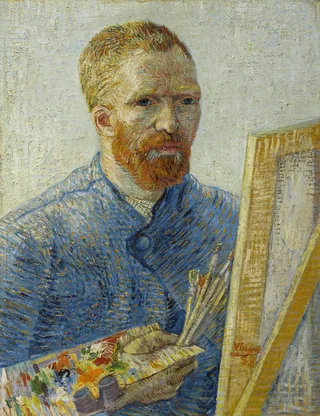
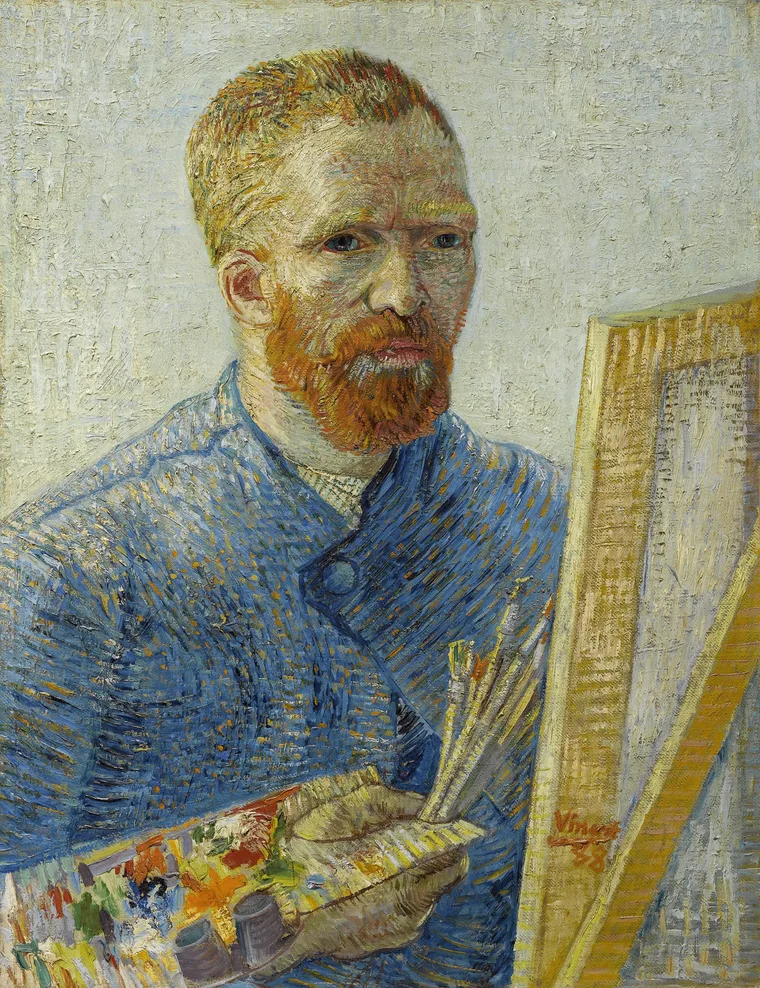
9. Self-Portrait as a Painter — Vincent van Gogh, 1887–1888
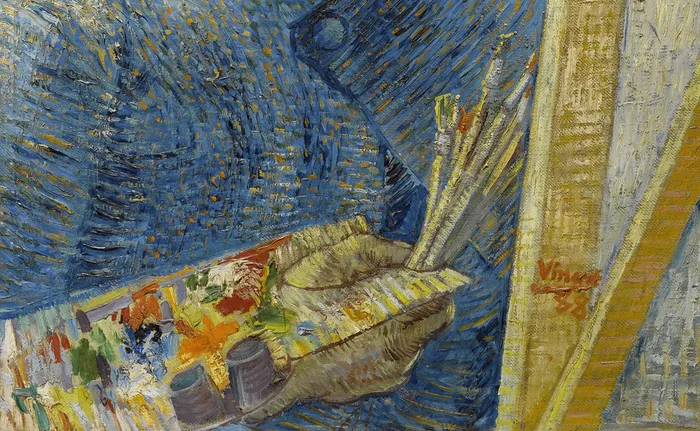
In June 1888, four months after moving to Arles, Vincent described his portrait at the easel in words for his younger sister Wil. He meant “a portrait that I painted in the mirror, and which Theo has”, and he went through it: “a pink-grey face with green eyes, ash-coloured hair, wrinkles in forehead and around the mouth, stiffly wooden, a very red beard, quite unkempt and sad, but the lips are full, a blue smock of coarse linen, and a palette with lemon yellow, vermilion, Veronese green, cobalt blue”. The museum considers this painting the last work he made in Paris.
The canvas on the easel stands at the right, turned edge-on to us, and on the yellow bar of its stretcher the signature “Vincent” and the figures “88” are painted in red-orange. There is only one hand in the picture, and it holds both the palette and a bunch of brushes. Orange and yellow dashes are scattered over the blue smock, the red beard blazes next to the blue, and the museum notes that the palette carries the same pairs of complementary colours, red and green, yellow and violet, blue and orange, with which the whole portrait is painted. He painted from a mirror, yet, as the museum's researchers noticed, he moved the fastening of his smock to the side where it belongs on men's clothing.
The painting stayed in Theo's flat when Vincent went south. In the same letter to his sister he described how he looked now. His hair and beard were cropped short, his complexion had changed from green-grey pink to grey-orange, he wore a white suit instead of a blue one, “always dusty”, and went about laden with sticks, easel and canvas “like a porcupine”.
Arles, 1888–1889
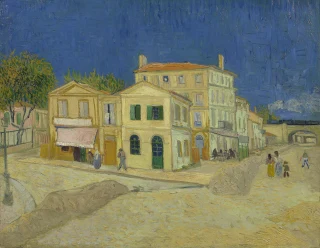
10. The Yellow House (The Street) — Vincent van Gogh, 1888
On 1 May 1888 Vincent rented the right-hand wing of the house at 2 place Lamartine in Arles for 15 francs a month. The house was, as he wrote to Theo, “painted yellow outside, whitewashed inside, in the full sunshine”, with two large rooms downstairs, for a studio and a kitchen, and two small ones upstairs. He could only move in in mid-September, when he bought beds with Theo's money. He meant to set up a studio of the south in the house, and he invited the painter Paul Gauguin as its first guest.
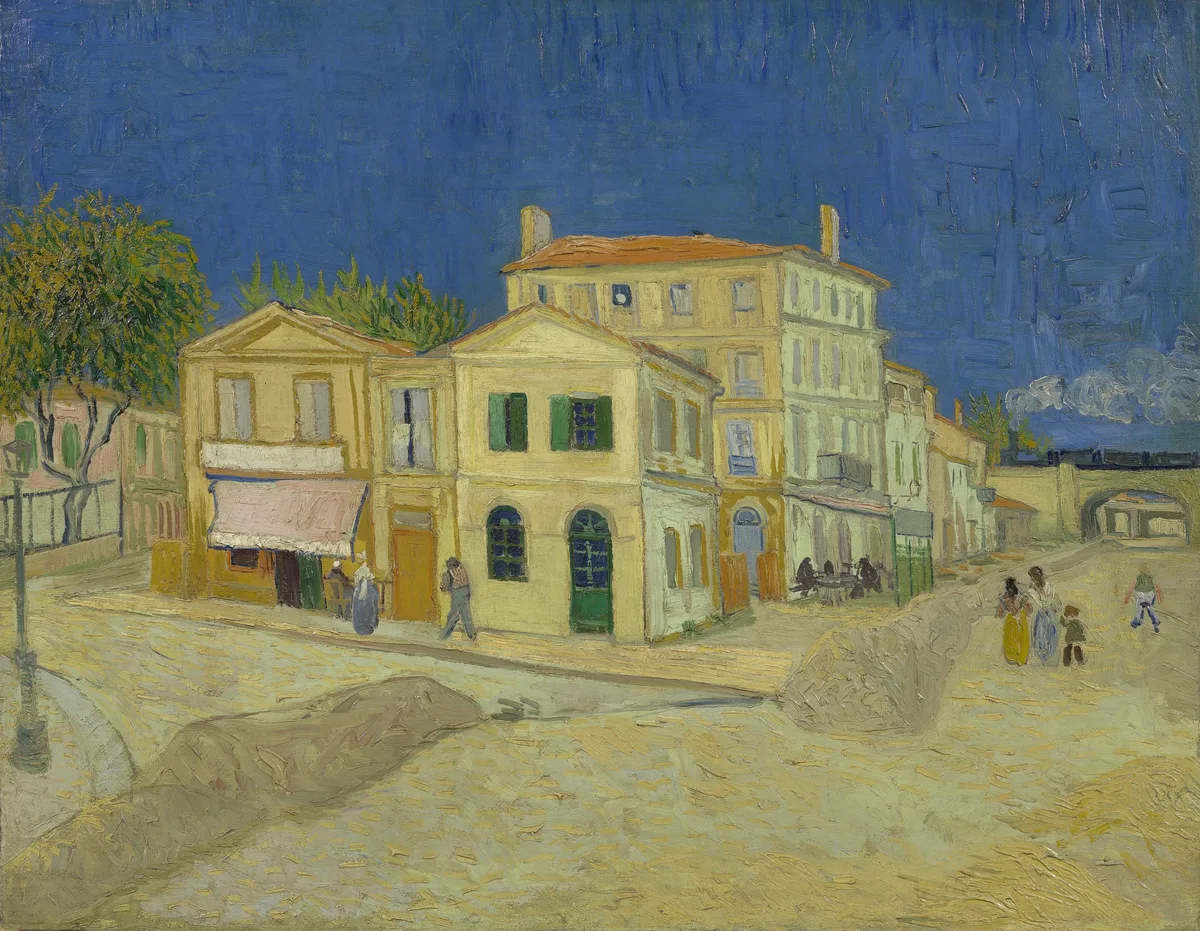
At the end of September Vincent painted the house from the street and described the picture to his brother, the house and its surroundings “under a sulphur sun, under a pure cobalt sky”, adding that it was a difficult subject and that he wanted to conquer it for that very reason. His friend Paul-Eugène Milliet, a lieutenant in the Zouaves, found the picture horrible and could not understand how anyone could enjoy painting “such an ordinary grocer's shop”. Vincent's answer was the boulevard at the start of Zola's L'Assommoir and the quay at the start of Flaubert's Bouvard and Pécuchet.
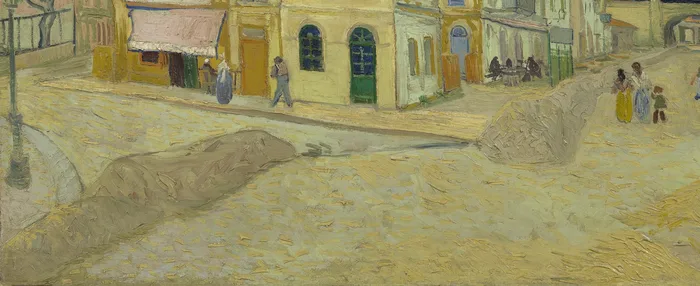
The Yellow House stands left of centre, with green shutters and a green door on the corner, and the shutters on the two upstairs windows differ, those on the left almost closed, those on the right thrown open. On the left is a pink house with green shutters, half hidden by a tree, the restaurant where Vincent ate supper every day. On the right a train crosses the railway bridge, trailing a long white streak of smoke across the blue sky, and at the far end of the street, between the two bridges, lived the postman Joseph Roulin, whose family Vincent painted in December. Two low grey-brown heaps lie across the street in the foreground. They were long taken for a trench for the gas pipes that Vincent had laid on in the house before Gauguin arrived, but in 2025 the museum's researcher Teio Meedendorp showed that gas had reached Arles long before, and that the heaps were sand for spreading over horse dung.
On 25 June 1944, during an American bombing raid on the bridges and the station, a bomb hit the house and the ruins were pulled down, while the railway bridges in the painting are still standing.
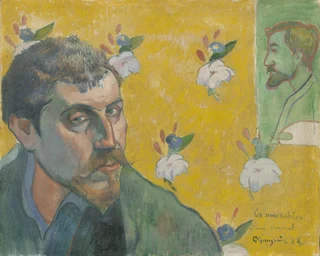
11. Self-Portrait with Portrait of Émile Bernard (Les Misérables) — Paul Gauguin, 1888
In September 1888 Vincent wrote from Arles asking Paul Gauguin and Émile Bernard, who were then working at Pont-Aven in Brittany, to paint portraits of each other and send them to him, and he would send his own work in return. This, as he understood it, was how Japanese artists exchanged work. The museum believes it was also a way of hurrying Gauguin along, because Vincent was afraid the company at Pont-Aven would not let him go. Gauguin was 40, recently back from Martinique and deep in debt, and young painters had gathered around him, while Bernard was 20.
They did it their own way, each painting himself and putting the other's portrait in the background. On 1 October Gauguin explained to Vincent that he had painted himself as Jean Valjean from Hugo's Les Misérables, the former convict “whom society oppresses, outlawed”, and described his face as “the mask of a thief, badly dressed and powerful like Jean Valjean, who has his nobility and inner gentleness”. The childish flowers on the wallpaper, he said, were there “to testify to our artistic virginity”.
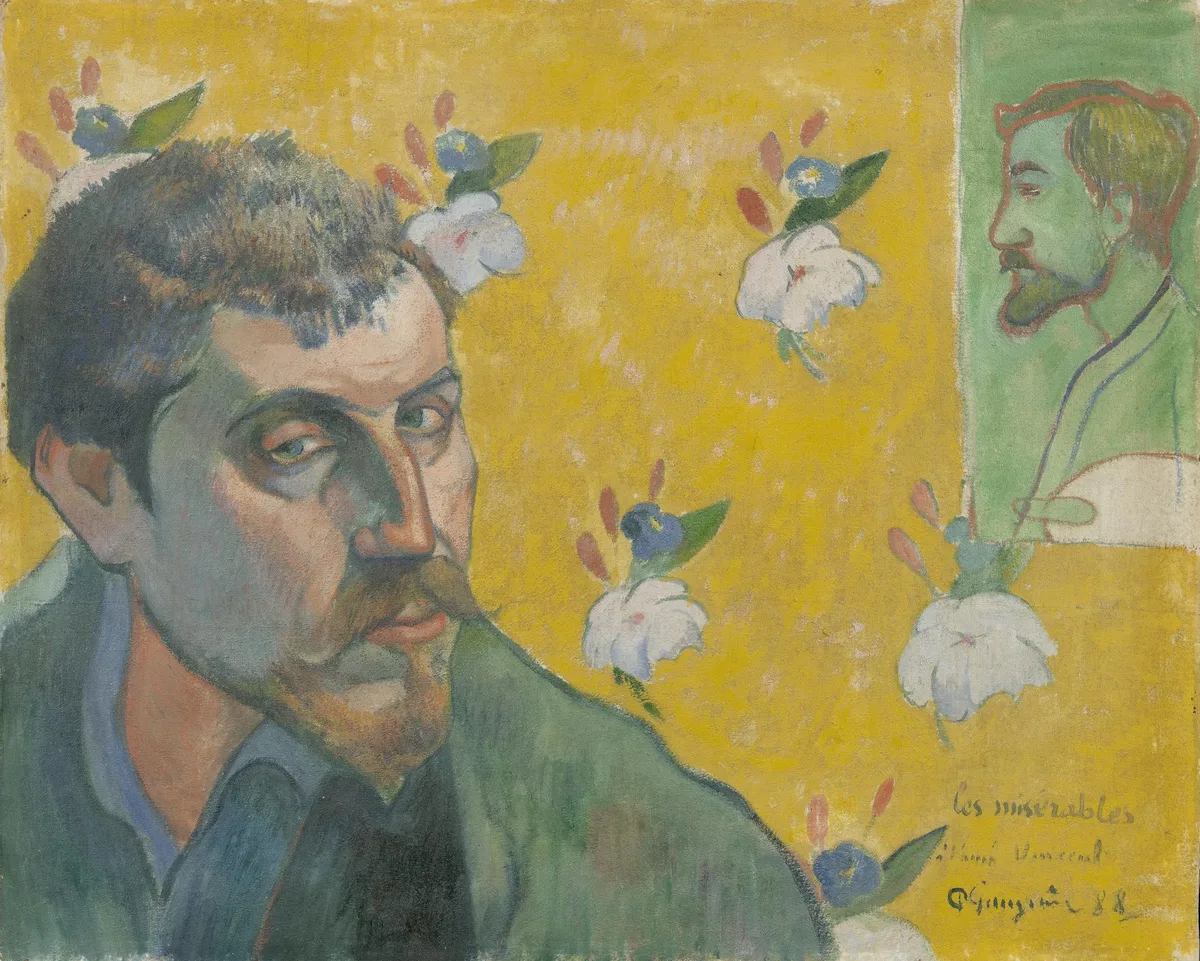
The painting reached Arles a few days later. Vincent wrote to Theo that it had “above all the effect of representing a prisoner”, with “not a hint of cheerfulness”, that the flesh in the shadows was “lugubriously tinged with blue” and that Gauguin looked ill and tormented, and that he himself preferred the portrait Bernard had sent. He wanted Theo to buy the painting, but Gauguin replied that it was not for sale and had been made for Vincent.
Gauguin's head is pressed against the left edge, the eyes slanting towards the viewer from under heavy lids. The face is broken into hard planes, hot orange on the nose and cheek and cold green shadow on the other half, with no transition between them, and a thick reddish moustache hangs under the nose. Everything else is flat chrome-yellow wallpaper with small posies. In the upper right corner, cut off by the edge, hangs a green rectangle with Bernard's profile outlined in red, and at the lower right, in dark paint, is written “les misérables”, below that “à l'ami Vincent”, “to my friend Vincent”, and the signature “PGauguin 88”.
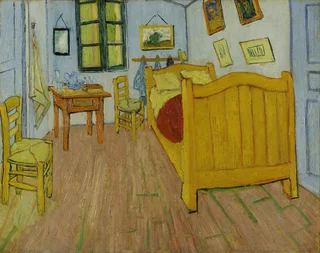
12. The Bedroom — Vincent van Gogh, 1888
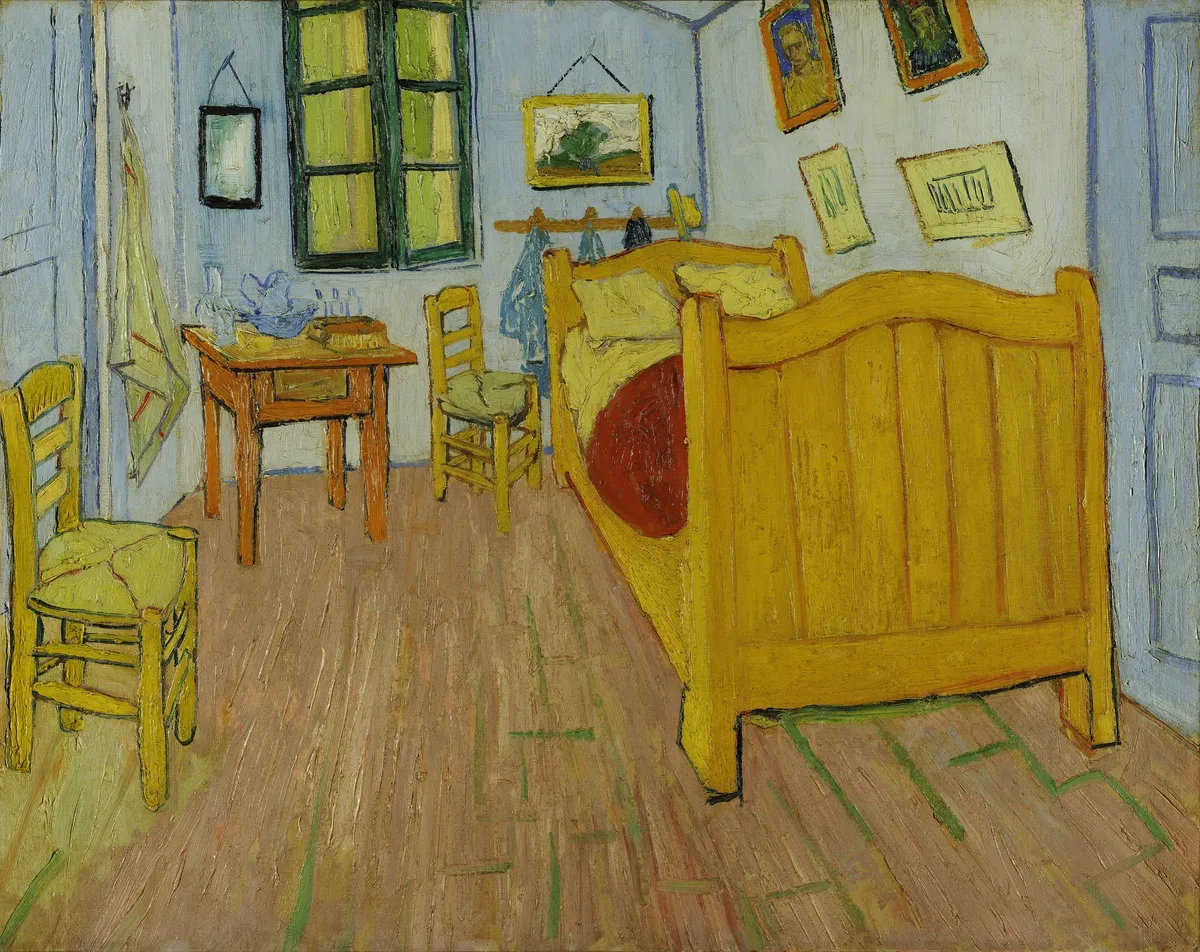
“My eyes are still tired,” Vincent wrote to Theo on 16 October 1888. For several weeks he had been furnishing and decorating the Yellow House for Gauguin's arrival, then he had been forced to rest for two and a half days, not daring to go out, and in that time he painted his own bedroom as part of the decoration of the house, as he explained in a letter to Gauguin himself. Looking at the painting, in his words, should rest the mind, and he had painted it “to take my revenge for the enforced rest”.
He described it to Theo colour by colour. The walls pale violet, the floor red tiles, the bedstead and the chairs fresh butter yellow, the sheet and the pillows very bright lemon green, the blanket scarlet, the window green, the dressing table orange, the basin blue, the doors lilac, and no shadows, flat tints “like Japanese prints”.
Today the walls and doors are blue. The violet mixture contained a red pigment that faded and left the blue behind, and the floor turned from red to a greyish pink, so the original lilac survives only in a stroke at the right edge, under the frame. Everything else is still there: the mirror in a black frame on the wall to the left of the window, the towel by the left-hand door, two men's portraits in orange frames on the right-hand wall, the straw hat on a peg behind the bedhead.
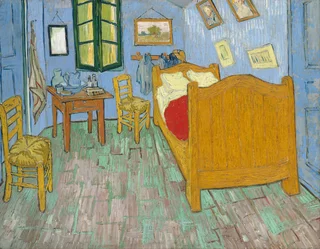
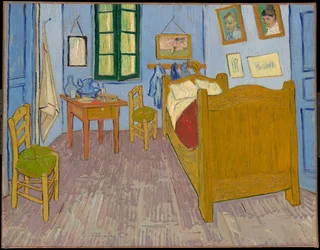
At the beginning of 1889, while Vincent was in hospital after an attack, the Rhône flooded, and in the unheated house water and saltpetre seeped from the walls. The paint on The Bedroom began to flake, so Vincent pasted newspaper over it, and at the end of April he sent it to Theo, calling it one of his best paintings. In 2010 the museum's restorer Ella Hendriks found microscopic traces of printing ink in the paint layer. In September 1889 at Saint-Rémy Vincent painted The Bedroom twice more, at the size of the original (that painting is now in Chicago) and smaller, for his mother and Wil (that one is in the Musée d'Orsay), and he did so before the original could be lined onto a new canvas.
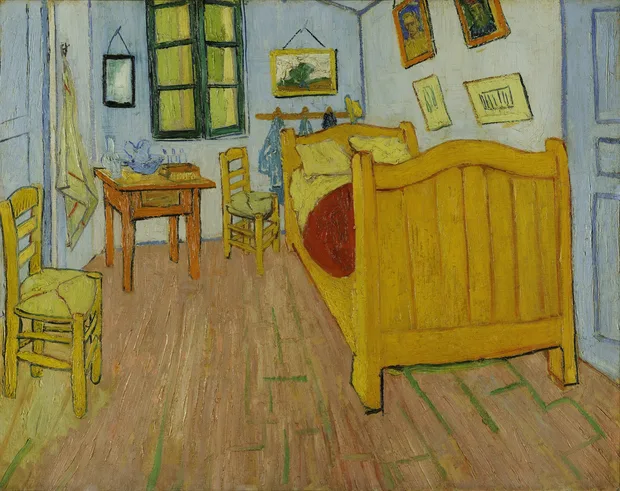
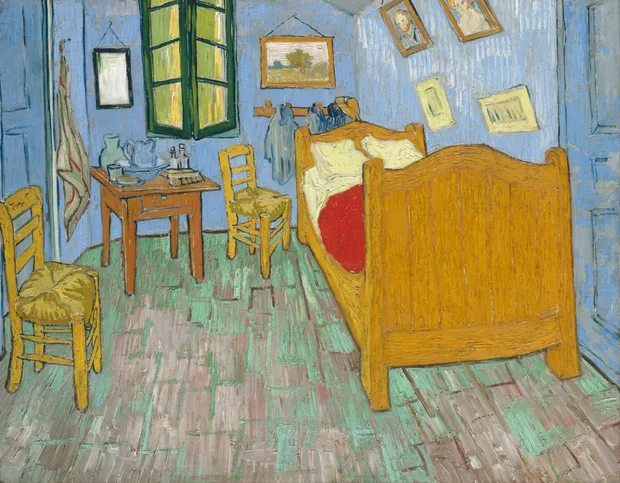
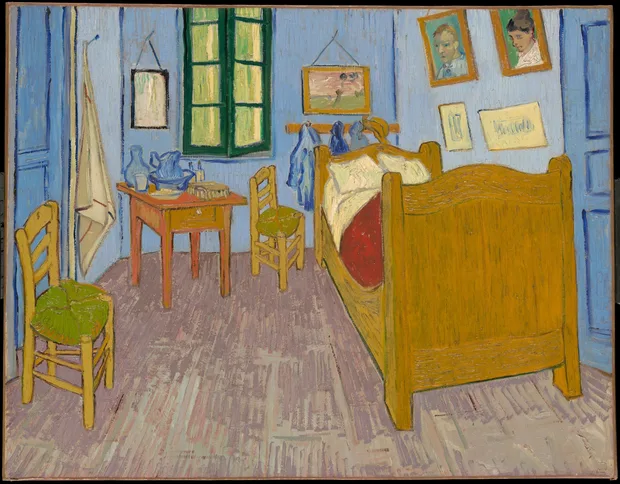
In 1931 the Dutch restorer Jan Cornelis Traas lined it afresh, and all that is known of the earlier lining is that Traas called it hopelessly bad. Since then the bottom edge has been covered by a strip of tape, and under it the floor has kept its former, more peach-coloured tone.
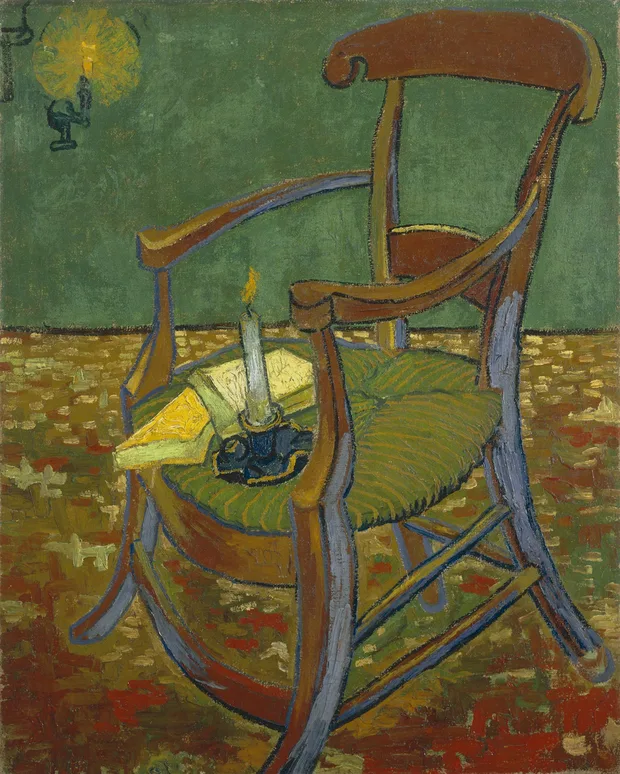
13. Gauguin's Chair — Vincent van Gogh, 1888
Vincent already owned Luke Fildes's drawing The Empty Chair in 1882. It had appeared in the English magazine The Graphic in 1870 and showed Dickens's study on the day of the writer's death. In December of that year Vincent wrote to his brother that there were many empty chairs, more would come, and sooner or later, instead of Fildes and the other artists, “there will only be Empty chairs”.
In November 1888 Gauguin was living with him in the Yellow House, and on or about 19 November Vincent told Theo about a new study, “Gauguin's armchair, red and green, night effect, on the seat two novels and a candle”. In the same letter he wrote that it did him enormous good “to have company as intelligent as Gauguin and to see him work”.
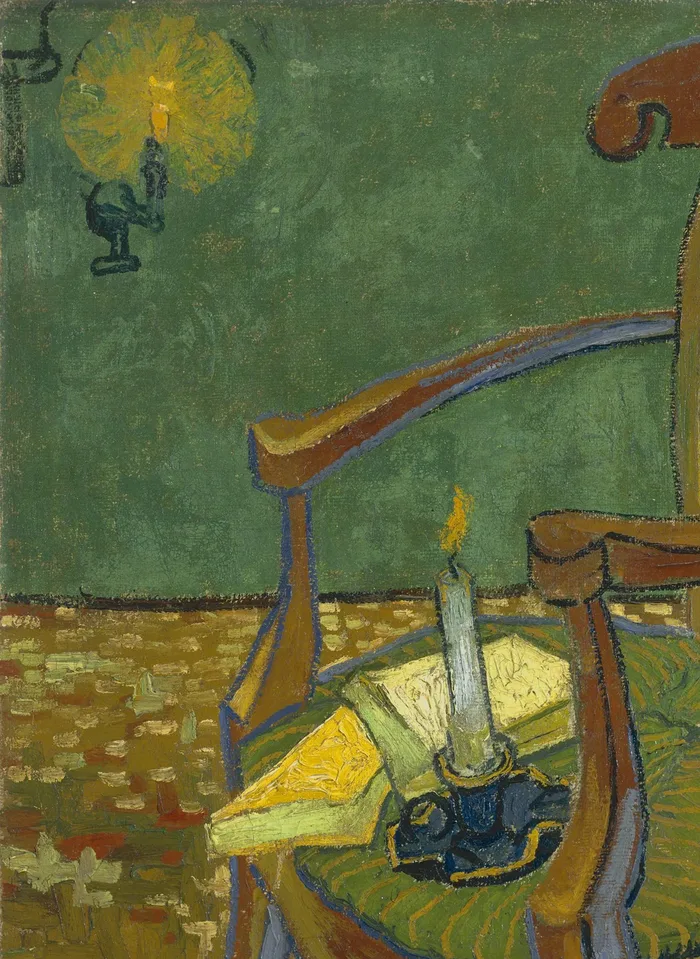
The armchair is red-brown, with a high curved back and arms, blue-violet highlights run over the wood, and the woven seat is green. A white candle burns on it in a blue holder, and beside it lie two books, one yellow and one pale cream. At the upper left a gas jet burns on the wall inside a large round yellow halo. Vincent had had gas laid on in the studio in October so that he and Gauguin would have light to work by in the winter.
In February 1890, by then at Saint-Rémy, Vincent told the critic Albert Aurier, who had just written an article about him, that a few days before they parted, when illness forced him into an asylum, he had tried to paint “his empty place”, the armchair with a lighted candle and modern novels “in the absent person's place”. Here his memory let him down: the painting was made a month before the break, while Gauguin was still living in the house.
Jo did not exhibit the painting, and it was left out even of the large retrospective of 1905 at the Stedelijk Museum in Amsterdam. Louis van Tilborgh puts this down to Jo's dislike of Gauguin, whom she partly blamed for Vincent's breakdown in December and whose armchair she did not want to show. The painting was first exhibited in 1928 in Berlin, at Paul Cassirer's gallery, three years after Jo's death.
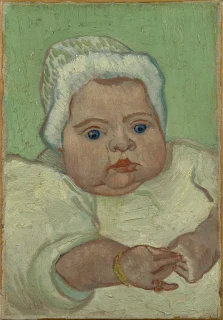
14. Portrait of Marcelle Roulin — Vincent van Gogh, 1888
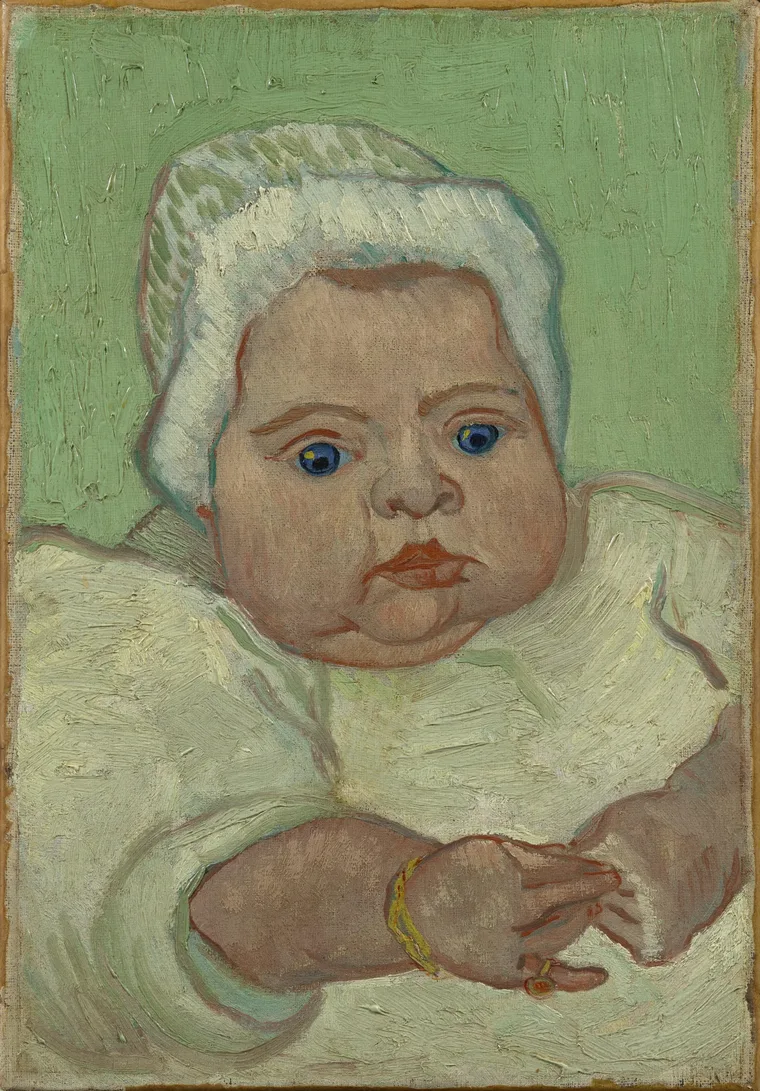
The postman Joseph Roulin, Vincent's neighbour and friend in Arles, sat for him on the day his daughter was born. On 31 July 1888 Vincent wrote to his sister Wil that he was working on the portrait of a postman “with his dark blue uniform with yellow”, and that the postman's wife had given birth that day, so he was “glowing with satisfaction”. The baby was named Marcelle, and she was the youngest of three children.
In December, when Marcelle was four or five months old, Vincent painted her three times on her own and twice on the lap of her mother, Augustine. At the beginning of December he told Theo that he had done the portraits of an entire family, the postman's, “the man, his wife, the baby, the young boy and the 16-year-old son, all characters and very French, although they have a Russian look”.
The baby looks straight at the viewer with round dark blue eyes, each with a small yellow dot of highlight. A cream bonnet frames her face like a hood, her lips are pursed into a small orange-red bow, and the pale yellow-green background is laid on in thick, raised strokes. At the bottom two plump hands meet, with a thin gold bracelet on the wrist and a little ring with a red stone on one finger.
In May 1889 the portrait travelled in a crate, with other paintings from Arles, to Theo, who had married Jo in April. In July Jo wrote Vincent a letter telling him she was expecting a child, and told him about the portrait. Visitors asked why it had been hung in such an out-of-the-way corner, but from her place at the table she could see “the child's big blue eyes, its pretty little hands and round cheeks”, and she hoped that her own child would be as strong, as healthy and as beautiful. Vincent replied that the Roulins' child “came to them smiling and very healthy, while the parents were at bay”.
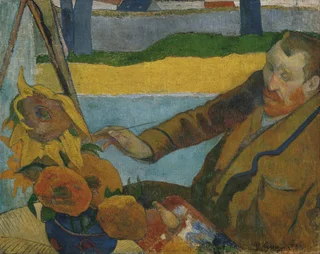
15. Van Gogh Painting Sunflowers — Paul Gauguin, 1888
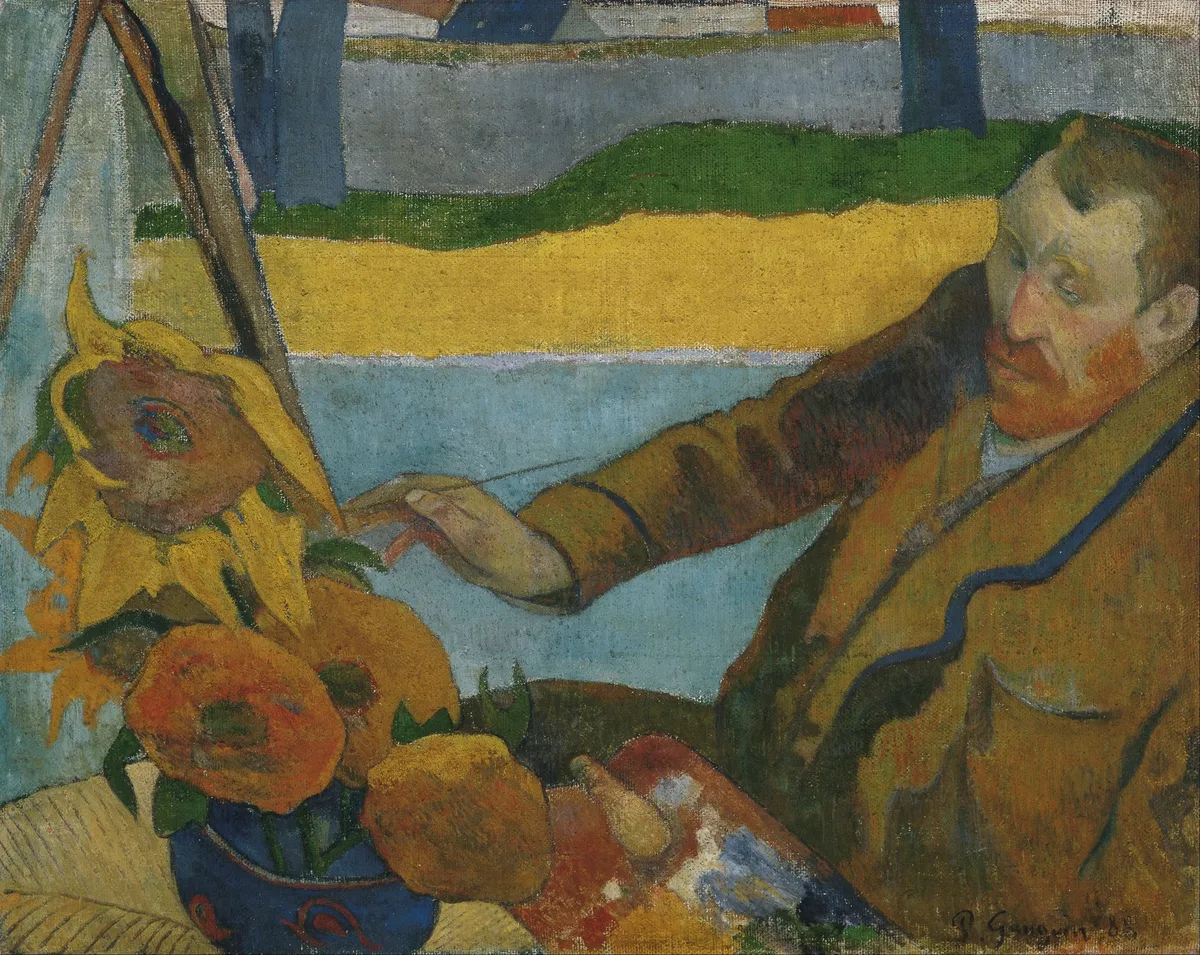
Vincent had painted his sunflowers in August 1888. Gauguin arrived at the Yellow House on 23 October, and in December, when there were no sunflowers left, he painted Vincent at the easel in front of a vase of them, from memory. Painting from memory was the very thing they argued about. Gauguin painted from his head and Vincent from nature, by the end of November the arguments were getting more and more heated, and Vincent himself called them “excessively electric”. Gauguin complained to Bernard that Vincent loved the chance effects of thick paint, “and I hate messing about”.
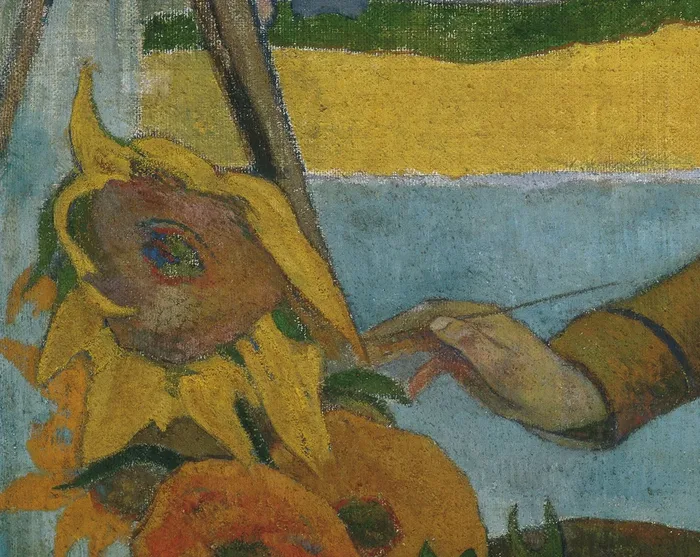
Gauguin painted Vincent from above. Vincent is squeezed into the lower right corner, his head bent, his eyes almost closed and lowered to his hand, and his right arm stretches across the whole picture, so that the tip of a thin brush reaches the leg of the easel beside the top flower. The sunflowers stand in a dark blue vase on the rush seat of a chair, and at the centre of the largest of them something like an eye has been drawn, which the museum's catalogue connects with Vincent's sunflowers now in London.
Gauguin finished the portrait around 20 December. On 23 December Vincent had an attack in which he mutilated his ear, and Gauguin left for Paris, where at the beginning of January he gave the painting to Theo. Theo wrote to Jo, then still his fiancée, that of all the portraits of Vincent this one best conveyed his inner self.
The remark usually quoted with this painting was recorded only by Gauguin, 15 years later, in his book Before and After, and the museum's catalogue regards it as impossible to verify. According to Gauguin, Vincent looked at the portrait and said, “It is certainly I, but it's I gone mad,” and that evening in a café he threw a glass of absinthe at Gauguin's head. Vincent himself, in September 1889, asked his brother whether he had seen the portrait of him painting sunflowers, and wrote that it was indeed him, “extremely tired and charged with electricity”, as he had been at the time.
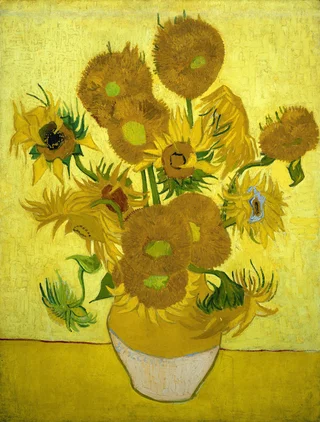
16. Sunflowers — Vincent van Gogh, 1889
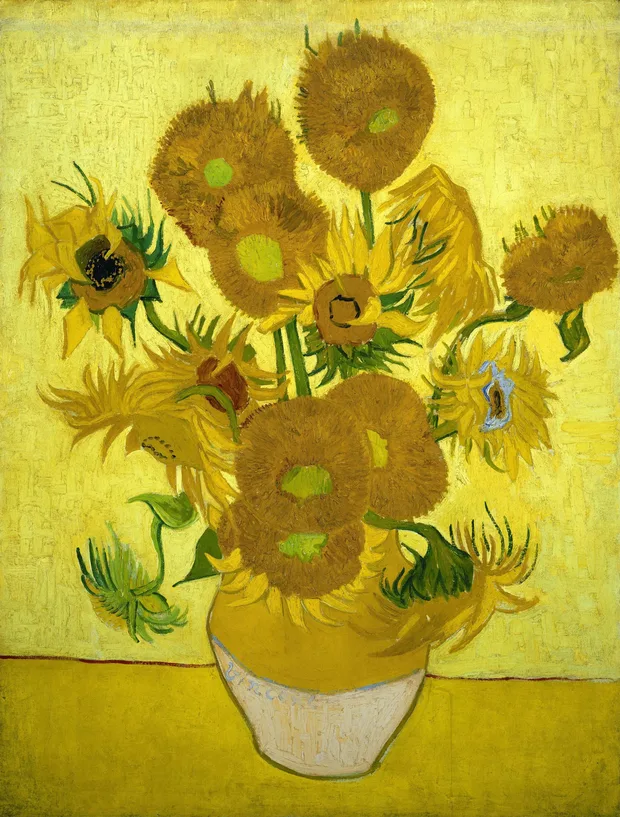
After leaving Arles, Gauguin wrote to Vincent asking for the sunflowers on a yellow background that had hung in his room in the Yellow House, and offered in exchange the studies he had left behind in Arles. On 17 January 1889 Vincent wrote indignantly to Theo that Gauguin was claiming a painting of sunflowers from him, and said he was “categorically keeping those sunflowers of mine”, since Gauguin already had two of them, “let that be enough for him”.
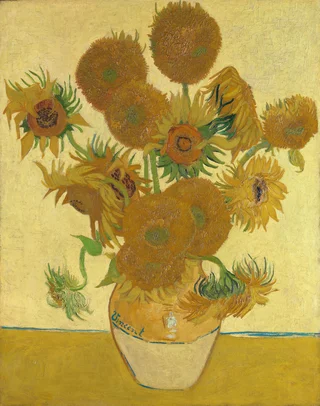
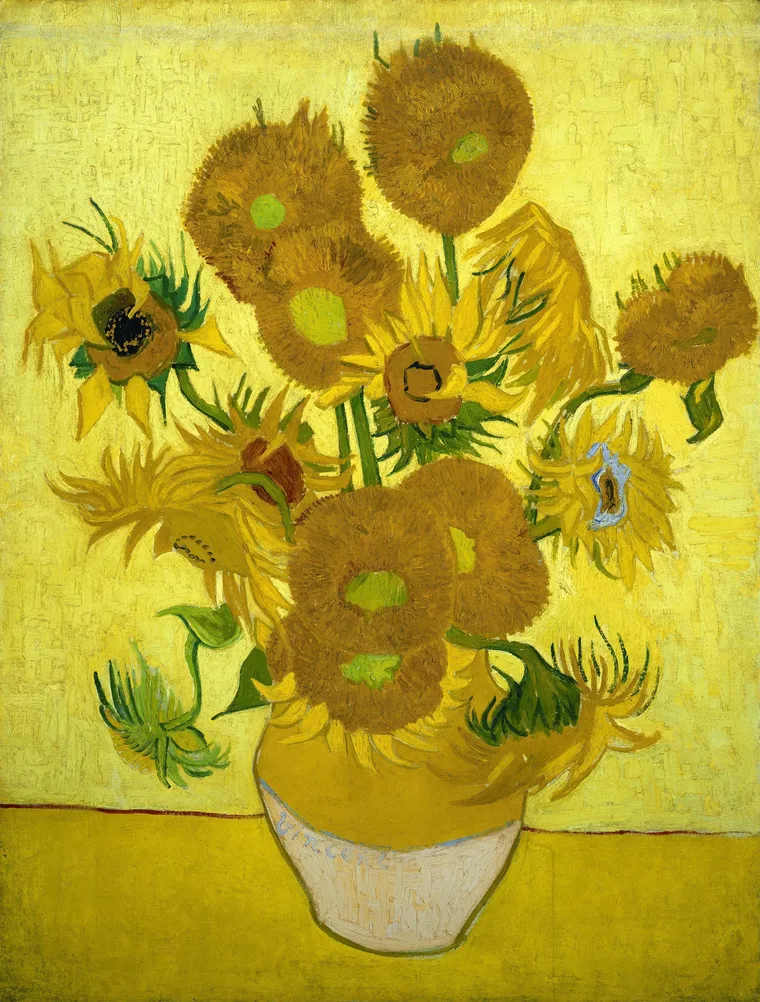
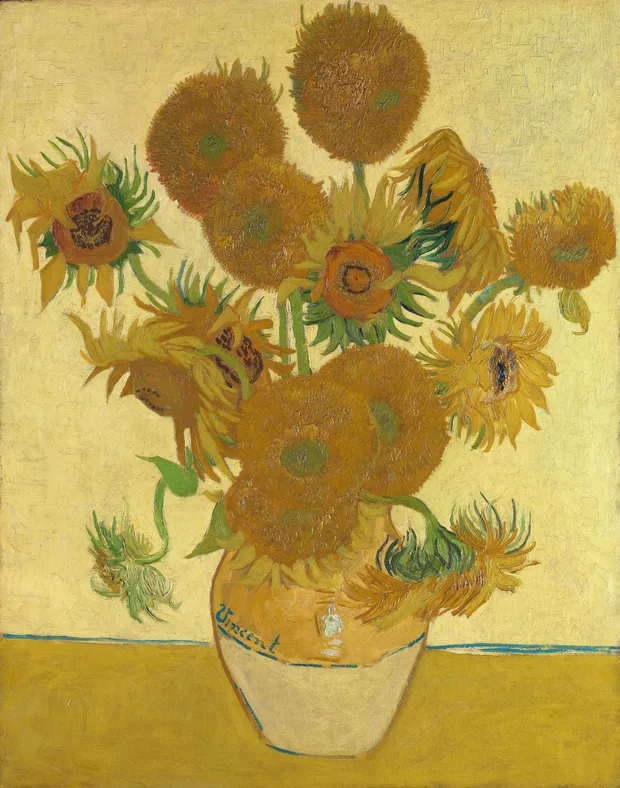
Four days later he answered Gauguin himself more gently. He contested his right to that canvas but praised his choice, remarking that if the painter Jeannin had the peony and Quost the hollyhock, he himself, before others, had taken the sunflower, and he promised to try to paint two exactly like it. On 28 January he told Theo he had finished “the absolutely equivalent and identical repetitions”. This canvas is one of them, a repetition of the August painting now in the National Gallery in London, and he painted it a few weeks after coming out of hospital.
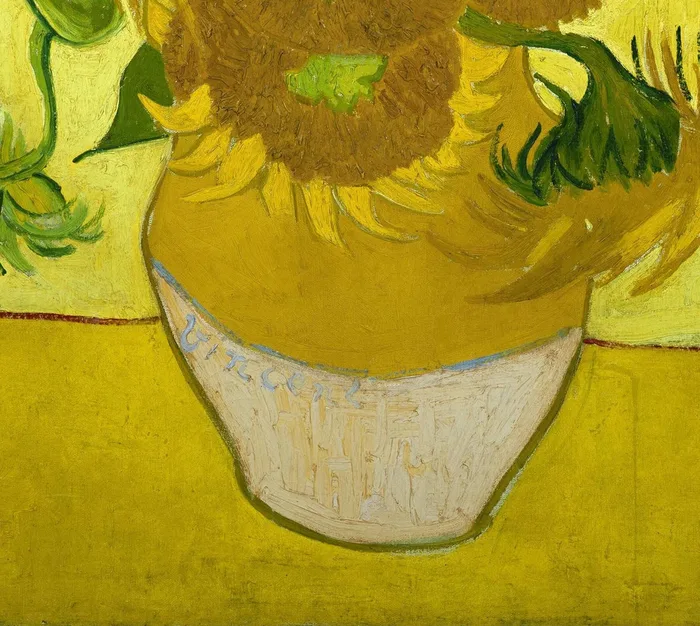
There are three yellows here, the pale lemon wall, the deeper yellow of the table and the orange-ochre vase with a cream band at the bottom, on which “Vincent” is written in light blue paint. A thin dark red line runs where the table meets the wall. Of the fifteen or so flowers, some still have their full crown of petals, others have shed them down to the seed heads, and one droops over the rim of the vase.
A barely visible seam runs right across the canvas near the top. While he was working, Vincent added a narrow strip of pine along the top and painted the top of the bouquet on it, and research in 2016–2019 showed that he did this himself, because his brushstrokes run across the join and his fingerprints are left in the paint on the strip. In 1961 the restorer Jan Cornelis Traas, the same man who had lined The Bedroom in 1931, removed the strip and reattached it with three bolts, and the seam has been more visible ever since.
In January 2019 the museum announced that it would no longer lend the painting to exhibitions, because the support and the paint layer, though stable, are sensitive to vibration and to changes in humidity and temperature. Since 1973 it had been lent only six times, the last time in 2014 to London, where it hung beside the August version.
Saint-Rémy and Auvers, 1889–1890
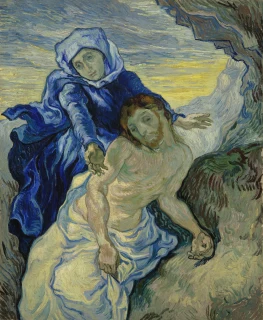
17. Pietà (after Delacroix) — Vincent van Gogh, 1889
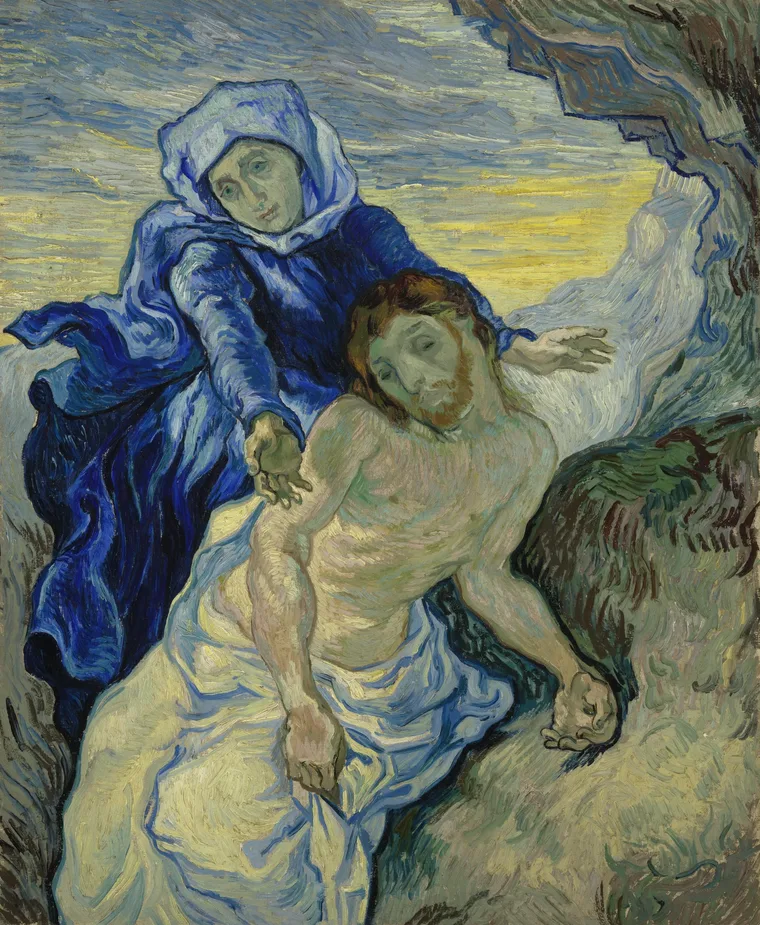
In May 1889 Vincent voluntarily entered the asylum at Saint-Rémy, and in July he had an attack that lasted until the end of August. During it a lithograph by Célestin Nanteuil after Delacroix's Pietà, a cheap print that Vincent kept with him, fell into some oil and paint together with other sheets and was spoiled. On 10 September he wrote to Theo that he had been sad about it, and that he had then occupied himself painting this Pietà.
By then he had not left his room for two months. He explained to his sister Wil that he did not much like seeing his own paintings in his bedroom, so he had copied one by Delacroix and a few by Millet. First he painted a small version, which he later promised to Wil and their mother (it is now in the Vatican), then this large one for himself, and he hung it in his room. To his brother he explained that he placed a black-and-white print by Delacroix or Millet in front of him as a subject and improvised colour on it, like a musician who plays Beethoven with his own interpretation.
Mary sits in a dark blue cloak with a pale hood, her arms spread wide and her palms open, looking at the viewer. To Wil he described her face as pallid, with “the lost, vague gaze of a person tired of being in anguish and in tears and keeping vigil”, and her hands as “a working woman's good, solid hands”. The dead Christ slides diagonally towards the lower left corner, his legs covered with a pale yellow cloth in blue folds, a dark rock looms in the upper right corner like the mouth of a cave, and the warmest colour on the canvas is Christ's red hair and red beard.
The lithograph was black and white, and the colour of Christ's hair was Vincent's own choice. This is why many people see a self-portrait in this Christ, although Vincent does not say so in his letters, and the likeness remains an interpretation. The spoiled lithograph survives in the family collection too, stains of oil and paint and all.
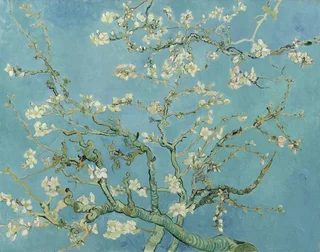
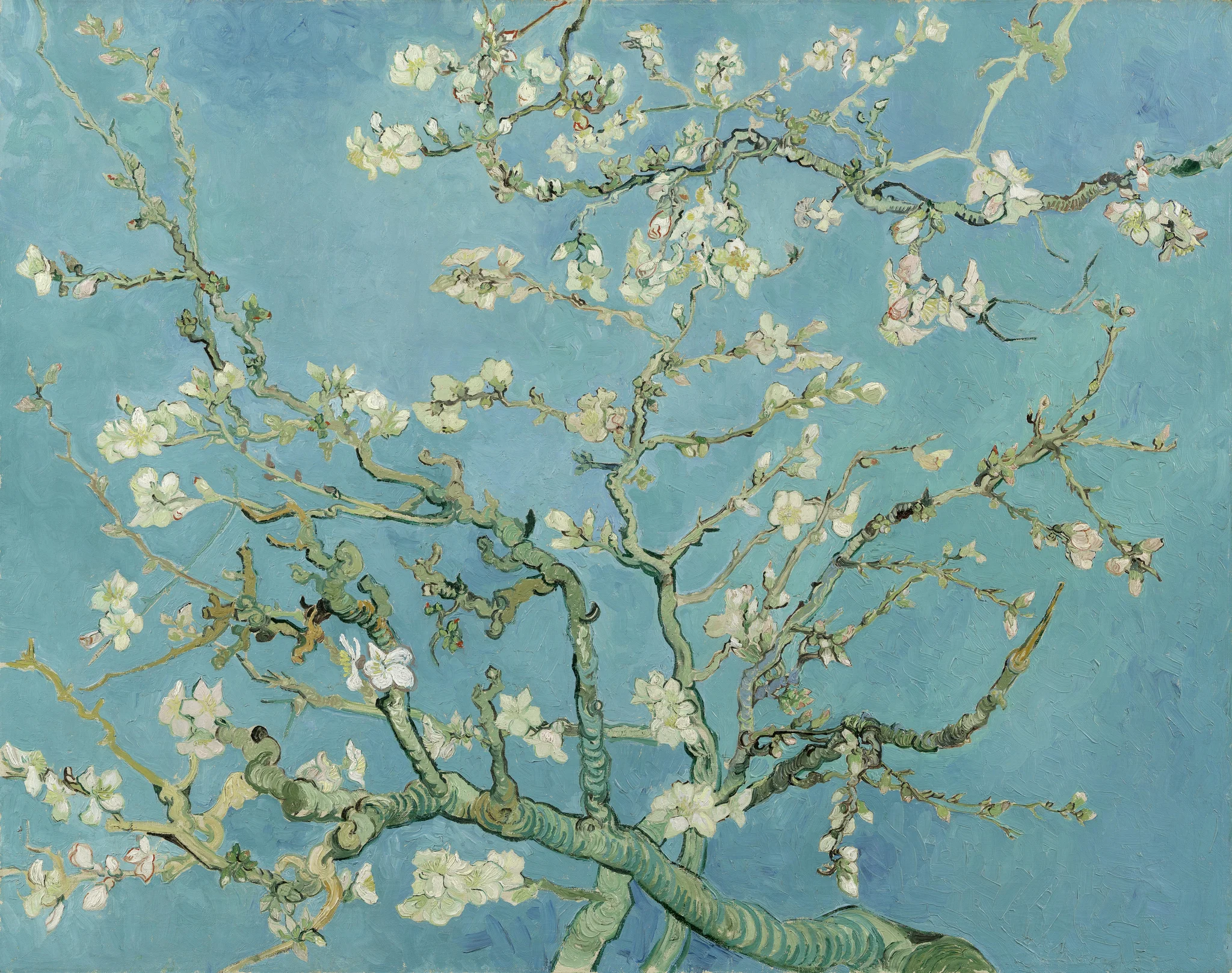
18. Almond Blossom — Vincent van Gogh, 1890
Theo and Jo's son was born in Paris on 31 January 1890 and named Vincent Willem after his uncle, who became his godfather. On 19 February Vincent wrote to his mother from Saint-Rémy that he would much rather the boy had been named after his father, “whom I've thought about so often these days”, but as it had been done now, he had started right away on a painting for him, “to hang in their bedroom”: “Large branches of white almond blossom against a blue sky.” In Provence the almond is the first to flower, in February.
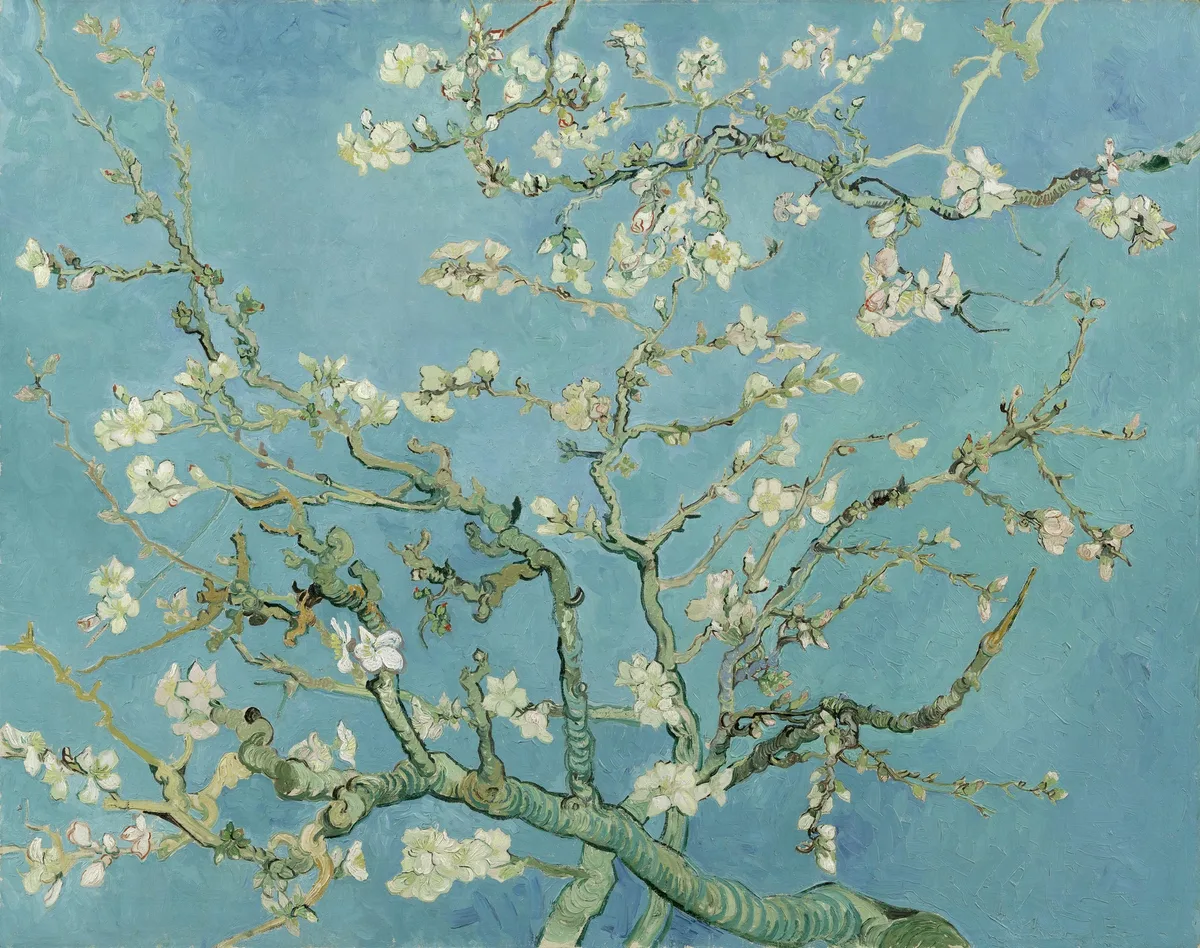
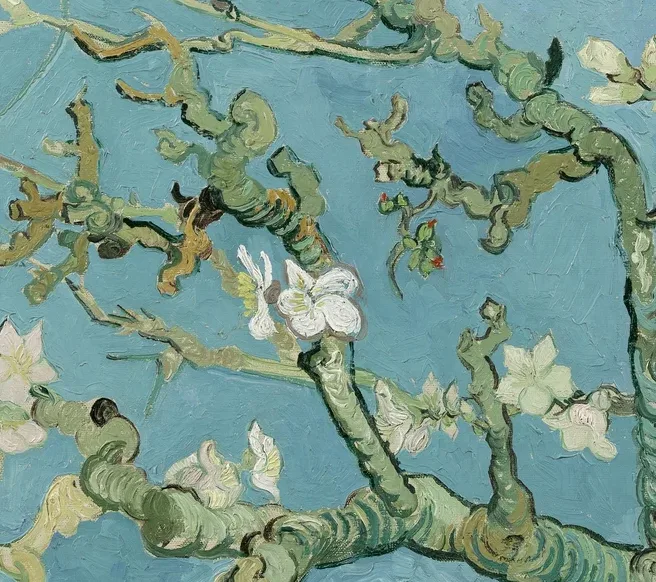
The canvas shows only branches and a turquoise sky, lightest at the upper left. Thick grey-green boughs come in from below, cross in the lower third and spread out in every direction, a separate thin branch hangs down from the upper right, and all of them run off the edges. The outlines are drawn with a dark line, as in Japanese prints. The blossoms are cream and white, some open, others still in bud, pinkish at the right edge, and just left of centre at the bottom, at the end of a thick bough, the whitest flower in the picture has opened.
On 22 February, back from a trip to Arles, Vincent went down with the longest attack of his illness and did not recover until the end of April, when the orchards had finished flowering. At the end of April he wrote to Theo that work had been going well and that the last canvas of branches in blossom was “perhaps the most patiently worked, best thing I had done”, and that he had fallen ill at the very time he was painting the almond blossom.
The boy the picture was painted for is the same Vincent Willem who in 1962 gave the family collection to the Foundation. In May 1890, on his way to Auvers-sur-Oise outside Paris, Vincent stopped at his brother's and saw the painting on the wall, and in June he wrote to his sister Wil that Theo and Jo had hung it “above the piano”.
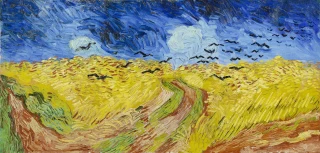
19. Wheatfield with Crows — Vincent van Gogh, 1890
In Irving Stone's 1934 novel Lust for Life, Vincent paints Wheatfield with Crows and shoots himself the next day, and the 1956 film with Kirk Douglas stages the scene. The museum calls the story a persistent myth, because Vincent painted several more pictures after this one.
On 6 July 1890 Vincent came from Auvers to Paris to visit Theo, Jo and their son. The baby was seriously ill, Theo was once again thinking of leaving his firm and setting up on his own, everyone was worn out, and Vincent hurried back to Auvers the same day. Around 10 July he wrote to them both, his “dear brother and sister”, that Jo's letter had been “really like a gospel” for him, a deliverance from the anguish of the difficult hours they had spent together, and that his own life was “attacked at the very root”. In the same letter he said he had painted three large canvases, “immense stretches of wheatfields under turbulent skies”, and had made a point of trying to express sadness and extreme loneliness in them, and he hoped they would show Theo and Jo what he considered healthy and fortifying about the countryside. The letter does not name the painting, which is identified by the description and the format.
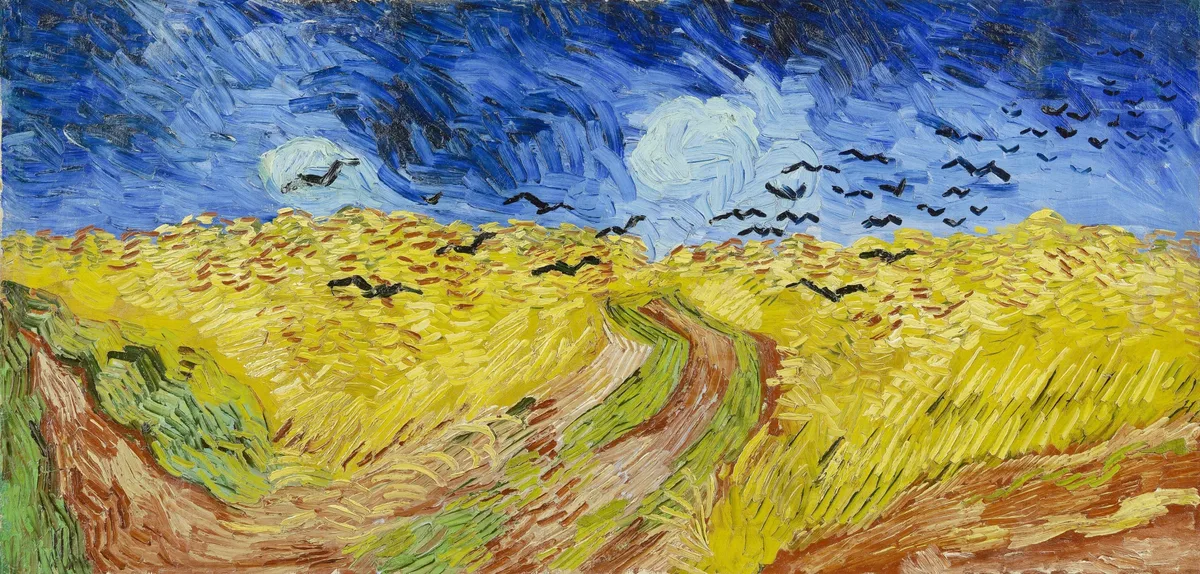
The canvas is twice as wide as it is high. The sky is almost black at the top edge and lightens downwards to a bright blue, with two round, pale turquoise clouds in it, and about 40 crows, painted as black V-shaped strokes, fly over the field. In the middle at the bottom a red-brown track rises between strips of bright green, bends to the right and stops in the middle of the field, far from its edge, while two other tracks run off the left and right edges. On 14 April 1991, 20 paintings were stolen from the museum and found the same day in an abandoned car. Wheatfield with Crows had been badly torn, and the canvas had to be restored.
Two days after Vincent's death Jo wrote to Theo how sorry she was that she had not been kinder to him when he stayed with them. In 1914, in her introduction to the edition of the letters, she wrote that in his last paintings one can feel a coming disaster drawing nearer, like the black birds that race over the field in a storm.
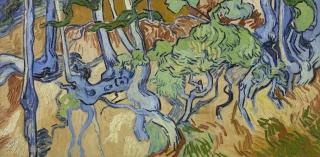
20. Tree Roots — Vincent van Gogh, 1890
Andries Bonger, Jo's brother and a close friend of Theo, mentioned in an unsigned text of 1893 that on the morning before his death Vincent had painted “a forest scene, full of sun and life”. In 2012 the museum's researcher Louis van Tilborgh and the vegetation specialist Bert Maes connected these words with this painting, and since then it has been considered probably Vincent's last work, left unfinished.
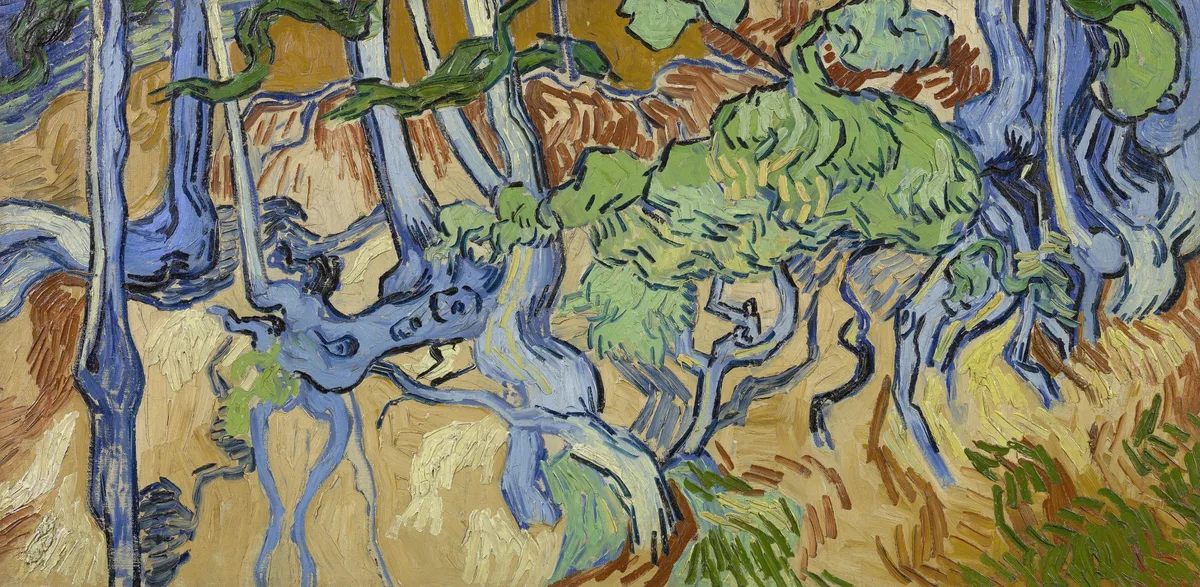
The museum itself describes it as, at first sight, a jumble of bright colours and wild shapes. Then trunks cut off by the top edge begin to appear in it, roots outlined in black and painted in every shade of blue from pale sky blue to ultramarine, orange and ochre earth and green foliage. Left of centre lies a big, knotted tangle of pale blue roots with round growths that look like eyes, and in places at the bottom the paint is so thin that the weave of the canvas shows through.
The painting shows a bank at the edge of a marl quarry cut into a hillside, with pollarded trees whose roots were laid bare when the slope was dug away. Bonger wrote of the morning, whereas the museum's researcher Teio Meedendorp, going by the sunlight on the roots, thinks the last strokes were put down towards the end of the day.
In 2020 Wouter van der Veen, scientific director of the Institut Van Gogh in Auvers, recognised the bank on an old postcard from the early 20th century showing the rue Daubigny, about 150 metres from the Ravoux inn, where Vincent lived. The museum's researchers agreed that this was very probably the spot and announced the find on 28 July 2020, 130 years after Vincent's death. The largest stump in the painting survives on the bank and can still be recognised.
What Else to See
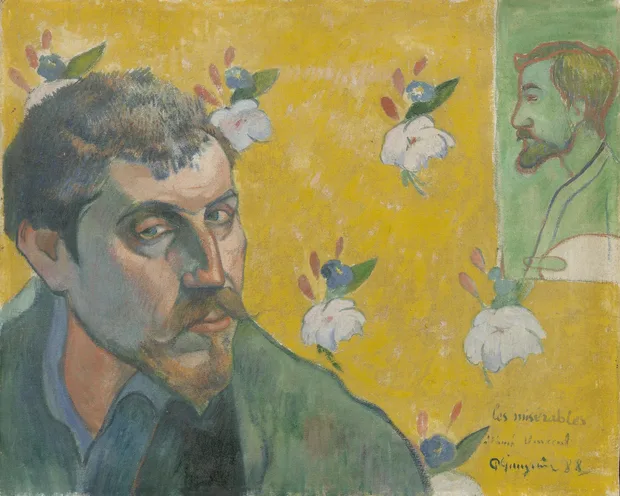
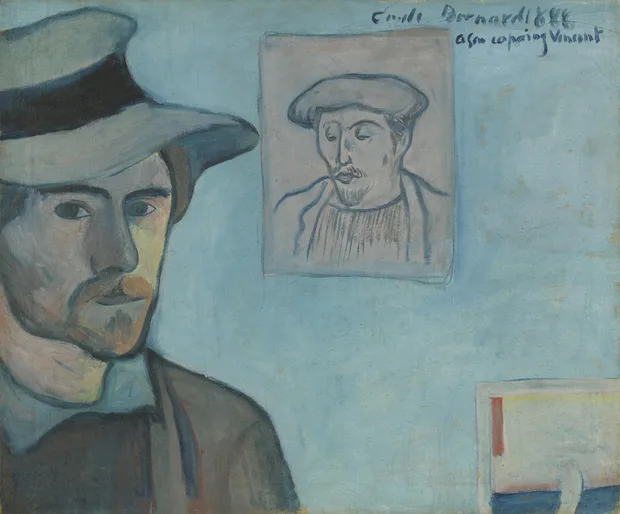
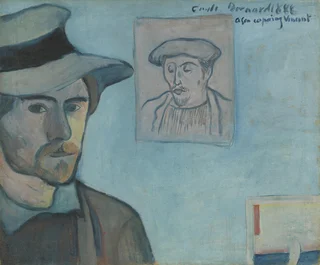
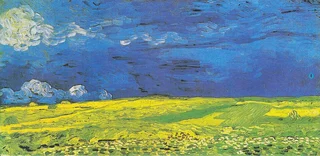
The family collection is larger than this: more than 200 paintings and about 500 drawings by Vincent, and over 700 letters. On a second visit it is worth starting with the Japanese prints the brothers bought from Bing and with the work of Émile Bernard, including his Self-Portrait with Portrait of Gauguin, his answer to the same request from Vincent as Les Misérables. Among the paintings bought after 1973, look for Millet, Jules Breton, Monet, Seurat and Signac. Of Vincent's own late work we recommend Wheatfield under Thunderclouds, which researchers consider the second of the wheatfields described in the July letter to Theo and Jo.