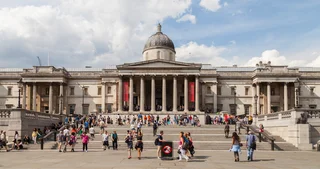
In 1824 Parliament bought 38 pictures from the collection of the London financier John Julius Angerstein for a new National Gallery, and the Gallery opened in his house on Pall Mall. The royal collection played no part in it. From then on the new gallery was put together piece by piece: pictures were bought at auction and received by bequest, money for them was raised by public subscription, special grants were requested from Parliament, and some purchases were argued over for years.
In these 25 works you can see how many different roads the collection was assembled by, from the state's first purchase to private gifts, auctions, bequests, public appeals and modern funds. We begin with the altarpiece that is number 1 in the Gallery's inventory and end with a self-portrait that in 2019 was taken to a library, a school, a doctor's surgery and a women's prison.
How the Gallery Began, 1824–1856
For its first three decades the Gallery had no director at all. The collection grew through gifts, bequests and individual purchases decided by the trustees.
1. The Raising of Lazarus — Sebastiano del Piombo, 1517–1519
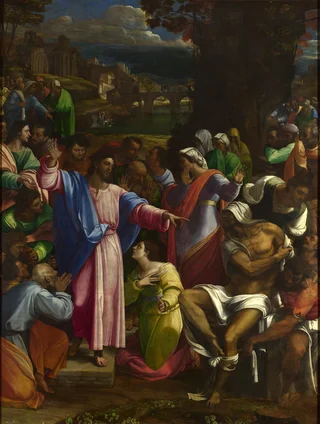
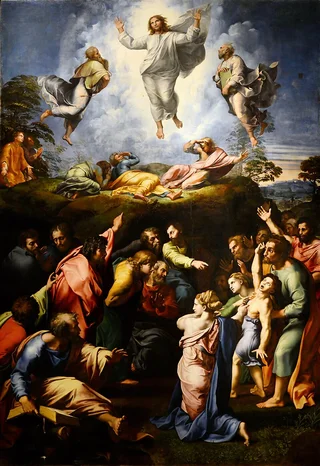
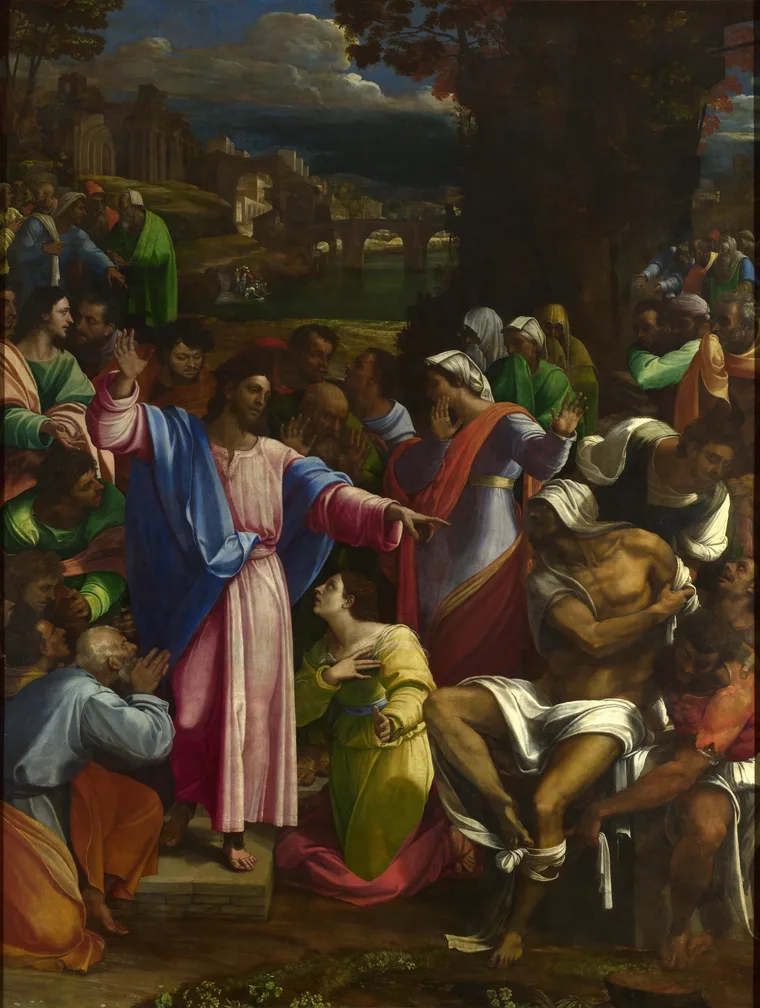
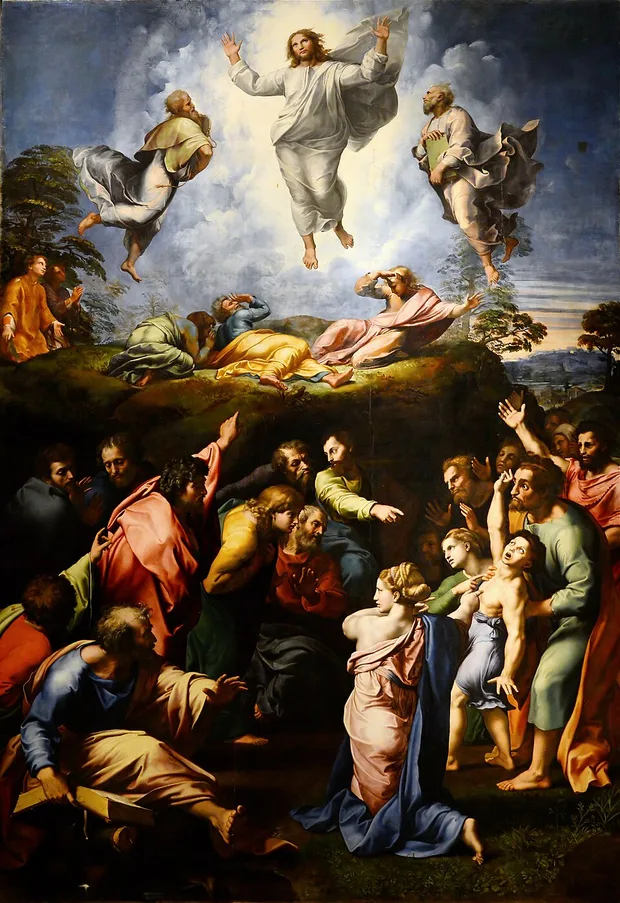
Late in 1516, in all likelihood, Cardinal Giulio de' Medici, the future Pope Clement VII, commissioned two altarpieces of the same size for the cathedral of Narbonne, his diocese in the south of France. He gave the Transfiguration to Raphael and the Raising of Lazarus to the Venetian Sebastiano Luciani, a friend of Michelangelo's. Michelangelo backed Sebastiano in his rivalry with Raphael and gave him drawings for the figure of Lazarus and probably for Christ. Sebastiano deliberately held back from finishing, so that Raphael would not see his panel before completing his own.
Lazarus sits at the lower right on the edge of the tomb. His head is still wrapped in the burial cloth, with one hand he is pulling the shroud away from his chest, and a man at the very edge of the picture is unwinding the white bandages from his leg. His body is heavy, muscular and grey-brown, and it is painted differently from the other figures. Christ stands left of centre and stretches his arm across the whole picture, pointing at Lazarus. Mary, the sister of Lazarus, kneels at Christ's feet, and behind her a woman in a red cloak recoils with both palms raised. She is apparently Martha, who in John's Gospel warned that the body would already stink. The sky, streaked with dark bands, looks almost like night, although the ruins and arches on the left are lit by late-afternoon sun. Sebastiano intended a deep blue, but the coarsely ground azurite darkened in the oil over time.
In April 1520, a little over a week after Raphael's death, the two pictures were shown side by side in the Vatican, and Sebastiano wrote to Michelangelo that he had “not been ashamed”. Infrared imaging in 2017 showed that he had built the composition himself, and that Michelangelo came in late, reworking in drawings a Lazarus already painted on the panel. The Transfiguration stayed in Rome, and only the Lazarus was sent to Narbonne.
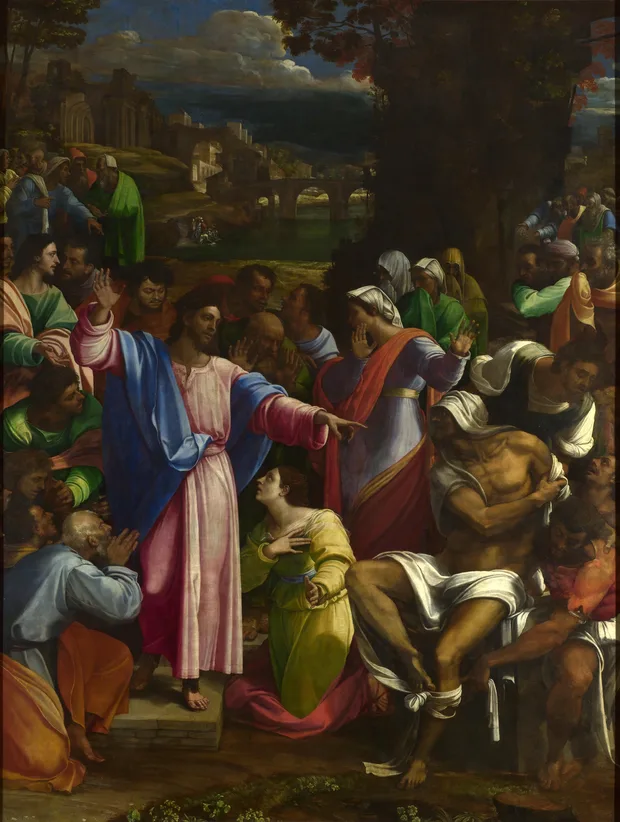
In 1722 the Regent of France, Philippe d'Orléans, bought the picture from the cathedral. The lower part of the original frame, a predella with the Medici emblem, survived in Narbonne, and in 2017 the Gallery set a carved copy of it into the new frame of the Lazarus. At the Palais-Royal the paint was transferred from panel to canvas. In 1793 the Italian pictures of the Orléans collection were brought to London for sale, and in 1798 Angerstein paid 3,500 guineas for the Lazarus, more than was paid for many of the Titians and Raphaels from the same collection. In 1824 it passed to the state with the rest of his pictures and received the number NG1.
2. Supper at Emmaus — Caravaggio, 1601
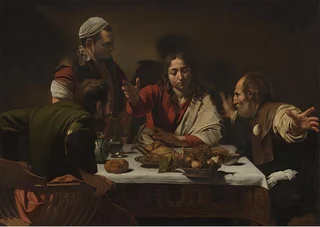
The basket of fruit sits right on the edge of the table and juts out over it as if about to fall. It holds dark and pale grapes, a split pomegranate, apples, pears and figs, and it casts a sharp shadow on the white tablecloth in which some see the outline of a fish, the symbol of Christ. Two disciples on the road to Emmaus had invited a stranger to supper and recognised him as the risen Christ when he blessed the bread. Caravaggio painted Christ young and beardless. The disciple on the left, in a green jacket with a hole torn at the elbow, grips the arms of his chair and is half rising from it. The disciple on the right, with a pilgrim's shell on his chest, flings his arms wide, and the innkeeper stands beside them with his thumbs tucked into his belt, looking on calmly.
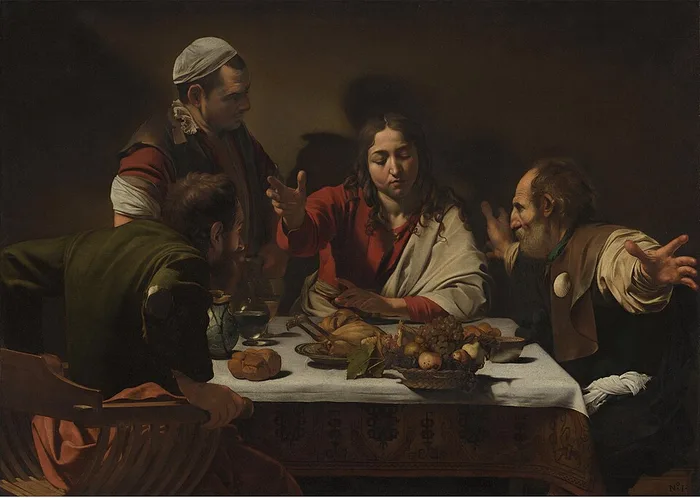
The picture was commissioned by the Roman nobleman Ciriaco Mattei, in whose house Caravaggio was then living. In 1672 the biographer of artists Giovanni Pietro Bellori reproached him for offending against decorum: the innkeeper serves Christ with his cap on, and grapes, figs and pomegranates do not ripen at Easter. The picture came to England from the Borghese collection in 1801, and in 1839 Lord Vernon gave it to the Gallery. In 1606, after fleeing Rome following a killing, Caravaggio painted the same scene again. That picture is in the Brera in Milan. It is quieter and darker, its Christ is older and bearded, and the table is simply laid.
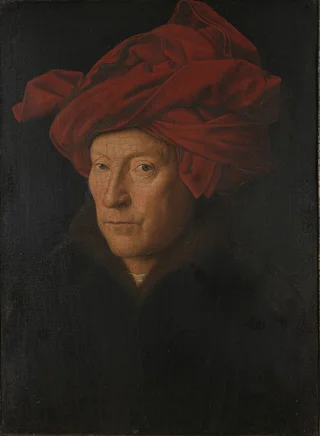
3. Arnolfini Portrait — Jan van Eyck, 1434
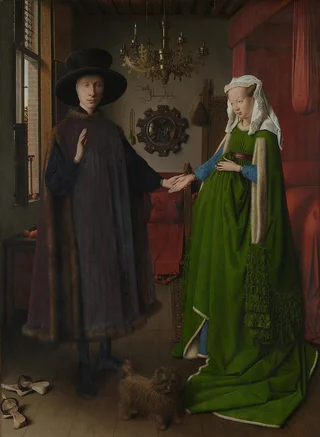
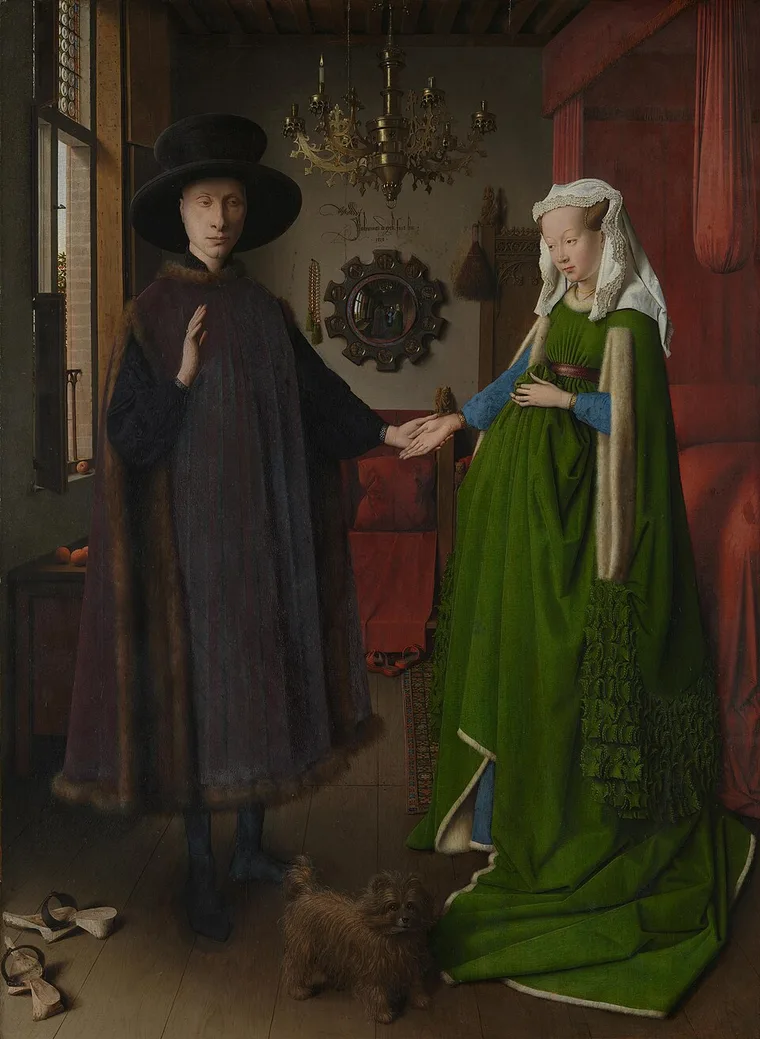
A round convex mirror hangs in the middle of the back wall, in a frame set with ten tiny medallions. It reflects the whole room from the opposite side, the couple's backs, and two small figures in the doorway, one in blue and one in red. Above the mirror, written on the wall in a flourishing hand, are the words “Johannes de eyck fuit hic 1434”, “Jan van Eyck was here”. One candle burns in the brass chandelier, and the other holders are empty. Two pairs of shoes stand at opposite ends of the room, pale wooden pattens with straps at the lower left and red slippers at the back, under the bench. The woman holds the gathered skirt of her green dress against her stomach, and she has long been taken to be pregnant, although van Eyck's Saint Catherine, a virgin martyr, stands in exactly the same way in his Dresden triptych.
In 1934 Erwin Panofsky identified the couple as Giovanni di Arrigo Arnolfini and Giovanna Cenami and read the picture as a certificate of marriage. Later, Burgundian documents came to light showing that this couple married only in 1447, six years after van Eyck's death. The man is now thought to be Giovanni di Nicolao Arnolfini, and the woman probably his second wife, of whom no documents survive. The surname itself was recovered from an inventory of 1516, which lists the panel as “Hernoul le Fin with his wife in a chamber”.
The panel ended up with a Scottish officer, James Hay. In 1816, through the portrait painter Thomas Lawrence, he offered it to the Prince Regent, who kept it for a year and a half and then returned it. Hay's account of how he came by it is open to doubt. He said he had bought it in Brussels, where he was recovering from a wound received at Waterloo. A more common suggestion is that it was taken in 1813 at Vitoria, where British soldiers plundered Joseph Bonaparte's baggage train with its pictures from the Spanish royal collection. In 1842 the Gallery bought it from Hay for 600 guineas, and it became the first early Netherlandish picture in the collection.
4. Self-Portrait at the Age of 63 — Rembrandt, 1669
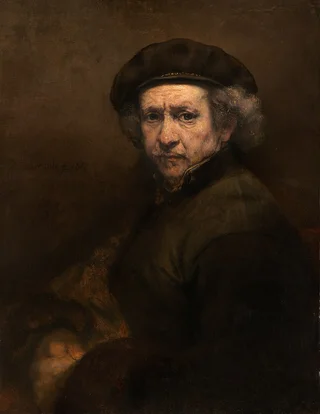
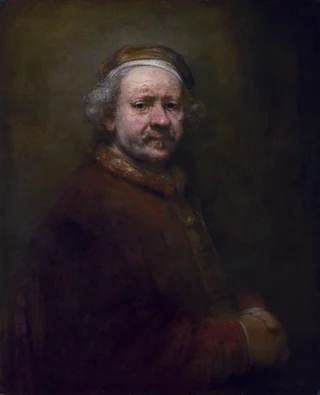
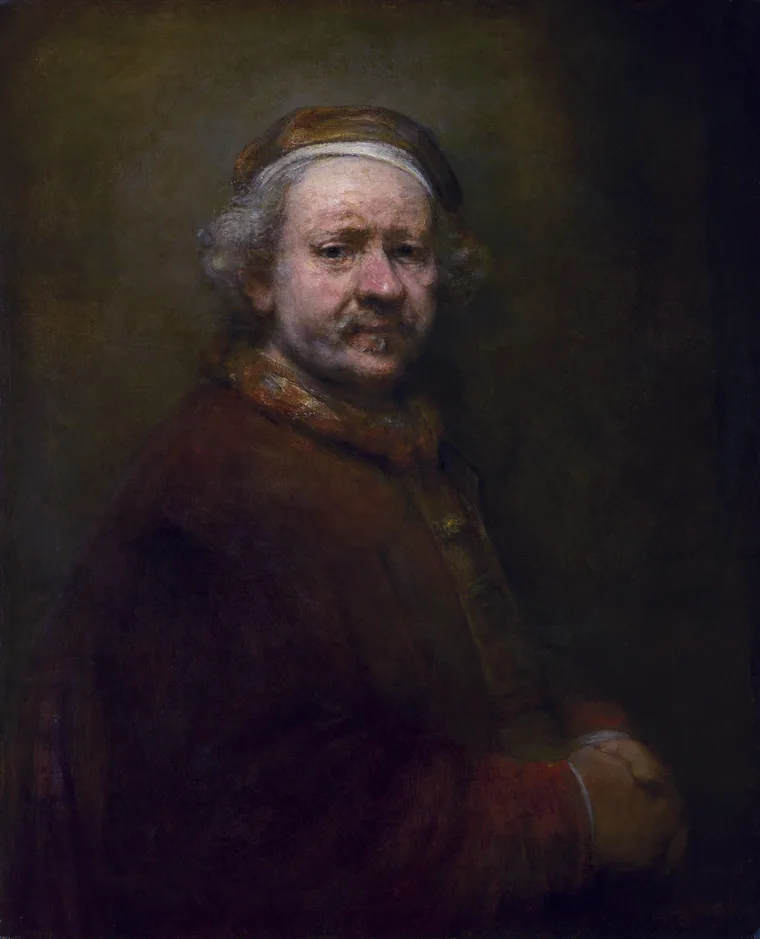
Rembrandt painted this self-portrait in the last year of his life, a few months after the death of his son Titus. He stands half-turned and looks at the viewer over his shoulder, his dark red coat sinks into shadow, and the light falls almost only on his face and the white band of his cap. The paint on the face lies thick and lumpy, and the bag under the right eye is laid down with a single curl of a loaded brush. The left edge of the canvas was cut down at some point, and of the signature at the lower left only the letter t survives.
X-rays revealed two changes. At first the cap was larger and entirely white, a proper painter's cap, and the hands held a brush, so the portrait showed an artist at work. Then Rembrandt made the cap smaller, painted out the brush and folded the hands. Without the brush, his profession was no longer shown directly, and almost all the attention now goes to the face. For more than a century the picture hung at the Surrey estate of the Viscounts Midleton, and in 1851 the Gallery bought it at the sale of their collection.
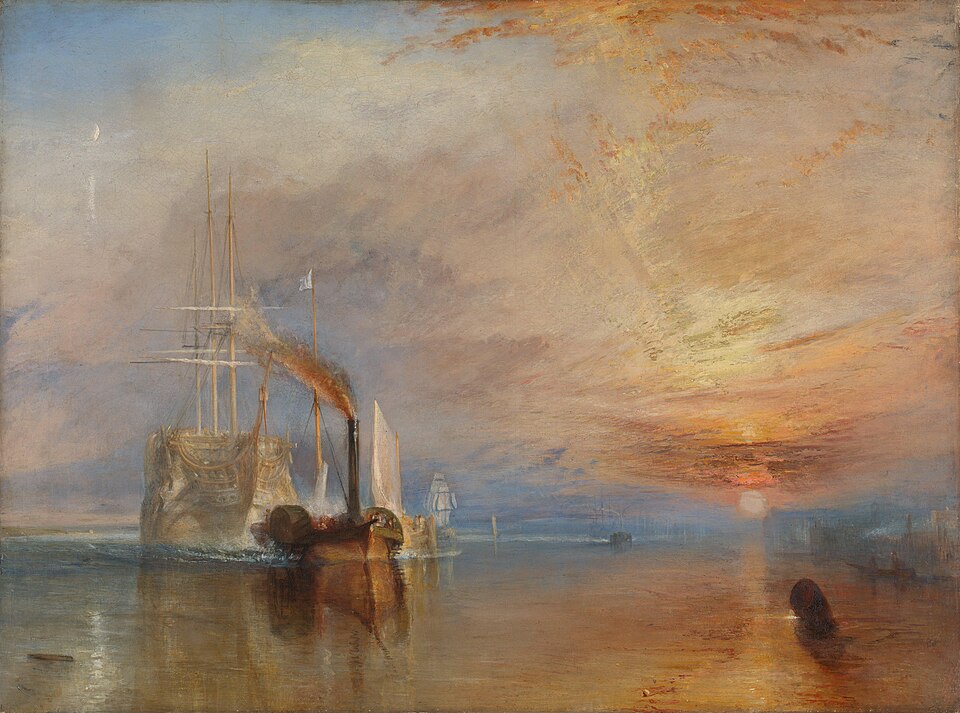
5. The Fighting Temeraire — J. M. W. Turner, 1839
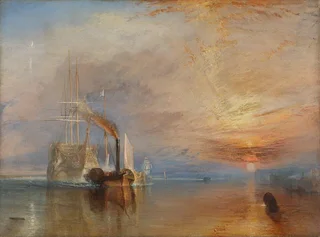
In August 1838 the Admiralty sold the old ship of the line Temeraire at auction to the shipbreaker John Beatson for £5,530. At Trafalgar in 1805 the Temeraire had come to the aid of Nelson's flagship, the Victory, and from 1820 she lay at Sheerness as a floating victualling store. In September two tugs towed her up the Thames to Beatson's yard at Rotherhithe.
Turner painted one tug instead of two and gave the ship back her masts, which had most likely been taken down by then. His Temeraire is pale, almost ghostly, and the tug ahead of her is low and black, with smoke and sparks pouring from its tall funnel. The only flag in the picture, a small white one, flies from the tug, and when the picture was shown at the Royal Academy in 1839 it came with lines by the poet Thomas Campbell about the flag that “braved the battle and the breeze” and “no longer owns her”. On the right the sun is setting into the water, and a thin crescent moon hangs in the upper left corner. A ship going upriver to Rotherhithe was heading west, so the sunset should have been ahead of her, and the tugs reached the yard at about one in the afternoon.
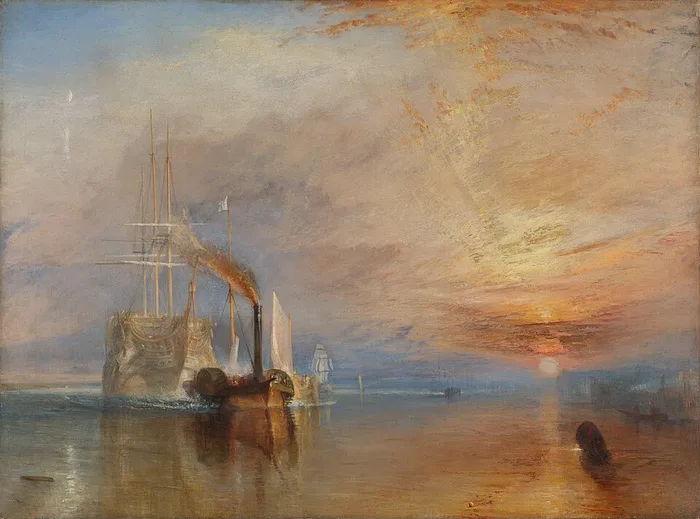
Nobody even knows for certain whether Turner was in England at the time. In August and September he usually travelled on the Continent, and the story of him sketching from a boat appeared later. He never sold the picture, and around 1845 he refused to lend it again, calling it “my darling”. Turner left his finished pictures to the nation on condition that they be shown together. After his death in 1851 his relatives contested the will, and only in 1856 did the Court of Chancery approve a settlement under which the money went to the family and everything by his own hand, almost 300 oil paintings and around 30,000 works on paper, passed to the state.
Eastlake Goes Buying in Europe, 1857–1861
The Gallery's first Director was the painter Charles Eastlake. Instead of waiting for gifts, he travelled through Italy buying pictures one after another, while the Gallery's travelling agent, Otto Mündler, searched them out for him in advance.
6. The Family of Darius Before Alexander — Paolo Veronese, 1565–1567
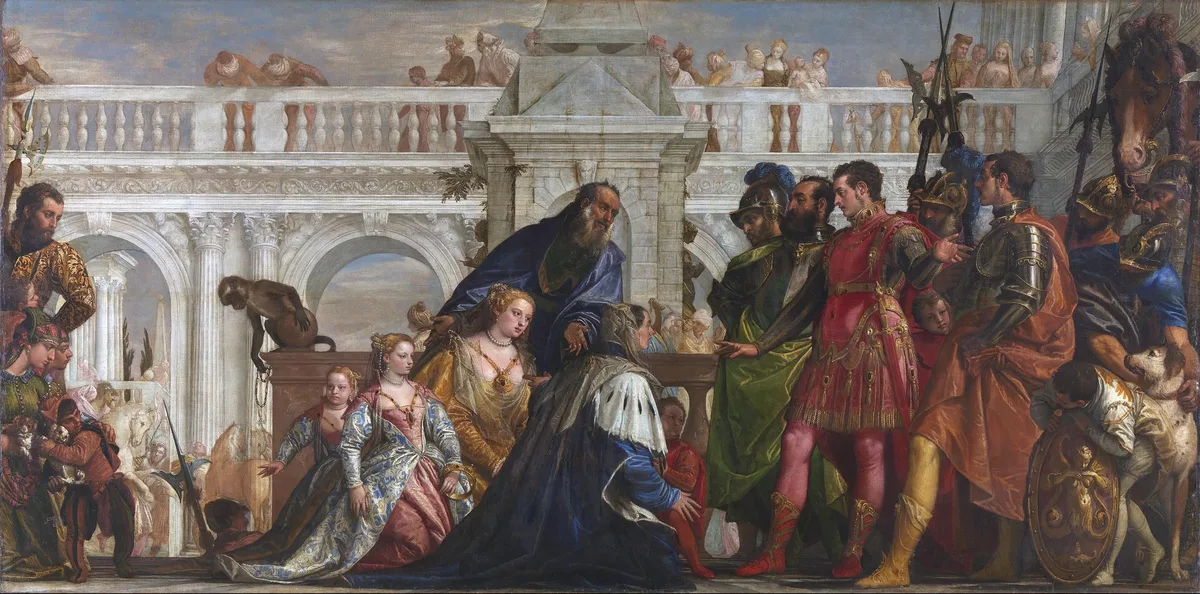
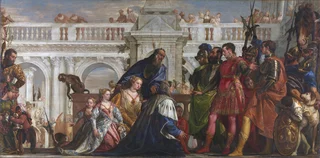
In the summer of 1857, before the picture had even reached London, Lord Elcho told the House of Commons it was a “second-rate specimen” of “a second-rate artist”. Eastlake had bought it that spring in Venice from Count Vettore Pisani for about £12,280. Elcho accused Mündler of driving up prices, and another member insisted that the Gallery had been sold a copy. The critic John Ruskin defended the purchase in The Times, and in January 1858 Queen Victoria came specially to see the picture.
The subject comes from the life of Alexander the Great. After the battle of Issus the mother, wife and daughters of the Persian king Darius were taken captive, and the mother, mistaking Alexander's friend Hephaestion for the king, knelt before him. Alexander forgave her the mistake, saying that Hephaestion too was Alexander. The family kneels left of centre, the mother nearest to us, seen from behind in a huge dark cloak with a broad ermine collar. Right of centre a young man in rose-red calms the women with one hand and with the other points back at his companions. He is most often taken to be Alexander, and the man in dark armour and an orange cloak to be Hephaestion. Above the princesses' heads, on a ledge to the left, sits a monkey on a chain.
In 1786 Goethe saw the picture in the Palazzo Pisani in Venice and was told a family legend that he found charming and improbable. Veronese, so the story went, was sheltering from bad weather in the Pisani house, painted this picture in secret, rolled it up, hid it under the bed and left it to his hosts as payment for their hospitality.
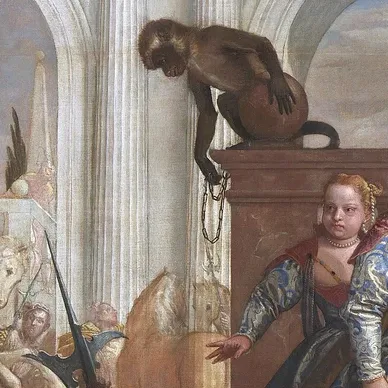
In 1858 Elcho and his supporters carried a resolution through the Commons abolishing the post of travelling agent, and Mündler lost his job.
7. The Battle of San Romano — Paolo Uccello, c. 1438–1440
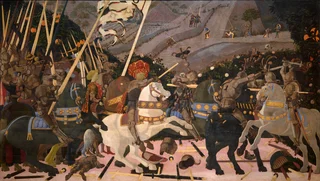
Three large panels of the battle of San Romano, fought in 1432 between the Florentines and the Sienese, hung in the house of the Florentine Lionardo Bartolini Salimbeni. After his death Lorenzo de' Medici got hold of them. One of the heirs ceded his part legally, and around 1484 the share of his brother Damiano was carried out of the house against its owner's will. The panels had hung high and were rounded at the top. For the Medici palace the tops were cut off and the corners built out so that the three pictures could hang in a row. Today they are divided between London, the Uffizi and the Louvre.
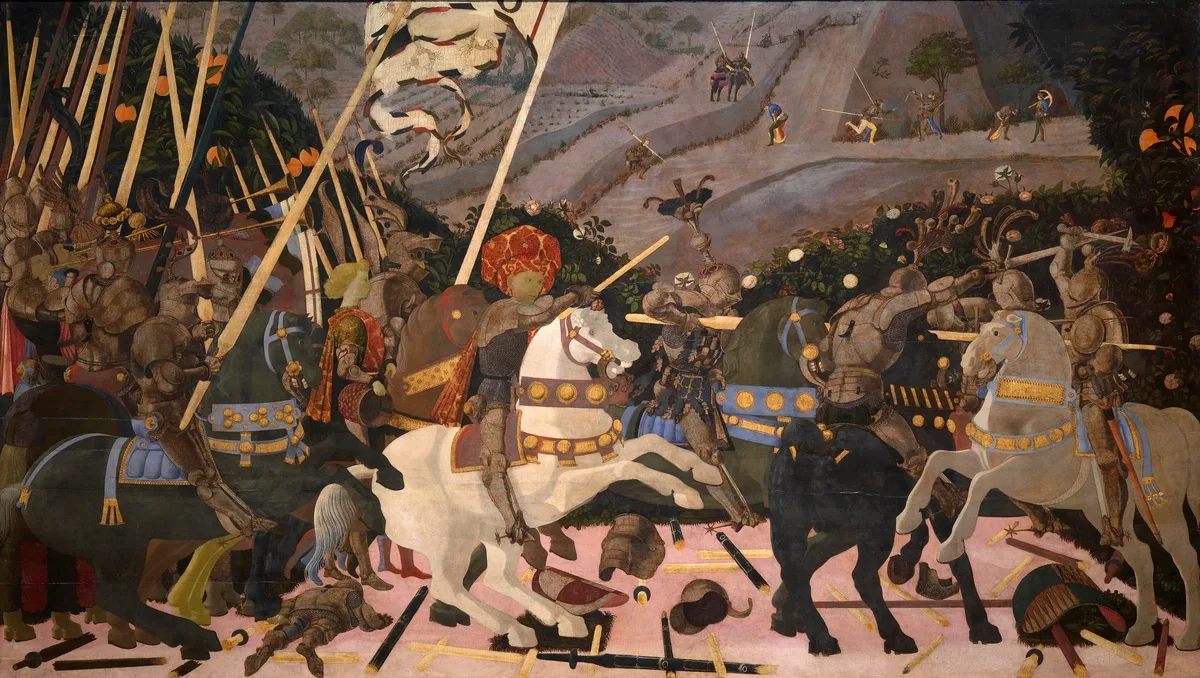
At the centre of the London panel the Florentine condottiere Niccolò da Tolentino leads the charge on a rearing white horse, his baton raised, with no helmet and a huge red hat patterned in gold. On the pink ground beneath the hooves, broken lances lie in a neat grid running back into depth, and only the fallen knight in the lower left corner, lying face down, is foreshortened the other way. Uccello's colours have changed a great deal. The harness was bright vermilion and has darkened to blue-grey, the armour was covered in real silver, which has turned brownish grey, and the green hedge with roses has gone almost black. The dark foliage in the upper corners is painted on the very pieces that were added at the corners.
Eastlake bought the London panel in 1857 from Florentine dealers. By 1598 Florence had forgotten the battle, and an inventory called the three panels “three large pictures of old jousts”.
8. An Allegory with Venus and Cupid — Bronzino, c. 1545
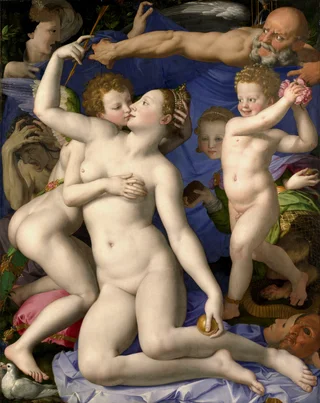
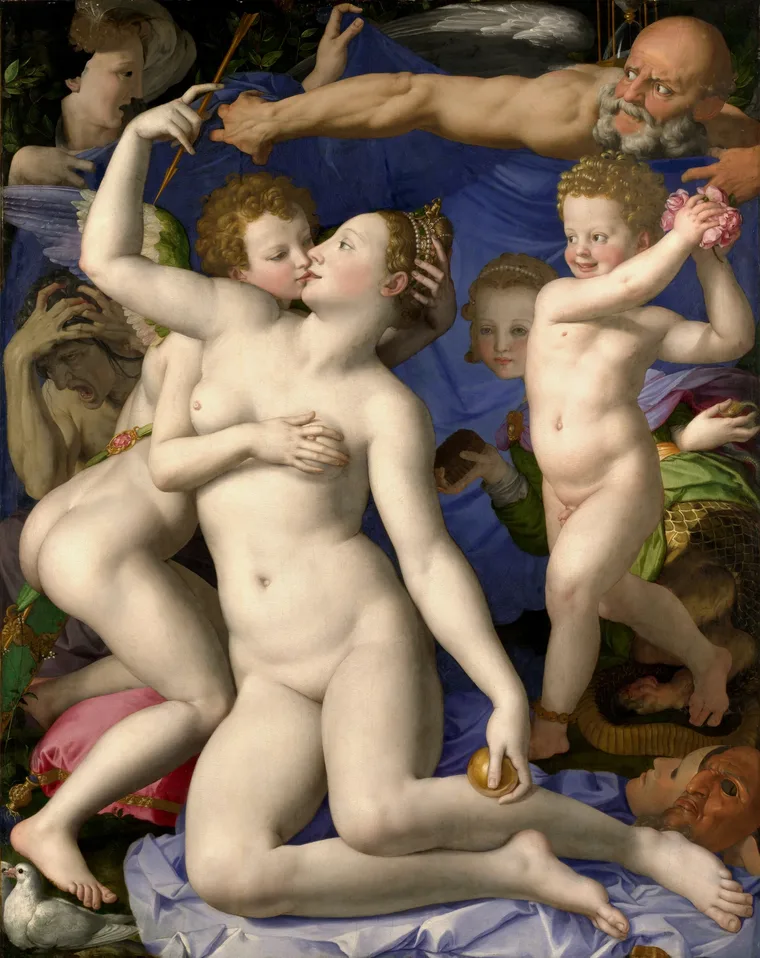
Venus kneels in the middle of the picture, turned towards the viewer, and kisses Cupid over her shoulder. In Bronzino's version Cupid is already an adolescent. He kneels on a pink cushion with his back to us, one hand on her breast and the other reaching for her crown.
When Eastlake bought the picture in Paris in 1860, two details in it were painted over almost at once. The restorer Raffaele Pinti, in all likelihood on Eastlake's instructions, painted out Venus's tongue, visible between her lips, and the nipple held between Cupid's fingers. The picture hung in the Gallery in that state for almost a century, and the overpaint came off only in the cleaning of 1958.
Meanwhile Venus is drawing an arrow from Cupid's quiver, and in her other hand she holds a golden apple. On the right a laughing boy is about to throw a handful of roses, and behind him a girl in green holds out a honeycomb, while below her dress a scaly body, a lion's paw and a serpent's tail can be seen. Time, a bald, bearded old man with an hourglass on his back, stretches his arm across the whole top of the picture. On the left, in shadow, a grey-green figure clutches its head and screams. It was long called Jealousy, and in 1986 it was suggested that the figure shows the symptoms of syphilis.
According to Vasari, Bronzino painted a nude Venus with Cupid kissing her, and the picture was sent as a gift to King Francis I of France. This is probably that picture, sent by Cosimo I de' Medici, Duke of Florence.
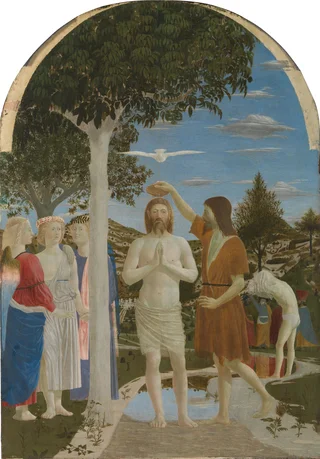
9. The Baptism of Christ — Piero della Francesca, 1440s
Eastlake saw this panel in 1858 in the sacristy of the cathedral of Sansepolcro, Piero's home town, judged it “almost ruined by sun and damp” and did not buy it. In 1859 the cathedral chapter sold the panel, and it entered the collection of the railway financier Matthew Uzielli. After Uzielli's death, in 1861, Eastlake bought the Baptism for himself at the sale and a couple of days later decided to give it to the Gallery.
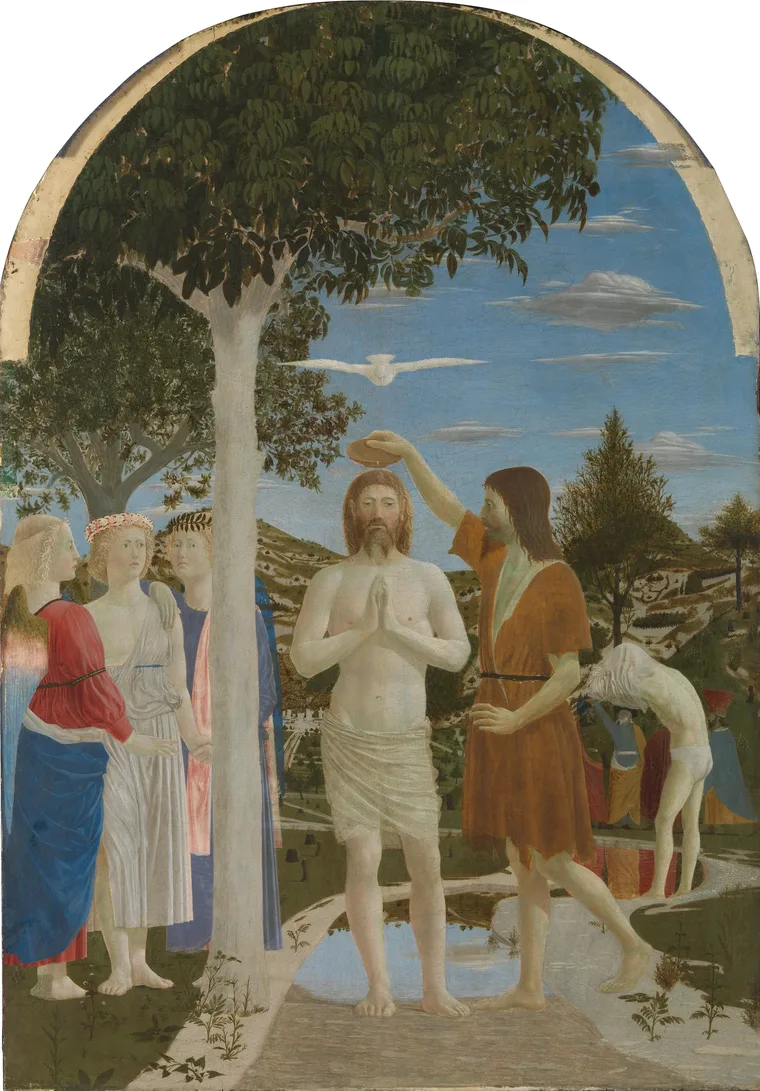
Christ stands exactly in the middle, facing us, his eyes lowered and his palms together. On the right John the Baptist, in profile, raises a shallow bowl, and a thin trickle of water falls on the top of Christ's head. Directly above the bowl hovers a white dove with its wings spread flat, and in shape it resembles the flat clouds in the sky. The trunk of the tree to the left of Christ is smooth and pale, the same pale tone as Christ's body. Behind the tree stand three angels, two of them holding hands. On the right a young man bends to pull his shirt over his head, and behind him the red, blue and ochre robes of the men on the bank are reflected upside down in the still water. The river comes right up to Christ's feet and stops, and he and John stand on a dry strip of brown earth.
Auctions and Private Collections, 1874–1890
After Eastlake the Gallery bought more and more often at auction and from the heirs of old collections who were selling off their pictures. Sometimes private benefactors added their own money to the public funds.
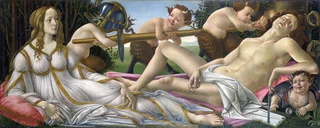
10. Venus and Mars — Sandro Botticelli, c. 1485
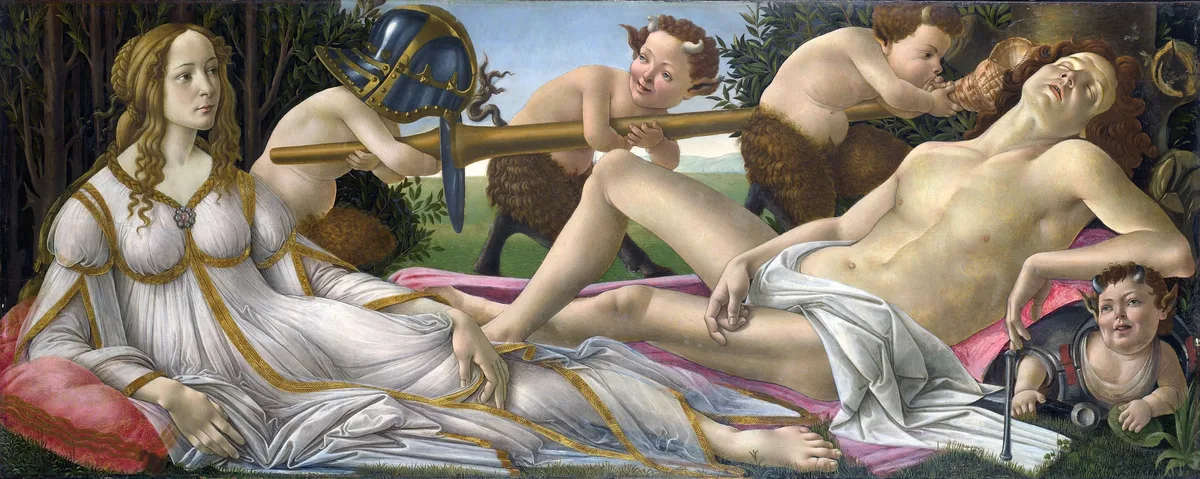
Mars is sleeping so soundly that a satyr is blowing a conch into his ear. He lies naked except for a white cloth around his hips, his head thrown back, while Venus opposite him is awake, dressed in white with a gold border, and watches him calmly. Another satyr has pushed his whole head into Mars's helmet, and a third has climbed into the empty breastplate in the lower right corner and grins at the viewer. In a hollow of the tree by Mars's head, in the upper right corner, is a wasps' nest, and the wasps swarm around his face.
Botticelli may have taken the satyrs playing with the armour from the Greek writer Lucian, who described a lost ancient painting in which little cupids played with the spear and breastplate of Alexander the Great. Long panels like this one were set into the panelling of a bedroom and were most likely made for a wedding. The historian Ernst Gombrich suggested that the wasps allude to the patrons, the Florentine Vespucci family, because the Italian for wasp is vespa, and the nest is painted where wedding panels usually carried a coat of arms.
In 1874 the Gallery bought the picture at Christie's, at the sale of the collection of Alexander Barker.
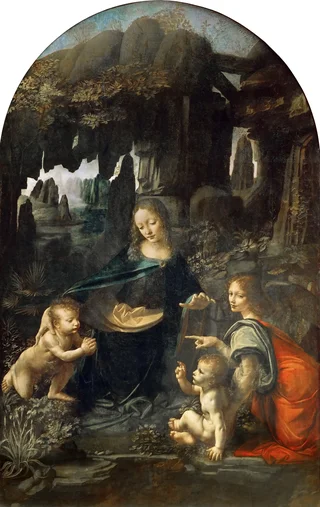
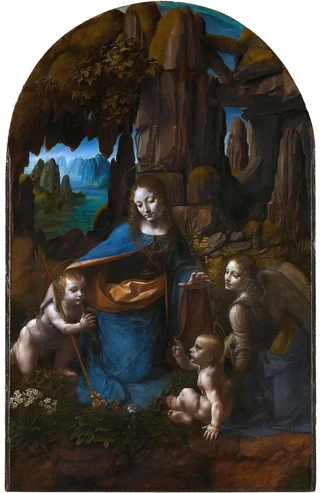
11. Virgin of the Rocks — Leonardo da Vinci, c. 1491–1508
The Milanese Confraternity of the Immaculate Conception signed the contract for this picture in 1483 with Leonardo and the brothers Ambrogio and Evangelista de Predis. The confraternity's chapel in the church of San Francesco Grande already had a carved and gilded altar frame, and three panels were to be fitted into it, the Virgin in the centre and angel musicians at the sides. Leonardo finished the first Virgin by the mid-1480s, and it is the Virgin of the Rocks now in the Louvre. Then the painters and the confraternity quarrelled over money, and according to the National Gallery, around 1491 the first picture was sold to an unknown buyer and a second one, the London panel, was begun for the chapel. From 1501 to 1506 Leonardo lived in Florence. In 1506 the panel was declared unfinished, and he received the last payment in 1508.
In the Louvre picture the angel on the right points at the infant John and looks out at the viewer, while in the London one he lowers his eyes and simply supports the Christ Child's back. Here thin gold haloes appear above the heads, and John holds a slender gold cross on a long staff. In 2004 infrared imaging found an abandoned first design beneath this composition, in which the Virgin knelt in adoration, and in 2019 new images showed it in more detail.
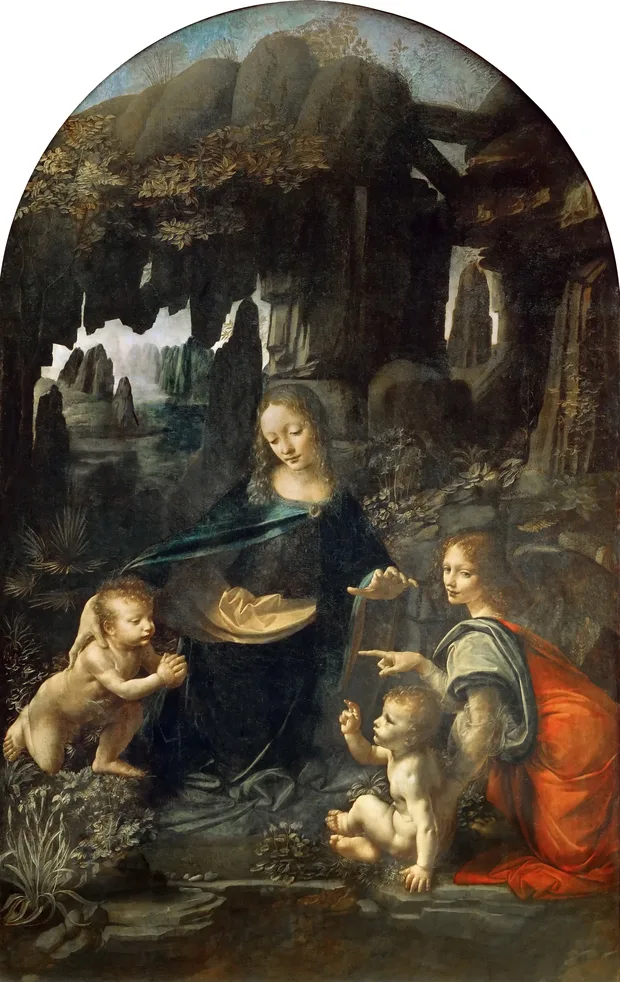
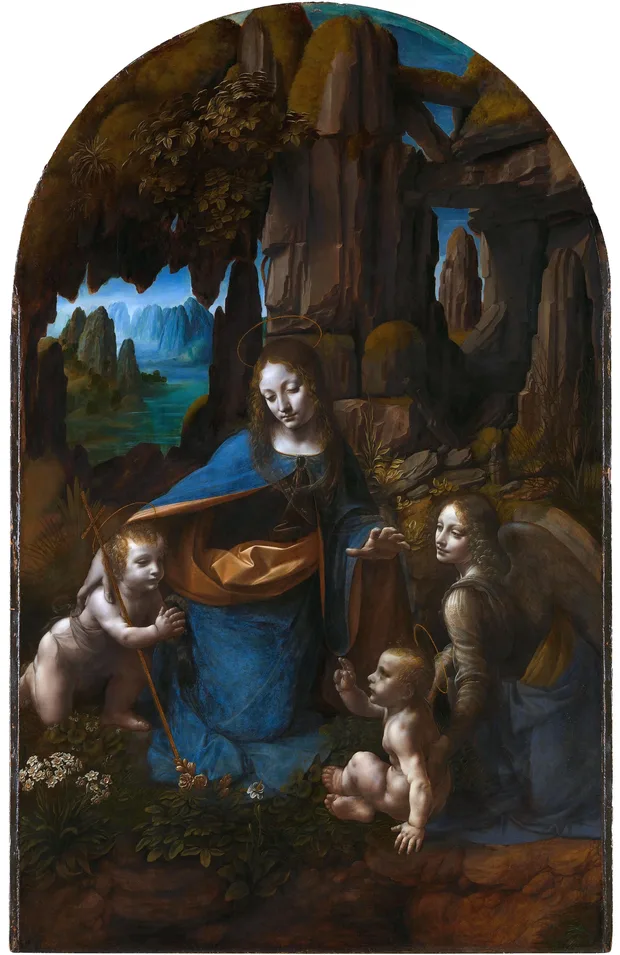
The confraternity was dissolved under the Emperor Joseph II. At the end of the 18th century the Scottish painter and dealer Gavin Hamilton bought the picture and took it to England, and in 1880 the Gallery bought it from the Earl of Suffolk. The Gallery bought the angel panels from the same altarpiece separately, in Milan, in 1898. In the years when he was finishing this panel, Leonardo was also working on a large cartoon of Saint Anne, which now belongs to the National Gallery as well.
The panel is unevenly finished. The blue sky in the gaps between the rocks at the upper right was put in roughly, in a last campaign, and the paint stops along the arc of the top edge, so the panel was evidently already in its frame. On the Virgin's blue cloak by John's foot a brown patch remains, a change that Leonardo never carried through.
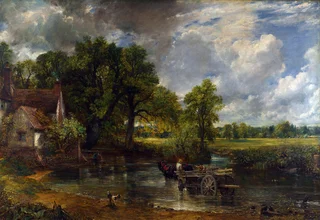
12. The Hay Wain — John Constable, 1821
The name The Hay Wain came from Constable's friend John Fisher, who in 1821 asked in a letter how “the hay wain” was getting on. At the Royal Academy the picture hung as Landscape: Noon and found no buyer. In 1824 Constable let the dealer John Arrowsmith have it with two other pictures for £250. Arrowsmith took them to Paris, and at the Salon The Hay Wain won a gold medal from Charles X.
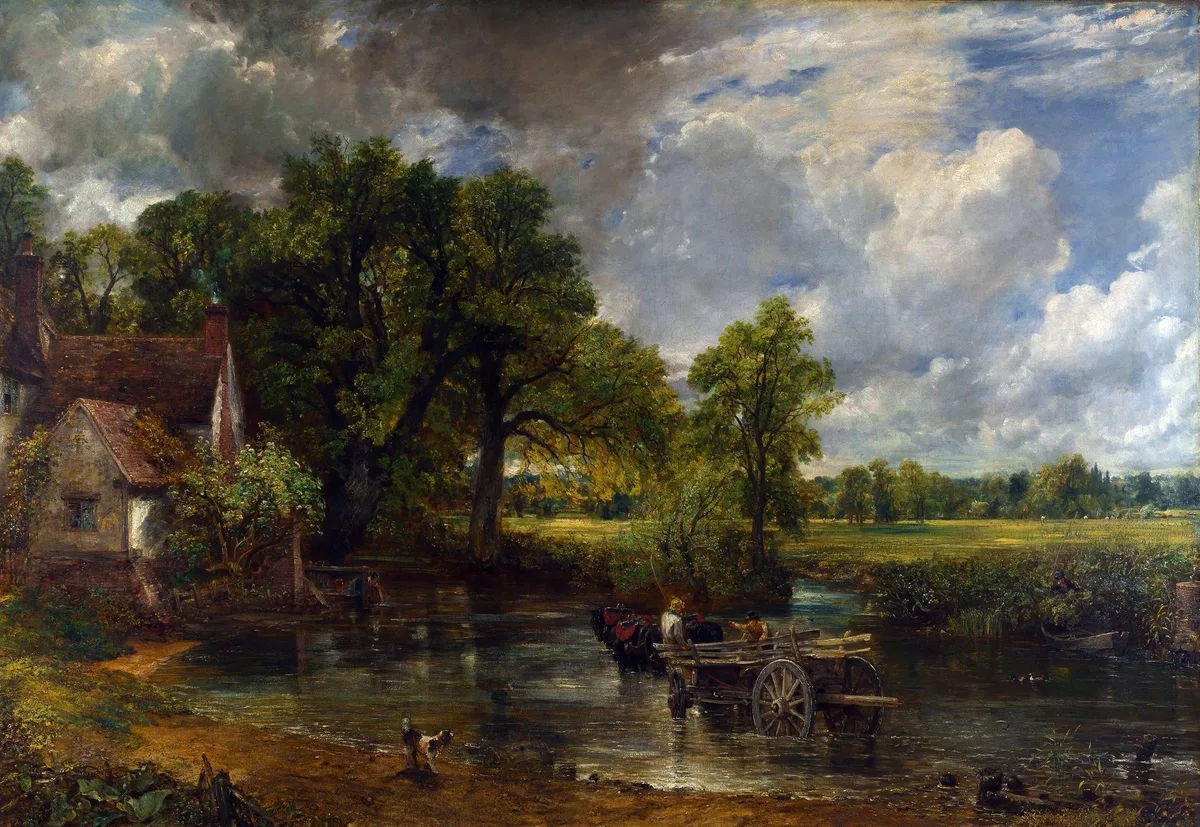
On the left stands the farmer Willy Lott's house with its pink tiled roof, and at the water's edge beside it a tiny woman bends down with a pitcher. In the middle of the shallow millpond stands the empty hay wain, its two big wheels half under water, drawn by three dark horses, and the red fringe on their collars is almost the only red in the picture. On the near bank a white dog with brown patches watches the wagon. Constable touched the leaves and the glints on the water with white flecks, and critics called them “Constable's snow”.
In France the picture passed from owner to owner for about 14 years, then returned to England, and in 1866 it came to Henry Vaughan, heir to a hat-making fortune. In 1886 Vaughan gave it to the Gallery.
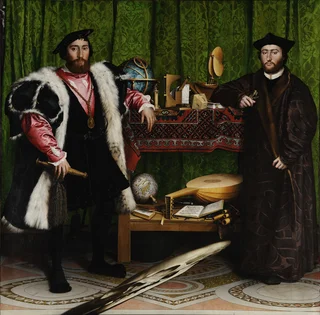
13. The Ambassadors — Hans Holbein the Younger, 1533
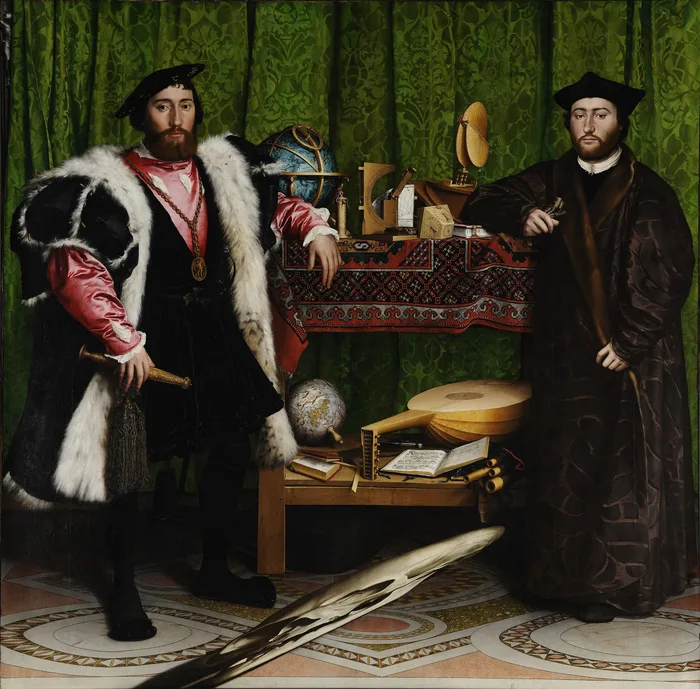
The Gallery bought this panel in 1890 without knowing who Holbein had painted. The two men had been taken for English courtiers and even for two Counts Palatine, until in 1895 the researcher Mary Hervey found a 17th-century document that named them both. On the left stands Jean de Dinteville, the French ambassador in London, and on the right Georges de Selve, Bishop of Lavaur, who came to visit him in the spring of 1533.
That was the year of Henry VIII's break with Rome and of Anne Boleyn's coronation. On the lower shelf between the ambassadors lie a lute with a broken string and a book of German hymns open at two hymns by Luther, and they are read as an allusion to discord within Christendom. On the upper shelf stand a celestial globe, sundials and other instruments for observing the sky and telling the time, and many of them are set so that they cannot give the correct time.
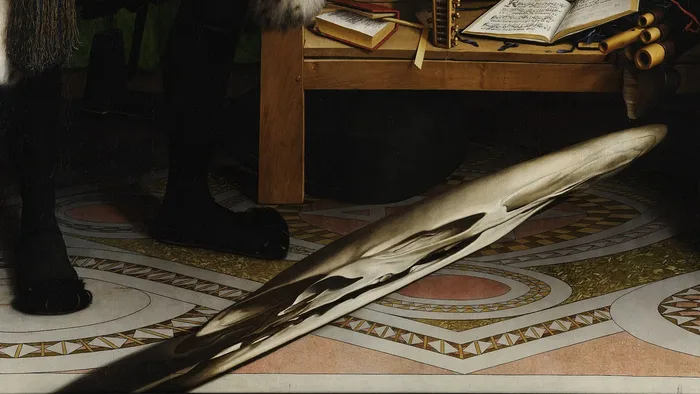
Across the floor at the bottom runs a long grey-white smear. Seen straight on it looks like a stretched bone, and seen from the side, from the right and close to the surface, it turns into a skull. The present frame, made in 1996, was given a deliberately shallow profile so that it is easy to stand at the side. In the upper left corner, almost hidden by a fold of the green curtain, hangs a small silver crucifix.
The Earl of Radnor sold the panel together with two other pictures for £55,000. The government put up almost half the sum, and three private donors gave the rest.
When the Usual Budget Was Not Enough, 1906–1929
By the early 20th century prices for old masters had risen, and the Gallery more and more often found itself competing with very wealthy American collectors. Major purchases now needed a public appeal, a special Treasury grant or a private fund.
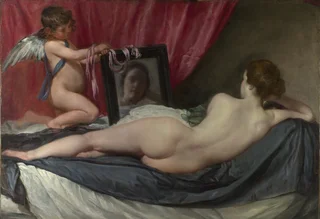
14. Rokeby Venus — Diego Velázquez, c. 1647–1651
On 10 March 1914 the suffragette Mary Richardson smashed the glass in front of this picture and struck the canvas several times with a small chopper she had hidden under her jacket. The day before, the suffragette leader Emmeline Pankhurst had been arrested in Glasgow, and Richardson declared that she had tried to destroy the picture of “the most beautiful woman in mythological history” as a protest against the Government for destroying Mrs Pankhurst. The Times counted six or seven cuts, the worst of them across the neck and shoulders.
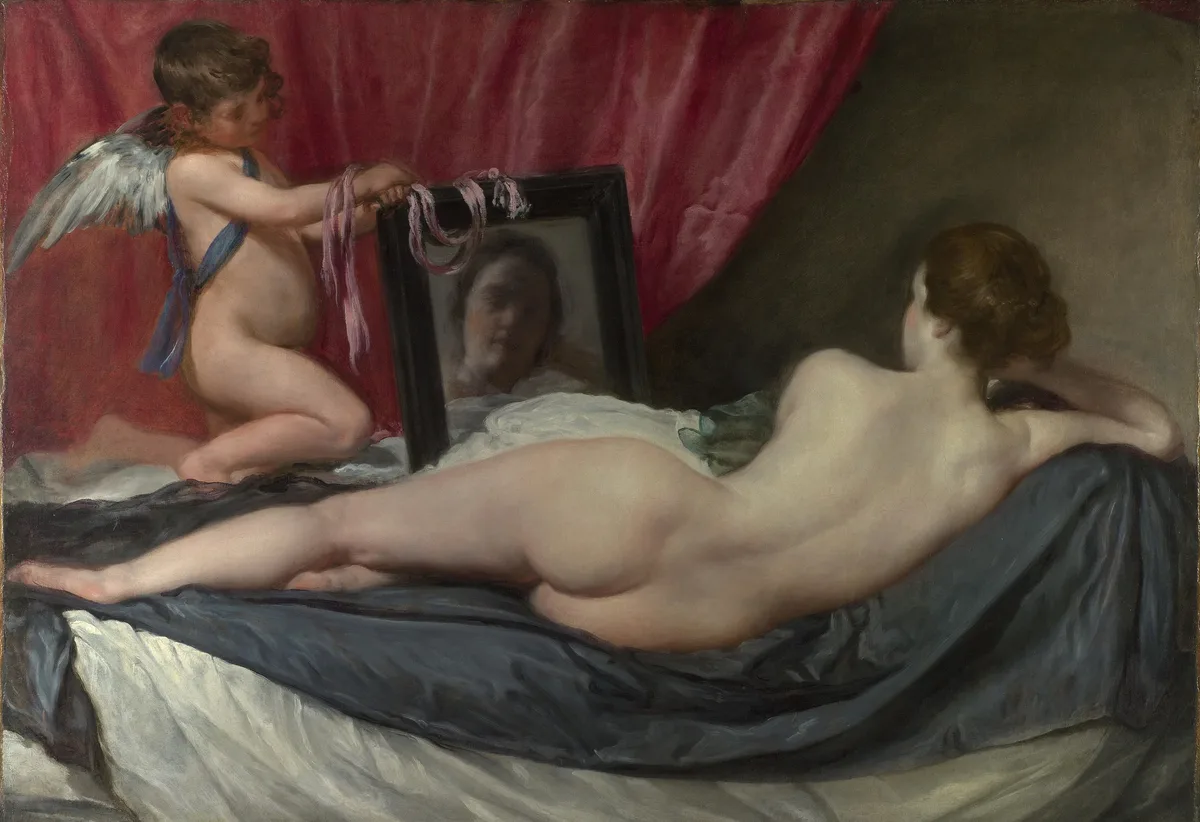
Venus lies with her back to us on dark grey-blue satin, her head to the right and her feet at the left edge, and her whole body runs in one unbroken line from shoulder to heel. Cupid, kneeling, holds up a black-framed mirror in front of her, with pink ribbons hanging from the frame. The face in the mirror is blurred and turned towards the viewer, although with Venus lying as she does, the mirror would reflect something quite different. This is the only surviving picture of a female nude by Velázquez.
The picture passed through Spanish collections, came to England in 1813 and hung at Rokeby Park, an estate in Yorkshire, which is where its English nickname, the Rokeby Venus, comes from. In 1905 the heir sold it to Agnew's to pay death duties. Agnew's put it on show in Bond Street, the newspapers began a campaign for “our national Venus”, and the National Art Collections Fund, founded two years earlier, opened an appeal, raised £45,000 and in 1906 presented the picture to the Gallery.
In November 2023 two Just Stop Oil activists struck the glass with hammers and explained that they were repeating the act of 1914. The broken glass slightly damaged the paint surface, and a few weeks later the picture was back on the wall.
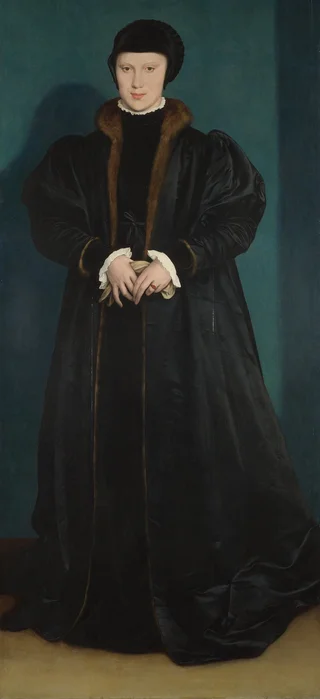
15. Christina of Denmark, Duchess of Milan — Hans Holbein the Younger, 1538
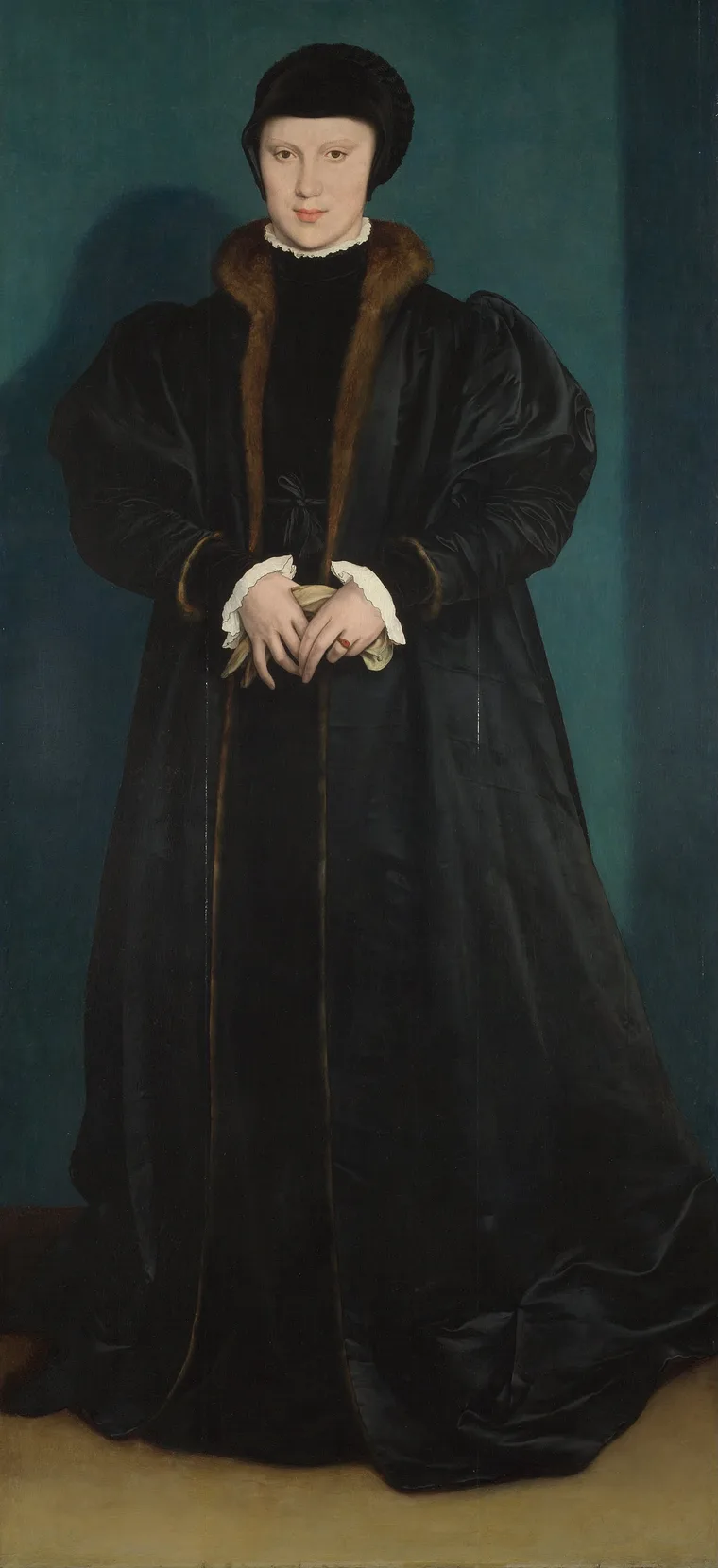
Christina of Denmark was 16 when, on 12 March 1538, she sat to Holbein in Brussels for three hours. The daughter of a deposed Danish king and a niece of the Emperor Charles V, she had been widowed at 13 by the death of the Duke of Milan and was still in mourning. Henry VIII, whose wife Jane Seymour had died shortly before, was looking for a fourth wife and sent his court painter to portray one of the possible brides. The study Holbein brought back was reported to have pleased the king exceedingly.
Christina stands full-length and life-size, and this is the only surviving portrait of a woman on that scale by Holbein. Behind her is a bare blue-green wall, and her shadow falls on it to the left. She wears a black satin gown with huge sleeves, lined with brown fur, and a close-fitting black cap that covers her hair. Her face and hands are the only pale areas on the whole panel. The hands are folded at her waist and hold leather gloves, on the ring finger of her left hand is a ring with a red stone, and on her lips there is a faint smile.
The marriage never took place, yet Henry kept the portrait. Later it passed to the Dukes of Norfolk, and in 1909 the 15th Duke sold it to Colnaghi. Colnaghi offered the picture to the American collector Henry Clay Frick, leaving the Gallery the right to buy it at the same price until 1 June. The Treasury promised a grant, the National Art Collections Fund opened an appeal, and John Singer Sargent, George Bernard Shaw and King Edward VII all gave money, and still by the end of May the sum fell short. At the last moment the balance came from a woman who insisted that her name be kept secret. She wrote from a German spa, the money arrived on 1 June, the very last day, and the Gallery's director, Charles Holroyd, is said to have covered his face with his hands and wept. Henry James, who had followed the appeal, later made the story the plot of a play and then of a novel.
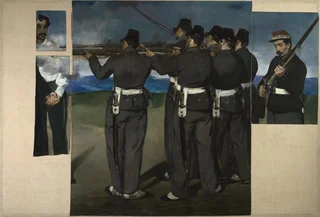
16. The Execution of Emperor Maximilian — Édouard Manet, c. 1867–1868
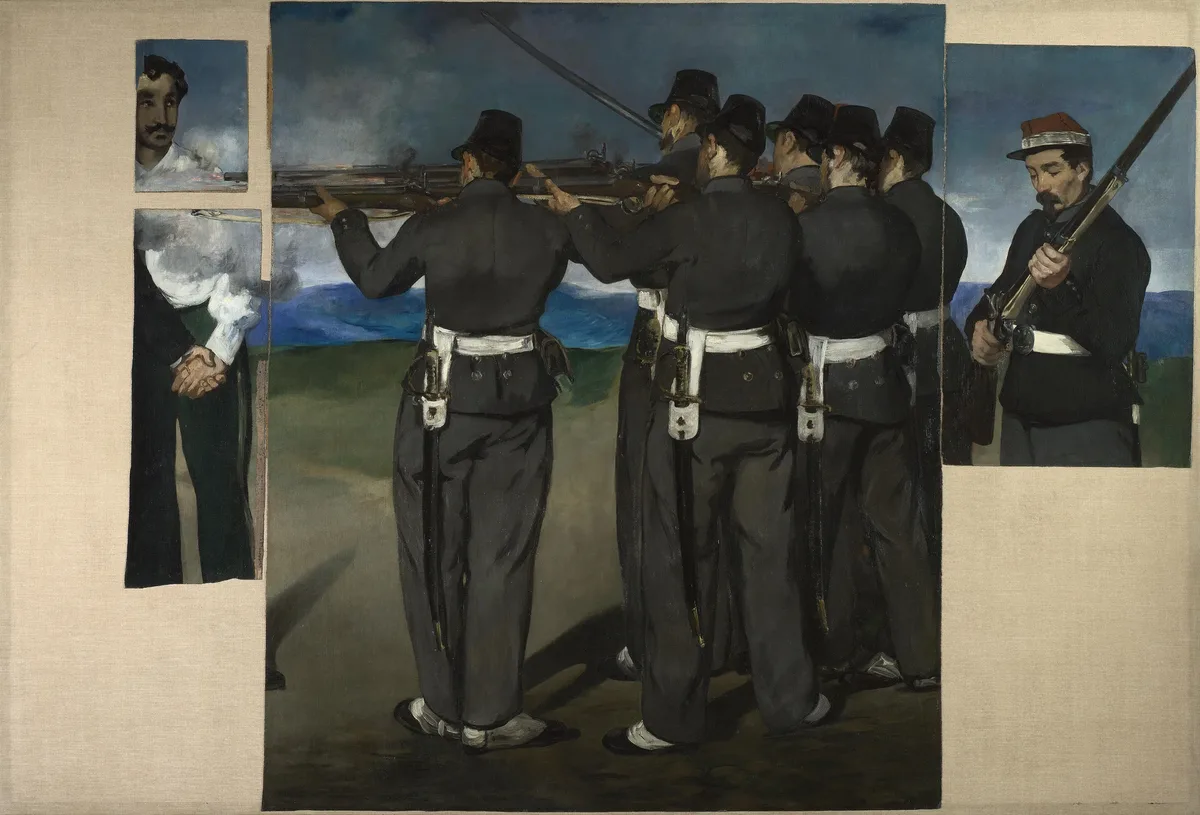
Four fragments painted in oil are stuck onto a large bare canvas the colour of oatmeal, and about a third of the surface is empty cloth. In the centre, seen from behind, the soldiers of the firing squad in black uniforms, white belts and white gaiters take aim to the left, rifles raised to the shoulder. At the upper left is a separate piece with the head of General Miramón, and below it a narrow strip with a white shirt in gunsmoke and two clasped hands. One of them is apparently the left hand of Maximilian holding Miramón's, and it is all that survives of the emperor on the canvas. On the right, standing apart, a sergeant in a red kepi calmly cocks his rifle for the final shot, his head lowered. Where the third condemned man, General Mejía, stood, there is bare canvas.
Napoleon III had set the Austrian Archduke Maximilian on the throne of Mexico, and in 1867 Maximilian was shot at Querétaro together with two generals. Manet, outraged by the execution, painted it in four versions. The London canvas was the second, and around 1868 he abandoned it. After Manet's death his widow's son, Léon Leenhoff, cut the canvas into pieces and sold them separately. According to the dealer Ambroise Vollard, whose story cannot be checked, Leenhoff used Maximilian's head as kindling.
Edgar Degas bought up the fragments and glued them onto a single canvas the size of the original, leaving blank the places of the lost pieces. Degas died in 1917, and in March 1918 his collection was sold in Paris, which in those days was being shelled by a long-range German gun. The economist John Maynard Keynes, then working at the Treasury, proposed a special grant for the Gallery to bid at the sale, and the Gallery's director, Charles Holmes, went to buy pictures in a Paris under bombardment.
At the Gallery the pieces were first taken off Degas's canvas and hung as separate pictures, and only in the late 20th century were they brought back together in the order in which Degas had arranged them.
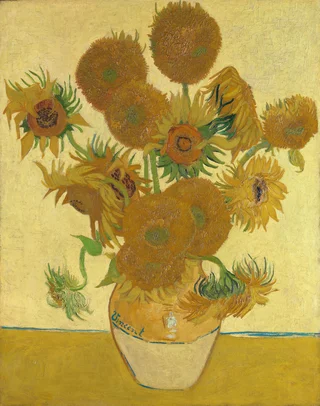
17. Sunflowers — Vincent van Gogh, 1888
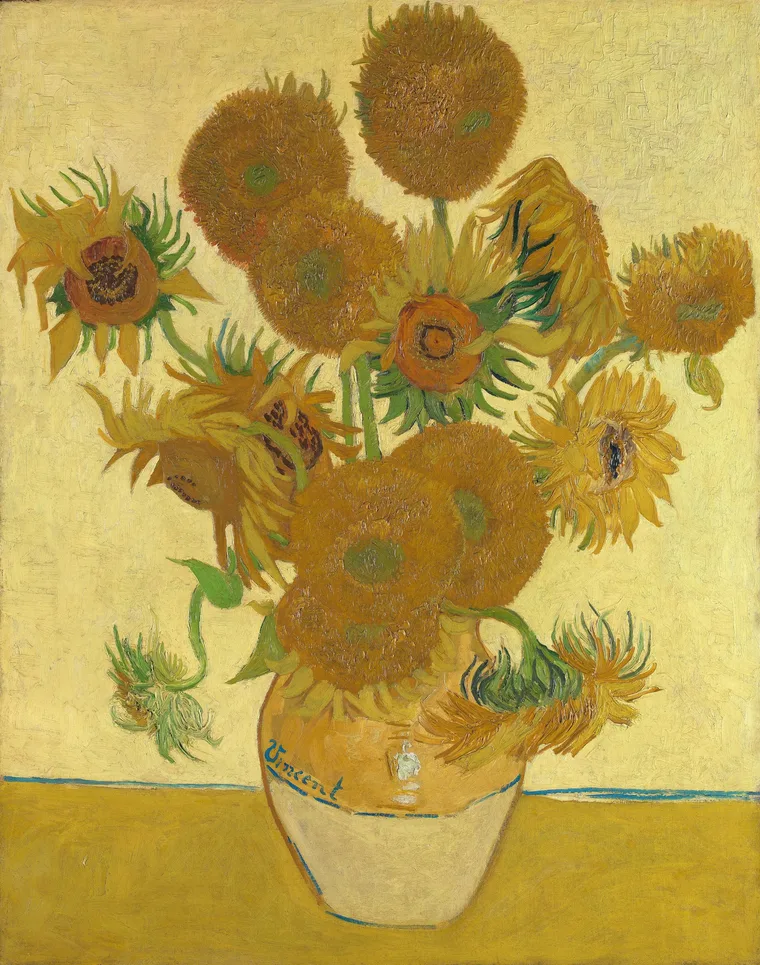
In a letter from Arles to his brother Theo in August 1888, Van Gogh describes his fourth painting of sunflowers, “a bunch of 14 flowers on a yellow background”. There are 15 on the canvas. He apparently added later the small wilted flower on a long curving stem that droops at the lower left almost to the table.
The yellow earthenware vase stands in the middle on a yellow table in front of a yellow wall, and all this yellow is broken only by the green stems, the orange-red centres and the blue lines, one along the edge of the table and two on the vase. On the upper half of the vase “Vincent” is written in blue. Some flowers still have their petals sticking out, others have shed them, leaving a domed seed head built up in thick strokes, and others again have turned their backs to us or hang down. The background is painted in short criss-cross strokes that look like weaving.
Van Gogh was getting the studio ready for Paul Gauguin's arrival and hung this picture in Gauguin's bedroom. In January 1889, after their quarrel and after Vincent had come out of hospital, Gauguin asked for it, and Vincent wrote to Theo: “I am definitely keeping these sunflowers. He already has two of them, that should be enough for him.” Instead he made a repetition of it, which is now in Amsterdam.
For more than 30 years the picture hung in the house of Theo's widow, Johanna van Gogh-Bonger. In 1924 it was bought through a London dealer by the trustees of a fund that the industrialist Samuel Courtauld had set up to buy modern foreign painting.
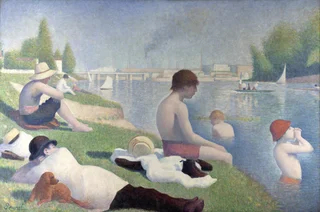
18. Bathers at Asnières — Georges Seurat, 1884
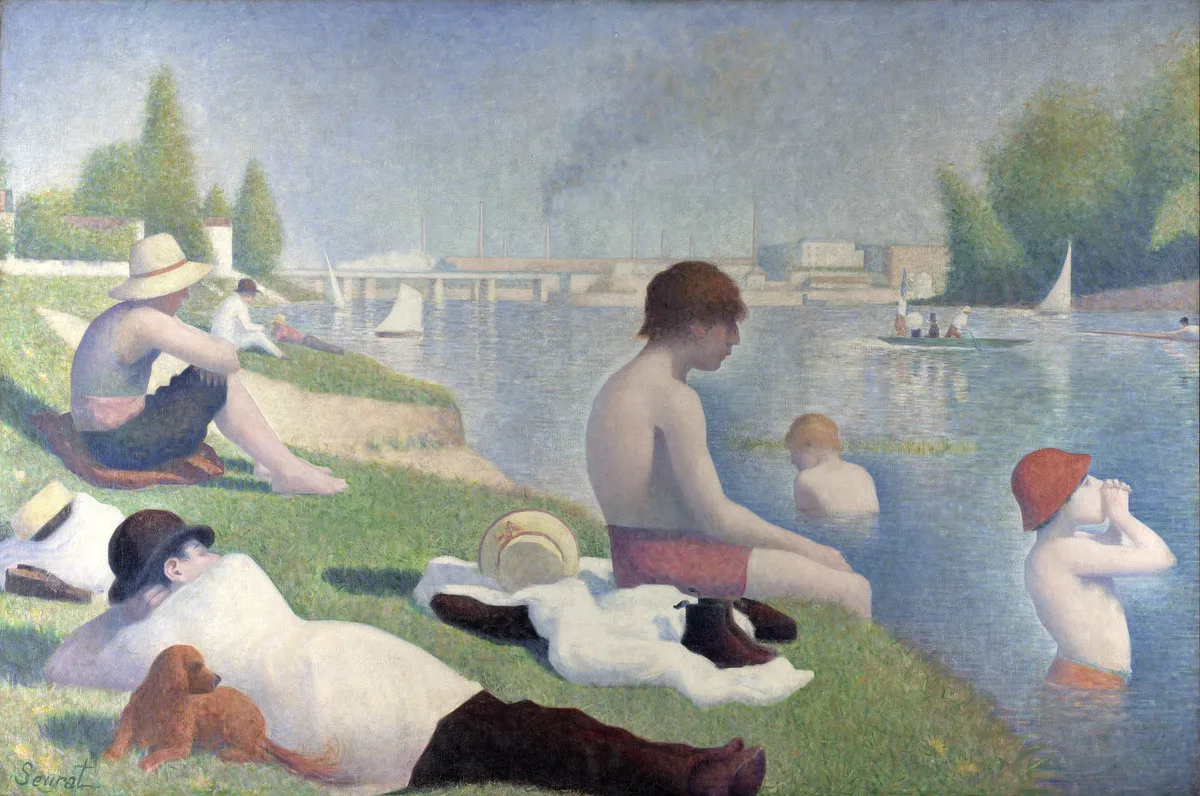
In the spring of 1884 the Salon jury rejected the first large painting by the 24-year-old Georges Seurat. Seurat had conceived the Bathers as a big academic canvas with figures almost life-size and painted it in the studio from studies made on the Seine. After the rejection he showed it at the first exhibition of the Group of Independent Artists, which managed without a jury, and there he met Paul Signac.
In the centre, on the edge of the bank, sits a youth in red-pink bathing trunks, his feet in the water and his head bowed. Behind him on the grass lie his clothes, a white shirt, a straw hat and brown boots standing upright. In the lower left corner a man in a bowler hat lies on his side with his back to us, a russet dog beside him. All seven men in the picture are seen in profile or from behind, and on the far bank stand the factories of Clichy, with dark smoke trailing from one of the chimneys.
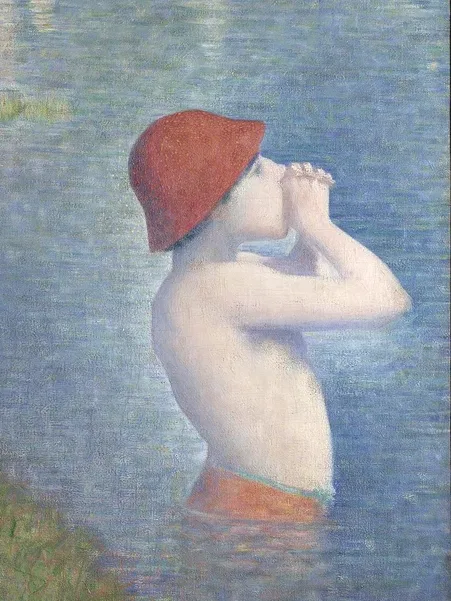
Around 1887 Seurat returned to the picture and added small dots of colour, mostly on and around the bathers. The boy in the water on the right, hands cupped to his mouth, is shouting across the river, and Seurat laid the shadow on his orange cap in blue and yellow dots. Some of the dots painted in zinc yellow have darkened to a greenish brown, and Signac noticed this as early as 1887.
After Seurat's death the picture stayed with his family. Around 1900 it was bought by the critic Félix Fénéon, who had championed Seurat from the start, and in 1924 the same trustees of the Courtauld fund bought it from a London dealer.
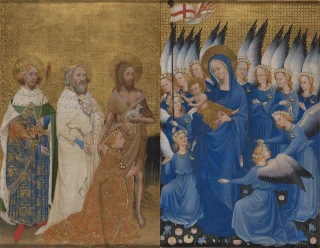
19. The Wilton Diptych — unknown artist, English or French, c. 1395–1399
King Richard II kneels in a red and gold robe woven with small white harts, his palms open as if he were about to receive something. Behind him stand three saints, Edmund with an arrow, Edward the Confessor with a ring and John the Baptist with a lamb on his arm, and John rests his hand on the king's shoulder. On the right wing, where Richard is looking, stands the Virgin in deep blue, and the Christ Child reaches out towards Richard. Around her crowd eleven angels in the same blue, with wreaths of roses and small white harts on their breasts, and their raised wings meet above their heads like a fence of feathers. The gold background is tooled with a fine repeating pattern, most clearly on the right wing.
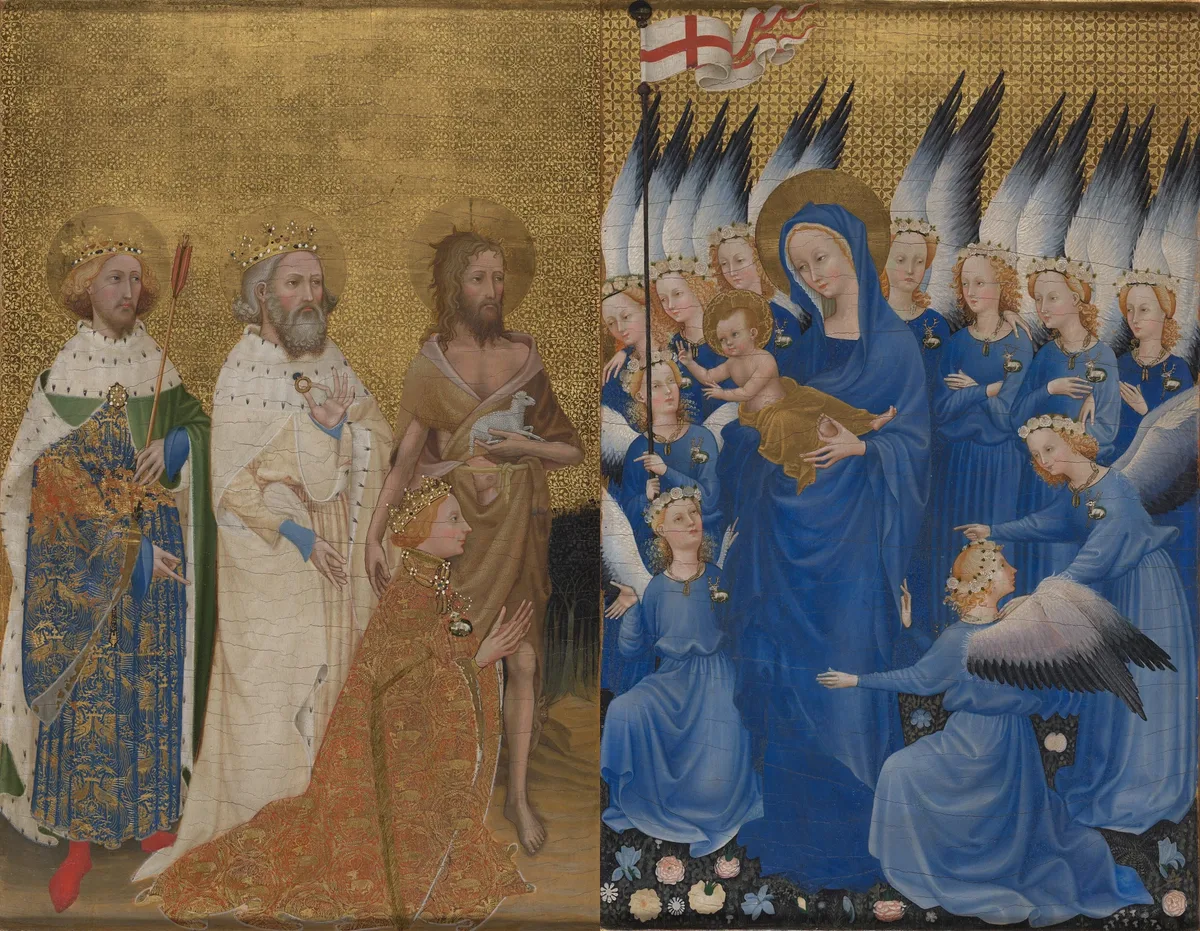
The two wings were hinged and folded shut, and on the outside of one of them lies a white hart, Richard's emblem, with a gold crown round its neck and a chain. The painter's name is lost, and scholars argue both about the date and about why Richard, who was around 30 in 1395–1399, looks like a youth in the diptych. The diptych is first recorded in an inventory of Charles I's collection, and afterwards it spent more than two centuries with the Earls of Pembroke at Wilton House, which gave it its name. In 1929 the Gallery bought it for £90,000. The government paid half, and several major donors and a fund raised the rest.
During the cleaning of 1991–1992, conservators found a tiny orb, smaller than a fingernail, at the top of the staff of the banner held by one of the angels. Painted on it are an island with trees and a white castle, a boat and the sea, and it is read as England given to the Virgin.
From Picture of the Month to Lottery Money, 1942–1997
During the war the collection was taken out of London, and after it major purchases were increasingly put together from government grants, private funds and, towards the end of the century, lottery money.
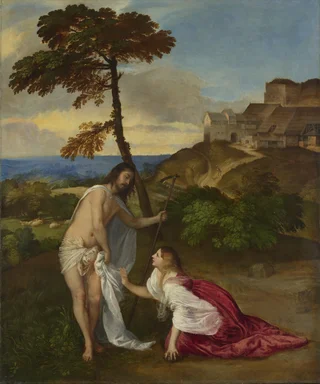
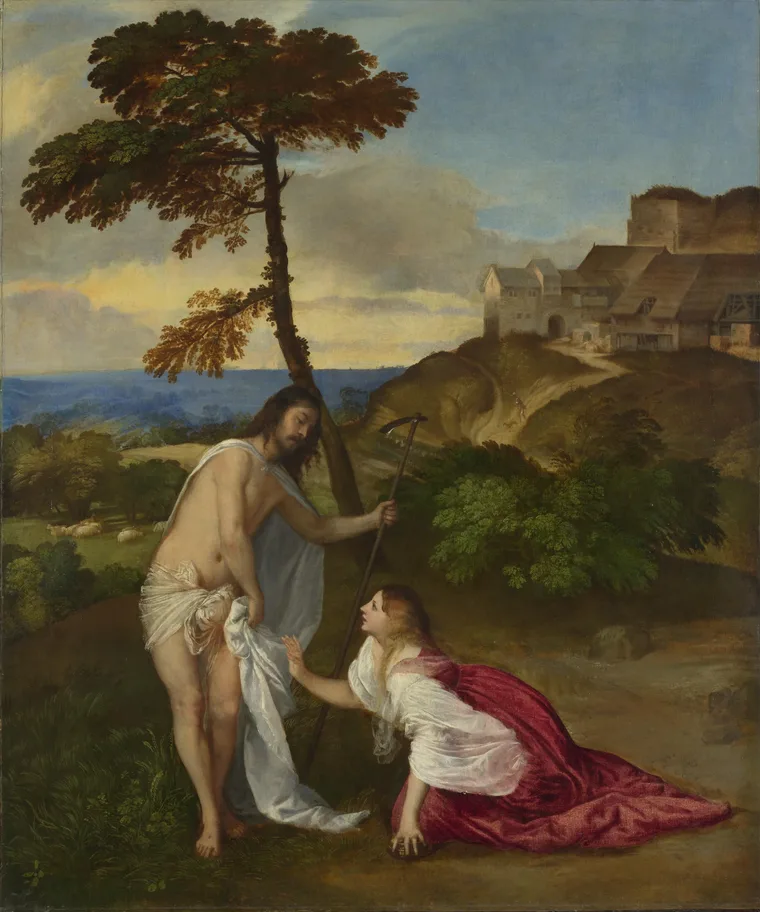
20. Noli me tangere — Titian, c. 1514
During the war the National Gallery's pictures were kept in a slate quarry in North Wales, while concerts were held in the empty building. In 1942 Londoners asked for at least one picture to be brought back, and the director, Kenneth Clark, asked the public what they wanted to see. This Titian was the one most often requested, and in March 1942 Noli me tangere became the first “Picture of the Month”.
Titian placed the two figures in the lower half of the canvas, on a hillside in the early morning. Christ is almost naked, in a transparent white loincloth, with a shroud over his shoulder. With his right hand he draws the shroud away from Mary Magdalene and pulls his hips back from her, yet his head and shoulders bend over her. In his left hand he holds a hoe, because Mary at first took him for the gardener. She kneels in a dark crimson dress and reaches towards him, holding on to a jar of ointment with her other hand. The X-ray shows that at first Christ wore a gardener's hat and was turning away from Mary.
The picture came to the Gallery in 1856 by the bequest of the poet and banker Samuel Rogers, who called it the gem of his collection.
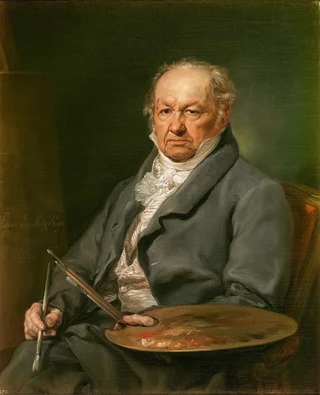
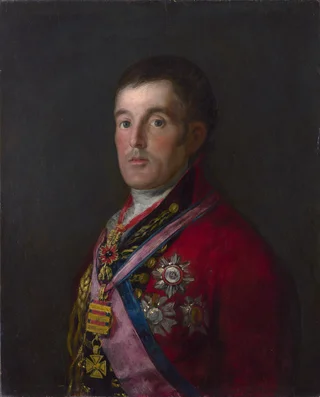
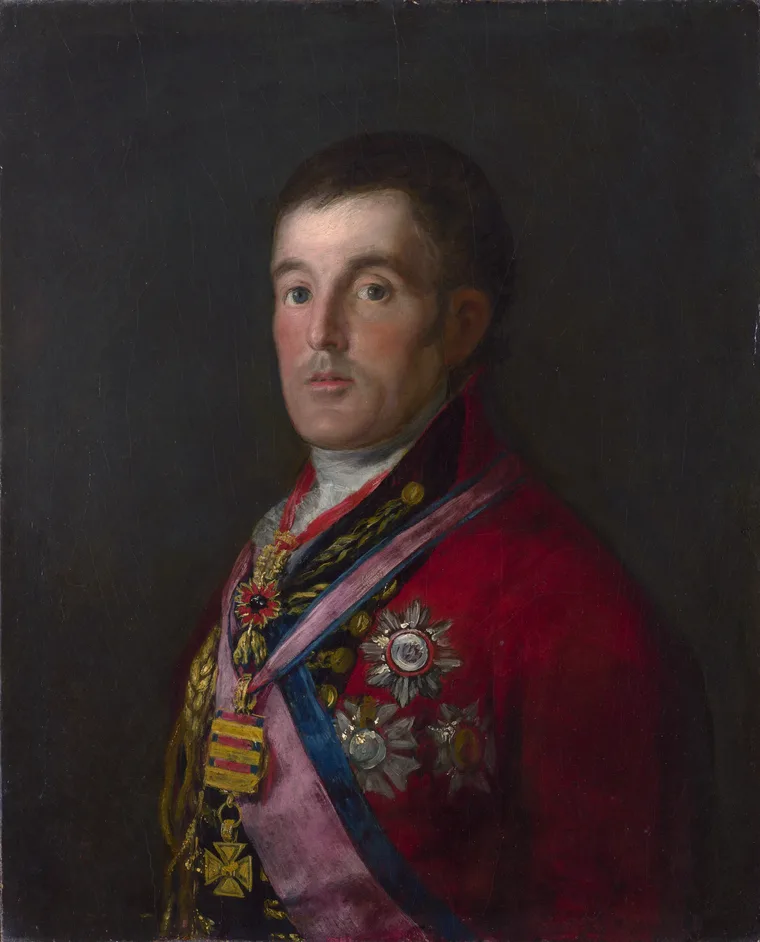
21. Portrait of the Duke of Wellington — Francisco Goya, 1812–1814
Goya painted Wellington in August 1812, soon after the Duke, fresh from his victory at Salamanca, had entered Madrid. The face in the portrait is tired, the cheeks are red, and the eyes are wide open and a little glazed. The chest is crowded with decorations, painted more thickly and untidily than the face, because for almost two years Goya added the honours as Wellington received them. The Army Gold Cross with clasps was instituted only in October 1813, and yet it appears in the portrait.
In 1961 the portrait came up for sale at Sotheby's and might have gone to America, so the Gallery bought it with the help of the Wolfson Foundation and a special Treasury grant. The pensioner Kempton Bunton was outraged that the government had added public money, and in August that year, soon after the portrait went on show, it was stolen from the Gallery. In anonymous letters the thief promised to return the picture if the sum paid for it went on television licences for poor pensioners and he himself was pardoned. The Gallery refused, and for four years the portrait lay at the back of Bunton's wardrobe.
In 1965 a parcel was left at the left-luggage office of a Birmingham railway station, the ticket was sent to a newspaper, and the police recovered the portrait undamaged, though without its frame. Bunton gave himself up to the police. The court acquitted him of stealing the painting, because he had not intended to keep it, and convicted him of stealing the frame, which was never returned. He got three months. In 1969 his son John, arrested on another matter, confessed that it was he who had carried the portrait out of the Gallery.
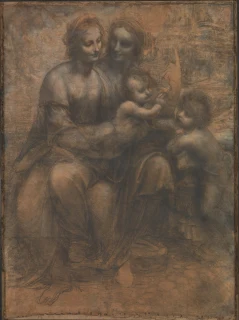
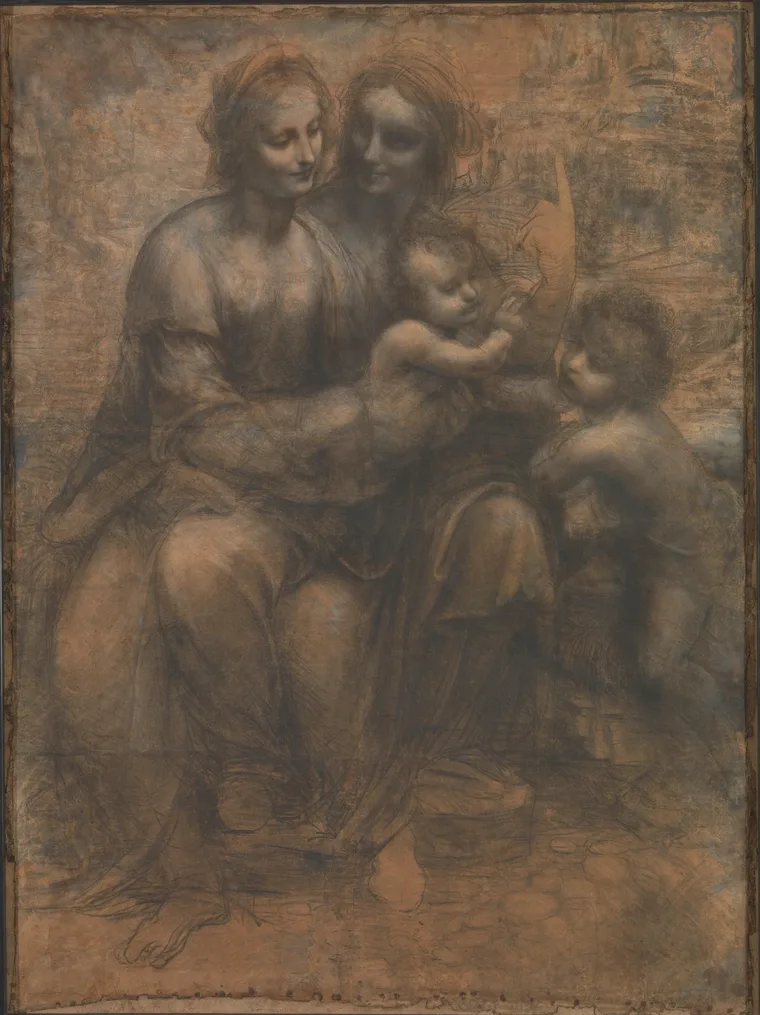
22. The Virgin and Child with Saint Anne and the Infant Saint John the Baptist (The Burlington House Cartoon) — Leonardo da Vinci, c. 1506–1508
In 1962 the Royal Academy of Arts, short of money for its exhibitions and its own school, announced that it would sell Leonardo's cartoon at auction. The cartoon had belonged to the Academy since the late 18th century and hung in its building, Burlington House, which is where its name comes from. The Prime Minister asked the Academy to wait while a public appeal was under way. Of the £800,000, more than half was raised by public subscription, and the Treasury provided the rest.
It is a drawing in charcoal and white chalk on tinted paper made of eight sheets glued together. Mary sits sideways on Saint Anne's lap, and at first glance it is hard to tell where one woman's knees end and the other's begin. The Christ Child twists out of his mother's arms towards the little John and touches his chin with two fingers. The faces and the Child's body are modelled in soft light and shade, while Anne's raised hand, its forefinger pointing upward, and the bare feet at the bottom are only outlined. Leonardo may have made the cartoon as a finished drawing in its own right, to propose an altarpiece to the Florentine government, and he did not get the commission.
In July 1987, shortly before the Gallery closed for the day, a visitor fired a sawn-off shotgun at the cartoon from a few paces away. The glass stopped the shot but shattered, and splinters were driven into the drawing at the Virgin's breast. The Gallery's conservators flattened the sheet, lifted the fragments of paper out of the damaged area and laid them back in place.
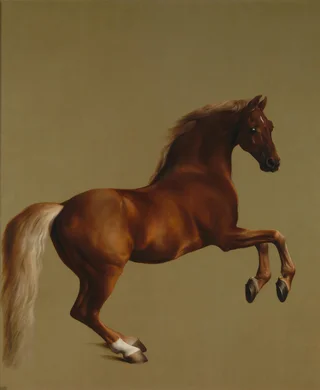
23. Whistlejacket — George Stubbs, c. 1762
The chestnut stallion is painted life-size against an even, pale gold background, with no rider, saddle or landscape. He is rearing, forelegs tucked under, his body in profile facing right and his head turned towards the viewer, and his dark eye shows a rim of white. The pale mane and almost white tail stand out against the coppery coat, and the whole upper left corner of the canvas is empty. Later it was said that the living Whistlejacket saw the finished portrait and went for the painted horse, a story now regarded as legend.
Whistlejacket belonged to Charles Watson-Wentworth, 2nd Marquess of Rockingham, one of the richest men in England. In 1759 the stallion won a 2,000-guinea race at York, and around 1762 Rockingham commissioned Stubbs's first pictures for him. Before that, Stubbs had spent a year and a half dissecting horses in a barn in Lincolnshire, drawing them layer by layer. Rockingham collected ancient sculpture and probably wanted the horses without a background himself, as on a classical frieze.
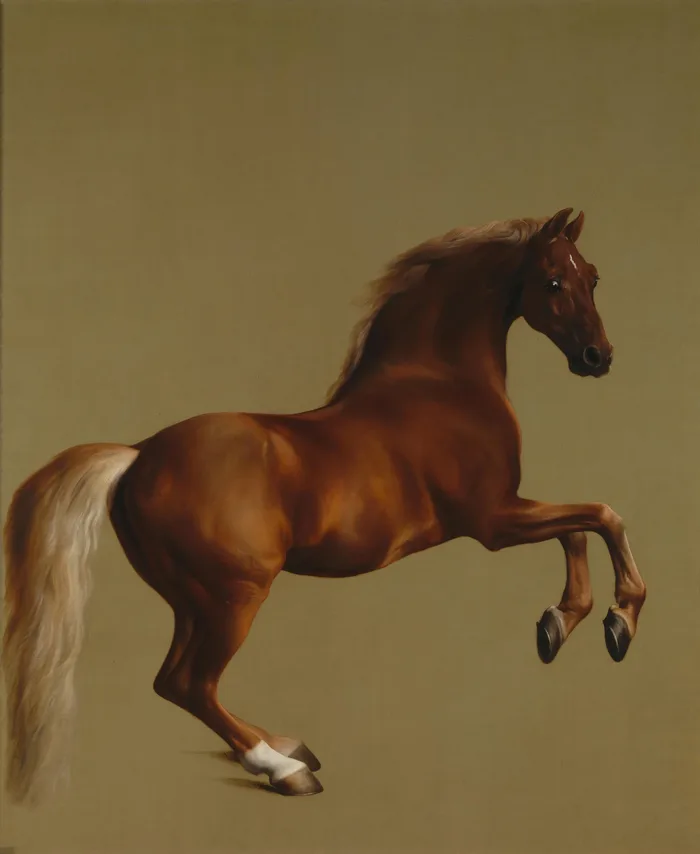
After Rockingham's death the picture was set into the white plasterwork of a wall in a room of its own in his house, and it stayed with his heirs, the Earls Fitzwilliam. In 1997 the Gallery bought it from them for about £11 million, one of the first major purchases made with money from the Heritage Lottery Fund.
New Acquisitions, 2014–2018
The last two purchases belong to the 21st century. In 2014 the Gallery acquired the first major American painting in its collection, a work by George Bellows, and four years later a self-portrait by Artemisia Gentileschi that scholars had not known before.
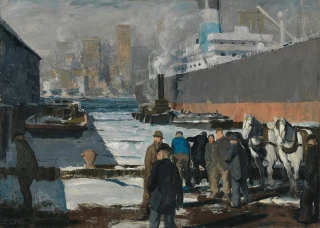
24. Men of the Docks — George Bellows, 1912
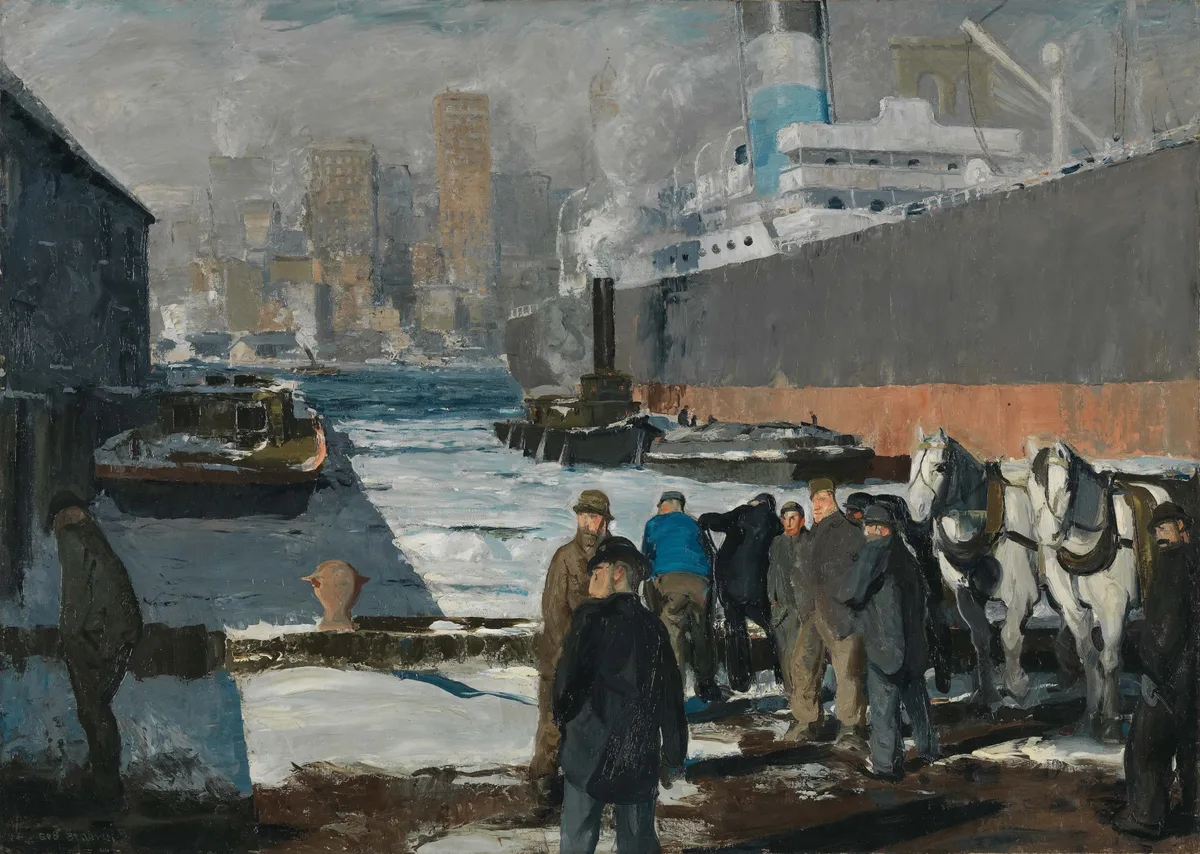
Bellows painted a dock in Brooklyn in winter. Across the East River, choked with ice floes, the skyscrapers of Lower Manhattan stand in the haze, and the right half of the canvas is filled by the dark hull of a huge liner with a rust-red band at the waterline. On snow churned into mud, dockers in dark coats and caps stand waiting to learn who will be hired to load that day, and almost all of them have turned their heads to the left, towards something beyond the edge of the picture. One, in a bright blue sweater, stands with his back to us, and beside the men are two white dray horses. On the left, in the shadow of a warehouse wall, a lone man walks away with his head down, apparently one who was not picked that day.
In 1920 the picture was bought from Bellows himself by Randolph-Macon Woman's College in Virginia. In 2007 the college, short of money, announced the sale of four paintings. Alumnae won an injunction, but in 2014 Men of the Docks was sold to the National Gallery after all, with money from the Gallery's American Friends and the Getty family. After the sale the Association of Art Museum Directors, which speaks for America's art museums, called on its members to stop collaborating and exchanging exhibitions with the college's museum.
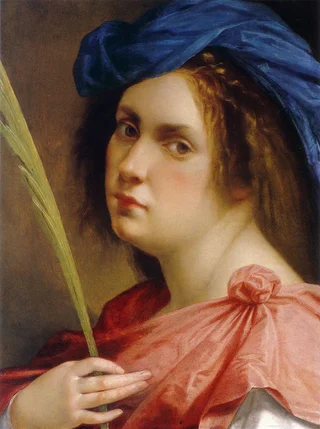
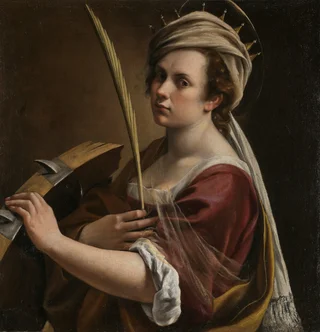
25. Self-Portrait as Saint Catherine of Alexandria — Artemisia Gentileschi, c. 1615–1617
In December 2017, at the Hôtel Drouot auction house in Paris, a painting came up for sale that historians had not known until then. It was estimated at €300,000 to €400,000, the hammer came down at €1.9 million, and that was a record for Artemisia. Dealers bought it, and in 2018 the National Gallery acquired it from them.
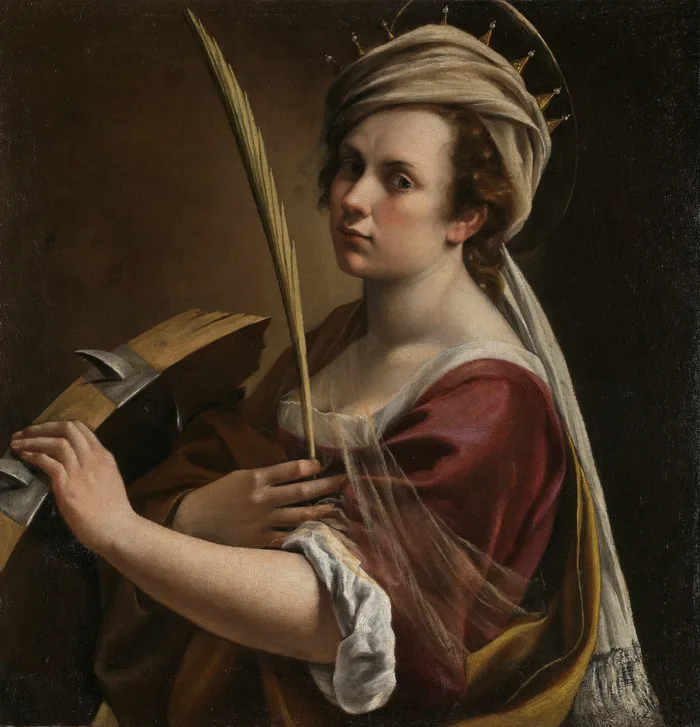
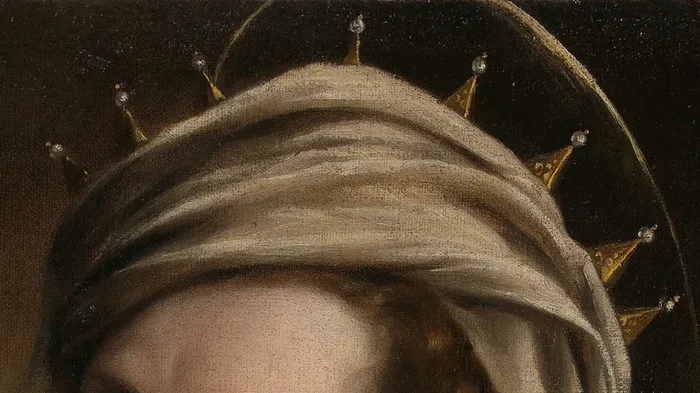
Artemisia painted herself half-turned, looking at the viewer over her shoulder, directly and a little warily. Her head is wrapped in pale cloth like a turban, and a small gold crown with pearls sits on it slightly askew. With one hand she leans on a broken wooden wheel studded with iron spikes, on which Saint Catherine was to have been executed, and with the other she holds a martyr's palm to her breast. Beneath the painted wheel, examination found what was probably a book at first. Artemisia may originally have painted herself as a sibyl and added the wheel, the palm and the crown later. She moved to Florence after the trial held in Rome in 1612 of Agostino Tassi, who had raped her, and it was there, it seems, that she painted Saint Catherine with her own features.
The top edge of the canvas was cut down at some point, taking with it the pearls of the crown and the tip of the palm. In 2018 conservators attached a strip of new canvas along the top, exactly wide enough to paint back the palm and the pearls, and left the halo cut off.
In 2019, ahead of a major Artemisia exhibition, the Gallery took the picture on a tour of the country. It was shown at the Glasgow Women's Library, at a Catholic school in Newcastle, in the waiting room of a GP surgery in Yorkshire and at a women's prison in Surrey.
In 1824 the public was shown the first 38 pictures in Angerstein's house on Pall Mall. Then, 195 years later, the Gallery sent one of its latest acquisitions around the country, to a library, a school, a doctor's surgery and a prison. In between lie almost two centuries of purchases, gifts, bequests and public appeals, and now and then very long arguments over particular pictures.
What Else to See
Beyond these 25 lie some of the Gallery's best-known pictures. Among them is Raphael's Portrait of Pope Julius II, which came from the Angerstein collection, was long considered a copy and was identified in 1970 by its Borghese collection inventory number. Worth seeking out too are Thomas Gainsborough's Mr and Mrs Andrews, Joseph Wright of Derby's An Experiment on a Bird in the Air Pump, William Hogarth's series Marriage A-la-Mode and Paul Delaroche's The Execution of Lady Jane Grey, which survived the 1928 flood at the Tate rolled up.