Daderot · PD
Te Fare Amu
Dettagli
La storia
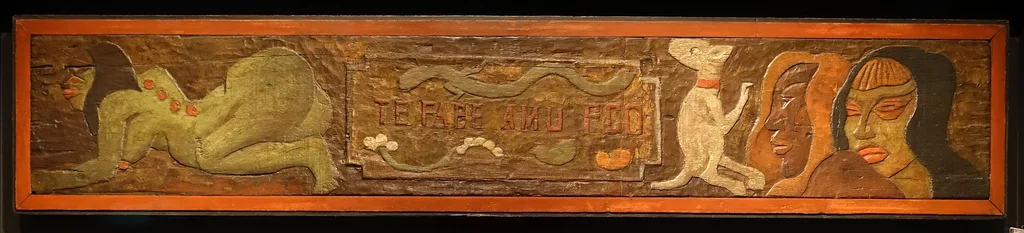
Gauguin sailed back to the Pacific in 1895, after an auction of his work in Paris went badly, and settled at Punaauia on the west coast of Tahiti, where he put up a hut of bamboo and thatch. He carved the woodwork of it himself. This panel of sequoia is one of those pieces, a lintel nearly a metre and a half across, cut with the words Te Fare Amu, the house for eating, so that the doorway said plainly what the room behind it was for. He signed it PGO, the monogram he used in Polynesia, and painted the carving in colour. Its first recorded owner was Emile Schuffenecker, the painter who had put Gauguin up in Paris in leaner years, and it is shown now at the Princeton University Art Museum with the rest of the Pearlman collection.