Part One. The Executed King's Collection
On 30 January 1649, Charles I of England walked to his own execution through his own banqueting hall. Above his head was a ceiling he had commissioned from Rubens twenty years earlier. The scaffold stood outside, at a first-floor window. The whole thing took about half an hour.
Six months later, Parliament voted to sell his pictures. The collection ran to some fifteen hundred works, the finest anyone in northern Europe had assembled in a single lifetime. It was broken into lots and handed out to the king's creditors instead of money.
The Spanish ambassador in London was Alonso de Cárdenas. Philip IV gave him two instructions: buy anything worth having, and never, under any circumstances, reveal who it was for. Madrid was shopping at the dead king's estate sale in secret.
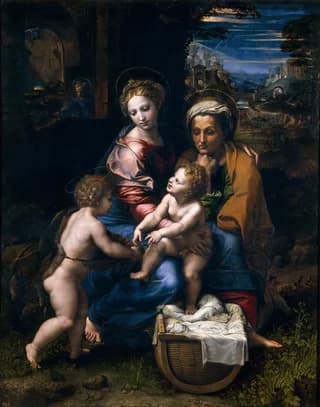
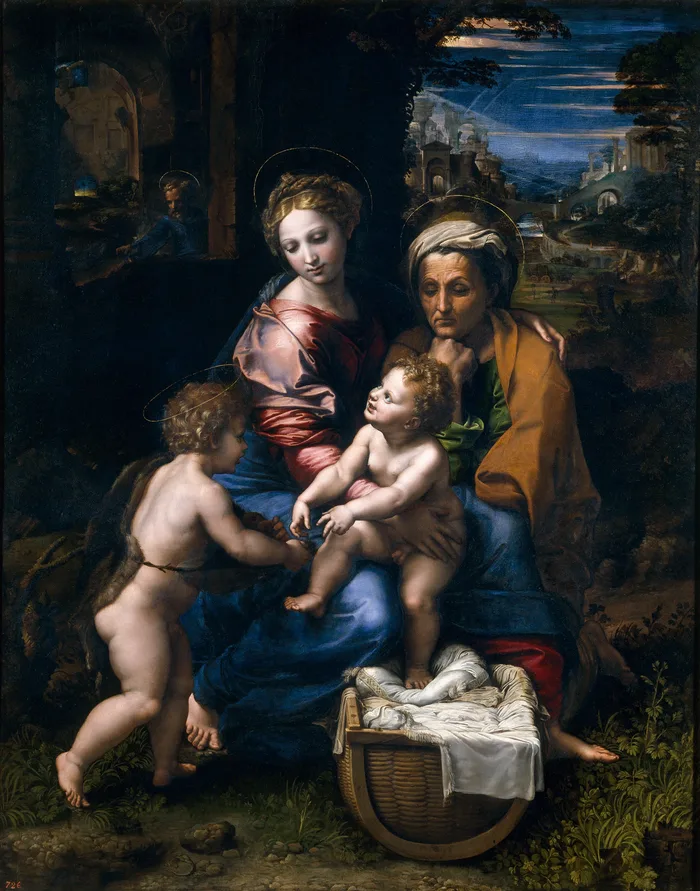
That is how Raphael's The Holy Family left England.
Nothing in the painting hints at what would happen to it. The Virgin holds the Christ Child against her knees. The infant John the Baptist offers him fruit. Saint Anne leans in over the children. Hands, bodies and lowered eyes close around the two infants and shut out everything else.
Raphael painted the scene a hundred and thirty years before Whitehall, for private devotion. After the execution it went to one of the king's creditors; Cárdenas bought it from him with money supplied by the chief minister, Don Luis de Haro, who presented it to Philip IV.
What follows is a story the Prado enjoys telling and nobody can confirm. Seeing the Raphael, the king is supposed to have said: "This is the pearl of my pictures." There is no way to check the line. The nickname stuck anyway, and the Spanish court called the painting The Pearl from then on. It still does.
The collapse of one court enriched another. Philip IV got a Raphael because a king had been beheaded in London and his collection had stopped being anyone's whole.
Great collections almost always grew this way. Paintings moved through marriages, inheritances, diplomatic gifts, purchases and national catastrophes. A picture could outlast its owner, his palace and his country.
Another painting came to Philip IV after a quieter kind of destruction. Somebody took its room apart.
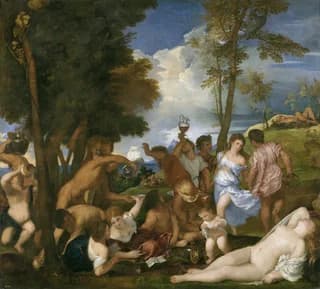
Titian painted The Bacchanal of the Andrians for Alfonso d'Este's alabaster study in Ferrara. The canvas is crowded with people, wine and motion. They drink, dance, sleep and reach for one another. In the foreground a naked woman sleeps with one arm thrown back over her head. In the bottom right corner a small boy has lifted his shirt and is urinating into the grass.
Down at the very bottom, near the revellers' feet, lies a sheet of music, and the notes on it can be read. It is a canon by Adrian Willaert, set to a French text: whoever drinks and does not drink again does not know what drinking is. Titian painted a drinking song into the picture, and you can still sing it.
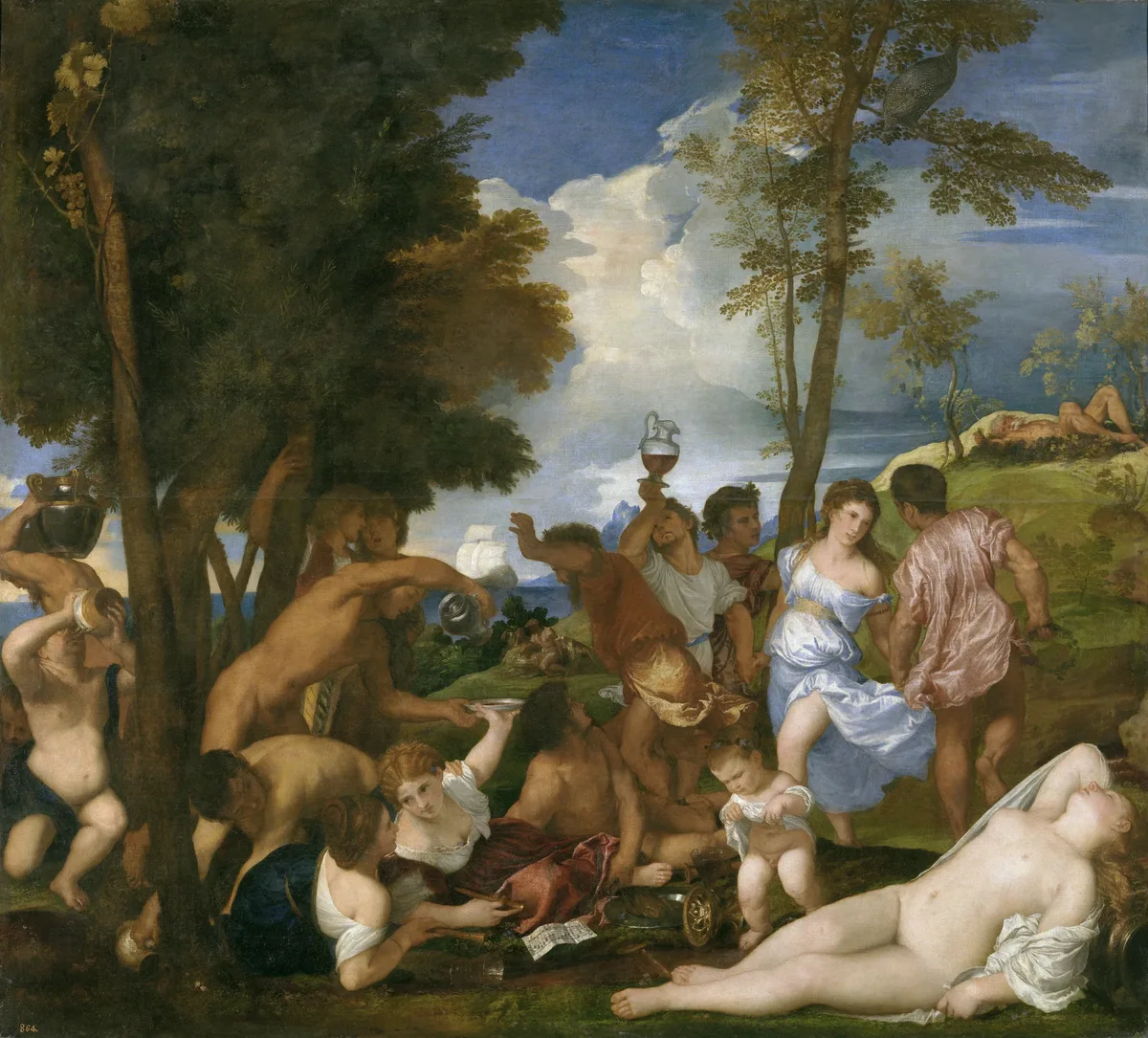
Alfonso d'Este's study was not a gallery for masterpieces. It was a small private room where several mythological paintings worked together, their subjects, colours and rhythms carrying from one wall to the next. A guest walked in and found himself inside a whole rather than in front of a picture.
In 1598 Ferrara passed to the Papal States, and Cardinal Pietro Aldobrandini took the paintings from the study back to Rome. Forty years after that, The Bacchanal reached Madrid.
The canvas survived. The room did not.
From documents and from the surviving companion pictures, scholars can work out what hung where. Nobody can bring back the first audience, the habits of that court, or what it felt like to walk through that door for the first time.
Both paintings entered the royal collection that would become the Prado two centuries later. One arrived from a fallen monarchy, the other from a dismantled room. Philip IV furnished his own palaces differently: he commissioned paintings for them, and there they did more than decorate.
Part Two. When Paintings Ruled a Palace
In the 1630s the Buen Retiro Palace in Madrid acquired a room called the Hall of Realms. Battle scenes showed victories. Equestrian portraits presented the royal family as commanders. Hercules appeared in several canvases, tying the dynasty to ancient strength.
A visitor did not need to study any of it picture by picture. Victory met him on one wall, royal authority on another, and the promise of a dynastic future ran around the room above his head. The paintings worked as a group long before any of them was famous on its own.
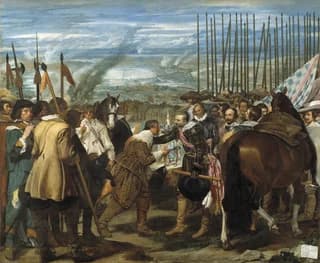
Velázquez's The Surrender of Breda was part of the programme. At the centre, the Dutch commander Justin of Nassau holds out the key of the city to the Spanish general Ambrosio Spínola. Spínola catches his arm and stops him going down on one knee.
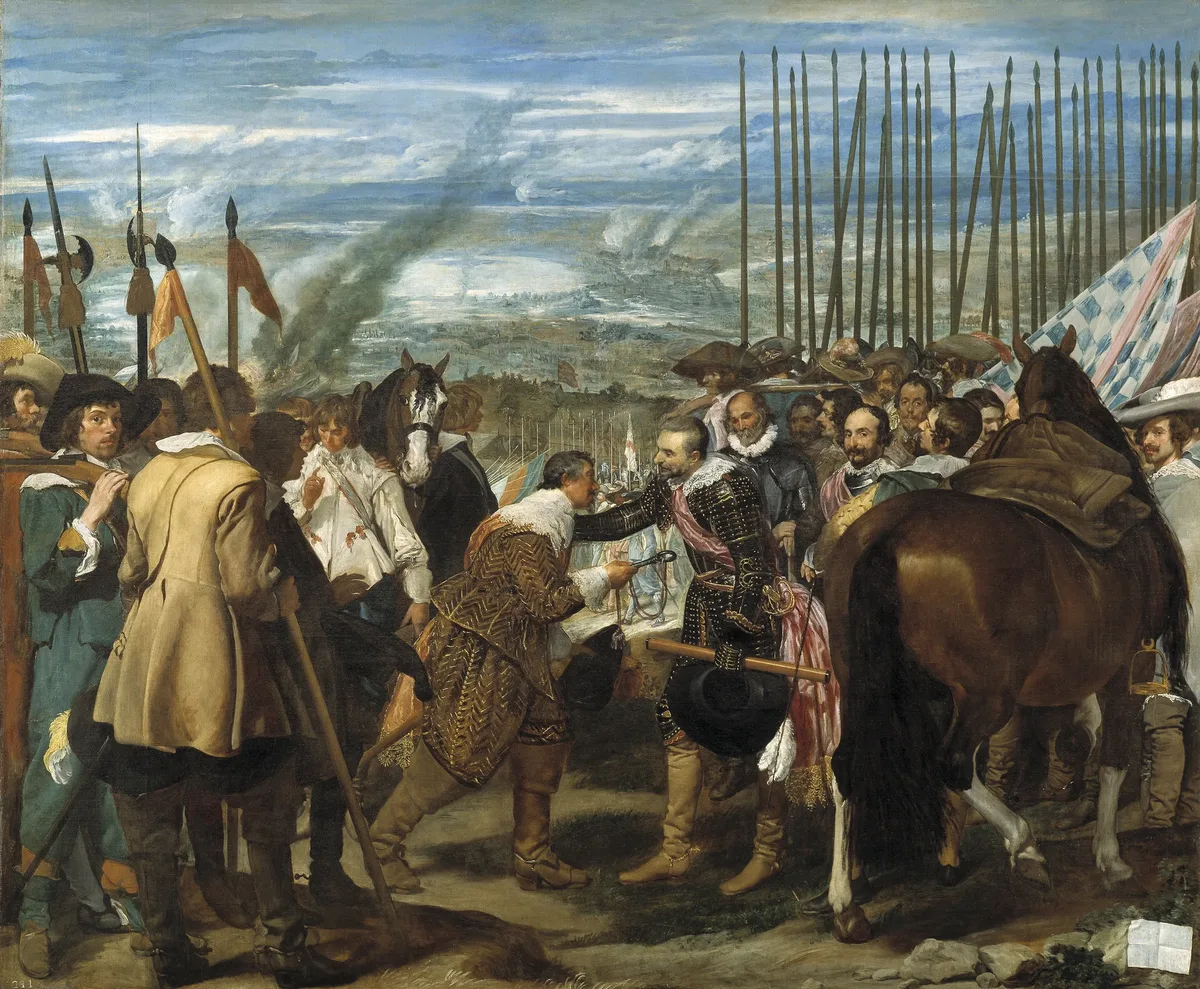
Behind the Spanish troops stands a palisade of upright lances, evenly spaced, dense, running off the top edge. The defeated on the left have nothing like it: loose grouping, bowed heads, no pattern. The Spaniards in this painting are not stronger than the Dutch, they are better organised, and Velázquez says so with nothing but a row of wooden shafts. In Spain the picture has its own name because of them: Las Lanzas, the lances.
Velázquez was not at Breda. The gesture he painted almost certainly never happened.
Other canvases in the room complicated the triumph. In Juan Bautista Maíno's painting of the recapture of Bahía, wounded and suffering men lie in the foreground beside the military success. The empire was celebrated in Madrid and fought for across an ocean, and the court watched that war as a spectacle.
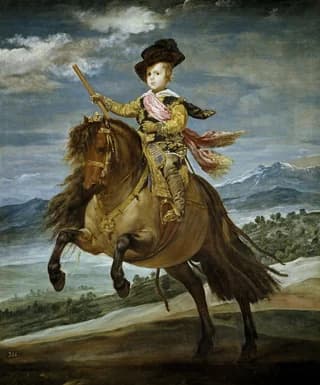
The room also spoke about the future. In the Equestrian Portrait of Prince Balthasar Charles, a child holds a rearing horse while a wide landscape opens beneath him, and he looks ready to command years before he could rule.
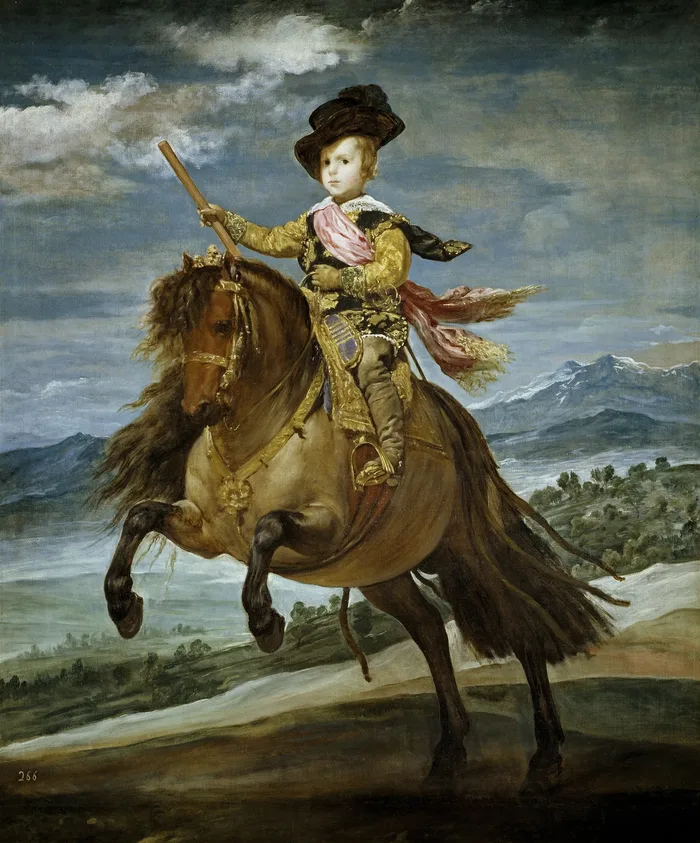
Balthasar Charles died in 1646, aged sixteen. He never came to the throne, and the portrait went on showing a future that did not arrive.
The Hall of Realms did not survive its patron as a piece of political theatre. The paintings came down and went to different places, and the connections between them broke. Close up, The Surrender of Breda is easier to read: you can see the gestures, you can see the two formations. What you no longer have around you are the other victories, the heroes and the royal portraits that gave the room its argument.
The museum has the paintings. The room has to be rebuilt in your head.
Velázquez knew that world from the inside. He was the king's painter and a palace official at the same time, in a household where rank and office decided everything. Eventually he painted the whole machine, with himself inside it.
Part Three. Velázquez Inside the Court
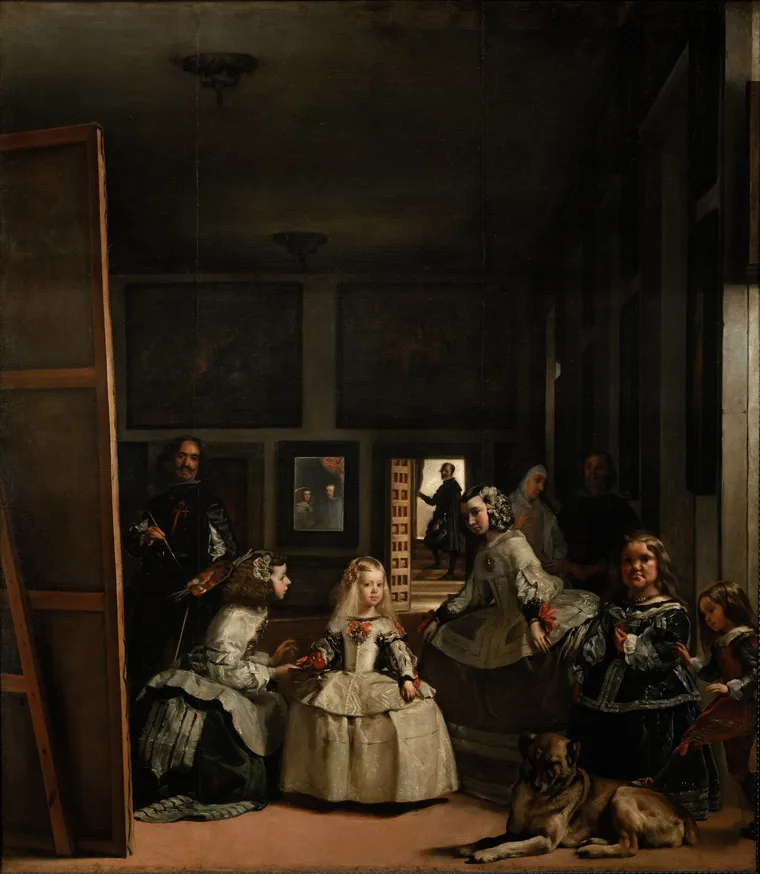
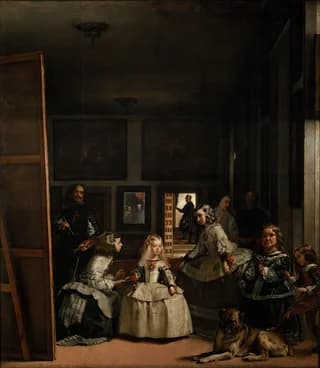
A girl in a pale dress stands at the centre of Las Meninas. She is the Infanta Margarita. Two ladies-in-waiting bend towards her. In front are a dwarf, another court servant and a large, sleepy dog. At the back, in an open doorway, the queen's chamberlain has stopped on the step. On the left, Velázquez stands at a tall canvas and looks past the picture at us.
A mirror hangs on the far wall, and Philip IV and Queen Mariana are reflected in it. They may be standing where we seem to be standing. The mirror may be reflecting the canvas Velázquez is working on. The painting refuses to say.
On Velázquez's chest is the red cross of the Order of Santiago, the badge of nobility he spent years pursuing and only received in 1659, three years after he finished this painting. The cross was added on top of the completed canvas, after his death. Legend says Philip IV picked up the brush himself. There is no evidence for it and it is almost certainly untrue, and the story is far too good to have been allowed to die.
Now look at the Infanta's left cheek.
On Christmas Eve 1734 the Alcázar in Madrid caught fire. It burned for four days, the palace was destroyed, and hundreds of paintings from the royal collection went with it. Las Meninas was carried out. The scorched edges of the canvas had to be trimmed, heat had lifted the paint in places, and the court painter Juan García de Miranda repainted the Infanta's cheek. We have been looking at it for nearly three hundred years without noticing.
The painting outlived the court as well as the palace. The world in which this scene could be read at a glance ended with the Spanish Habsburgs, and the people in the room turned from colleagues into historical figures whose jobs now have to be explained.
The Infanta pulls the eye, yet the king and queen appear only as a reflection. Velázquez stands directly in front of us with his canvas turned away, so we will never know what is on it. The door at the back leads further into the palace, and the man on the step may be coming in or going out.
A small library has grown out of those gaps. Las Meninas has been read as an argument about painting, about the standing of the artist, about the presence of the king, about the act of seeing itself. None of the readings has closed the question.
When the painting reached a public museum, people stood in front of it who would never have been let past the palace gate. The most closed room in Spain became a place anyone could walk into.
Velázquez painted a court that still looked permanent. Goya inherited a different one.
Part Four. Goya Watches the Court Come Apart
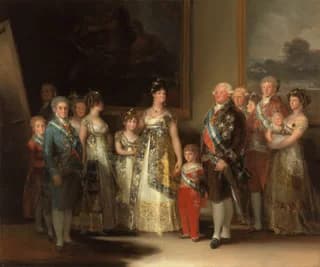
In 1800 Goya painted Charles IV of Spain and His Family. Thirteen people in silk, orders and diamonds line up in front of him. Queen María Luisa stands almost at the centre, Charles IV beside her. Goya himself is in the shadows at the back, at a large canvas, exactly where Velázquez had put himself a century and a half before.
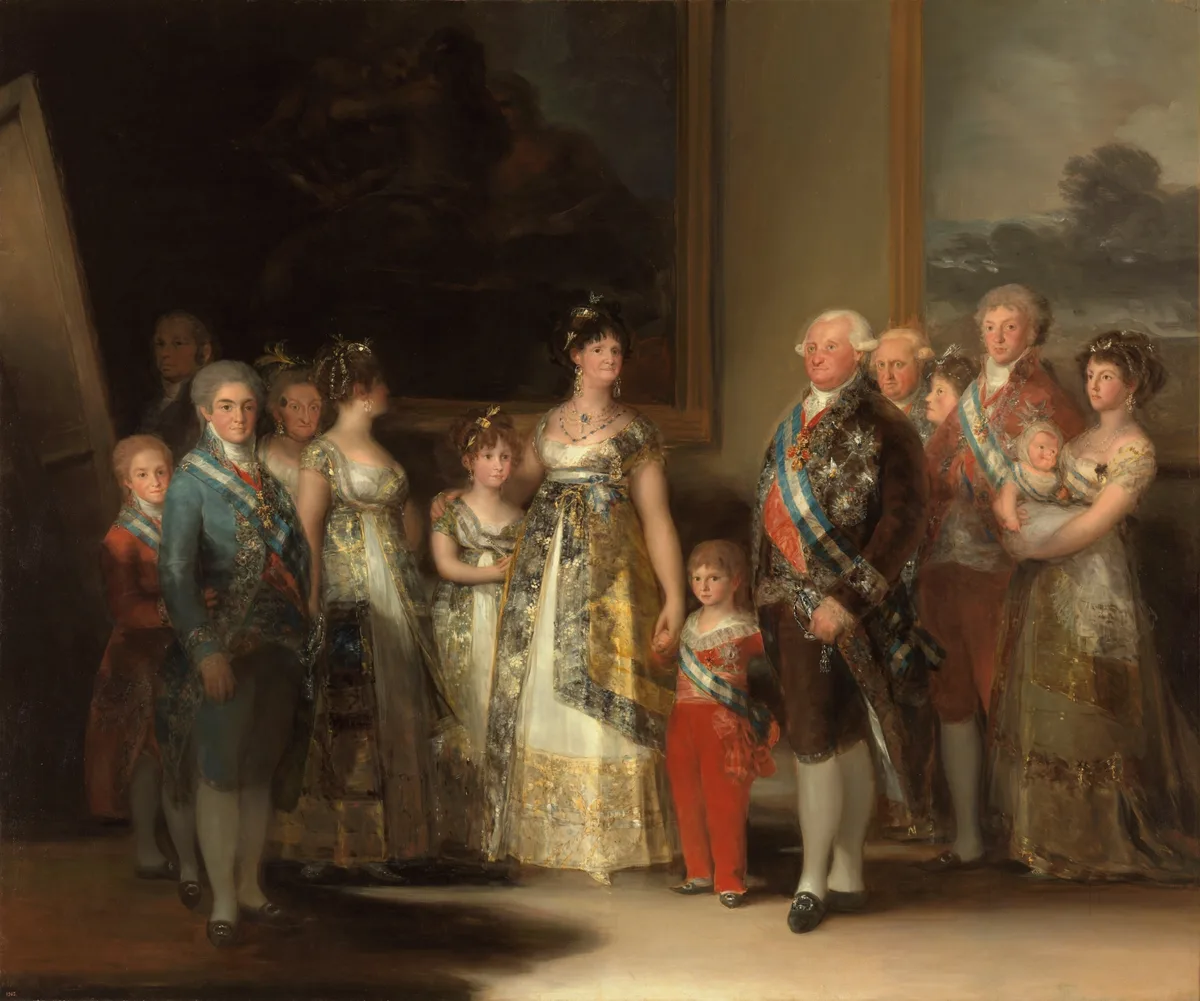
The picture is usually described as a joke at the family's expense. Fifty years later Théophile Gautier wrote that the king and queen looked like the corner baker and his wife after winning the lottery, and the line has been repeated ever since. The temptation is easy to understand: Goya flatters nobody here. But there is no evidence that he intended a caricature, the commission was official, and the king was pleased with the result. What Goya painted was heavy fabric, red faces, thick bodies and the awkward distances between relatives.
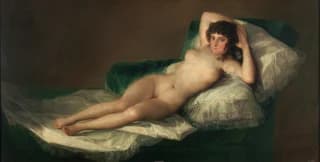
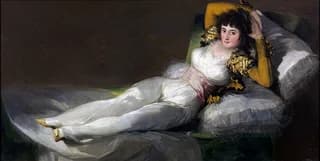
Around the same time he painted a woman lying on cushions with no clothes on, looking straight out at the viewer.
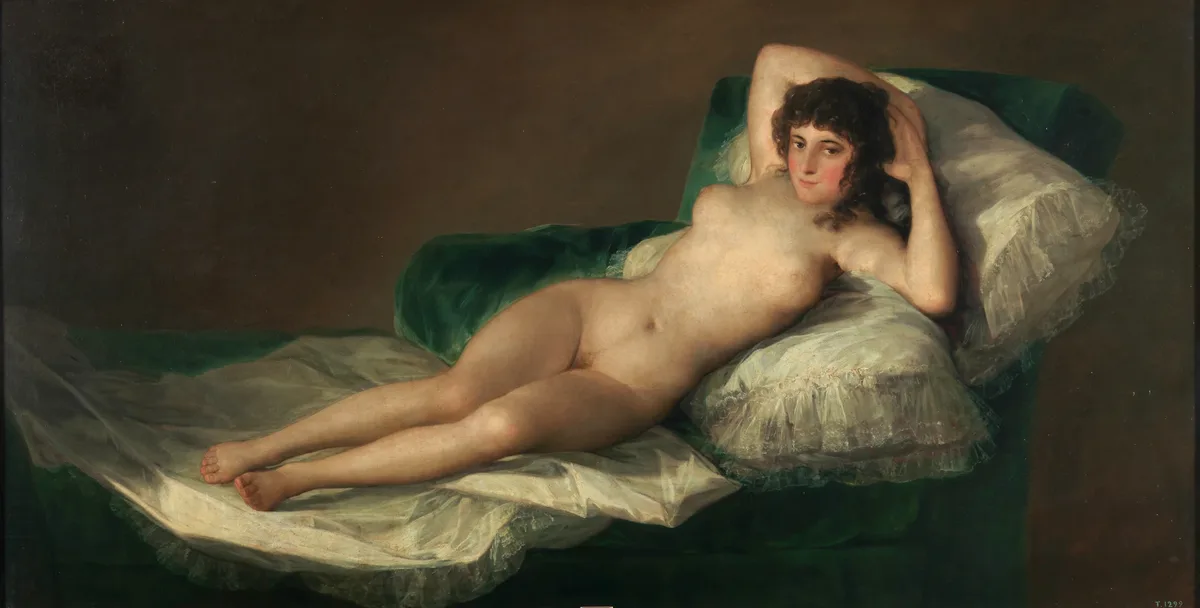
La maja desnuda hung in the private office of Manuel Godoy, the most powerful minister in Spain, together with its clothed twin. Nobody knows who she is. Gossip named the Duchess of Alba almost immediately; there is no serious basis for it, the story is two hundred years old, and it will outlive us.
Godoy fell in 1808 and his property was seized for the crown. In 1813 the Inquisition confiscated both majas. In May 1815 Goya was summoned before the tribunal and required to explain who had commissioned the obscene pictures, who the women were and what he had meant by them. The paintings were released in 1836 and spent another sixty-five years in a closed room at the Academy of San Fernando. La maja desnuda entered the Prado in 1901, eighty-two years after the museum opened.
By then the Inquisition had been gone for nearly seventy years.
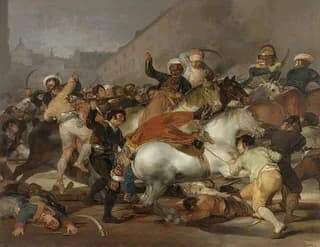
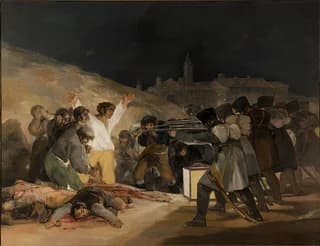
Back in 1808, between the seizure and the tribunal, French troops entered Madrid. On 2 May the city rose. That night the executions began.
Goya painted the two days only in 1814, after Ferdinand VII returned. The commission was official and commemorative. What he produced was not a ceremony.
In The Second of May 1808, bodies and weapons collide from every direction, fighters drag riders off their horses, faces are twisted out of shape. The crowd has no centre and the eye has nothing to hold on to.
The Third of May 1808 has a lantern. It sits on the ground and lights the condemned men and nobody else. A man in a white shirt has thrown his arms up. Facing him is a row of soldiers — backs, legs, rifles, every barrel at the same angle. Not one face.
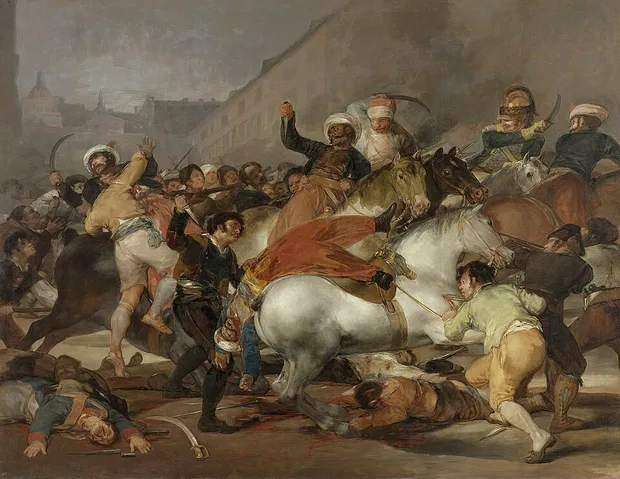
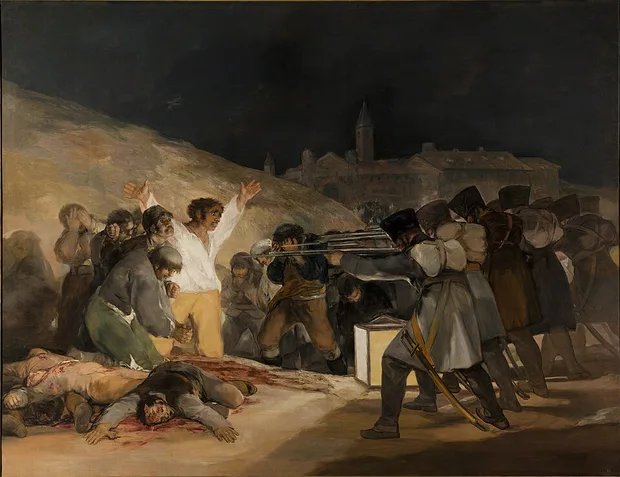
Goya saw neither event. We remember both of them the way he painted them.
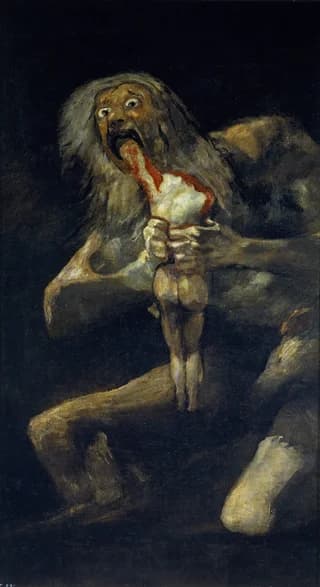
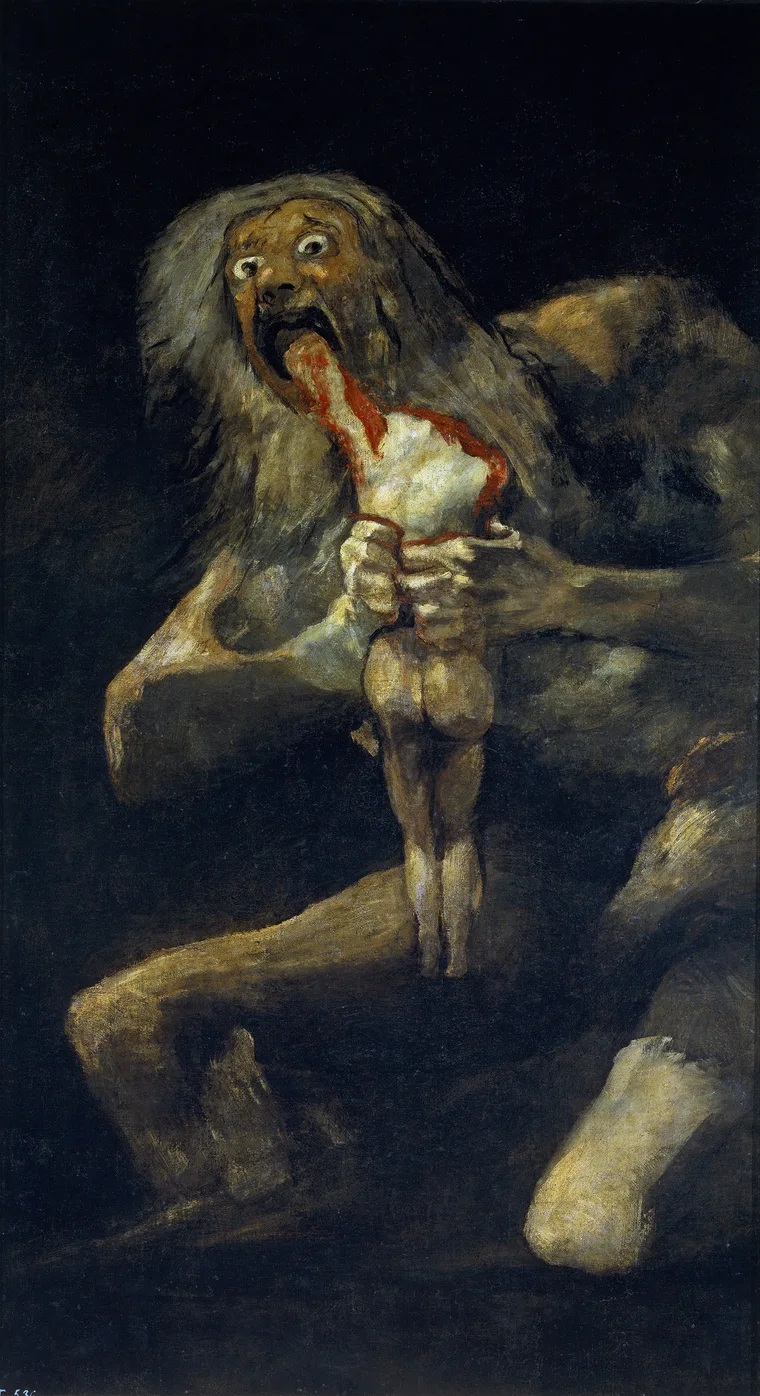
His most frightening work was made for nobody. In 1819 he bought a house outside Madrid called the Quinta del Sordo, the deaf man's villa, named after a previous owner. Goya had been deaf for fifteen years by then.
He painted two of its rooms directly onto the plaster, for himself. What he had in mind is unknown, and the titles we use were attached long afterwards.
In the picture now called Saturn Devouring His Son, a giant grips a mutilated body in both hands and bites into it. His eyes bulge out of the darkness. His fingers press into the meat hard enough that you can see it give.
Half a century later the house was bought by a French banker, Baron Émile d'Erlanger. He hired the restorer Salvador Martínez Cubells, who lifted the murals off the walls and transferred them to canvas, a difficult and risky operation. D'Erlanger then took his prize to the Paris Exposition Universelle of 1878 and put it up for sale.
Nobody bought it. Not one panel.
In 1881 the baron gave the paintings to the Spanish state because he had failed to sell them. That is how some of the best-known images in European art arrived at the Prado, as stock nobody wanted.
They arrived altered, too. What hangs in the museum is not the plaster Goya worked on. It is the paint layer lifted off that plaster and fixed to a new support.
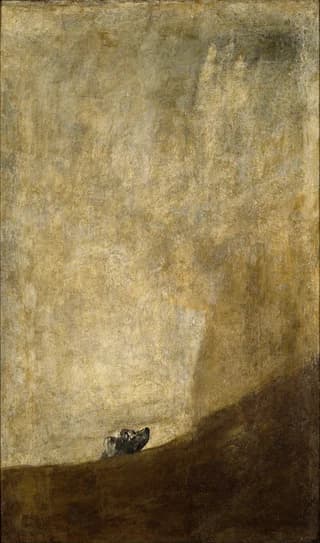
The Dog comes from the same house. Above a steep band of earth or shadow you can see a small dog's head, and above that three quarters of the canvas is empty. The Spanish title means half-submerged, and most visitors are certain the animal is drowning. The picture does not prove it. The dog may be buried, trapped, hidden — or simply looking up at something we cannot see.
It had something to look at. Other murals were on the walls around it, and Goya decided what went next to what. That arrangement is lost, and the dog is on its own.
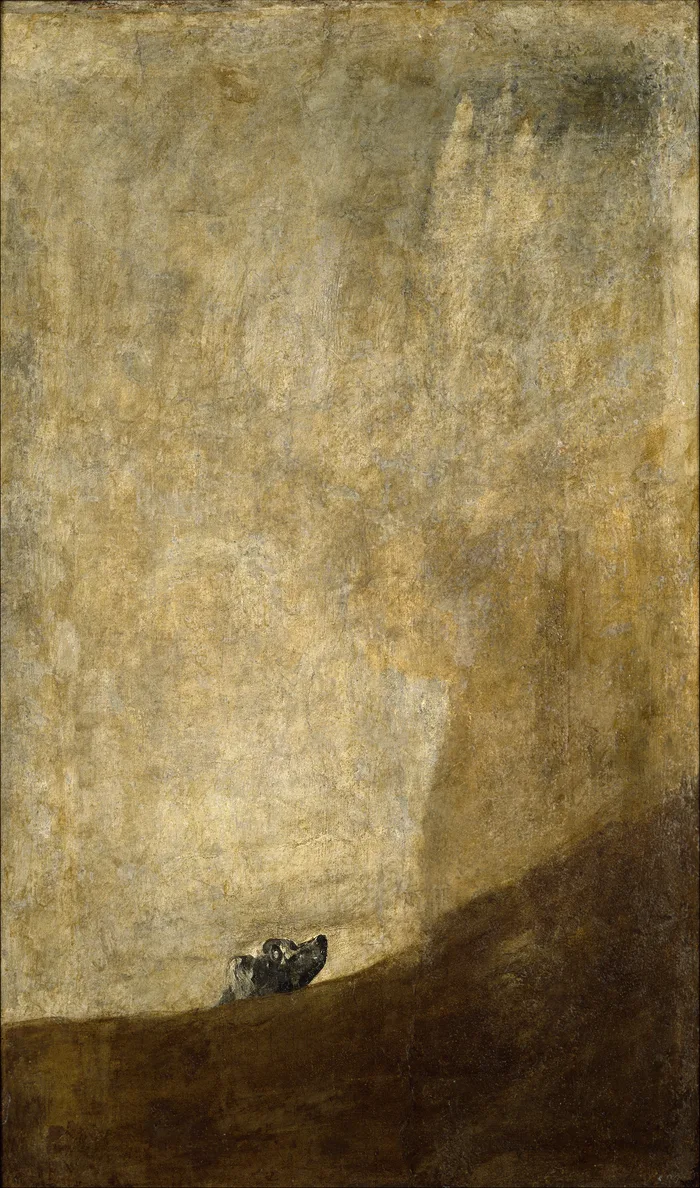
The house it was cut out of was demolished long ago. The building it was taken to had started life well before Goya, and not as a museum at all.
Part Five. The Building That Became a Museum
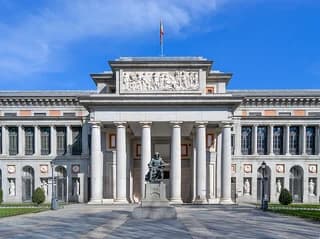
An architectural model from 1786 shows a long, severe building with projecting end wings and an entrance in the middle. Nobody knows who made the model. The design is Juan de Villanueva's, and Charles III commissioned it for a Cabinet of Natural History — minerals, specimens, herbaria.
The building went up for science and was nearly finished. Then the French army entered Madrid in 1808, the unfinished halls were turned into a barracks and the vaults into an arms store. The Cabinet of Natural History never opened.
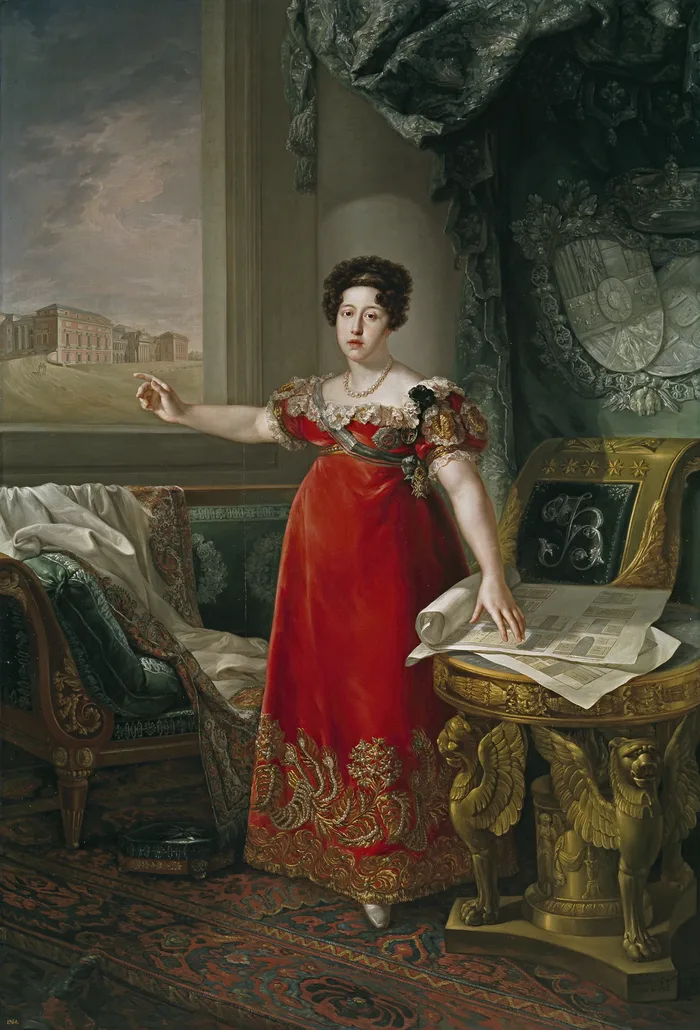
After the war Ferdinand VII decided to put a royal museum of paintings in it instead. His wife, María Isabel of Braganza, took on the conversion and the hanging.
The museum opened in November 1819. The first catalogue listed 311 paintings, at a time when the royal collection held more than fifteen hundred.
The display was a choice. Someone decided which pictures would represent the collection, how they would be grouped and what the public would see first. More than a thousand works stayed on the other side of the door.
What the visitor gained was everything in one place. Pictures that had spent centuries scattered across royal residences could finally be compared: Raphael against other Italians, early Velázquez against court Velázquez against late Velázquez, in an afternoon. Paintings made for prayer, for ceremony or for somebody's private room joined a public history of art.
Their earlier histories did not go anywhere. They were simply now sorted by artist, school and period — categories none of the original patrons had ever thought about.
Ten years after the opening, Bernardo López Piquer painted María Isabel as the museum's founder. She sits beside a set of plans and gestures towards the building. She had been dead for eleven years.
The portrait gave the founding a convenient face. In fact the authority was Ferdinand VII's. The building was Villanueva's, and had not been meant for pictures. The collection had taken three hundred years to assemble. María Isabel did a great deal, and no single person made the Prado.
The museum grew and began to take in things the kings had never owned. The Spanish state was closing monasteries and dissolving religious communities; buildings were put to other uses and altarpieces were taken apart. The pieces travelled to Madrid.
Part Six. How the Prado Invented Spanish Painting
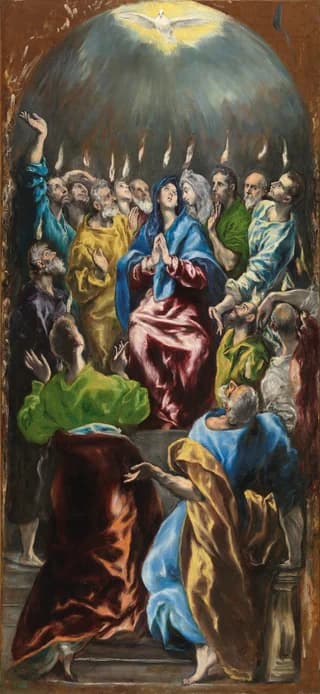
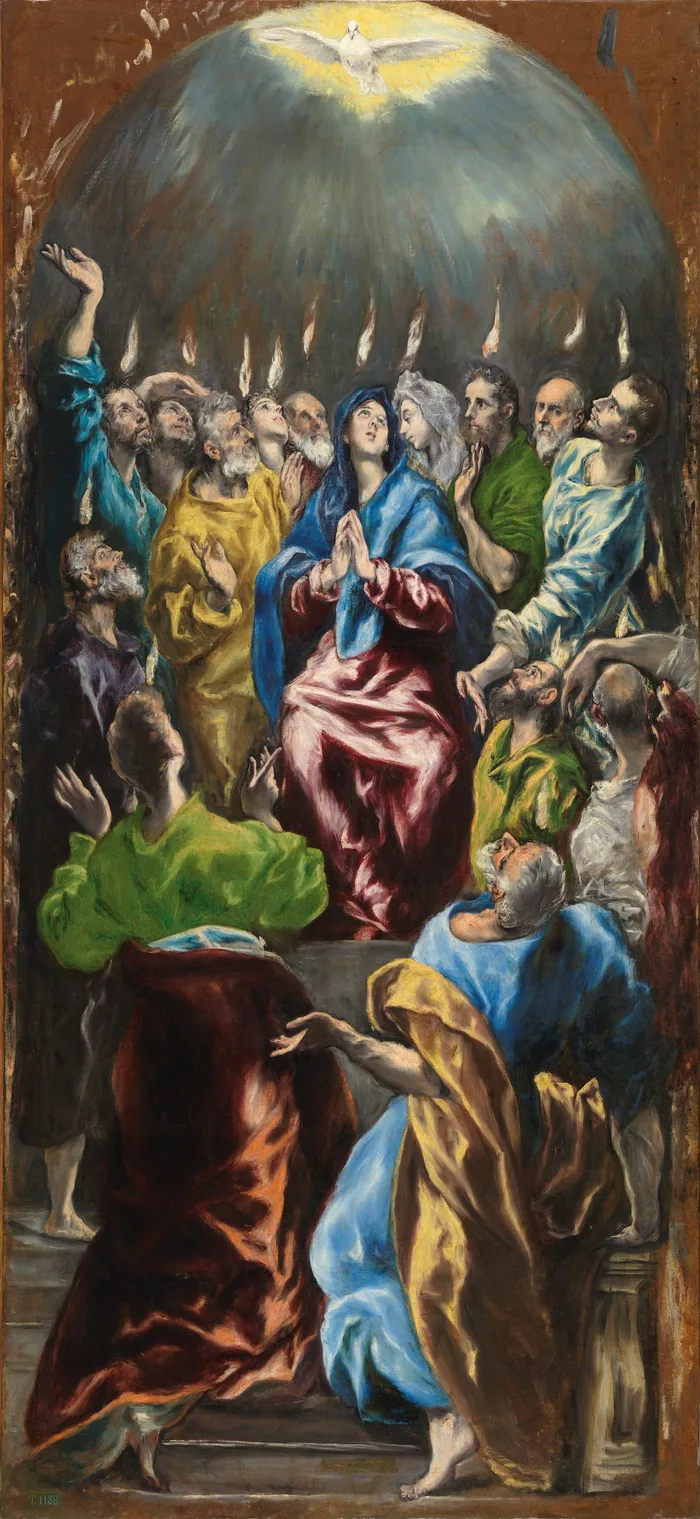
El Greco's The Pentecost was never meant to be a picture on its own.
The Virgin sits near the centre while apostles and other figures look up, and small tongues of flame come down onto them. Hands rise towards the light. Elongated bodies pull the eye towards the top of the canvas.
The painting belonged to an altarpiece in the Colegio de Doña María de Aragón in Madrid. Other canvases from the same commission stood around it, the structure of the altar fixed their height and their order, and during a service the congregation saw the whole thing at once, from below, by candlelight.
In the nineteenth century, works from closed monasteries were collected in the Museo de la Trinidad. When the Trinidad was absorbed into the Prado in 1872, five canvases from El Greco's commission moved across with it.
In a museum they can be conserved and studied. The altar is in pieces, the service is over, the neighbouring images hang in a different order, and the thing they were all painted for is running with nothing attached to it.
Then something strange happened.
In his lifetime El Greco was regarded as a difficult provincial master, and a century after his death he was close to forgotten. At the Prado his paintings were gathered in quantity for the first time: not one in a church and one in a chapel, but a dozen on a single wall. He became visible whole. When Europe began rediscovering El Greco around 1900, this was where people came to do it.
The same thing happened to the whole Spanish school. By hanging pictures by artist and by century, the Prado made it possible to walk through the history of Spanish painting in a day — a history that had not previously existed in anyone's head, because there had been nowhere to see it. Most of the works in it arrived after losing an altar, a monastery, a palace or a private room.
The Prado did not only preserve Spanish painting. To a real extent it invented it: as a sequence, as a school, as something you could walk past.
That operation had a price, and one portrait shows it better than any other. The canvas is undamaged, nothing happened to it at all, and the man in it became somebody else anyway.
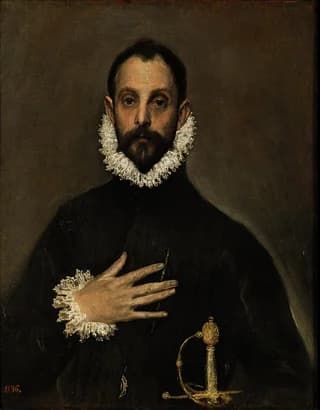
In The Nobleman with his Hand on his Chest, a pale face rises above black clothing. A sword hilt shows at his side. His right hand is pressed to his chest, the fingers arranged oddly, the middle and ring fingers held together. Nobody knows his name.
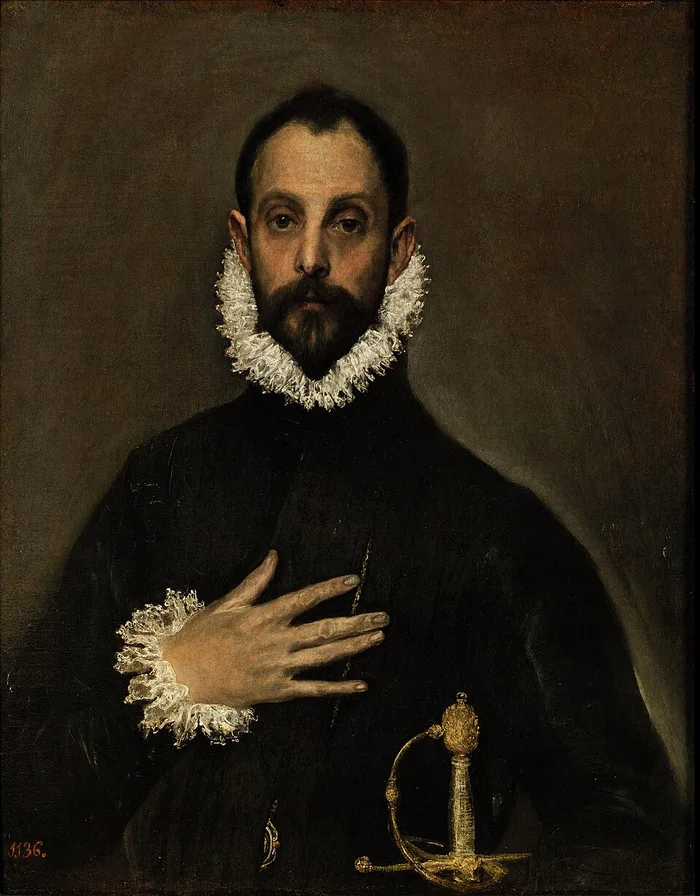
During the nineteenth century, viewers began to see Spanish honour in him, Spanish austerity, Spanish spirituality. He went onto book covers and into schoolrooms as the face of a nation. All of that describes the people looking at him, and none of it describes him.
In a gallery, a fragment of an altarpiece looks as finished as a portrait painted for a private study. The hanging levels everyone, and within a minute you have stopped wondering where anything came from.
By the twentieth century it all looked settled for good. Then the shelling of Madrid began.
Part Seven. When the Paintings Lost the Museum
On 5 November 1936 the Prado's directors were ordered to evacuate the collection.
The Civil War was on and the city was being bombed. Museum staff and workers from the Junta del Tesoro Artístico took the paintings down, recorded their condition, built crates and loaded them onto lorries. In the end there were twenty-two convoys, seventy-one lorries and one thousand eight hundred and sixty-eight crates.
At the bridge over the Ebro at Tortosa the convoy stopped. The crate holding Las Meninas would not fit under the span. The officer in charge proposed the obvious solution: take the canvas off its stretcher and roll it up.
The restorer Manuel Arpe y Retamino told him he would do it over his dead body. Arpe knew that three-hundred-year-old paint flakes when the canvas bends. He won the argument, and the convoy went the long way round to another crossing.
After that came Valencia, then Barcelona, then northern Catalonia, and in February 1939 the crates reached Geneva. Inside them were paintings that had already survived an execution in London, a dismantled room in Ferrara, the Alcázar fire, an Inquisition tribunal and the demolition of Goya's house. Now they had to survive the museum that was supposed to protect them.
They came home in September 1939. A new war was starting in Europe in exactly those weeks, and the crates got through between the two.
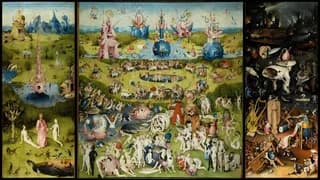
The whole succession of borrowed homes is clearest in The Garden of Earthly Delights.
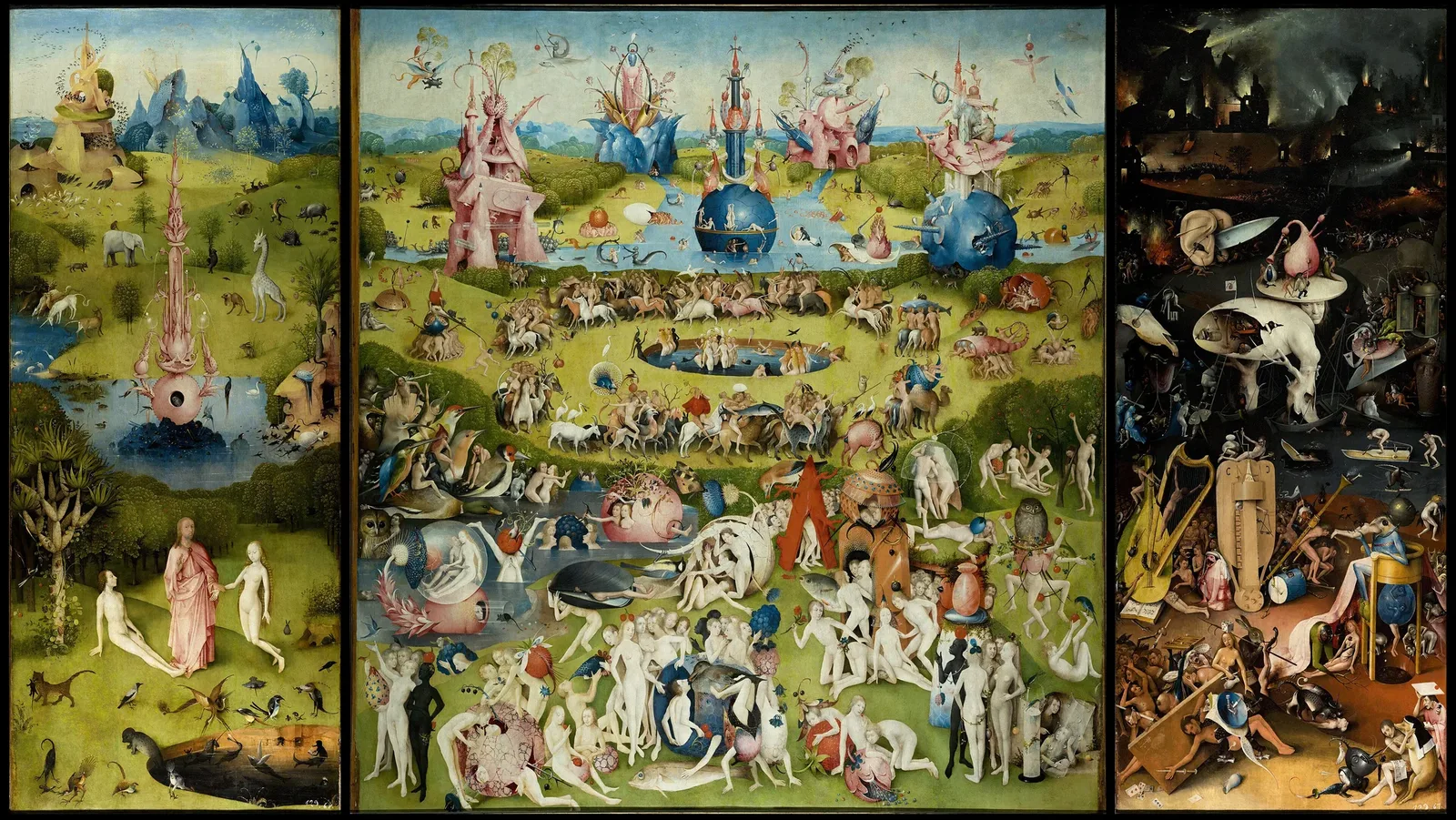
By 1517 the triptych stood in the palace of the House of Nassau in Brussels, where the Italian traveller Antonio de Beatis saw it and wrote it down. In 1568 the property of William of Orange was confiscated. In 1591 Philip II bought the triptych and sent it to El Escorial, where he kept it near him. The panels came to the Prado in 1933 and have been there ever since, although they belong to another body, Patrimonio Nacional.
The route is better documented than the intention. Who commissioned it is disputed. What the whole thing means is not known by anyone.
Close the wings and the outside shows a pale flat world inside a transparent sphere. Open them: a strange paradise on the left, in the centre a crowd of bodies, fruit, birds and fragile constructions, and on the right darkness, musical instruments the size of a man, and a very businesslike machinery of punishment.
The same shapes come back from panel to panel inverted. What is enjoyed in the centre is used as an instrument on the right. The longer you look, the less of any tidy reading survives.
Bosch's contemporaries suspected heresy. In 1605 Fray José de Sigüenza, the librarian of El Escorial, wrote the sentence that is still the best thing anyone has said about him: others paint men as they appear from the outside, and this one has the nerve to paint them as they are within.
The triptych has been through a palace, a confiscation, a monastery and a museum. None of them managed to explain it.
Every one of these paintings kept a mark of what happened to it. Raphael's has a nickname handed to it by a Spanish king. Las Meninas has trimmed edges and a cheek repainted by another man seventy-four years after Velázquez died. Saturn has canvas where it used to have a wall. La maja desnuda has most of a century behind a locked door. The Dog has an emptiness where the rest of the room used to be. Nothing on the wall labels will tell you any of this.
Now you know where to look.