Alexander Rondanini
Details
The story
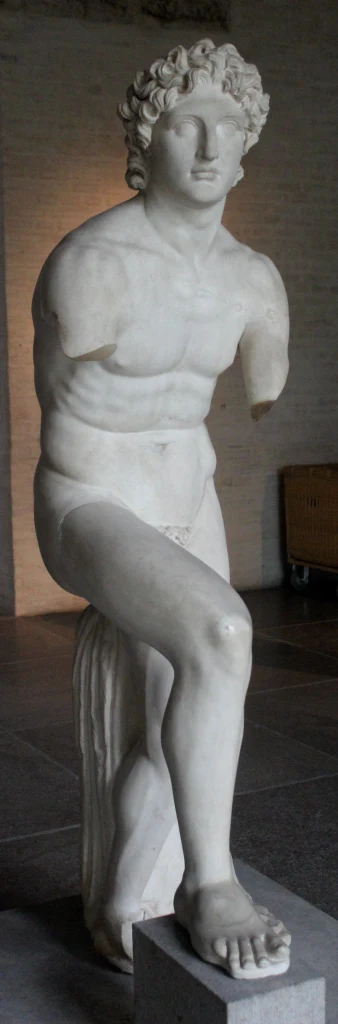
Johann Joachim Winckelmann, the 18th-century German scholar who helped found classical archaeology, called this statue the only true portrait of Alexander the Great. It stood then in the Palazzo Rondanini in Rome, and in 1814 Crown Prince Ludwig of Bavaria bought it for the sculpture museum he was planning in Munich.
A young hero stands springing on his left leg, the right foot set forward on a raised step, the upper body leaning slightly ahead. His arms are broken off and probably reached forward. Above the middle of the forehead the hair rises in the upswept lock that marks portraits of Alexander.
Older archaeologists saw the king mounting his chariot, addressing his soldiers or surveying a battlefield sword in hand. The museum says most recent scholars have moved away from that and now read the hero as Achilles, perhaps taking his new armour from his mother, the sea goddess Thetis, a pose that south Italian vases of the 4th century BC show in just this way. That leaves the Alexander features to explain. Alexander traced his mother's line back to Achilles, and when he crossed into Asia he first visited Achilles' tomb at Troy. The museum suggests the statue may be meant as both heroes at once. This marble is a Roman copy of the 2nd century AD, after a late Classical work of around 330 BC, made while Alexander was still alive and campaigning in Persia.