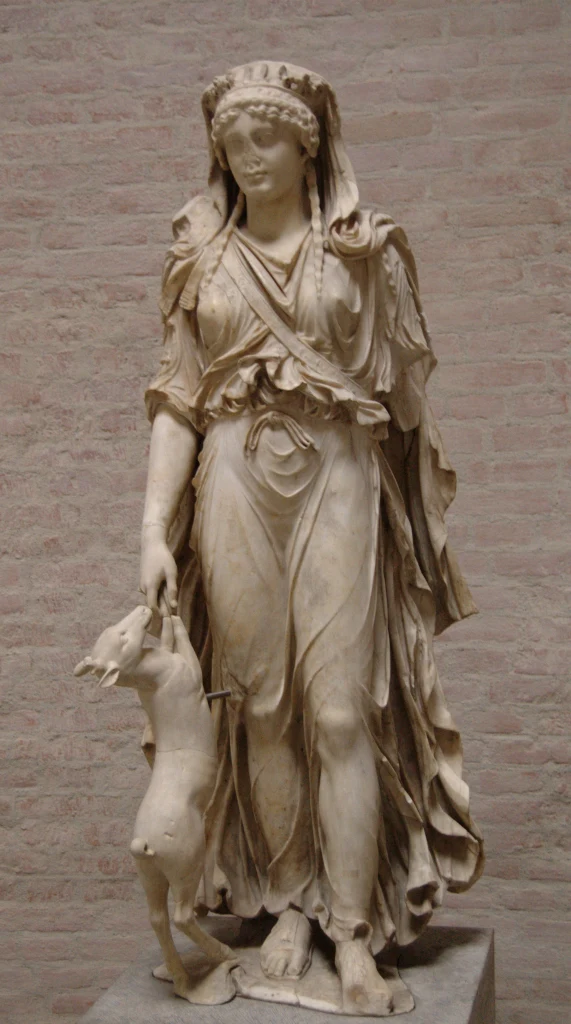
Artemis Braschi
Details
The story
When this statue was carved in Rome, around the middle of the 1st century AD, the Archaic style of Greek sculpture was more than 500 years old. The sculptor reached back to it on purpose, to give the goddess an air of great age.
The museum takes his borrowings apart one by one. The headdress and the upright stance, knees pressed straight, come from Archaic art of the 6th century BC. The stiff locks falling onto her breast belong to the turn from the late Archaic to the early Classical. The head, turned slightly to her right, follows the early Classical manner of the 5th century BC. And the thin dress, pressed against her body by a gust of wind while its hems fly out, resembles Greek sculpture of around 400 BC. So the museum treats the statue as a Roman creation in the old manner, put together from quotations spanning several centuries.
Artemis steps lightly forward with a quiver on her back and a diadem and veil on her head, and a fawn leaps up at her right leg. She was found in 1793 in excavations for Cardinal Braschi, a nephew of Pope Pius VI, at an ancient villa near Rome, and traces of red paint still remain on her dress.




