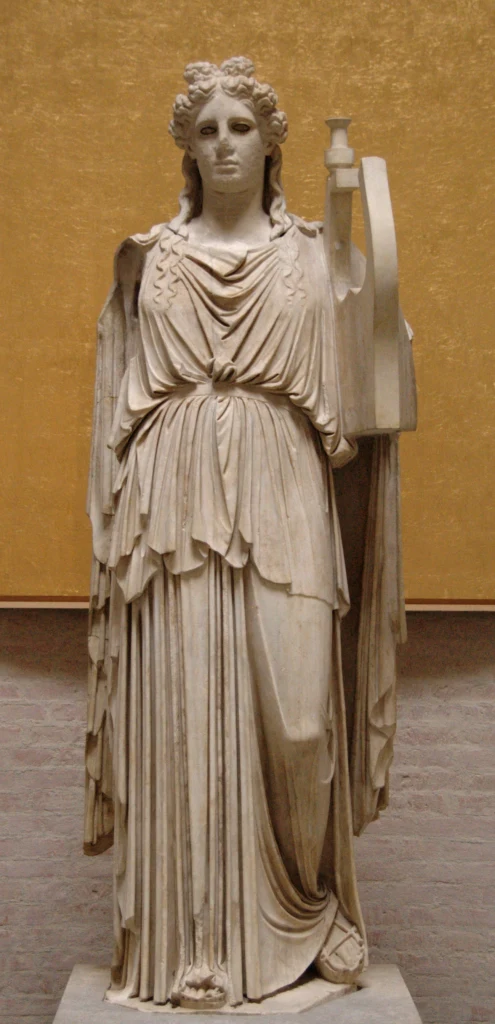
Apollo Barberini
Details
The story
After his victory at Actium in 31 BC, Octavian, soon to be called Augustus, made Apollo his own protecting god. In 28 BC he dedicated a temple to Apollo on the Palatine Hill in Rome, right beside his house. The museum thinks this statue was carved in those years, in a Roman workshop under Augustus, though it puts a question mark against that date.
Apollo appears here as the leader of the Muses, the god of music, in a robe that falls to the ground, a mantle hanging at his back and the kithara, a large lyre, in his left hand. At 2.53 metres he is far larger than life. According to the museum the statue copies a Greek original of around 420 BC that probably stood as the cult image in a temple, and it suggests the sculptor Skopas, again with a question mark. The museum notes that the only parts missing today are the pupils of the eyes, which were made of coloured stone.
The statue was found in 1678 in an ancient villa at Tusculum, in the Alban Hills near Rome, and went into the collection at the Palazzo Barberini, which gave it its name.
More works by Unknown Roman sculptor (Imperial period)
 Alexander RondaniniUnknown Roman sculptor (Imperial period), 150
 Aphrodite of KnidosUnknown Roman sculptor (Imperial period), 50
 Apollo BelvedereUnknown Roman sculptor (Imperial period), 120
 ApoxyomenosUnknown Roman sculptor (Imperial period), 50
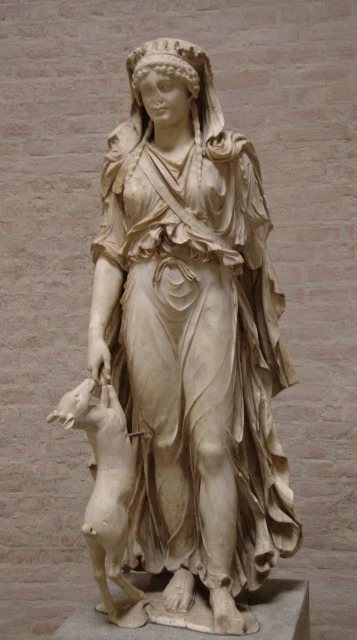 Artemis BraschiUnknown Roman sculptor (Imperial period), 50