Aphrodite of Knidos
Details
The story
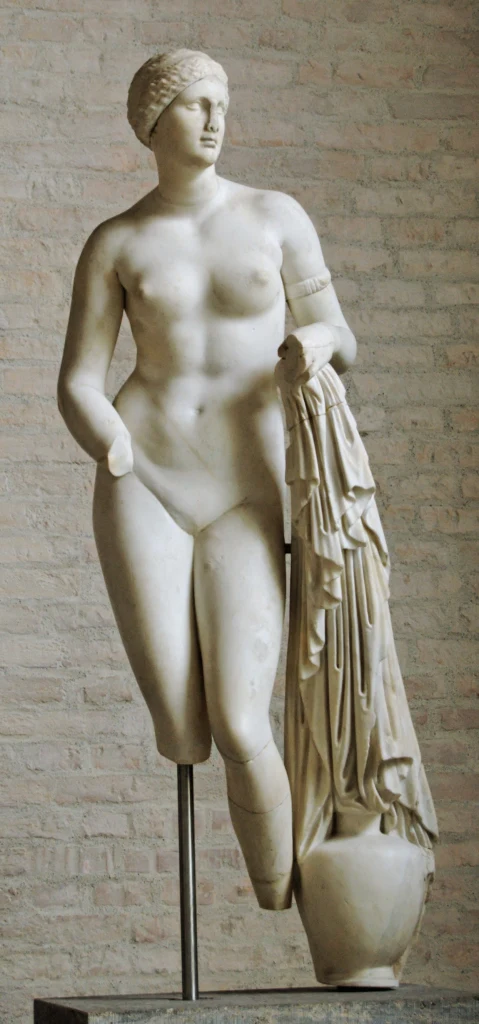
In 1811 Rome was part of Napoleon's empire, and the Braschi, the family of the late Pope Pius VI, sold this marble that year. It was bought for the young Crown Prince Ludwig of Bavaria. It was said to have been found near the ancient harbour at Fiumicino, at the mouth of the Tiber.
She follows the statue that the Roman writer Pliny called the most famous in the world, the Aphrodite that Praxiteles made for the city of Knidos around 330 BC. A large nude female figure was something new, and at first it gave offence. Praxiteles supplied a reason for the nudity. The goddess is about to bathe, and a tall water jar stands at her side. In this Roman version, carved in the 1st century AD, her mantle hangs over her left arm and falls onto the jar, and the museum calls it a variant of the type.
The original is lost. Its pose survives on coins of Knidos, and one of them, struck around AD 202 to 205 under the emperor Caracalla, belongs to the same Munich museum.