Apollo Belvedere
Details
The story
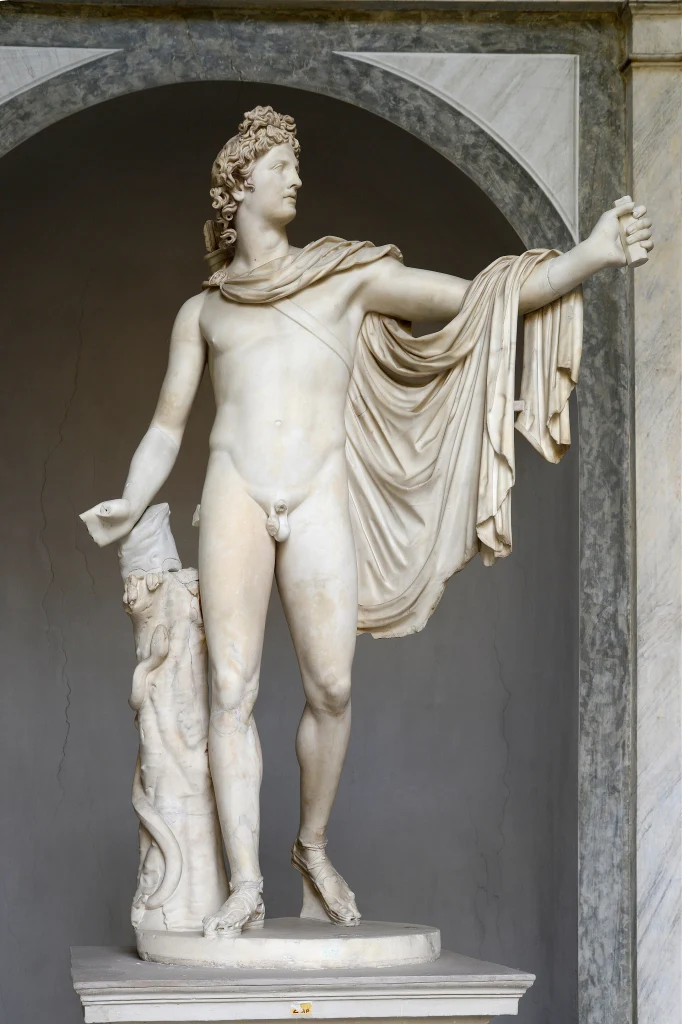
In December 2019 the museum's staff noticed fine cracks in the legs of the Apollo Belvedere, and the statue went off display for almost five years. When it came back in October 2024, its left hand was new, and also very old. In the 1950s, in the ruins of the imperial palace at Baia on the Bay of Naples, excavators had found fragments of plaster casts that a Roman workshop took directly from famous Greek statues. One of them, a left hand, came from a cast of the bronze original of this Apollo, and a copy of it has now replaced the hand added in the Renaissance.
The marble itself is a copy too. A workshop in Rome carved it in the first decades of the 2nd century AD after a bronze made in Greece around 330 BC, probably by the Athenian sculptor Leochares, who also worked on the Mausoleum of Halicarnassus. The god has just let fly an arrow from the bow that hand once held. The statue was found in Rome in 1489 and acquired at once by Cardinal Giuliano della Rovere, the future Julius II, and it is recorded in the Belvedere by 1508. In 1532 and 1533 the sculptor Giovannangelo Montorsoli gave it a new left arm and right forearm.
The conservators also fixed a carbon fibre support behind the figure, anchored to the plinth, which takes about 150 kilograms off the cracked legs. Antonio Canova had given it a support of the same kind when it came back from Paris in 1816.