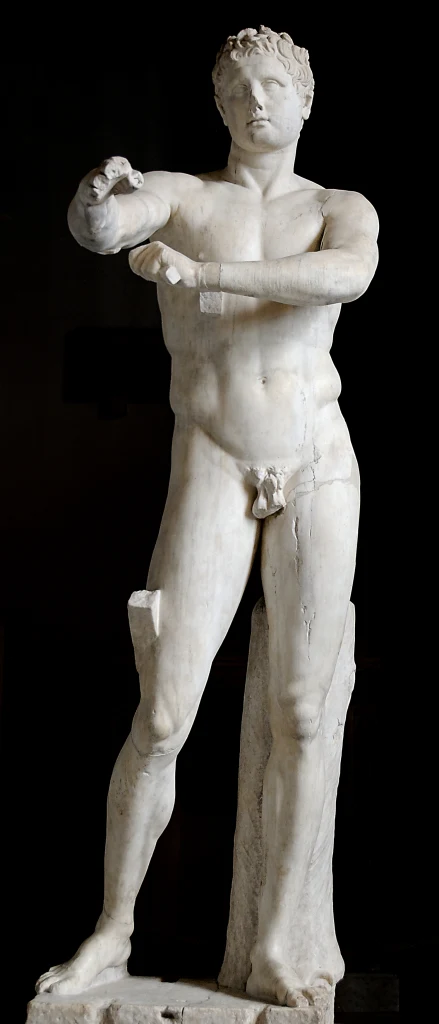
Apoxyomenos
Details
The story
Around 20 BC Marcus Agrippa, the right-hand man of the emperor Augustus, set up a bronze athlete by the Greek sculptor Lysippos in front of the public baths he had built in Rome. According to the Roman writer Pliny, the emperor Tiberius later liked it so much that he had it moved into his own bedroom, until the crowd in the theatre shouted for their Apoxyomenos to be given back, and he gave in.
That bronze is lost. This marble is a copy made around AD 50 of a work Lysippos created around 320 BC, late in his career, and it is usually linked with the statue in Pliny's story. The name comes from a Greek verb for cleaning oneself. Athletes oiled their bodies before exercise and afterwards scraped off oil and sand with a curved tool, the strigil. The young man is doing exactly that, drawing the strigil along his outstretched right arm. The museum points out how that arm, pushed forward, opens up space in front of the body. Lysippos was known for giving his figures a smaller head and longer, slimmer limbs than earlier Greek sculptors.
The marble came out of the ground in 1849 in Trastevere, during the excavation of a building of the Imperial age. The lane where it was found was later named after it, and it is still called Vicolo dell'Atleta, the Athlete's Alley.
More works by Unknown Roman sculptor (Imperial period)
 Alexander RondaniniUnknown Roman sculptor (Imperial period), 150
 Aphrodite of KnidosUnknown Roman sculptor (Imperial period), 50
 Apollo BarberiniUnknown Roman sculptor (Imperial period)
 Apollo BelvedereUnknown Roman sculptor (Imperial period), 120
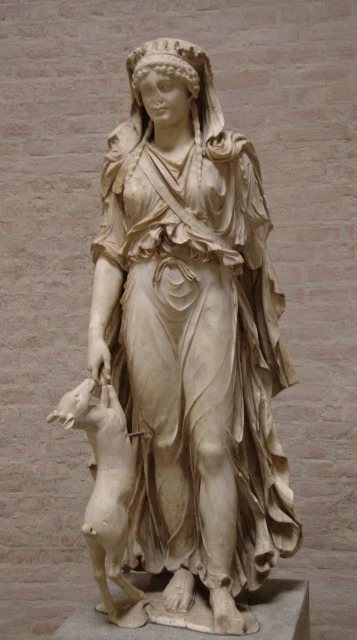 Artemis BraschiUnknown Roman sculptor (Imperial period), 50