Augustus of Prima Porta
Details
The story
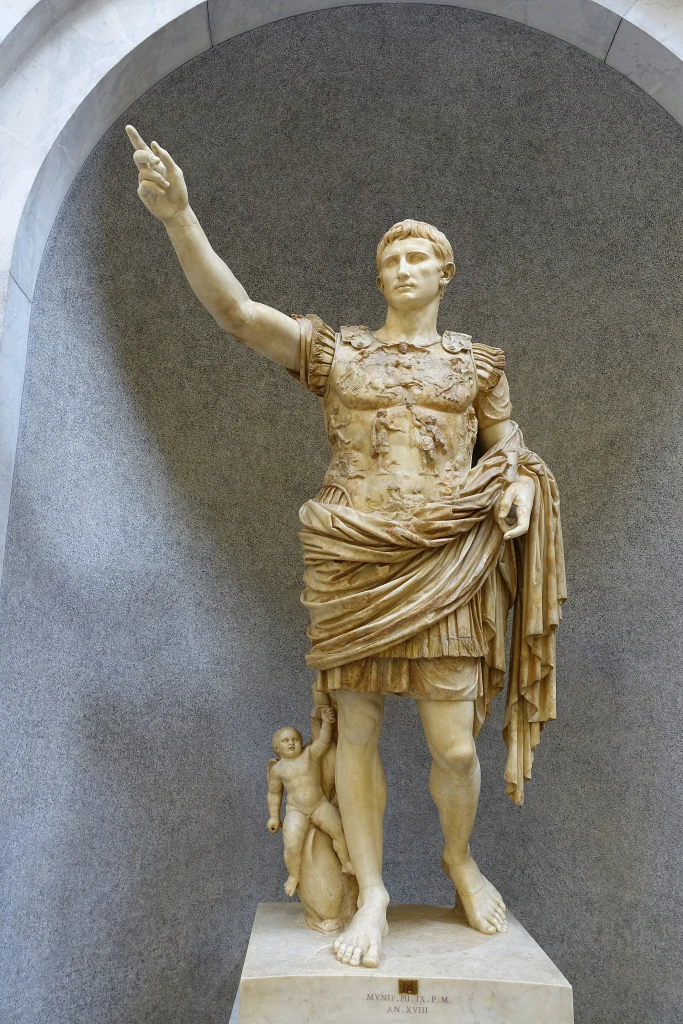
At the centre of the emperor's breastplate, a bearded man in trousers hands a Roman military standard to an officer. He is a Parthian, from the great empire on Rome's eastern frontier, and the standard is one of those lost in 53 BC, when the general Crassus was crushed at Carrhae. For more than 30 years that defeat stood unavenged. In 20 BC Augustus got the standards back by negotiation, without a battle, and his regime celebrated it on coins and monuments as a great victory. Here the handover is framed by the whole cosmos, the Heavens spreading a canopy above, the chariots of the Sun and the Dawn, Diana riding a hind, and Mother Earth at the bottom, with figures of two provinces at the sides.
The statue came out of the ground on 20 April 1863, in the ruins of a villa at Prima Porta, just north of Rome on the Via Flaminia, which had belonged to Livia, Augustus's wife. The museum dates the marble to the early 1st century AD, and it probably repeats a lost bronze. Augustus stands as if addressing his troops, in a pose borrowed from the Doryphoros, the spear-bearer of the Greek sculptor Polykleitos. His feet are bare, as gods and heroes went in ancient sculpture. Beside his right leg a small Cupid rides a dolphin, a reminder that Augustus's family, the Julii, claimed descent from Venus, Cupid's mother.




