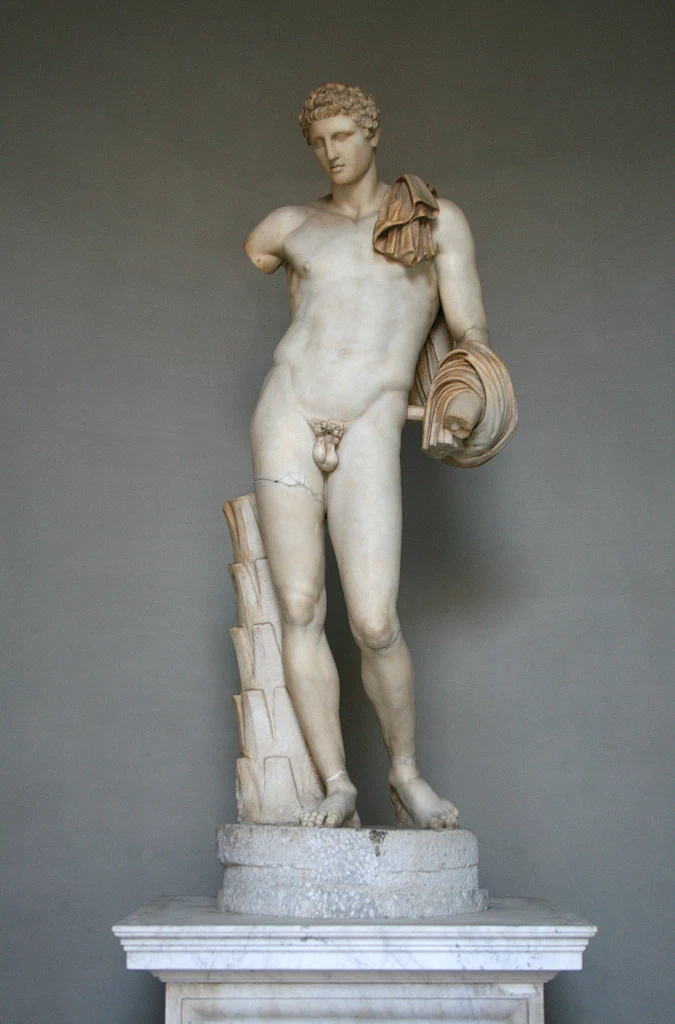
Belvedere Hermes
Details
The story
The young man looks down, a cloak thrown over his left shoulder and wound around his forearm. For well over two centuries he was known as Antinous, the favourite of the emperor Hadrian, because of where he was found. The statue came out of the ground around 1540 in the gardens near Hadrian's tomb, now Castel Sant'Angelo, and Pope Paul III bought it a few years later for the Belvedere statue court. The name stuck, and under it the figure became a measuring rod. The painter Nicolas Poussin and the sculptor François Duquesnoy studied and measured it in Rome as a model of ideal proportion, and in 1683 the engraver Gérard Audran put it into a book of the proportions of the human body, taken from the finest ancient statues and meant for young artists.
Only in the catalogue Ennio Quirino Visconti published from 1818 was he firmly named as Hermes. The museum dates the marble to Hadrian's reign and reads him as Hermes the guide of souls, waiting with lowered gaze to lead the dead to the underworld. His pose follows a type known from bronzes of the circle of Praxiteles.




