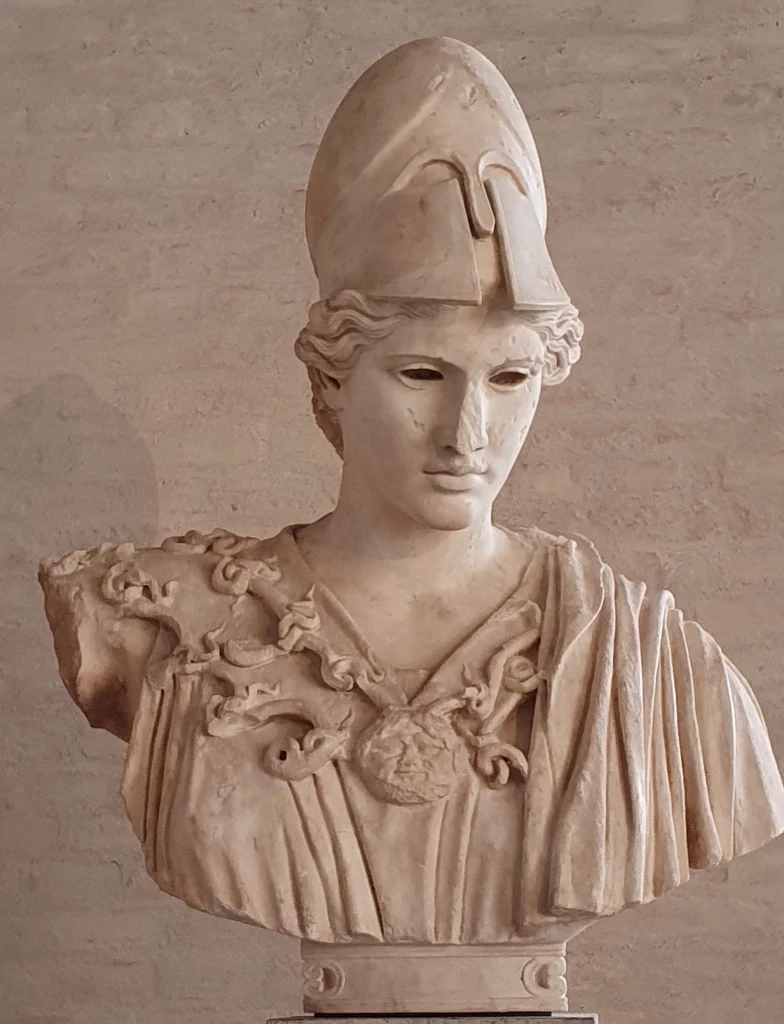
Bust of Athena (Velletri type)
Details
The story
In 431 BC Athens went to war with Sparta. The struggle, known as the Peloponnesian War, dragged on for 27 years and ended in Athenian defeat. The museum says the bronze statue behind this bust was made during that war. The bronze is lost. This marble is a partial copy of it, carved around the middle of the 2nd century AD.
Athena, the protecting goddess of Athens, wears her helmet and, over her shoulders, the aegis, her goatskin cloak with the head of the Gorgon at its centre. Her head is bowed and her gaze turned down. The eyes were once made of coloured stones set into the marble.
The type takes its name from a full-length statue found at Velletri, south of Rome, in 1797 and now in the Louvre. This bust came out of the ground about 25 years earlier, around 1770, near the ancient town of Tusculum, some 20 kilometres from Rome, where it probably decorated a Roman villa. The museum thinks it is what remains of a complete statue. Many scholars connect the lost original with Kresilas, the sculptor of the Diomedes in this room, an attribution the museum leaves open.




