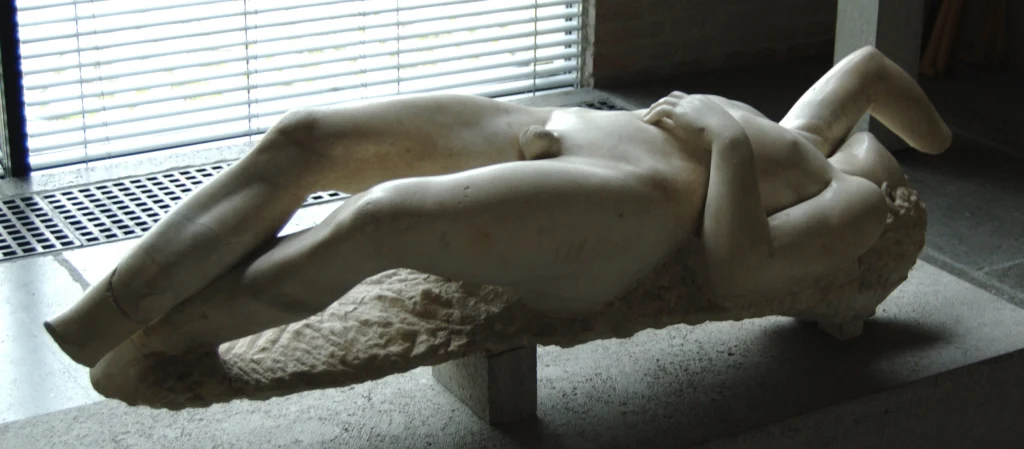
Dying Son of Niobe
Details
The story
In the 1st century AD the Roman writer Pliny the Elder drew up a list of the Greek masterpieces to be seen in Rome. In the temple of Apollo Sosianus he came to a group of the dying children of Niobe and admitted that people could not agree whether Skopas or Praxiteles had made it.
The myth behind it is cruel. Niobe, queen of Thebes, boasted that she had borne far more children than the goddess Leto, who had only two, Apollo and Artemis. The twins answered with their arrows and killed Niobe's sons and daughters.
The best-known Niobid statues today were dug up in Rome in 1583 and stand in the Uffizi in Florence. This young man, lying on his back in death, follows a figure of that kind, a type dated around 320 BC. Whether the Munich marble is itself a Greek work or a Roman copy has not been settled. He measures almost two metres from head to foot, and in the same room kneels the torso called Ilioneus, another of Niobe's sons.




