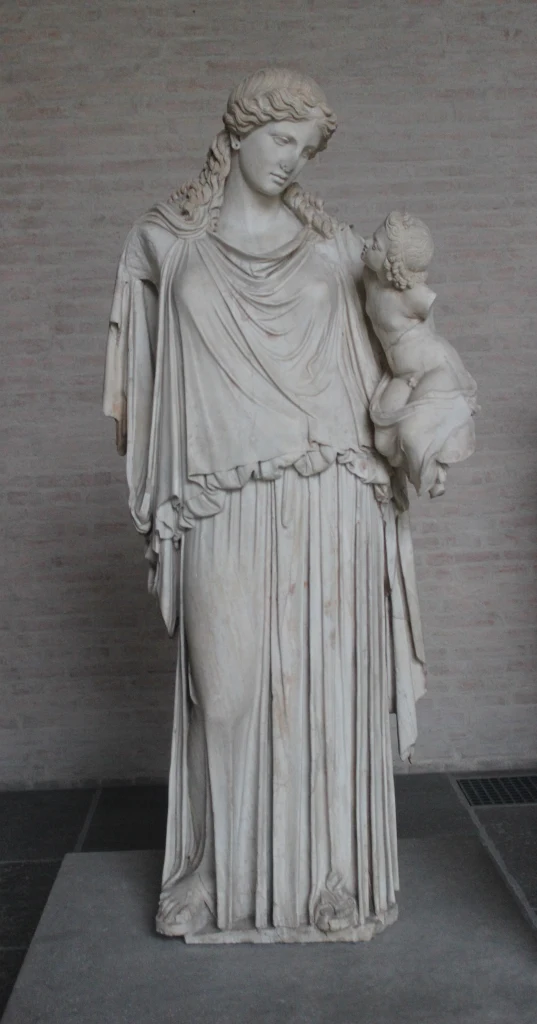
Eirene and Ploutos
Details
The story
In 375 BC an Athenian fleet beat the Spartans at sea, and a peace followed. Athens marked it by setting up altars to Eirene, Peace herself, and before long the city offered her a sacrifice every year. In the market square stood a bronze statue of the goddess by the sculptor Kephisodotos, probably the father of Praxiteles, whose Aphrodite shares this room. Some five centuries later the travel writer Pausanias still saw it there. This marble group is a Roman copy of that bronze.
Eirene carries a small boy on her left arm. He is Ploutos, Wealth, and the meaning was plain to any Athenian. Prosperity grows up in the arms of peace. In the original she held a sceptre in her right hand.
For decades nobody in Munich knew who she was. The group was shown as Leukothea, a sea goddess, holding the infant Dionysus. In 1867 the archaeologist Heinrich Brunn, comparing it with the figure on Athenian coins, recognised the Peace of Kephisodotos, and today the room is named after her.




