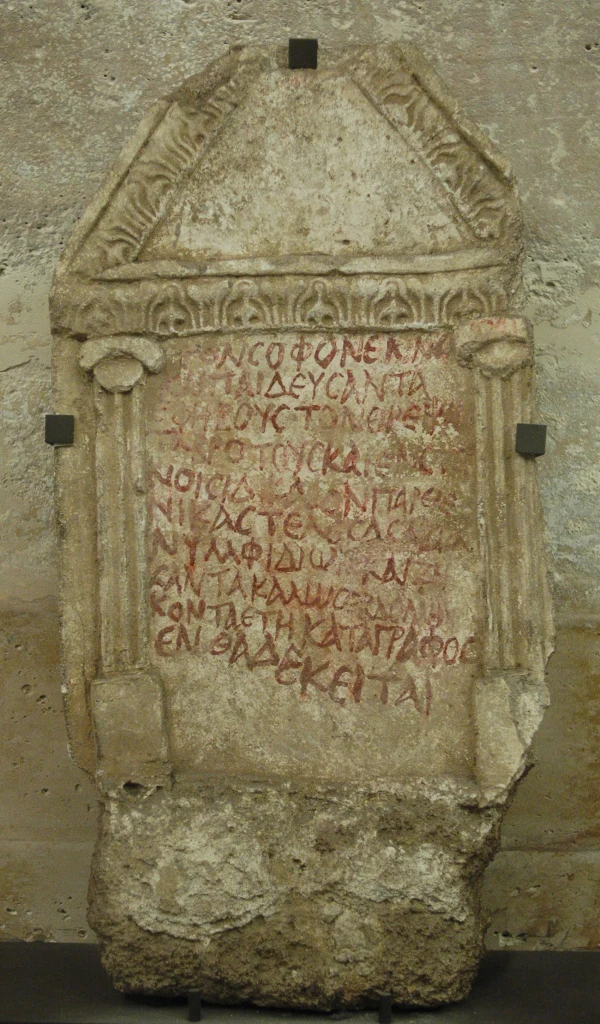
Funerary Stele of Katagraphos
Details
The story
This limestone slab, about two-thirds of a metre high, is shaped like the front of a temple. Two fluted Ionic pilasters carry a pediment edged with egg-and-dart moulding, and the panel between them was left smooth for the epitaph. The words were never carved. They were painted in red, in Greek, over a coat of stucco, and they name the dead man, Katagraphos, as a paidagogos. In Greek and Roman households that was the slave or freedman who took the boys of the family to school and back, carried their things and watched over their behaviour. The stele dates from the 3rd or 4th century AD and was probably made at Sidon, on the coast of present-day Lebanon, an old Phoenician city that by then lived under Roman rule and wrote its epitaphs in Greek. It came from the collection of Louis De Clercq, a 19th-century French collector of antiquities from the Levant, and his grandson gave a large part of that collection to the Louvre in 1967, on condition that it be put on show. The stele belongs to the Near Eastern department, which lends it to the Greek and Roman galleries.




