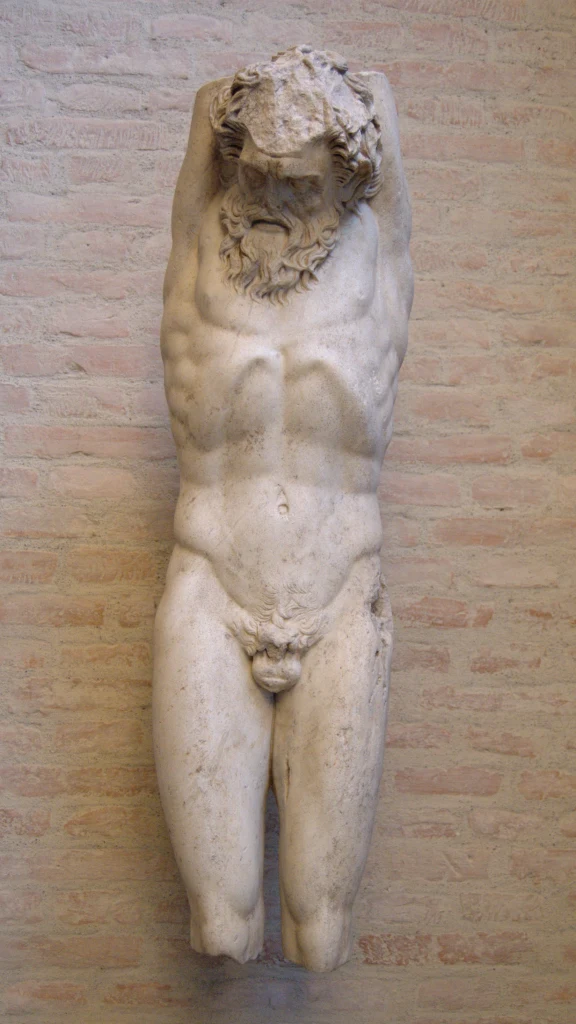
Hanging Marsyas
Details
The story
In the myth, the satyr Marsyas picked up a double flute that the goddess Athena had thrown away, taught himself to play it, and dared to challenge Apollo, god of music, to a contest. He lost, and Apollo had him flayed alive. Here he hangs by his wrists from a tree, his arms stretched above his head, and the whole weight of his body pulls downwards as he waits for the knife.
Most scholars trace the composition to Pergamon in Asia Minor, where in the late 3rd or early 2nd century BC sculptors set Apollo, the hanging satyr and the Scythian slave with the knife together in one group. Roman workshops copied the figure again and again, and archaeologists speak of a white and a red Marsyas. This copy belongs to the white type, the calmer one, in plain marble. The red type twists more violently and was often cut in pavonazzetto, a purple-veined marble quarried in Phrygia. Phrygia was Marsyas's own country in the myth, where a river carried his name.
The torso is 128 centimetres high. The arms, both legs below the knee and the tail have broken away and were never restored.




