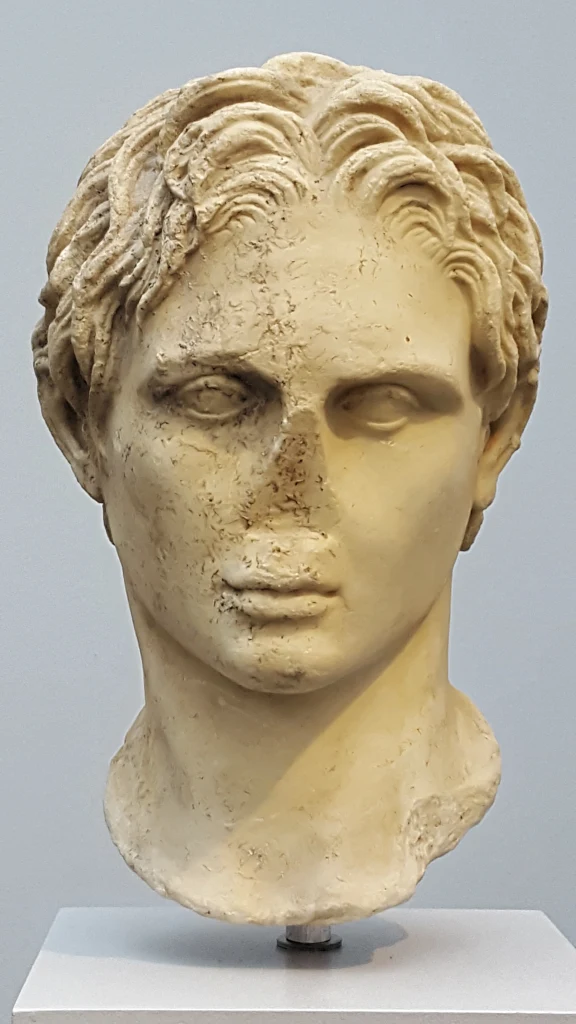
Head of Alexander the Great (Schwarzenberg type)
Details
The story
According to the biographer Plutarch, Alexander the Great wanted only one sculptor to portray him, Lysippos of Sicyon. Plutarch adds that many of Alexander's successors and friends later imitated two of his traits, the slight tilt of his neck to the left and the melting look of his eyes, and that Lysippos had captured both most faithfully.
The museum thinks this head probably goes back to a bronze by Lysippos made around 330 BC. The bronze is lost, and this is a Roman copy in marble, carved early in the 2nd century AD. Alexander is beardless, and over the middle of his forehead the hair rises in an upswept lock, the anastole. The head turns to the left, just as Plutarch describes, and the museum notes how much movement that turn gives the portrait.
The nose has broken off. The head, 36.5 centimetres high, does not belong to the museum. It is a long-term loan from the Schwarzenberg family, which is why archaeologists call it the Schwarzenberg Alexander.




