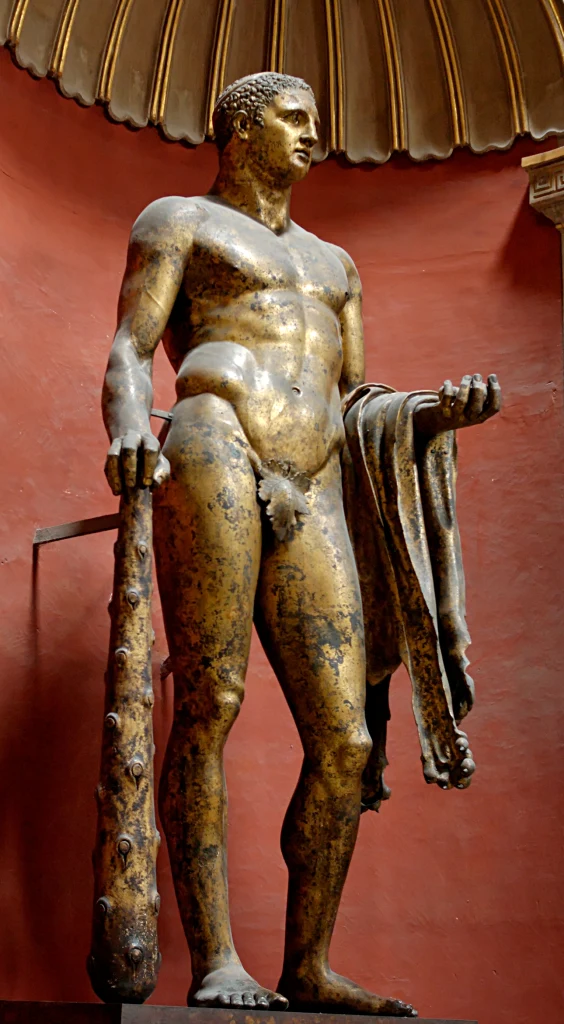
Hercules Mastai
Details
The story
In 1864 workmen digging beneath the courtyard of Palazzo Pio Righetti, near Campo de' Fiori, on ground once covered by the Theatre of Pompey, found a larger-than-life figure of gilded bronze lying flat in a trench. Over it lay a slab of travertine cut with three letters, F C S, for Fulgur Conditum Summanium. Lightning sent by Summanus, the Roman god of thunder by night, had struck the statue, and following Roman custom it had been given a burial of its own, together with the remains of a lamb.
Pope Pius IX acquired it soon afterwards, and it still carries his family name, Mastai. These were the last years of papal Rome. Six years later Italian troops entered the city, and the pope's rule over it came to an end. The sculptor Pietro Tenerani restored the bronze, filling the damage with plaster, and today it stands in the Round Hall, the domed room of the museum modelled on the Pantheon.
The young Hercules leans on his club, with the skin of the Nemean lion over his arm and the golden apples of the Hesperides in his left hand. Scholars have dated it anywhere from the end of the 1st century to the beginning of the 3rd century AD, and the museum suggests that its model may go back to an Attic work of the early 4th century BC.




