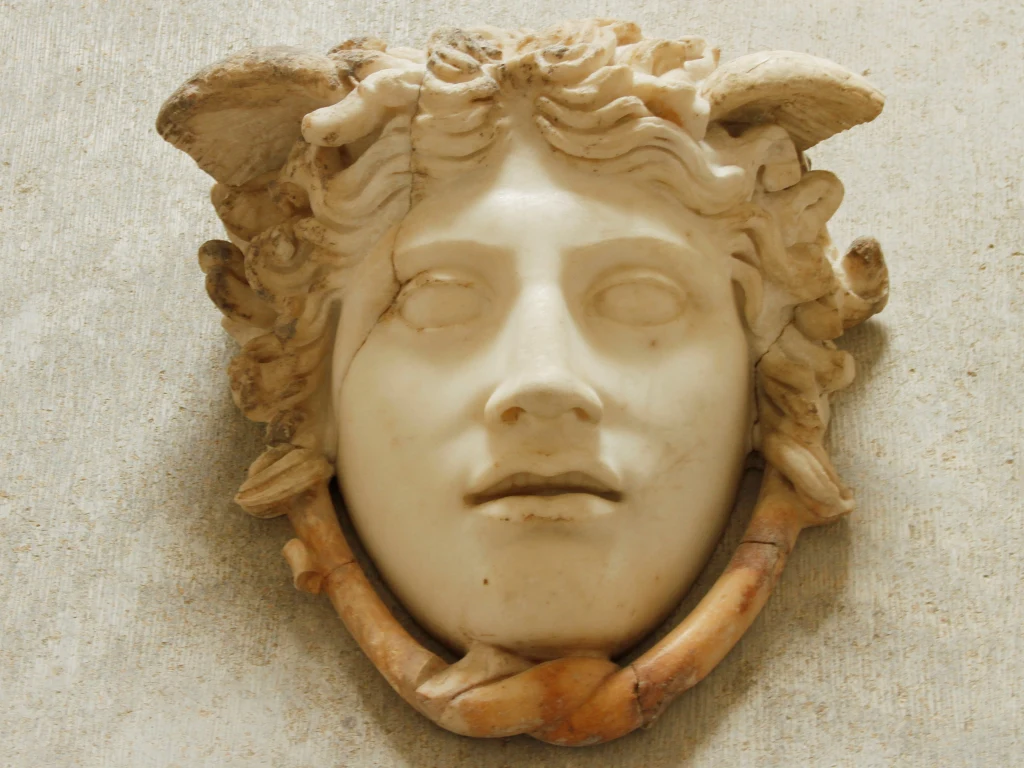
Medusa Rondanini
Details
The story
Goethe reached Rome in the autumn of 1786 and lodged on the Via del Corso. Opposite, in the Palazzo Rondanini, was this marble head of Medusa, and he wrote about it in his Italian Journey, praising how the anxious stare of death was caught in a beautiful face larger than life. Just knowing that such a work could be made and still existed, he said, made him twice the person he was. He came back to look at it with the painter Angelika Kauffmann the following summer.
For generations Greek artists had made the Gorgon a monster, with staring eyes, tusks and a lolling tongue, a face meant to frighten off harm. This Medusa is a young woman. Small wings rise from her hair, and snakes knot beneath her chin. The museum calls the head a Roman marble copy of the Medusa on the shield of Phidias's great Athena in the Parthenon, made around 440 BC. Other scholars have proposed a later model.
The head was later bought from the Rondanini heirs for Crown Prince Ludwig of Bavaria, and it is shown in the same room as the Barberini Faun.




