Sarcophagus of Saint Helena
Details
The story
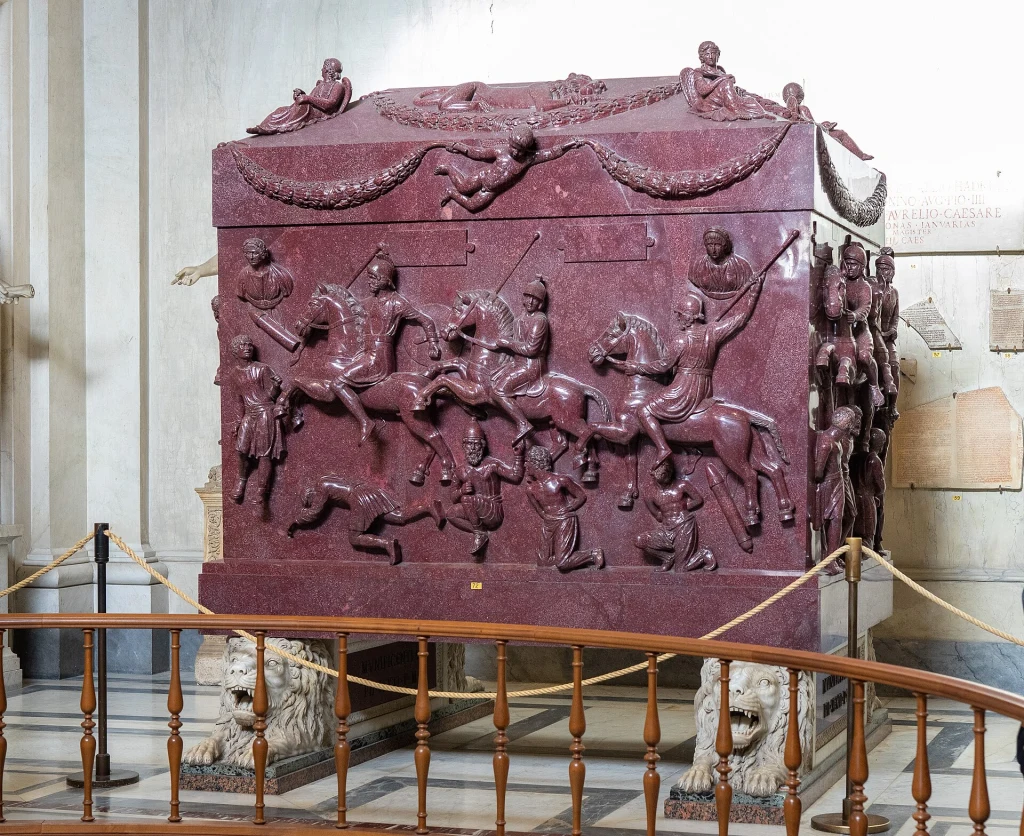
Roman horsemen ride down barbarians along the sides of this coffin, and prisoners sit beneath them. It is an odd choice for the burial of a woman, and the museum notes that scholars think the sarcophagus was first made for a man of the imperial family, Helena's husband Constantius Chlorus or, more probably, her son Constantine the Great.
It was carved in the early 4th century, probably sometime between about 310 and 320, from red porphyry, a stone quarried in the Egyptian desert and used almost only for imperial monuments. Constantine went on to found a new capital in the East, and he was buried there, in Constantinople. It was his mother Helena who was laid in this coffin, in her mausoleum on the Via Labicana outside Rome, at today's Tor Pignattara.
The coffin did not stay there. In the 12th century Pope Anastasius IV had it taken to the Lateran basilica to serve as his own tomb. In 1777 it was brought into the Vatican, where Gaspare Sibilla and Giovanni Pierantoni restored it and Francesco Antonio Franzoni carved the four lions it stands on. On the lid, cupids and figures of Victory carry garlands, and on the ridge two lions lie on either side, one of them asleep.




