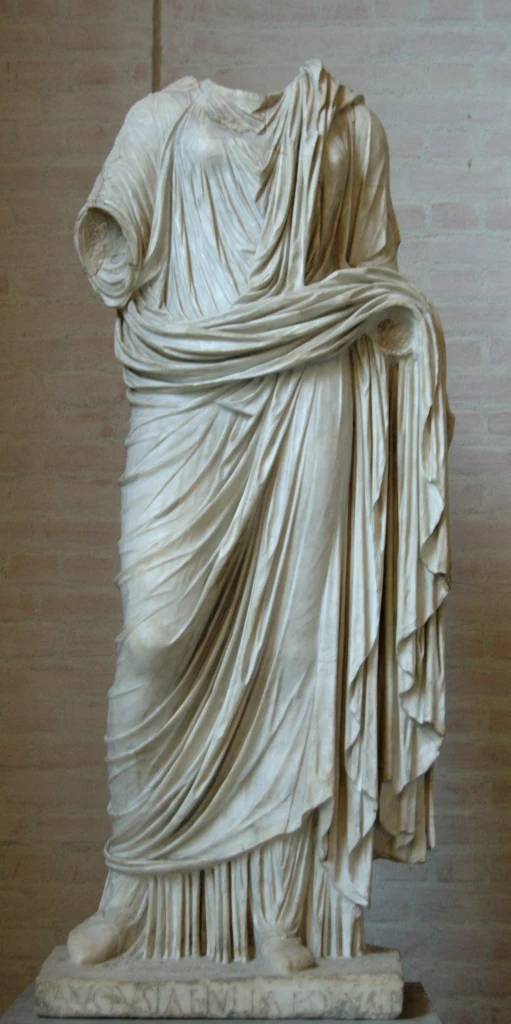
Statue of Livia
Details
The story
In AD 14 Augustus died, and his will was read out in the Senate. The historian Tacitus reports that it adopted his widow Livia into the Julian family and gave her the name Augusta. From then on she was Julia Augusta, and that is the name cut into the plinth of this statue, followed by the words daughter of Drusus, her father's name.
Without that inscription nobody could say who she is. The head was carved separately and set into the body, and so were the left hand and the right forearm. All three are lost. Several breaks run across the upper body, and the upper part of the back has broken away. Even so, the statue still stands 1.67 metres high.
The museum dates it between AD 14 and 42. The first year is her change of name. In 42 her grandson, the emperor Claudius, had divine honours voted to her, and after that inscriptions call her Diva, the deified. On this plinth she is still simply Augusta.




