The "King of Munich"
Details
The story
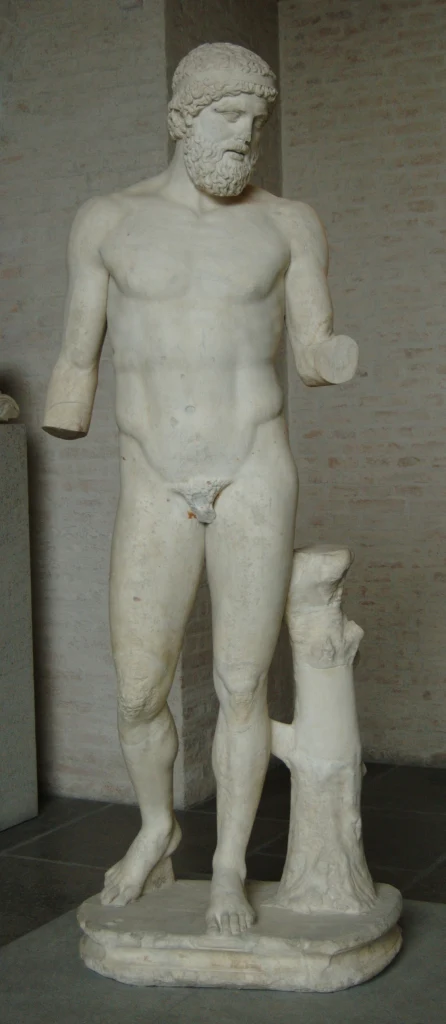
Nobody knows who this man is. His nickname, the King of Munich, comes from the city where he stands and from the band tied around his hair, which was taken for the sign of a royal hero. Bearded, naked and well over two metres tall, he lowers his head and turns it to the left, towards something he once held in his bent left arm. Both forearms are lost, and with them whatever he carried, so nothing on the statue gives him a name.
The museum calls him a Roman copy of the 2nd century AD after a Greek original of the early or high Classical period, and says he once belonged to a group. It suggests, with a question mark, a cult statue of Hephaistos, god of fire and the forge. In 1970 the archaeologist Ernst Berger proposed another answer, Herakles from a colossal bronze group of Zeus, Athena and Herakles that the sculptor Myron made for the sanctuary of Hera on the island of Samos. The geographer Strabo describes those three figures standing together on a single base.
The tree trunk beside his leg is the Roman copyist's addition. The bronze original stood without one, and the heavier marble needed the support.




