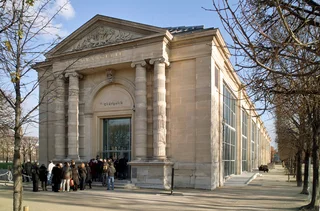
The Musée de l'Orangerie stands in the Tuileries Garden, and under its roof are two collections. The first is the Water Lilies, which Claude Monet gave to the State together with the rooms built to his requirements. The second was assembled by the Paris art dealer Paul Guillaume and, after his death in 1934, cut down and reshaped by his widow, Domenica. She sold the boldest of his purchases and from 1937 began buying on her own account. Her second husband was the architect Jean Walter, and the collection bears the names of both her husbands.
In the 1960s, when the building was being prepared to receive the Jean Walter and Paul Guillaume collection, an extra floor was built over Monet's oval rooms. The new ceiling shut out the daylight from above that Monet had insisted on, and the light came back only with the renovation of 2000–2006, when the added floor was taken down and the Walter-Guillaume collection moved to new galleries.
1. The Water Lilies — Claude Monet
On 12 November 1918, the day after the Armistice, Claude Monet wrote to Georges Clemenceau, head of the government and an old friend, that he was finishing two decorative panels, which he wanted to sign on the day of victory and give to the State through him. Clemenceau persuaded him to give more. By an agreement of 1920 the gift had grown to 12 panels, and a round pavilion designed by the architect Louis Bonnier was to be built for them in the garden of the Hôtel Biron, a mansion in Paris. The pavilion was never built. On 31 October 1921 Monet agreed to the Orangerie, and there the architect Camille Lefèvre built to his instructions two oval rooms, lit by daylight falling through a glass roof.
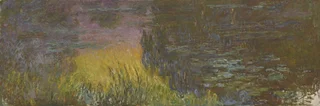
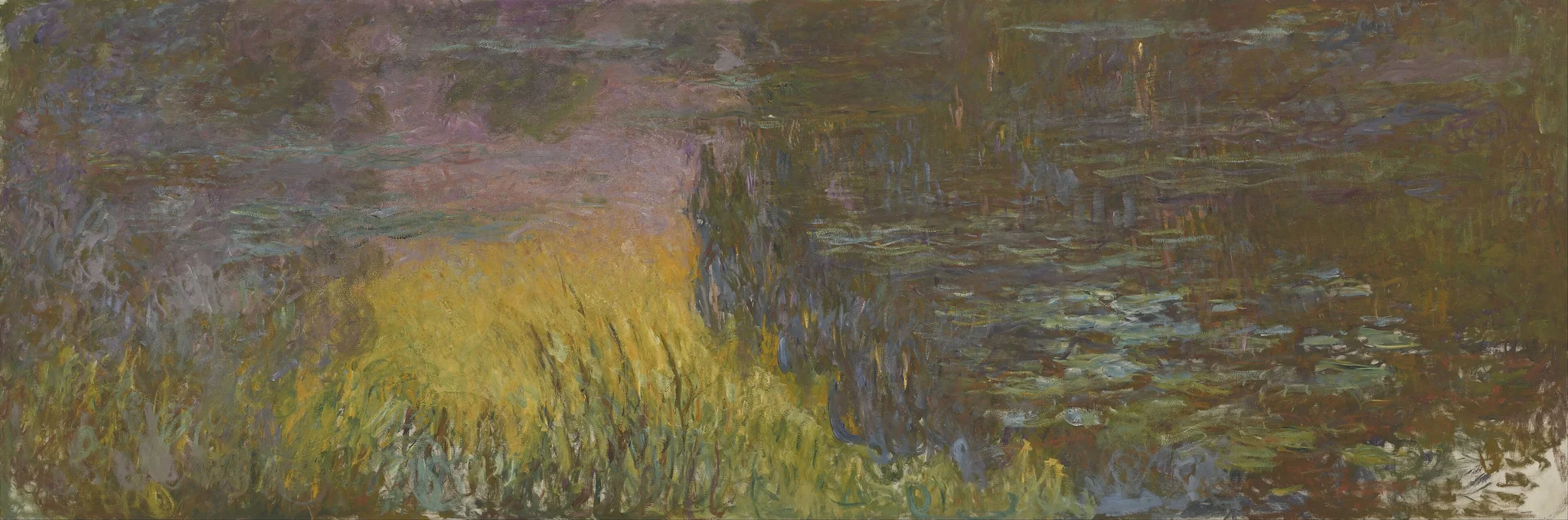
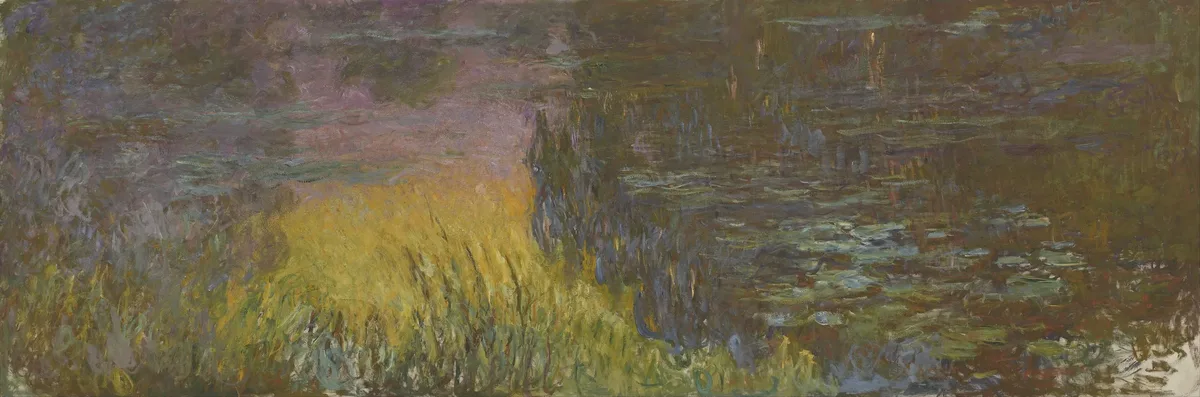
Monet wanted, as he put it himself, “the illusion of an endless whole, of a wave with no horizon and no shore”. Eight compositions follow one another along the curved walls of the two ovals, nearly 100 metres of painting in all. In Setting Sun a yellow-orange band of reflected sunlight rises up the water from the dark mass of reeds in the lower left corner. Further right the water thickens to blue-violet and red-brown, and the lily pads are marked with turquoise-green strokes. In one of the morning compositions with willows the trunks are cut off by the top and bottom edges of the canvas, and only green strands of branches hang down over the water from above.

Monet went on working on the panels until his death. In January 1925 he wrote to Clemenceau that the gift would not go ahead, and Clemenceau replied that Monet had no right to break his word. The painter died in December 1926, and the rooms opened without him on 17 May 1927, with Clemenceau present. The deed of gift, signed on 12 April 1922, promised the State 19 panels, while 22 went up on the walls.
2. Paul Guillaume, Novo Pilota — Amedeo Modigliani
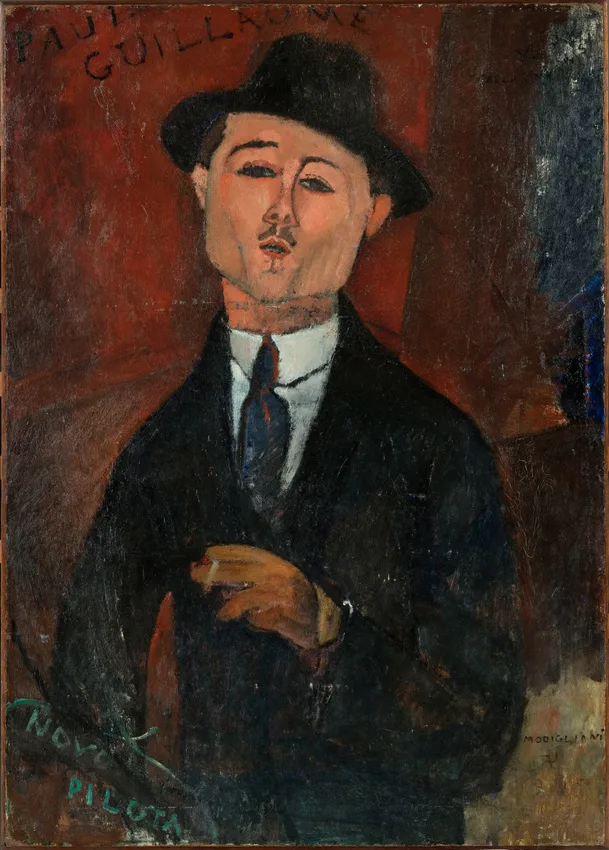
When Amedeo Modigliani painted this portrait, Paul Guillaume was 23 and was already dealing in African sculpture and showing the Cubists. The poet Max Jacob had introduced him to the painter a year earlier, and by 1915, as the museum cautiously puts it, Guillaume was probably already his dealer. He rented Modigliani a studio in Montmartre, and about 100 paintings and 50 drawings by Modigliani later passed through his hands. In 1915–1916 Modigliani painted four portraits of Guillaume in all, and Novo Pilota is the first of them.
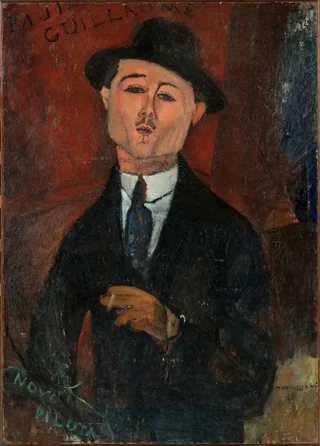
Modigliani painted it on cardboard, in the house of his companion, the English poet Beatrice Hastings, on the rue Norvins. Guillaume sits against a red ground in a black felt hat, a dark suit and a white shirt with a high collar, holding a cigarette at his chest. His face looks like a pale mask with a long straight nose and a short moustache. His chin is raised, and under heavy lids his eyes look down along his nose.
Modigliani wrote words straight onto the cardboard, in paint: the name “PAUL GUILLAUME” at the top left, a Star of David and “Stella Maris” at the top right, “NOVO PILOTA” in turquoise-green letters with a flourish at the bottom left, and his signature and the year at the bottom right. In Italian novo pilota means “new helmsman”, and Stella Maris, “star of the sea”, is the Latin name for the Virgin as protector of sailors. According to the museum, Modigliani portrayed the young dealer as the guide and protector of modern painting. Guillaume's other hand, at the lower right, Modigliani only sketched in.
3. Harlequin and Pierrot — André Derain
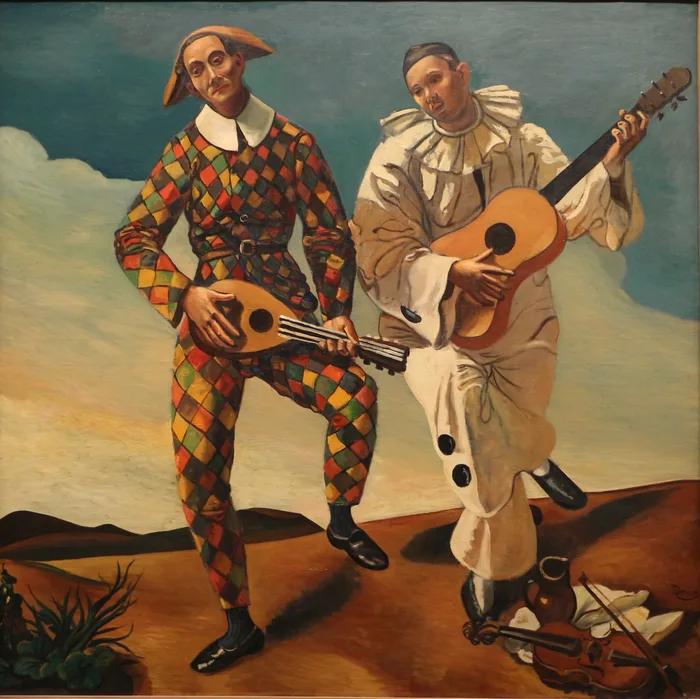
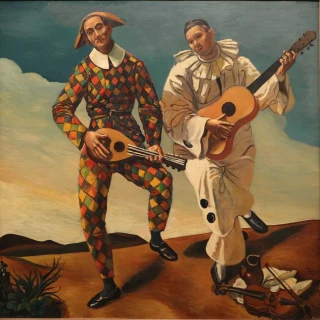
Harlequin and Pierrot stand full length on a bare, reddish plain under a blue sky, and each has one knee raised, as if both had stopped still in the middle of a dance. Harlequin, in a tricorne set crosswise on his head and a costume of red, green, yellow and blue diamonds, plays a small mandolin and looks straight ahead. Pierrot, in a loose white smock with a ruff and a black skullcap, holds a guitar with its neck upward and keeps his eyes lowered, and his face is as grave as Harlequin's. In the lower right corner a violin with its bow, a dark jug and a crumpled white cloth lie on the ground, and the museum points out how carefully Derain painted this small still life.
Guillaume commissioned the picture and owned it from 1925, and it was photographed on the wall of his apartment on the avenue de Messine. Harlequin and Pierrot turn up once more, barely sketched in, in the background of the portrait of Guillaume's wife that Derain painted in 1928–1929 (number 11 in this list). The museum identifies Pierrot's face as Guillaume's own. Elsewhere in its records the museum states that both figures were posed by the Catalan painter Jacinto Salvadó, who worked for Derain and who later posed in a harlequin costume for Picasso too.
4. La Carriole du Père Junier — Henri Rousseau
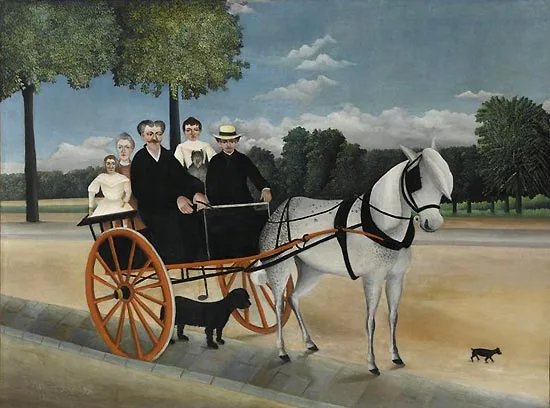
Henri Rousseau was known as the Douanier, the customs officer, because for many years he had worked at one of the Paris toll gates where duty was levied on goods coming into the city. By 1908 he had long been retired, lived in poverty and owed money to the greengrocer Claude Junier, whose wife cooked Rousseau's meals. Junier had just bought a horse and was proud of it, and Rousseau paid off the debt with a painting of the greengrocer's family out driving in their cart. By 1914 the picture had passed from Junier to the dealer Paul Rosenberg, in 1918 it was with Villard, and only in 1927, 17 years after Rousseau's death, did Guillaume buy it.
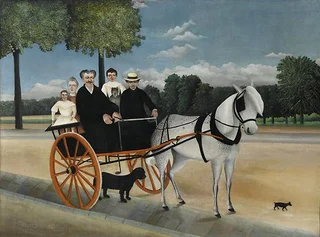
Rousseau worked from a photograph and, as the museum points out, changed a few things in it: he took a tree off the boulevard, and he moved the dogs and changed their sizes. The cart and the horse are turned side-on, parallel to the edge of the canvas. The closely spoked wheels are bright orange, the same colour comes back in the shafts and the harness, and the dapple-grey mare barely touches the road with her hooves, so that the museum describes her as standing “on tiptoe”. Every passenger except the white-haired Junier, who holds the reins, looks straight at the viewer. There is a tradition that the man in the straw hat on the right is Rousseau himself, and that the mare was called Rose.
There are three dogs in the picture, each on a different scale. A big black one stands under the cart between the wheels, a young woman at the back holds a small one in her arms, and a tiny one runs along the road far ahead. The American painter Max Weber, who was friends with Rousseau at the time, asked why the black dog was so big, and Rousseau answered that his canvas required it.
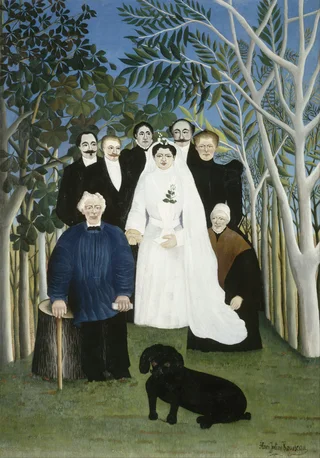
5. The Wedding Party — Henri Rousseau
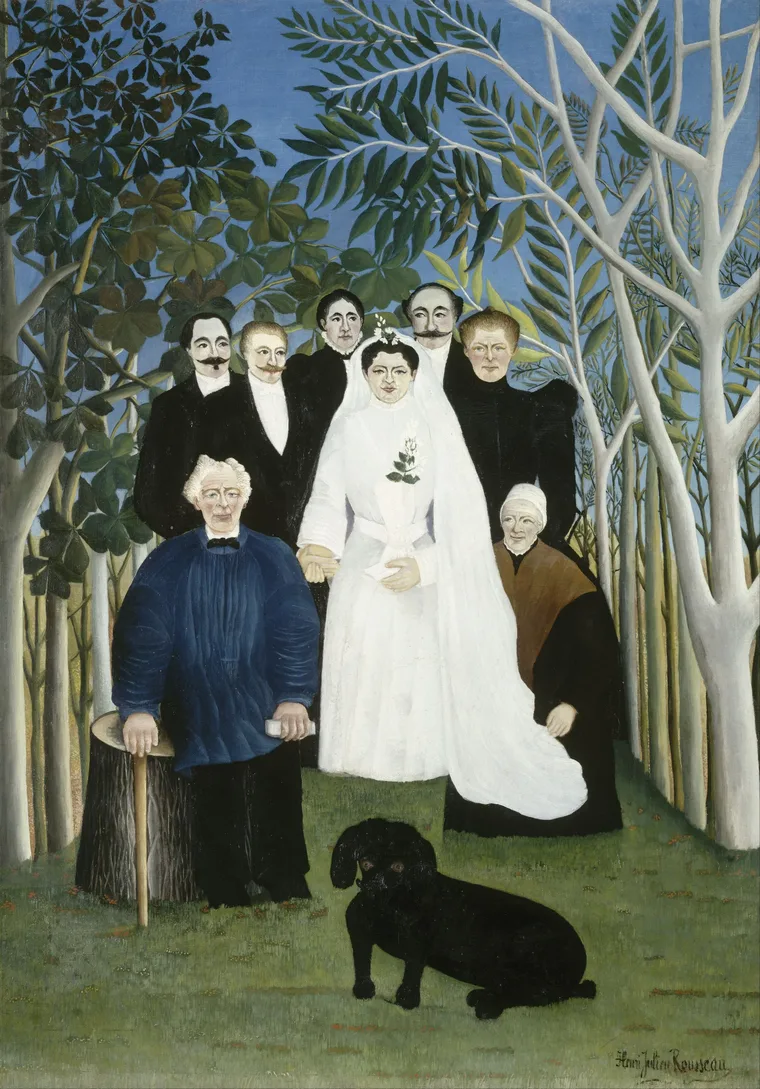
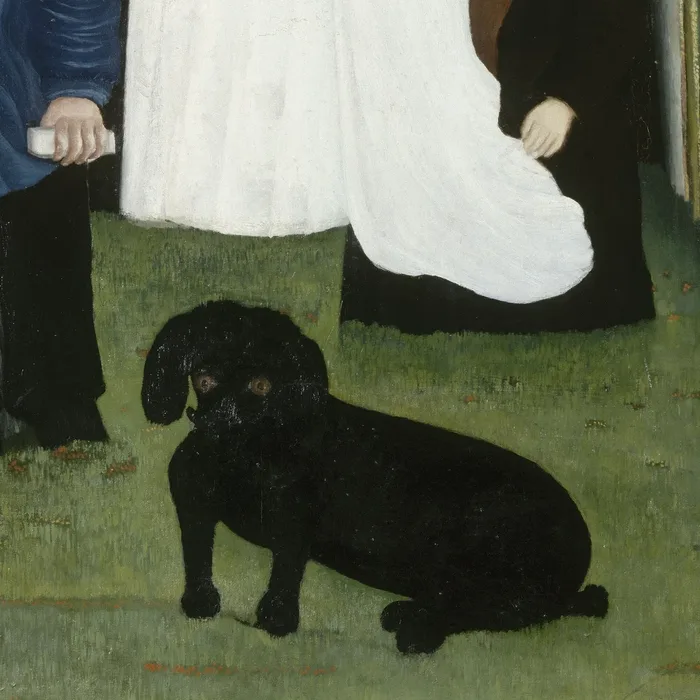
Eight people have gathered on a lawn in a tight group, as if in front of a photographer, and all of them look straight at the viewer. The five heads of the back row are stacked one above another against the foliage, as though cut out of paper. At the front left a white-haired old man in a blue smock sits on a sawn-off stump, leaning on a cane, on the right an old woman in a white bonnet rests her hands on her knees, and between them is the bride in a white dress that reaches the ground. Her feet cannot be seen on the grass, and the museum writes that she seems suspended in the air. The bride's long veil falls onto the old woman's skirt, and in the foreground sits a shaggy black dog, too big for its place, looking at the viewer with reddish-brown eyes.
Guillaume bought The Wedding Party in 1929 from the painter Serge Férat, a friend of the poet Apollinaire and one of the first collectors of Rousseau. The museum calls Rousseau a “master of spatial paradoxes” and believes he raised the bride off the ground on purpose.
In 2025, ahead of a Rousseau exhibition that opened in 2026, the C2RMF, the research laboratory of the French museums, examined the painting under X-rays and infrared light, and the news service franceinfo reported the results. According to its report, Rousseau added the four figures in the background later, the bride's dress was at first longer, he reworked the veil, and he added the dog. The dog's eyes may cover the place where the bride's feet used to be. Under the veil, the old woman was found to have three hands.
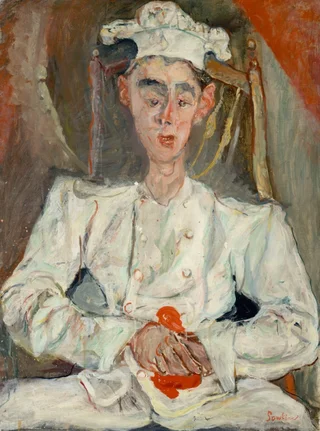
6. The Little Pastry Cook — Chaïm Soutine
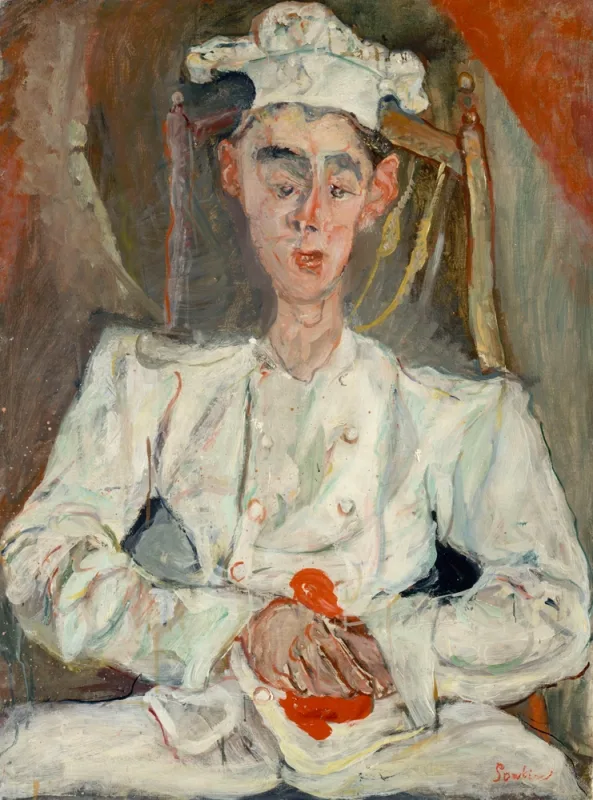
In the winter of 1922–1923 the American collector Albert Barnes saw a portrait of a young pastry cook by Chaïm Soutine at Paul Guillaume's in Paris. Soutine was poor at the time and known only in Montparnasse. In 1923 Guillaume described that picture in the magazine Les Arts à Paris, recalling the pastry cook “with an immense and magnificent ear”, and wrote that Barnes's delight in the canvas made Soutine a famous painter in a single day. Barnes bought about 50 paintings by Soutine, most of them from the stock of the dealer Léopold Zborowski, with whom the painter was then working, and about 16 through Guillaume. The museum writes that Guillaume was apparently describing the pastry cook now at the Barnes Foundation in Philadelphia.
The Orangerie's pastry cook is a different one. Soutine painted him in 1922–1923, and the museum knows of six versions of the subject in all. The young man sits facing the viewer in a crumpled white toque pushed to the back of his head and a double-breasted jacket that spreads sideways almost from one edge of the canvas to the other. His neck is thin, his head looks small for such a body, his ears stick out, and the one on the viewer's right is bigger and redder than the other. His hands are folded low in his lap, and under them lies a bright red cloth, the brightest patch in the picture.
Guillaume bought this canvas in the early 1930s, after it had belonged to Zborowski and then to the dealer Jos Hessel, and he did so, the museum says, “in memory of the first pastry cook he had loved so much”.
7. Large Nude with Drapery — Pablo Picasso
In the early 1920s Picasso was painting massive women in classical poses, and the museum, which dates this picture to 1921–1923, lists its sources. They are antiquity, Raphael's Fornarina pressing a cloth to her breast, Ingres, and Renoir, whose bathers Picasso had in his own collection.
The woman is seated and fills almost the whole canvas: the top of her head nearly touches the upper edge, and her knees are cut off by the lower one. Her head is bowed, her eyes are closed, and long wavy chestnut hair falls down her back. With her left hand she presses a white cloth to her right shoulder, and that hand is broader than her face, so that the museum's record calls it disproportionate. With her right hand she twists the same cloth between her thighs. The background is a flat grey, and in the lower folds the white is laid on so thinly that a brownish-grey underlayer shows through. The picture also has a second title, Woman at Her Toilette.
Guillaume bought it in 1927 and two years later showed it in an exhibition of his collection. After his death, the museum writes, Domenica parted with the boldest works of that period but kept this one. In 1936–1937 she lent the Large Nude to a Picasso exhibition in New York.
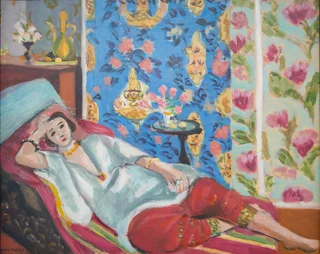
8. Odalisque in Red Trousers — Henri Matisse
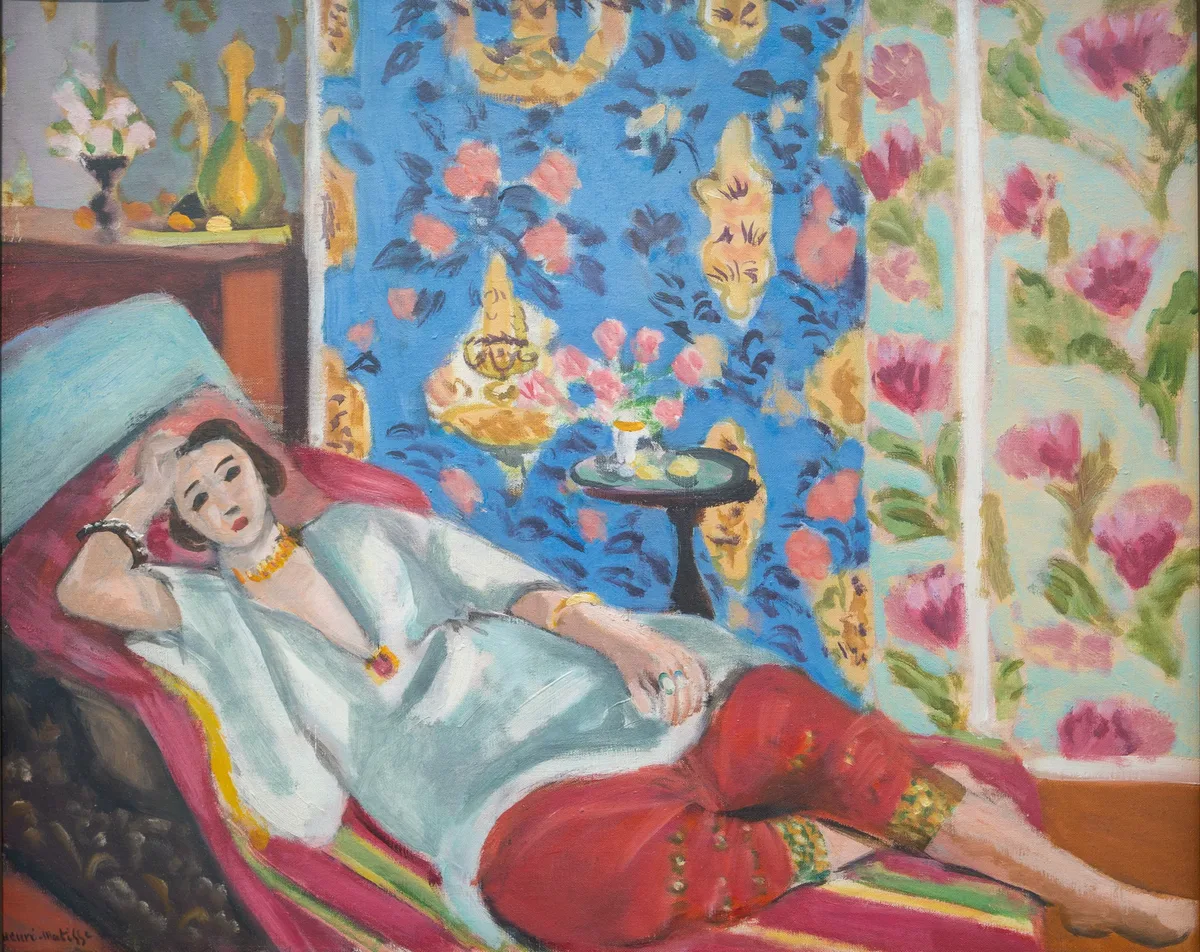
In 1927 a critic compared Matisse's Nice odalisques to “a wallpaper dealer's display”. Guillaume bought this odalisque himself, and in 1929 it hung in the exhibition of his collection at the Bernheim-Jeune gallery. After his death, according to the museum, his widow kept almost none of Matisse's pictures apart from those he had painted in Nice between 1917 and 1929.
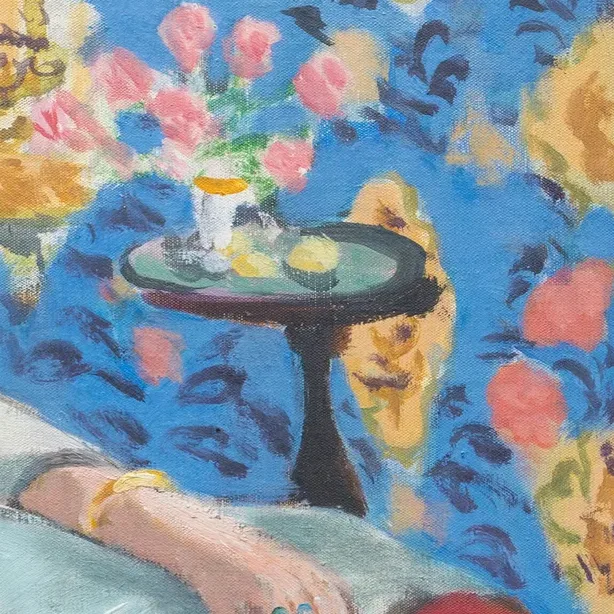
Matisse painted her in Nice in 1924–1925. The woman lies on a couch that runs diagonally from the upper left corner to the lower right, her head resting on a turquoise bolster and a crimson cushion, her right arm raised to her temple. She wears a white tunic, beads and bracelets, and her red trousers are gathered at the calves with bands embroidered in gold. Behind her hangs a cloth of deep cobalt blue with pink roses and large yellow-ochre motifs, and on the right stand two tall panels with crimson flowers on a pale mint ground. Matisse set down the face in a few strokes and painted the fabrics around it more densely than the figure. The museum calls the small round table with a vase of flowers in front of the blue cloth disproportionately large and sees in it the only sign of depth in the room.
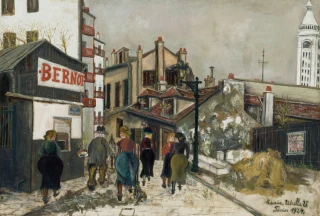
9. La Maison Bernot — Maurice Utrillo
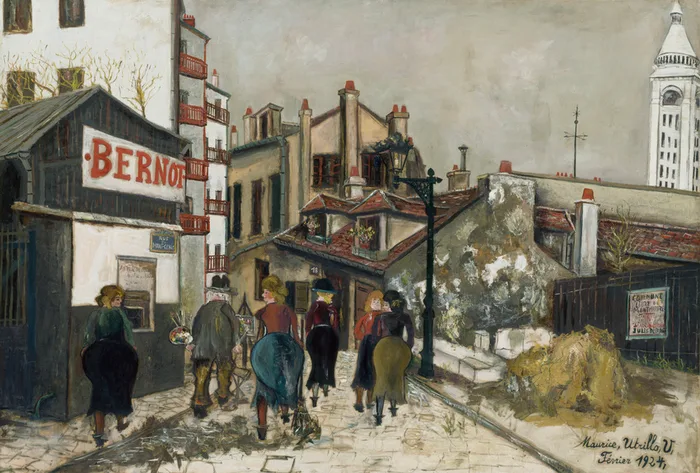
Among the passers-by in this Montmartre street is a man standing with his back to the viewer at a small easel with a canvas on it. He is grey-haired, in a bowler hat and a grey-green overcoat, and in his left hand he holds brushes and a palette thickly smeared with paint. Nearby about six women walk along the street, also with their backs to the viewer, in cardigans and heavy dark boots, and their skirts, turquoise, black and olive, flare out like bells, so that the figures look like dolls.
The cobbled rue du Mont-Cenis runs downhill. On the left is a shop with a white sign reading “BERNOT” in red capitals, and beside the door hangs a blue plaque with the street name. According to the museum, the shop sold coal. On the right a cast-iron lamp post rises and a wall with flaking plaster runs along the street, and in the upper right corner, cut off by the edge of the canvas, the white bell tower of the Sacré-Cœur basilica shows. Utrillo outlined the windows, the roofs and the lamp in thick black lines.
Utrillo grew up in Montmartre, but in 1924 he was living far from Paris, in the Ain département in eastern France, and, as the museum writes, most likely painted the street from a postcard. The picture belonged to Guillaume and after his death stayed with Domenica. In the lower right corner Utrillo signed “Maurice, Utrillo, V,” and added the date, February 1924. The letter V stood for the surname of his mother, the painter Suzanne Valadon.
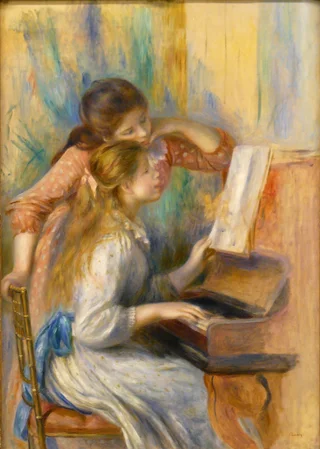
10. Young Girls at the Piano — Pierre-Auguste Renoir
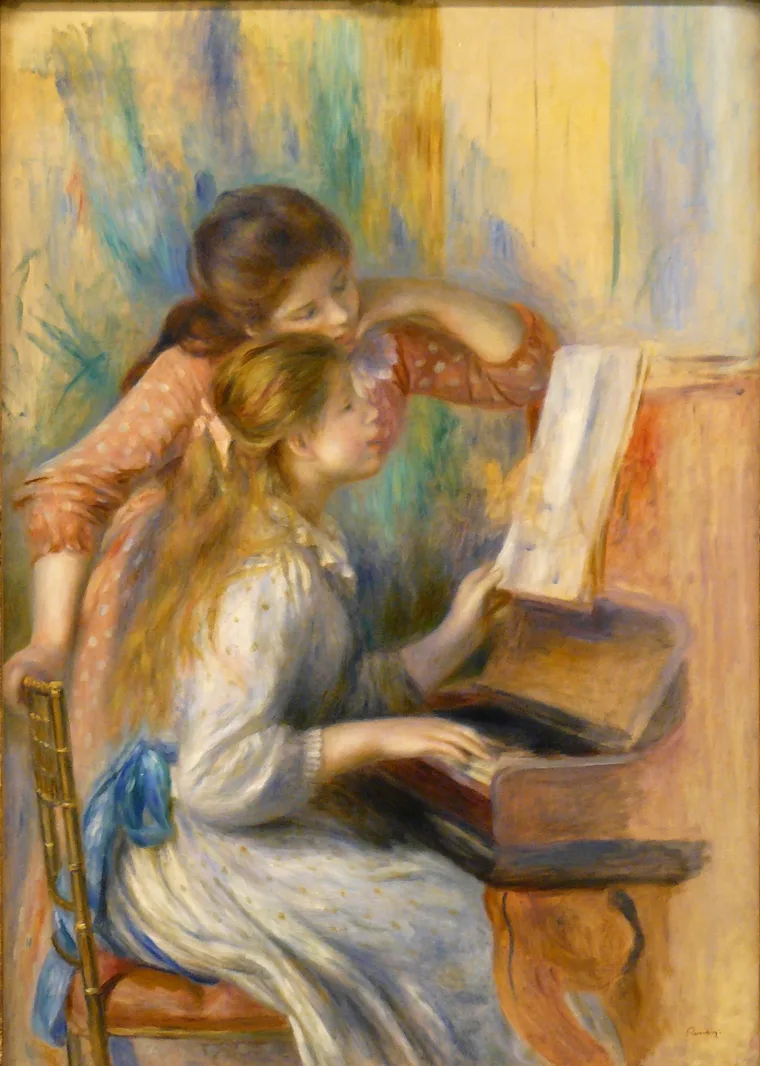
In 1892 the French State bought Young Girls at the Piano from Renoir for the Musée du Luxembourg, where the work of living artists was shown, and it was the first of his paintings to enter a national collection. That picture is now in the Musée d'Orsay. Renoir painted the composition several times. The Orangerie canvas is painted more freely, and the Musée d'Orsay calls it an oil sketch. The Orangerie itself does not use the word “sketch” and writes that at least six other versions exist.
A fair-haired girl sits at the piano in strict profile. Her hair hangs loose down her back and is caught up at the crown with a pink bow, and she wears a white-and-grey dress with a small polka dot and a wide pale-blue sash, tied at the back in a big bow, whose ends hang down over the chair. She plays with one hand and has raised the other to the edge of the music. A dark-haired girl in a salmon-pink dress leans on the piano with her chin in her hand and looks at the score. The upper left corner is filled with quick green, turquoise, blue and ochre strokes in which a curtain, foliage and wallpaper can all be seen, and at the lower left the edge of the canvas cuts off a slender gilt chair. The museum writes that Renoir avoided unnecessary detail in order to concentrate on the two figures, and suggests that the picture was painted in the artist's own home: in 1890 he had given his wife a piano as a wedding present.
Renoir kept this canvas for a long time. From 1914 to 1917 he left it on deposit with the Durand-Ruel gallery in Paris, in 1919 the picture was with the dealer Ambroise Vollard, and from 1928 it belonged to Guillaume. After her husband's death Domenica kept it.
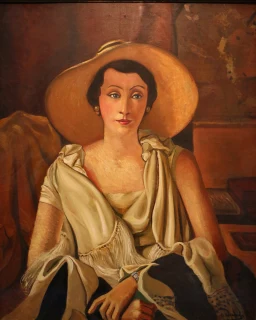
11. Portrait of Madame Paul Guillaume in a Large Hat — André Derain
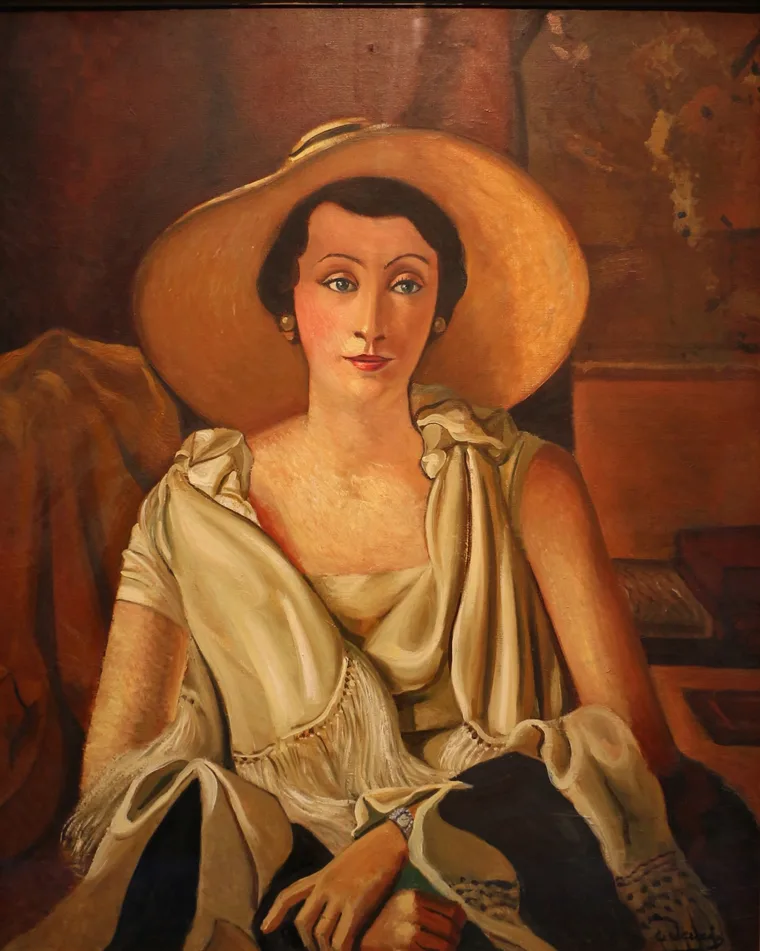
Paul Guillaume's wife was born Juliette Lacaze, and it was Guillaume who gave her the name Domenica. In 1928–1929 she was painted by André Derain, a former Fauve who by the end of the 1920s had become Guillaume's leading painter. The portrait belonged to Guillaume from 1929. He showed it that same year in the exhibition of his collection, and at home he hung it in the place of honour in the bedroom of their town house on the avenue Foch.
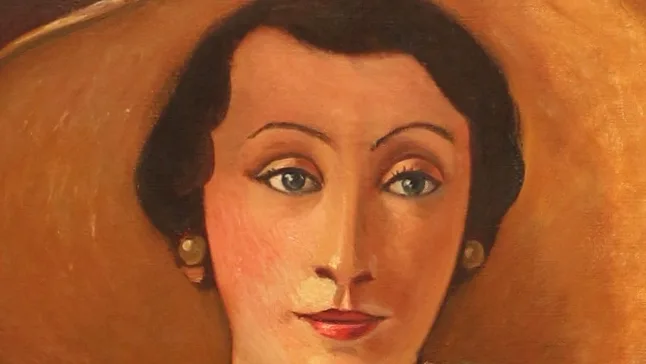
Domenica sits in an armchair in an enormous straw hat whose brim is wider than her shoulders and lies behind her head like a pale disc. Everything in the picture is painted in beiges, ochres and creams except a dark-red curtain at the upper left. Her shoulders are wrapped in a cream satin shawl with a long white fringe, and her hands are crossed in her lap. Her eyes are large and pale blue, and, as the museum notes, Derain put white highlights in the pupils to bring the gaze to life. The pearl earrings pick up the same white.
At the upper right, according to the museum, Pierrot and Harlequin are barely sketched in, and the museum itself asks whether this is the large picture Guillaume commissioned or one of the two sketches for it, which the couple also kept at home. After Guillaume's death in 1934 the collection passed to Domenica. She kept the portrait, lent it in 1950 to the exhibition One Hundred Portraits of Women at the Galerie Charpentier in Paris, and in 1959 sold it to the State together with the collection. A biography of Domenica published in 1996 is called The Lady in the Large Hat.
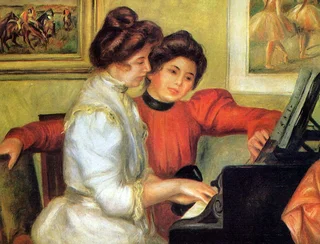
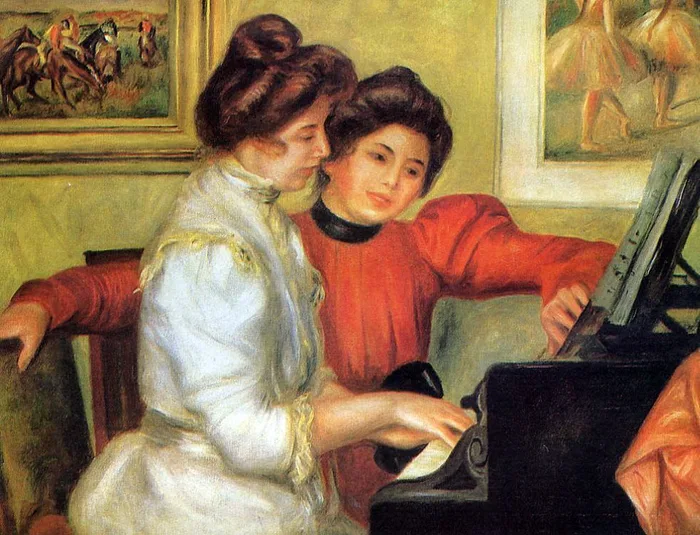
12. Yvonne and Christine Lerolle at the Piano — Pierre-Auguste Renoir
Domenica bought this picture on 10 June 1937 and signed the papers as “Madame Paul Guillaume”, although her husband had been dead for three years. Before it came to her, the painting had passed through galleries in Paris, New York and Switzerland.
Around 1897 Renoir painted Yvonne and Christine, the daughters of the painter and collector Henry Lerolle, at the piano. The subject is the same as in Young Girls at the Piano, except that here the girls have names, and the wall behind them is hung with pictures from their father's collection. One sister, in a white dress with a high collar, sits at a black piano and plays. The other, in a red-orange dress with a black velvet ribbon at her throat, stands behind her with her face turned to the viewer and reaches out towards the music. At the upper left, in a gilt frame, hangs a picture by Edgar Degas of racehorses and jockeys, and at the upper right his dancers in pink tutus, whose heads are lost beyond the top edge of the canvas. The museum identifies these pictures as Before the Race and Dancers under a Tree. The second is now in the Norton Simon Museum in Pasadena.
Both sisters later married sons of the collector Henri Rouart, an old friend of Degas, Yvonne marrying Eugène and Christine marrying Louis.
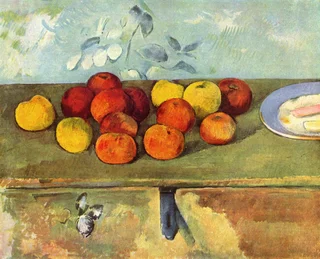
13. Apples and Biscuits — Paul Cézanne
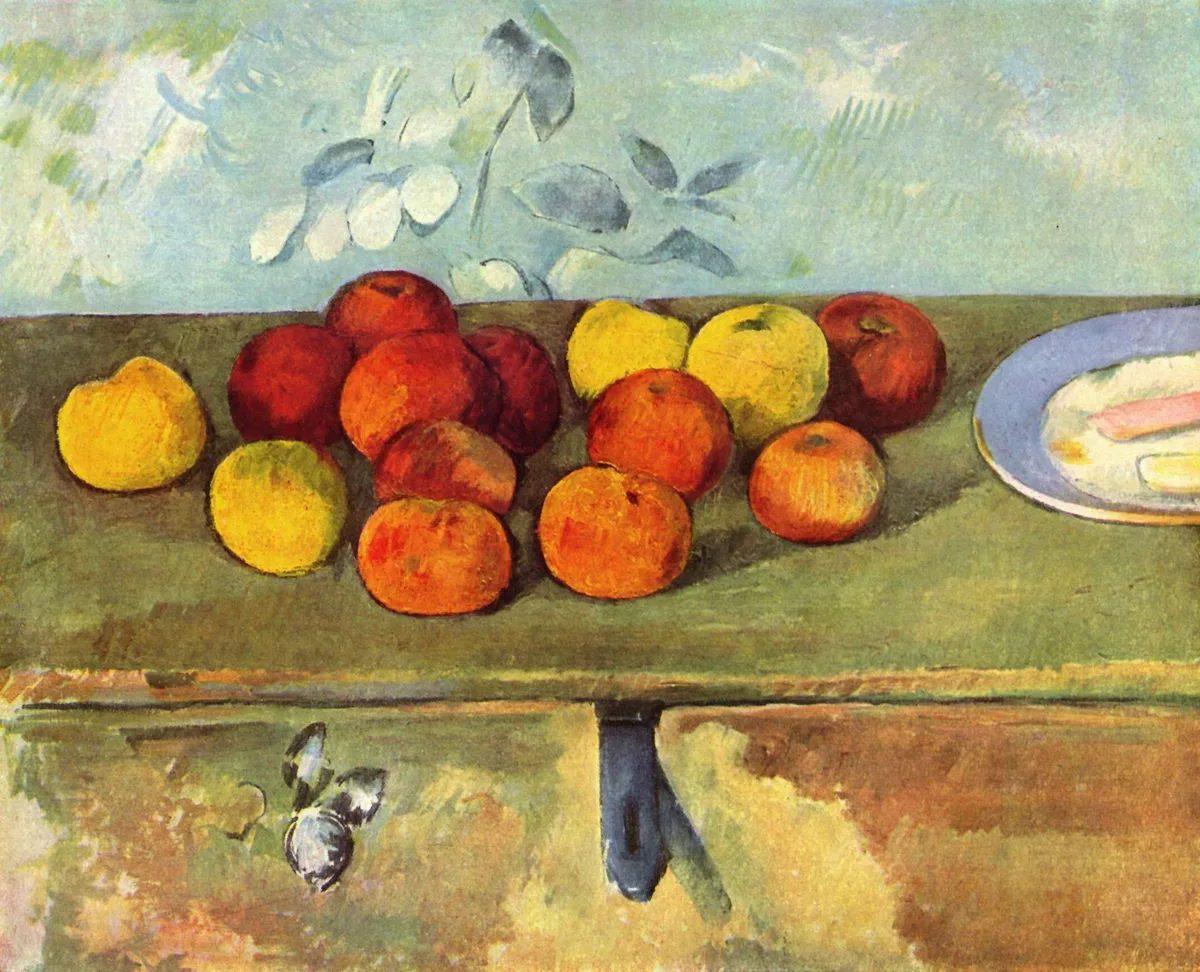
The American magazine TIME reported the sale of this still life in an article headed “Lost to the Louvre”. On 14 May 1952 the collection of Gabriel Cognacq, heir to the Samaritaine department store, was auctioned at the Galerie Charpentier in Paris, and Apples and Biscuits went for 33 million francs. According to the magazine, no Cézanne had ever fetched more at auction. The Louvre held a right of pre-emption, which meant it could claim the picture for the same sum, but it did not use it. The sale record gives the buyer as Madame Jean Walter, while TIME called the buyer “a French lead-mine millionaire”, meaning her husband. The museum says that a purchase at that price drew public attention to Domenica's collection.
On the long wooden lid of a chest lie 14 apples in a loose row, yellow, red and orange, and behind them is a bluish-green wall with a pattern of grey-and-white sprigs. The biscuits of the title barely made it onto the canvas. At the right edge stands a white plate with a blue rim, only about a third of which is in the picture, and on it lie a few flat pink and cream biscuits. The plate is tilted as if seen from above, from a higher point than the apples. The dealer Ambroise Vollard, one of the painting's first owners, entered it in his stock book at a price of 150 francs.
14. Landscape — Attributed to Paul Gauguin
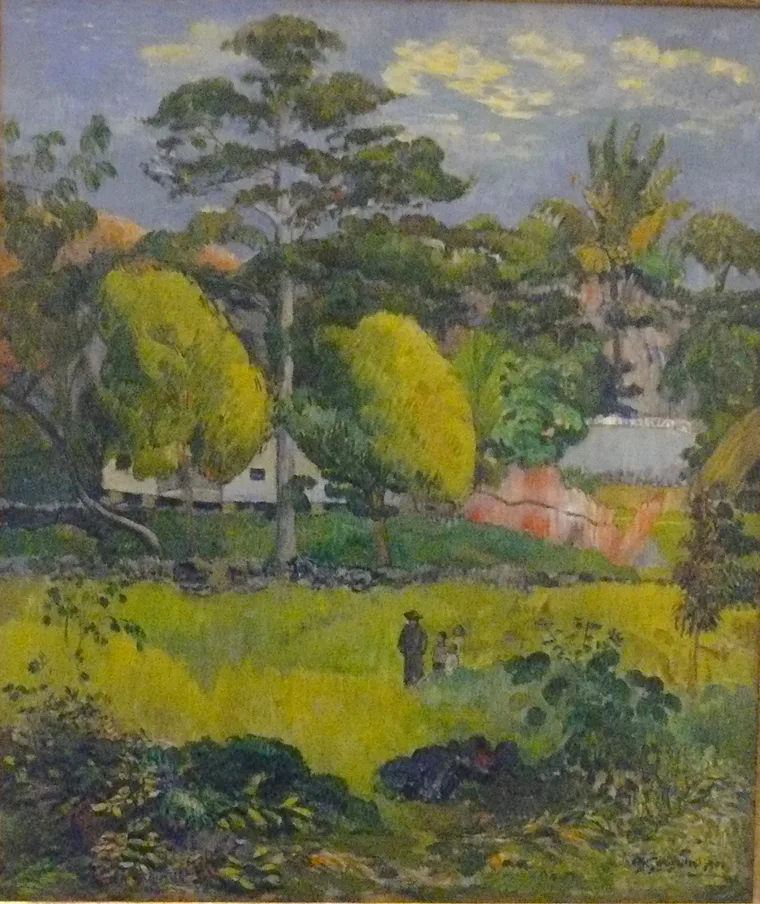
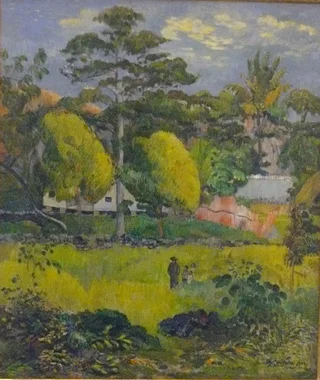
The museum lists this landscape under Gauguin with the qualification “attributed to”, while the lower right corner bears a signature and date, “P. Gauguin 1901”. The picture used to be called The Priest and the Children. Greenery takes up almost the whole canvas: a tall, slender tree with a flat, tiered crown, two round trees of an acid yellow, palms and banana leaves at the upper right, and the sky left as a narrow strip along the top edge. In the middle of a yellow-green meadow a few strokes mark a small dark figure in a long black robe, with others, smaller still, beside it. The museum sees in them a missionary followed by three children, and writes that the tiny figures seem lost in the vegetation.
With the qualification “probably”, the museum places the landscape on the island of Hiva Oa in the Marquesas, in the first months after Gauguin moved there from Tahiti in September 1901. It is the only Gauguin in the collection, and it was Domenica who bought it, although the museum does not say when or from whom. Among its earlier owners were the Viennese collector H. Böhler, the Amsterdam gallery Huinck & Scherjon and the Hollywood director Josef von Sternberg, who made The Blue Angel.
15. Argenteuil — Claude Monet
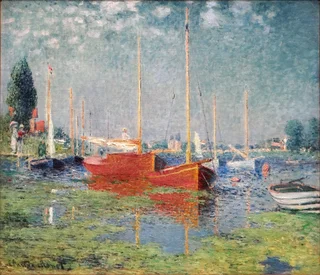
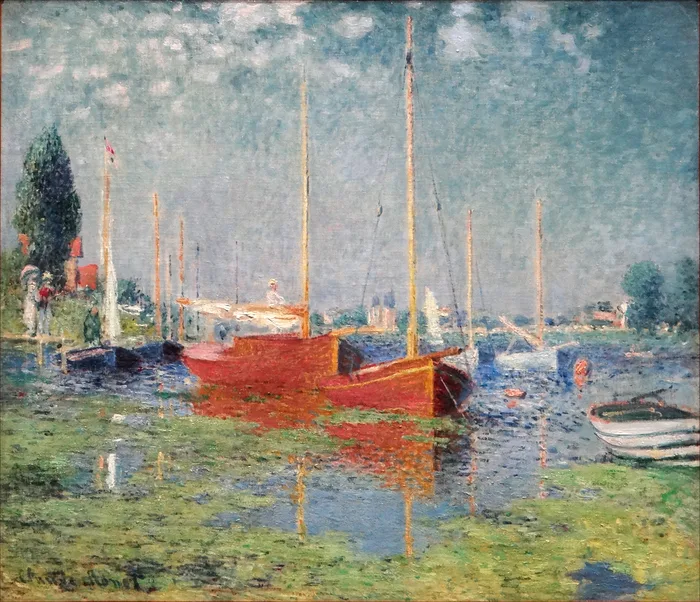
The American painter Romaine Brooks kept this picture at her home in Nice from about 1921, and around 1955 Domenica bought it. It is the only Monet in the Jean Walter and Paul Guillaume collection.
Monet settled in Argenteuil, a small town on the Seine near Paris, in December 1871, and in 1875 he painted its mooring for sailing boats. In the centre two boats with vermilion hulls lie at anchor, and their red reflection runs down through the water in broken strokes. A row of thin pale-yellow masts stretches across the whole picture, and the tallest almost touch the top edge. The museum notes that the lines of perspective fan out from the boats to the right and to the left. The water in the foreground is covered with yellow-green and olive strokes, in which the museum sees vegetation floating on the Seine, and the bottom strip of the picture is almost entirely green.
In 1959 Domenica sold the collection to the State. When an extra floor was built on the Orangerie to house it, the Water Lilies lost their light from above. The added floor was taken down only in the renovation of 2000–2006.
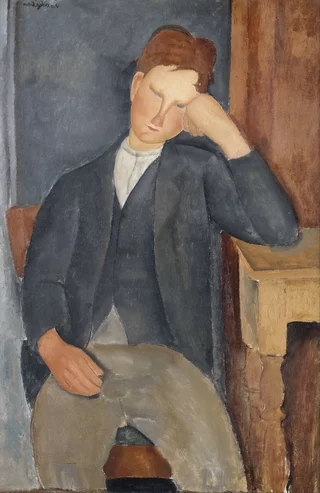
What Else to See
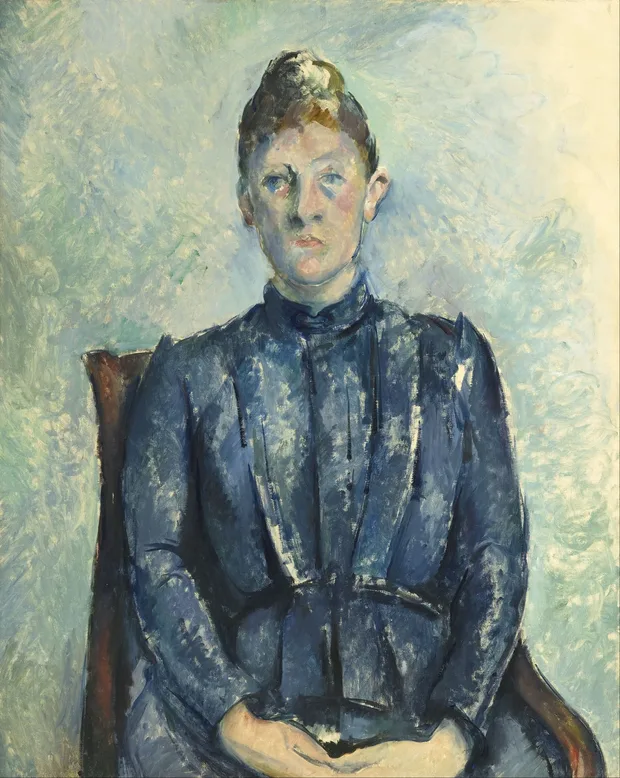
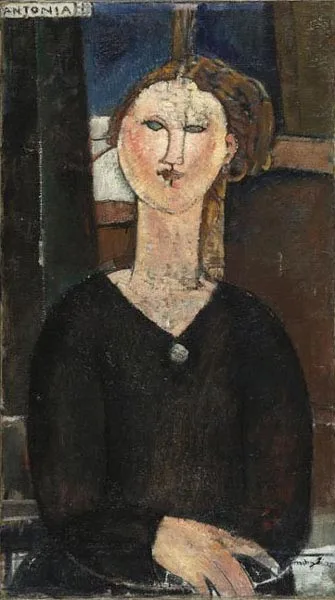
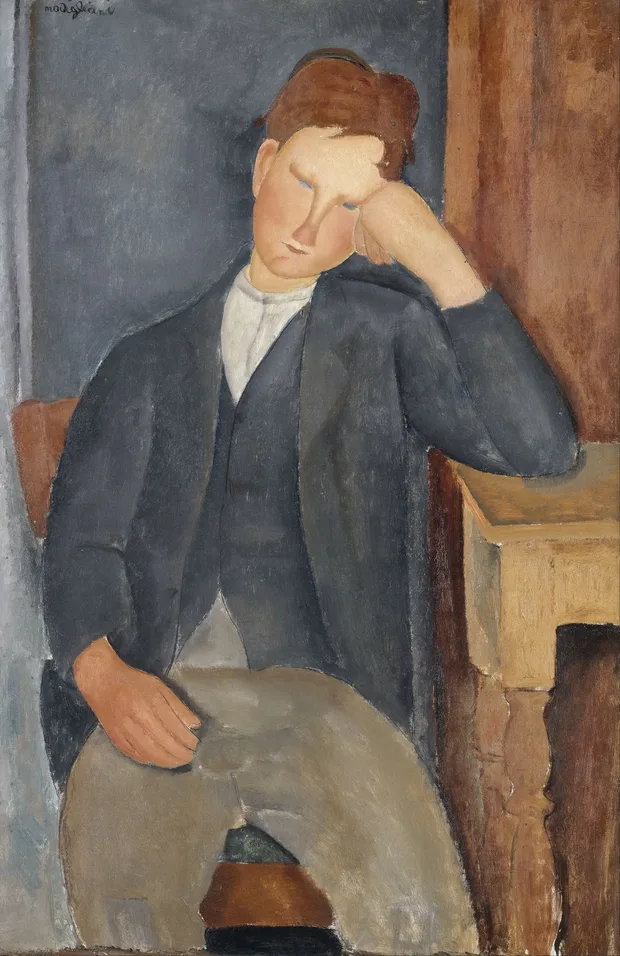
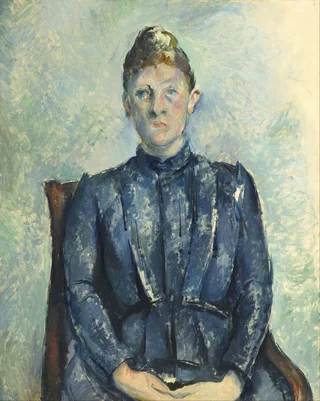
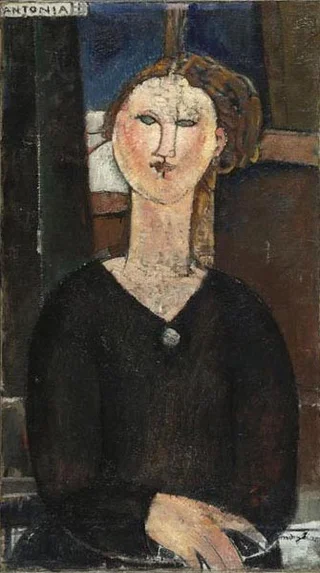
The collection holds 22 paintings by Chaïm Soutine and 15 by Cézanne, among them the Portrait of Madame Cézanne, and of the Modiglianis, Antonia and The Young Apprentice are worth seeing as well as Novo Pilota. Guillaume himself appears in one more portrait, by Kees van Dongen. Picasso's Large Bather was painted in 1921–1922, the same years as the Large Nude with Drapery.