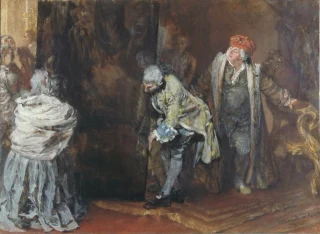
On 17 March 2022 a small painting from the circle of the Flemish artist David Teniers, Old Man Caressing a Kitchen Maid, came back to Dresden. The gallery had lost it after 1945, and it turned up in Naples, where it was seized and handed back. In the catalogue of losses it published in 1963 the gallery listed 507 missing paintings, and by the count of its curator Uta Neidhardt about 63 have since come back to the Old Masters Picture Gallery.
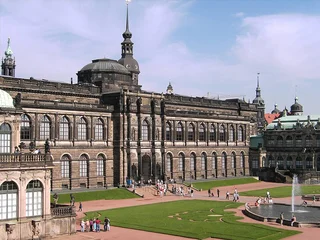
Most of the collection was bought under Augustus III, Elector of Saxony and King of Poland, who reigned from 1733 to 1763 and who, together with his minister Heinrich von Brühl, turned the picture gallery of his father, Augustus the Strong, into one of the great galleries of Europe in about 15 years. His agents bought whole collections and single paintings for him in Bohemia, Paris, Venice, Modena and Piacenza. From 1747 the purchases were hung in the converted former stables, today's Johanneum, and then came the Seven Years' War: Prussia occupied Saxony, bombarded Dresden in 1760, and the buying stopped. In 1855 the pictures were given a gallery wing on the Zwinger, built to designs by Gottfried Semper.
The court buys pictures (1741–1749)
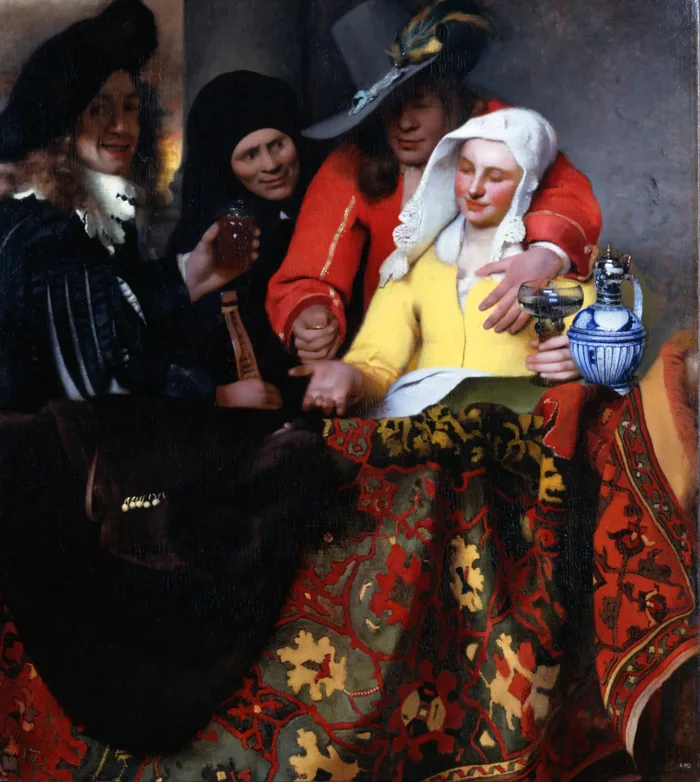
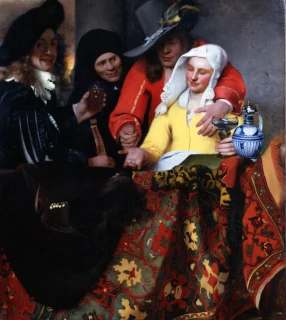
1. The Procuress — Johannes Vermeer, 1656
In 1656 Vermeer, then 24, painted his first known genre scene. Until then he had worked on large biblical and mythological compositions, and here he kept their big figures and combined them with the kind of tavern scene familiar from the Utrecht followers of Caravaggio.
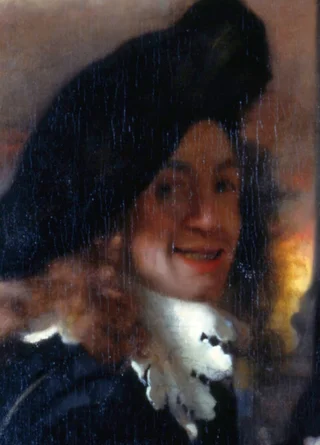
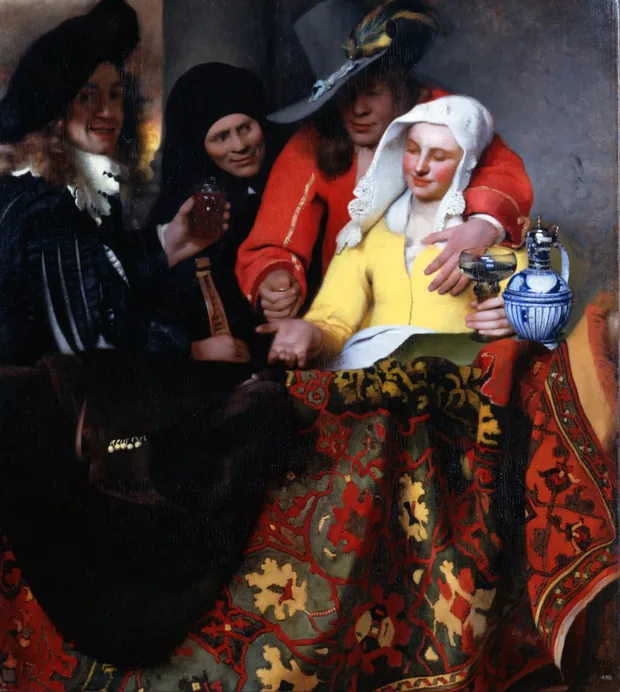
The canvas is almost square and divided in two. The lower half is taken up by a huge patterned carpet thrown over a balustrade, and above it four people stand crowded together. On the left a young man in a black beret and a white lace collar grins straight at the viewer, raises a glass of amber drink and holds a small cittern by its neck. Next to him an old woman in a black hood smiles as she watches the girl and the money, and her face is lit. A soldier in a scarlet coat and a broad grey hat with a plume has put his arm round the girl's shoulders and laid his hand on her breast, while his own face stays in the shadow of the brim. The girl, in a bright lemon-yellow jacket, has lowered her eyes. In one hand she holds a glass of white wine and the other she has opened palm upward, and a little left of and above the centre of the picture the soldier pinches a gold coin between his fingers right over that palm. At the right edge a blue-and-white jug with a pewter lid stands on the carpet.
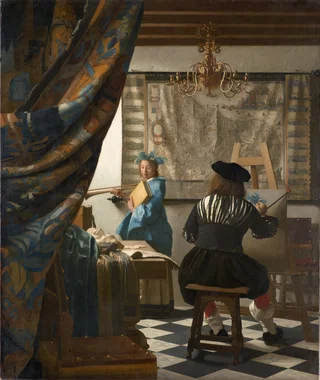
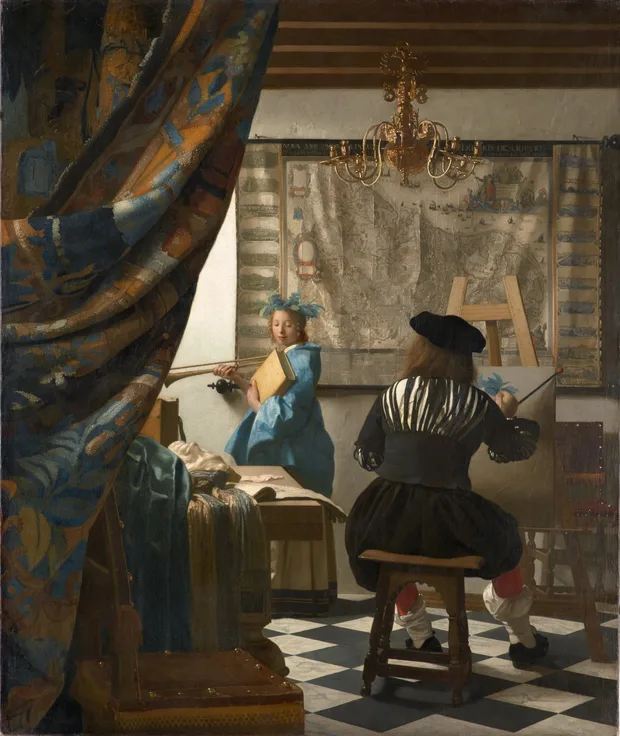
The art historian Arthur Wheelock considers the young man on the left “probably” a self-portrait of Vermeer. The reading rests on the beret and the slashed doublet, which resemble the costume of the painter in The Art of Painting, a figure Vermeer showed from behind.
The picture came to Dresden with the collection of the Counts of Waldstein from the castle of Dux in Bohemia. The painter Johann Gottfried Riedel had restored those pictures for the count in 1735–1737 and then arranged their sale to the Saxon court, and in May 1741, under his supervision, 268 paintings bought for Augustus III for 22,000 gulden were taken out of Dux. As his reward Riedel was made inspector of the gallery in 1742.
In the lower right corner are a signature and the date 1656, and this is one of three paintings on which Vermeer put both his name and the year. The signature “Meer” had been seen in Dresden from the start, but for a hundred years nobody knew which Meer it was. In 1859 the French critic Théophile Thoré-Bürger climbed a ladder to the picture, which hung high on the wall, read the date and connected it with Delft, and in 1862 the gallery catalogue entered the painting under Jan van der Meer of Delft.
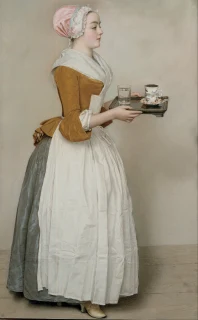
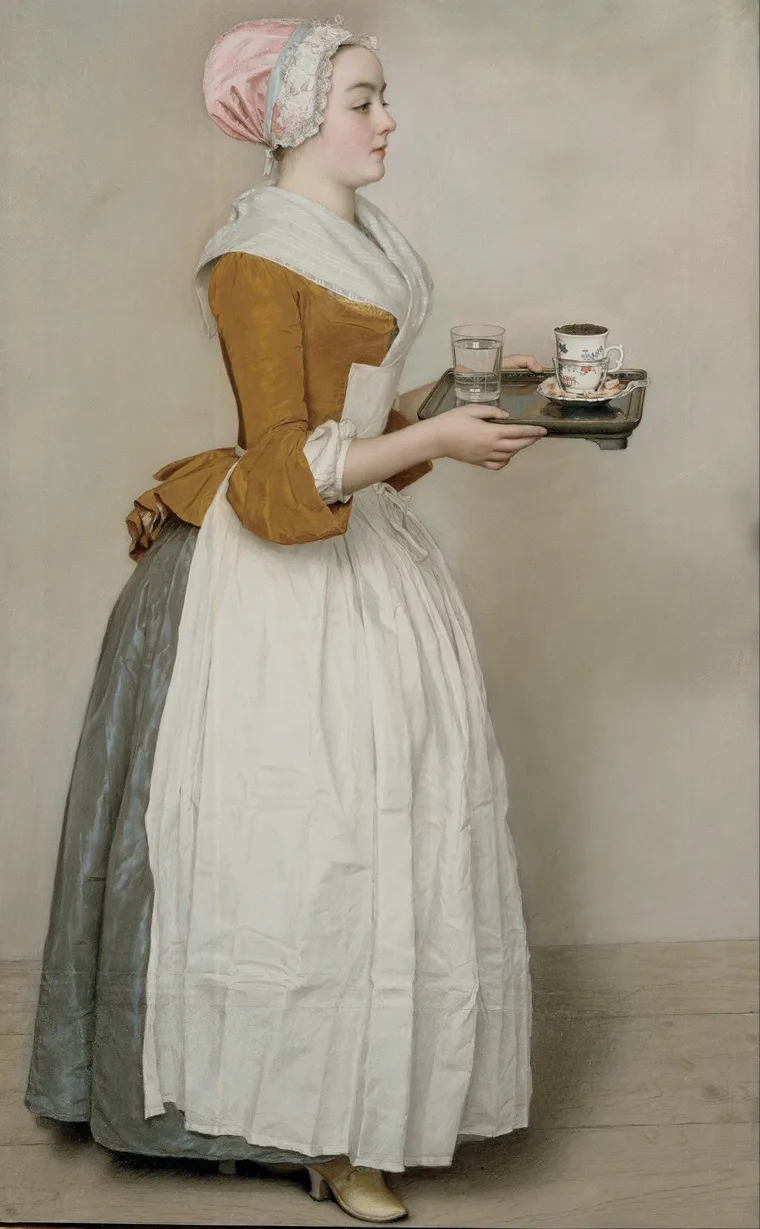
2. The Chocolate Girl — Jean-Étienne Liotard, c. 1744–1745
Count Francesco Algarotti, who bought pictures in Venice for Augustus III, paid Liotard 120 zecchini for a pastel of a maidservant carrying chocolate on a tray, and the artist's receipt is dated 3 February 1745 (the same Algarotti had bought the Madonna of Burgomaster Meyer for Dresden in 1743, more on it below). Before this the Genevan Liotard had spent four years in Constantinople, where he went about in Turkish dress and a long beard, and from 1743 he worked in Vienna at the court of Maria Theresa. He most likely made this pastel there and brought it to Venice to sell. The museum takes the servant to be an unnamed housemaid.
In 1746 Algarotti reported to the minister Brühl that the Venetian pastellist Rosalba Carriera had called The Chocolate Girl the most beautiful pastel she had ever seen.
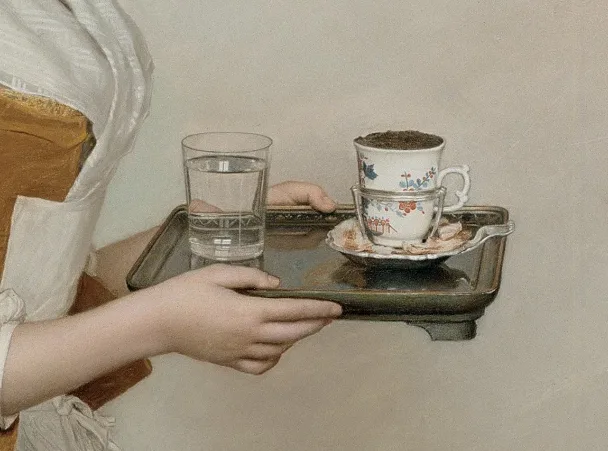
The girl is shown full length in strict profile, walking from left to right over a pale plank floor along a bare grey-beige wall, and she looks down ahead of her. She wears a pink silk bonnet with a lace frill and a blue ribbon, a white fichu, a golden-ochre bodice with a silky sheen, a long white apron and a silver-grey skirt, and a pale yellow high-heeled shoe shows beneath the hem. On a small dark tray with a gilt rim stand a tall glass of water and a white porcelain cup painted with flowers and full of frothy chocolate, set in a silver openwork holder on a saucer with biscuits. The glass reflects the bright rectangles of window panes, and her thumb, steadying the tray from behind, shows through the water. Two thin lines cross the sheet a little below the knees, where the two pieces of the parchment support are joined.
In 1751, six years after the purchase, Algarotti described the pastel in a letter to the Paris connoisseur Pierre-Jean Mariette. He wrote that it was painted almost without shadows, that its light came from two windows reflected in the glass, and that for the care of its finish it was “a Holbein in pastel”. Yet a faint grey shadow of the figure falls on the wall to the right of the skirt, below the tray, and on the floor around her feet.
In 1883 the American chocolate firm Walter Baker & Co. of Massachusetts made The Chocolate Girl its trademark under the name “La Belle Chocolatière”.
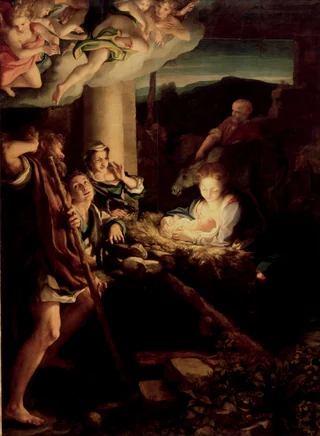
3. The Holy Night — Correggio, c. 1528–1530
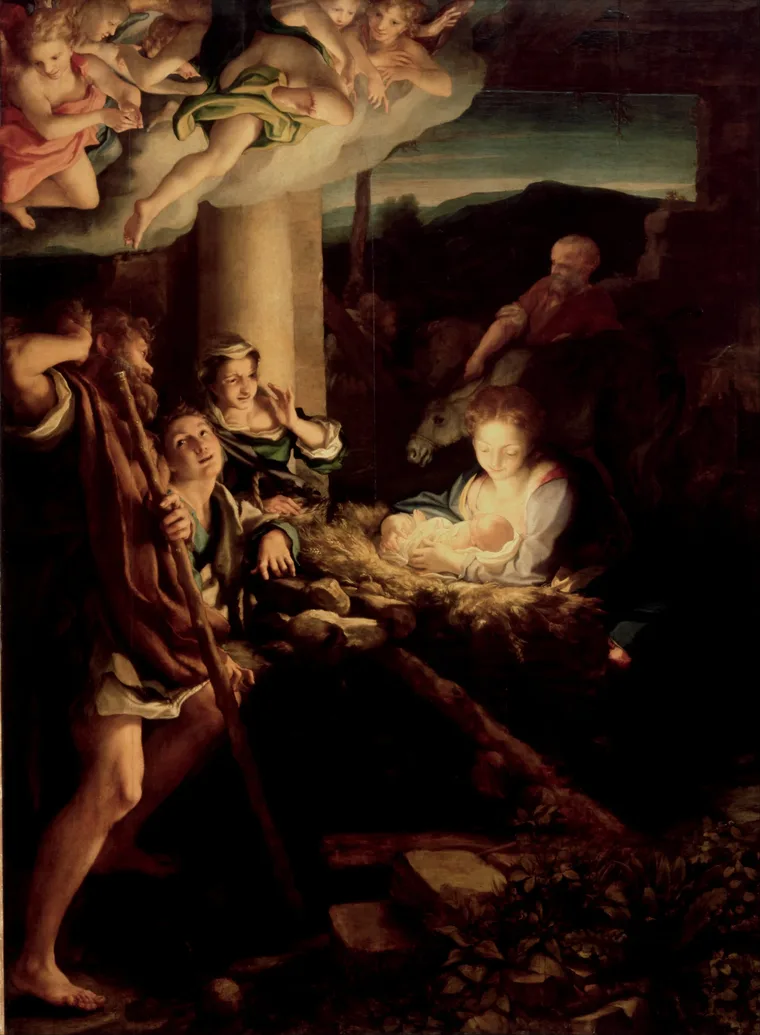
On 14 October 1522 in Reggio Emilia, Alberto Pratonero wrote out a note in his own hand promising to pay Antonio Allegri of Correggio 208 lire in old Reggio money for a panel of the Nativity of Christ with all the figures that belong to it, to the measurements of a drawing the painter had brought him himself. Correggio received a deposit of 40 lire the same day. The panel was meant for the Pratonero family chapel in the church of San Prospero, and in the museum's view Correggio painted it mostly towards the end of the 1520s, in the same years in which he was painting the domes in Parma.
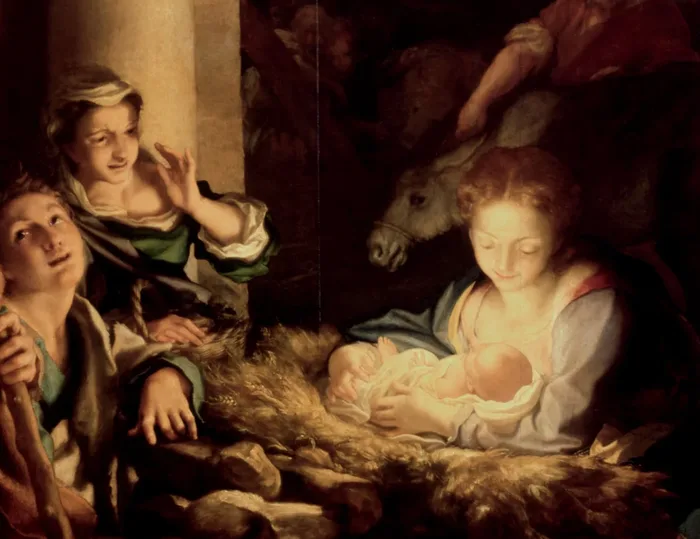
The lower half of the panel is almost black, and the light comes from the Child, who lies in the manger on straw and ears of wheat. Mary holds him in her arms, bending so low that her face is lit from below and is brighter than any other face in the picture. On the left a huge barefoot shepherd with a staff has stepped forward into the dark, a boy beside him has turned to look at him, and behind them, by a column, a woman in a white headscarf screws up her eyes and shields them from the glare with a raised hand. At the upper left angels tumble down on a cloud, on the right Joseph in red rests his hand on the back of a donkey, and only at the right edge, above dark hills, does a cold blue-green strip of dawn grow light. The museum calls the Night the first large-scale night scene in Italian painting.
In 1640 Francesco I d'Este, Duke of Modena and Reggio, had the altarpiece taken down and carried off to Modena. The church register, as it is retold, records that the picture was taken away to the great sorrow of all the people, and the same year a copy by Jean Boulanger appeared in the chapel.
More than a century later his descendant Francesco III d'Este, deep in debt, sold Augustus III 100 paintings from his gallery for 100,000 zecchini. The War of the Austrian Succession was going on, Modena was occupied by troops, and the deal was handled by Bonaventura (Ventura) Rossi, a Saxon court painter and restorer who worked in Venice. The contract was signed in the summer of 1745. Brühl's letters suggest that at one point the minister admitted to his secretary Heinecken that he had forgotten the last agreement with Rossi, and asked him to send it together with the list of the pictures they had taken. In July 1746 the paintings left Italy and by the end of the summer they were in Dresden, where the gallery inspector wrote that this was the very picture which “all over Europe” was called “the famous Night”. It remained the most celebrated painting in Dresden until the early 19th century, when the Sistine Madonna overtook it.
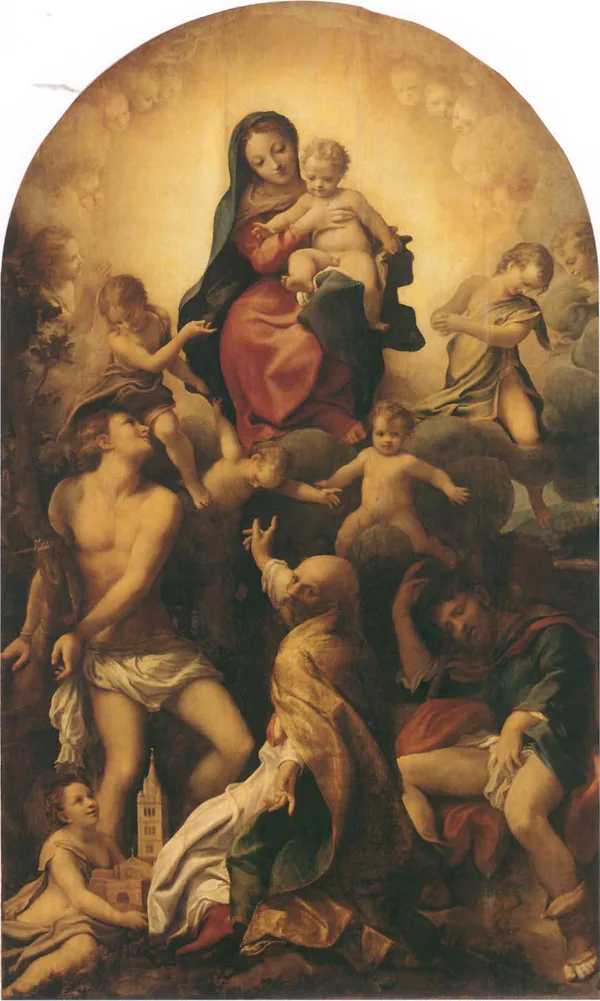
Under the contract a copy of the Night painted by Giuseppe Nogari stayed in Modena.
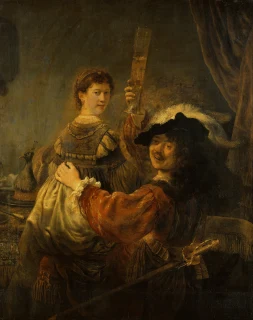
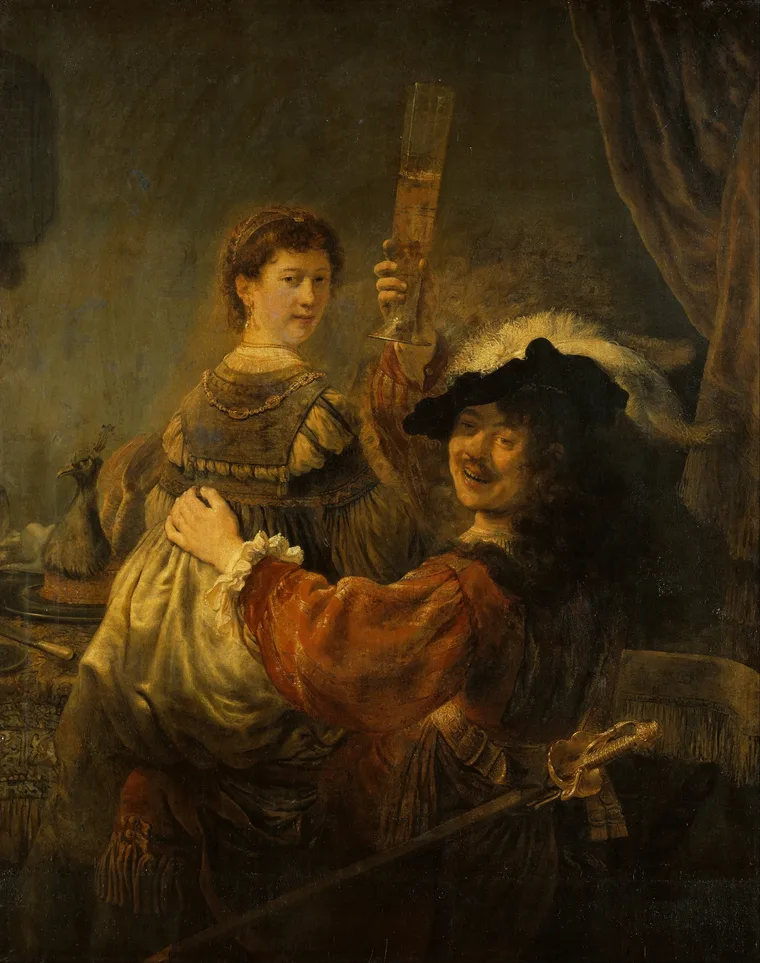
4. Rembrandt and Saskia in the parable of the Prodigal Son — Rembrandt, c. 1635
A man in a black velvet beret with a full white ostrich plume sits half turned away from us, has twisted round and is roaring with laughter, looking straight at the viewer. With one hand he raises a very tall, narrow glass on a flared foot above the woman's shoulder, with the other he holds her round the waist, and at his side hangs a sword with a gilded, curling hilt. The woman sits on his knee with her back to us and looks round over her shoulder with a slight smile. On the left, on a table covered with a patterned carpet, stands a peacock pie, with the bird's head and neck on the golden crust and its tail feathers rising behind the woman's back. In the upper left corner a dark board hangs on the wall, cut off by the edge of the canvas, and above the peacock's crest a faint signature, “Rembra… f.”, can be made out.
For a long time the picture was called Self-Portrait with Saskia on His Knee. Rembrandt married Saskia van Uylenburgh in 1634, and the museum, which gave the picture its present title, sees in the couple the prodigal son of the parable squandering his inheritance in a tavern, and a prostitute.
In 1749 Théodore Le Leu, the Saxon court's agent in Paris, bought the picture for Augustus III from the Paris dealer Noël Araignon. By then the canvas had already been altered, and X-rays show that it began as a wider tavern scene with one more figure, a musician. The musician was painted out in the depth of the room, where the peacock feathers now rise, the left side of the canvas was cut down and a strip was added at the bottom. All of this was done before the picture reached Dresden.
Scholars disagree about whether Rembrandt himself made these changes. The Rembrandt Research Project accepts the original composition as authentic, painted around 1635, and of the substantial changes made later, probably at the time the left side was cut down, it writes that “the autograph nature” of them “is much less certain”.
The court painter paints the city (1748–1765)
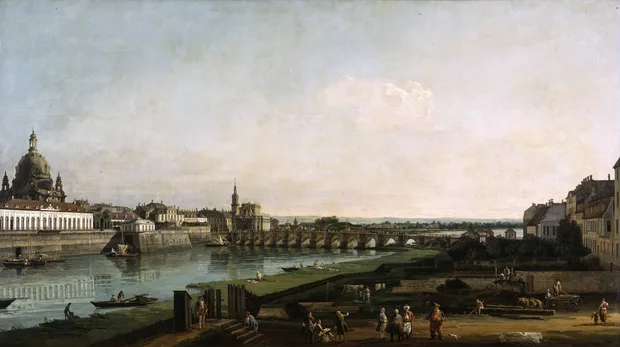
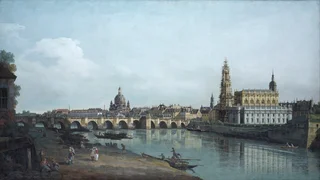
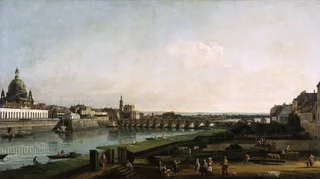
5. Dresden From the Right Bank of the Elbe Below the Augustus Bridge — Bernardo Bellotto, 1748
Bernardo Bellotto was born in Venice to Fiorenza Canal, sister of the painter Antonio Canal, known as Canaletto, and from about 1735 he learned to paint city views from his uncle. In July 1747 he was invited to Dresden by the Elector Friedrich August II, who was also Augustus III, King of Poland, and in 1748 Bellotto became court painter. In Saxony and Poland he was called Canaletto after his uncle, and he himself signed with his own name followed by the nickname. On this picture he wrote “Bernardo Bellotto detto Canaleto”, “Bernardo Bellotto, called Canaleto”, at the bottom centre on the dark bank.
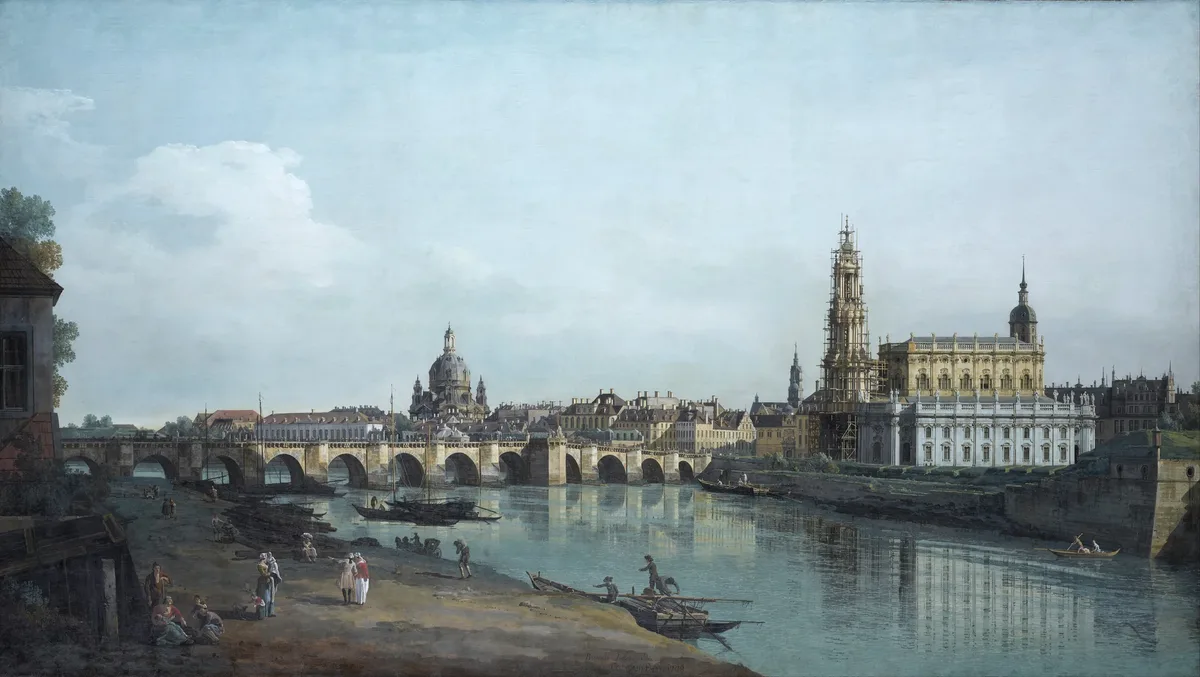
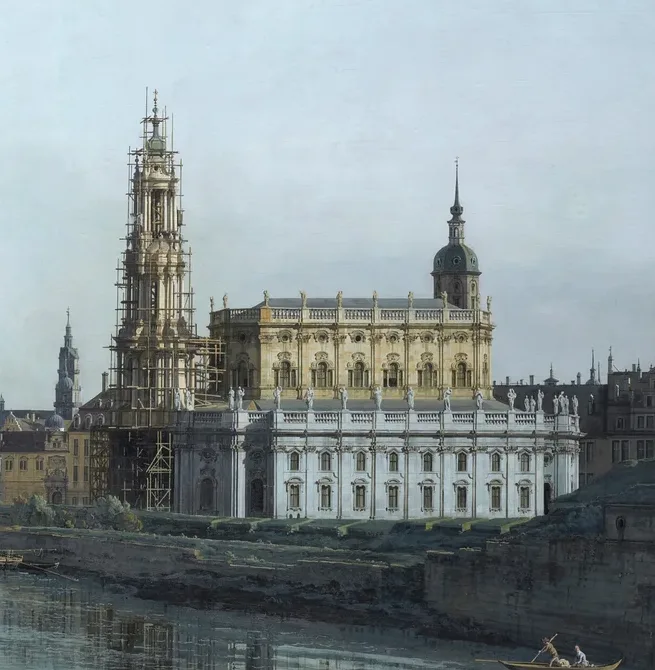
Bellotto painted this picture a year after he arrived, from the right bank, downstream of the bridge, looking across the Elbe at the old town. On the left the long stone Augustus Bridge crosses the river on its many arches, with a crucifix on its central pier, and barges with tall masts are moored by the bank in front of it. Above the rooftops in the middle rises the dome of the Frauenkirche with its lantern and four corner turrets. The church was consecrated in 1734, and the lantern was finished in 1743. On the right the Catholic court church is reflected in the river, pale bluish-white below and warm yellow above, with statues on its balustrades, and its unfinished tower is enclosed in wooden scaffolding with platforms and ladders. At the lower left, by a plank shelter, stands a poor family, a woman with a baby, a man with a stick and children, and further right an elegant couple, the man in a pale coat pointing out the river to his companion.
Because of this painting, the spot from which the city is seen this way came to be called the “Canaletto view” in Dresden.
Of what stands on this skyline, the Frauenkirche, the castle and the court church were left in ruins in February 1945, in the bombing of Dresden. The Augustus Bridge was damaged in May, when SS units blew up two of its spans.
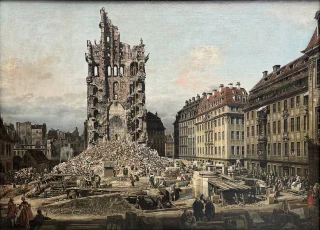
6. The Ruins of the old Kreuzkirche, Dresden — Bernardo Bellotto, 1765
Frederick II's artillery hit the Kreuzkirche, the Church of the Holy Cross on the Old Market, on 19 July 1760, the worst day of the Prussian siege of Dresden during the Seven Years' War. The nave and choir burned and fell in, while the stone west tower stayed standing. In the same bombardment Bellotto's house in the Pirna suburb burned down, together with paintings and the copper plates for his etchings (more about the painter himself in the entry on Dresden From the Right Bank of the Elbe).
In 1763 Augustus III and Brühl both died. Bellotto lost his salary as court painter, and at the new Academy of Fine Arts he was given only the post of teacher of perspective.
In 1764 work began on a new Kreuzkirche, and on 22 June 1765, after heavy rain had undermined the foundations, part of the old tower collapsed. Bellotto wrote that date into the inscription on his own etching of the same view, where he calls himself a member of the Electoral Academy of Fine Arts. In the painting he showed what came after the collapse. The remains of the tower are being taken down by hand, and in the foreground the new church is already going up.
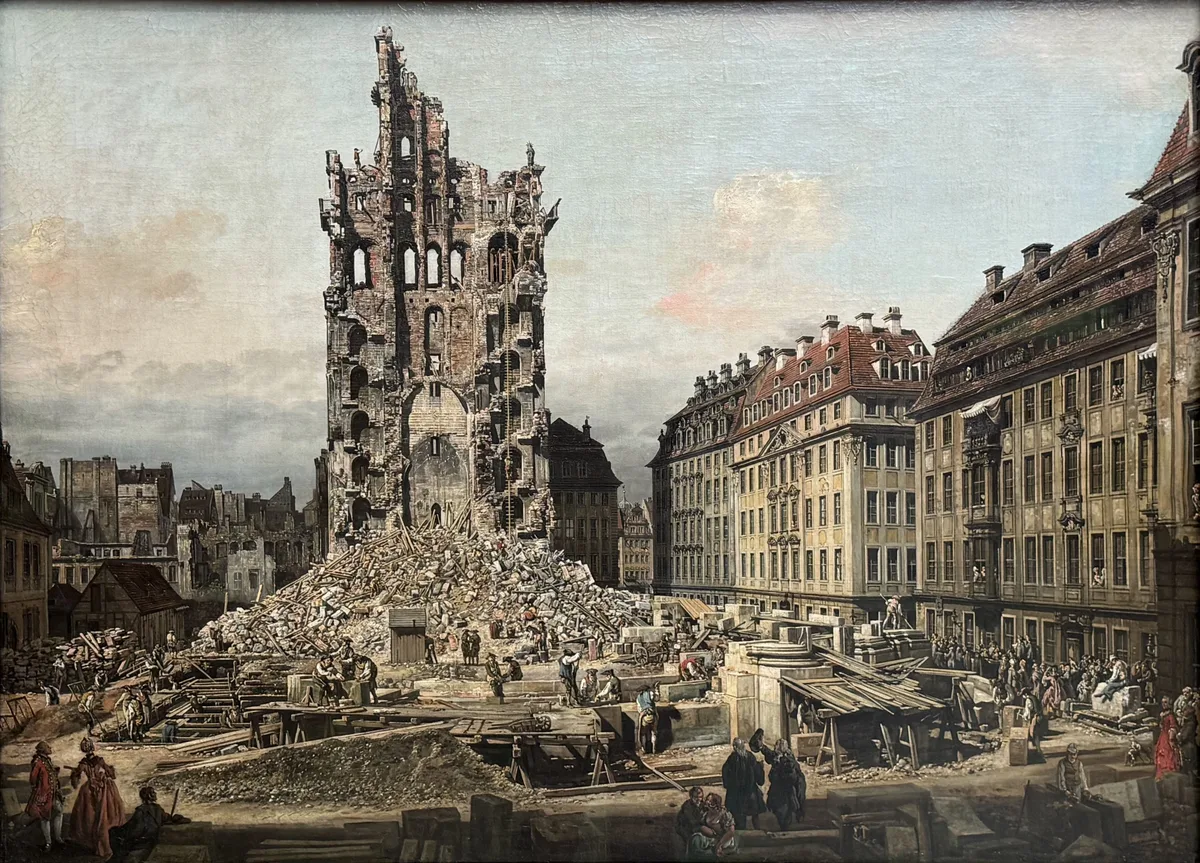
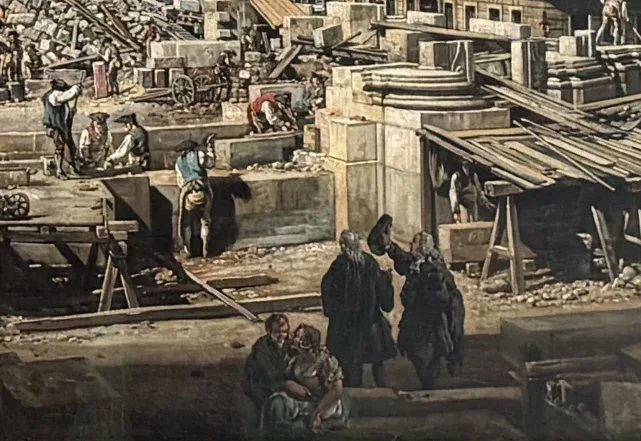
Left of centre stands the burnt-out shell of the tower in reddish-brown and grey stone, with rows of arched windows and a broken, jagged top, and one side of it is open, so that the inner walls show. A long ladder runs up the right side almost to the top, and a tiny figure stands on the upper ledge. At the foot lies a slope of rubble mixed with broken beams. Behind on the left is a burnt-out quarter of roofless walls and empty windows, and on the right a whole row of tall, pale houses with red roofs stretches out in the sun, with a crowd gathered by their walls to watch the work. Across the middle runs the building site, with walkways on trestles, stacks of dressed stone, a round stone drum under a plank lean-to and workmen in shirtsleeves. In 2022 the journal Bauwelt called this one of two paintings by Bellotto that show the aftermath of war.
At the bottom centre, on the lowest of the stones made ready for the new church, a couple sits pressed close together.
The names change (1837–1972)
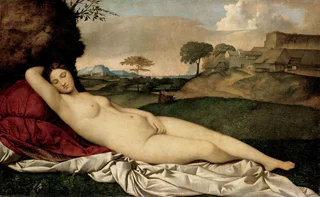
7. Sleeping Venus — Giorgione and Titian, c. 1508–1510
The Venetian Marcantonio Michiel, who kept notes on the private collections of Venice, recorded in 1525 in the house of Girolamo Marcello that the canvas of a naked Venus asleep in a landscape with Cupid was by the hand of Zorzo of Castelfranco, that is Giorgione, while the landscape and the Cupid had been finished by Titian. The museum believes that Marcello most likely commissioned the picture for his wedding in 1507. Giorgione died of plague in the autumn of 1510.
The woman lies across the whole lower half of the canvas, her head at the left edge and her foot almost at the right. Her eyes are closed, her face is turned towards us and rests in the crook of her raised right arm, folded behind her head, and her left hand lies over her lap. Under her head is a heap of deep crimson cloth, and under her body a crumpled sheet, white as satin, which hangs over the grass along the whole lower edge. Beyond her are a valley with scattered trees, blue mountains, farm buildings with steep roofs and a ruined wall with arches. On the right, past her foot, the sheet gives way to an even dark green meadow, and that is where Cupid sat.
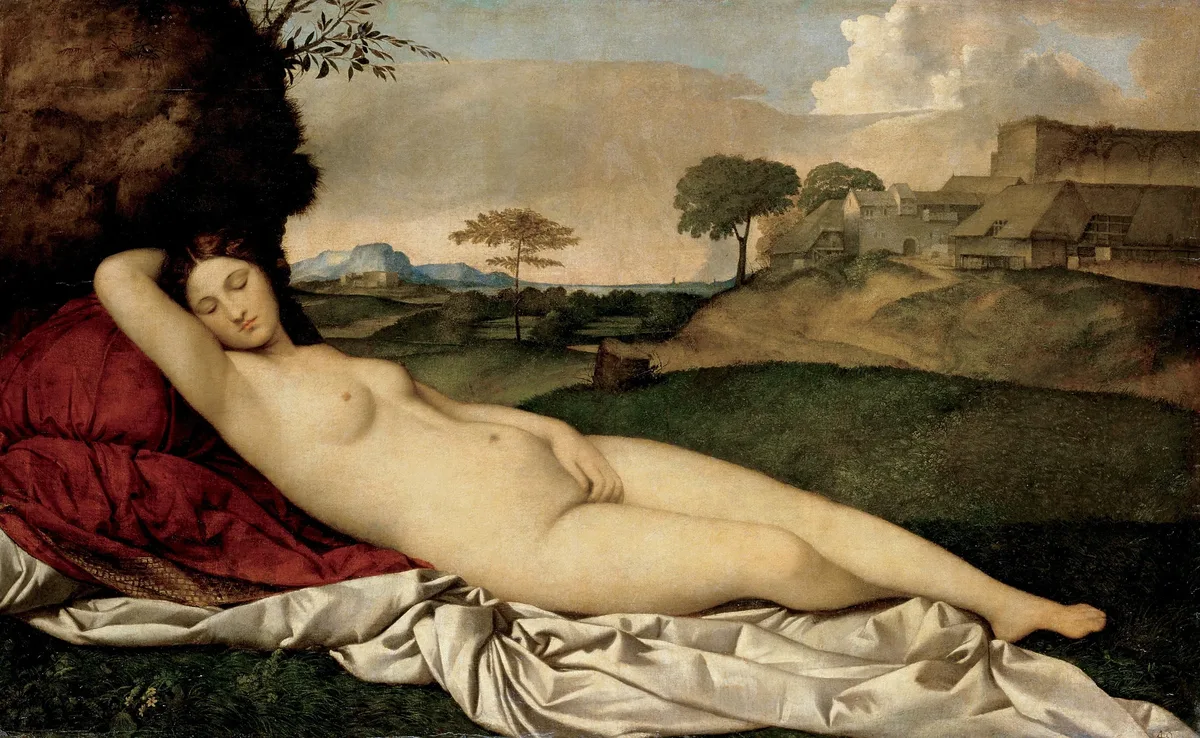
The picture came to Dresden under Augustus the Strong. On 26 January 1699 the Amsterdam dealer Charles Le Roy signed a receipt for 15 paintings, and one of them was entered there as a Venus “with a little Cupid” by Giorgione. In the court inventory of 1722–1728 it was put down as a Titian. In 1837 the Cupid was painted over with the green of the meadow because, the museum says, he was too badly preserved. By the middle of the 19th century the gallery's catalogues called the picture a copy by Sassoferrato, and in 1880 the Italian connoisseur Giovanni Morelli recognised it as the canvas Michiel had described and gave it back to Giorgione, after whom Titian had finished it.
In X-rays, fragments of the Cupid show under the grass.
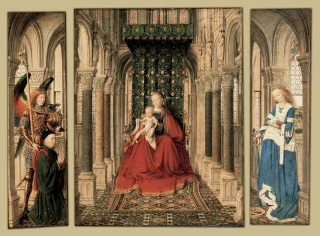
8. Dresden Triptych — Jan van Eyck, 1437
Closed, the triptych fits in two hands. On the outside of the wings the Archangel Gabriel and Mary are painted in grey, like stone statues in shallow niches, and the dove above Mary casts a shadow on the wall of the niche. Opened, the triptych becomes a church seen down the length of the nave, with columns of dark green and pinkish-brown marble, small statues on brackets and three lancet windows of coloured glass at the top. In the middle of the nave Mary sits on a throne under a dark green canopy, her red mantle spreading over the steps to the very bottom of the panel, and the Child on her lap holds a scroll with words from the Gospel of Matthew, “learn of me, for I am meek and lowly in heart”. On the left wing the Archangel Michael in gilded armour lays his hand on the shoulder of the kneeling donor. On the right wing Saint Catherine in a tall crown reads a book, with a sword at her side and a wheel in the corner, and through a window behind her a tiny town with towers and distant hills can be seen. Some scholars connect the coat of arms on the frame with the Giustiniani family of Genoa, while the museum calls the donor unknown.
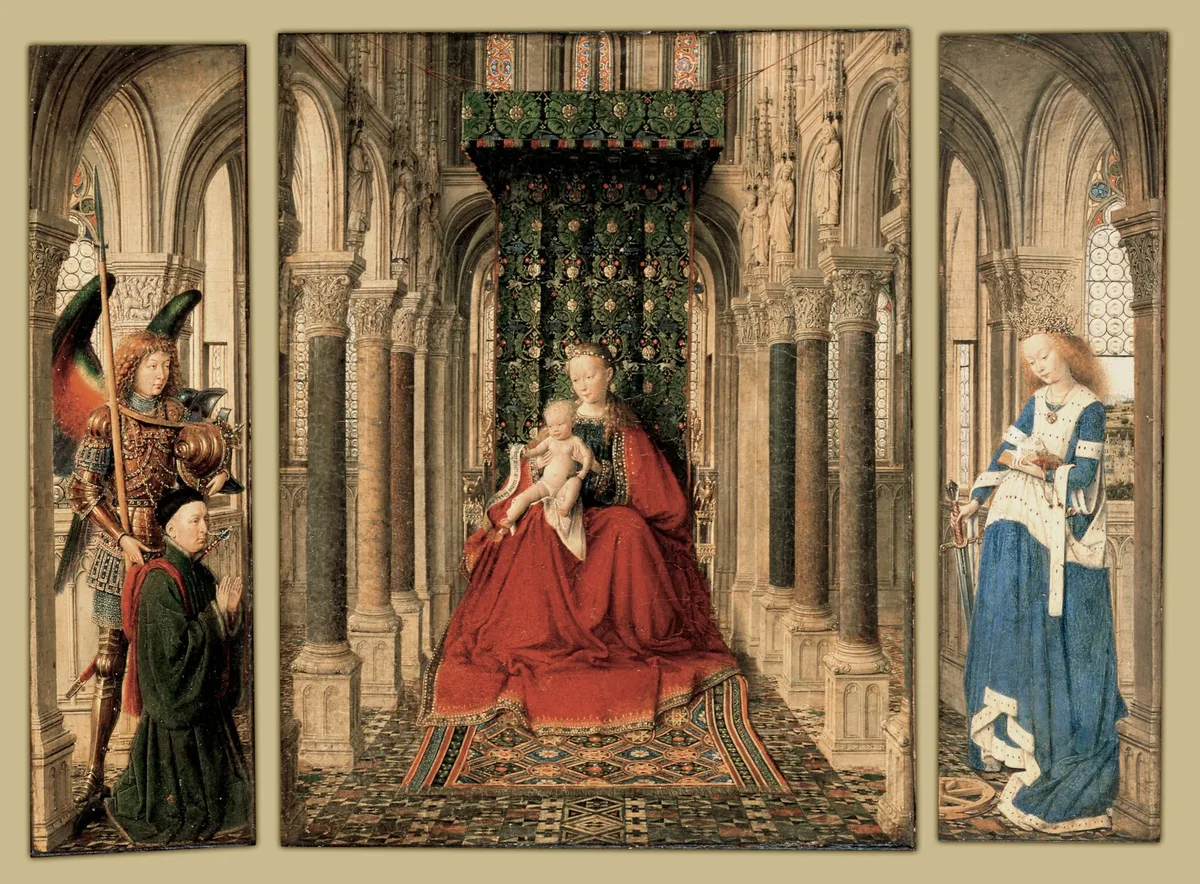
The wings keep their original frames, and Latin inscriptions run along them. On the inner moulding of the central frame, just in front of the tiled floor, are the signature “Johannes de eyck me fecit et complevit”, that is, “Johannes de Eyck made and completed me”, the year 1437 and van Eyck's motto ALC IXH XAN, “as I can”. For several centuries this line was hidden under a solid coat of brown paint, and all that time the name of the painter kept changing. In the Cologne collection of the banker Eberhard Jabach the triptych was described as the work of Hubert van Eyck, Jan's brother, the Dresden inventory of 1754 lists it under Albrecht Dürer, and in 1830 the Berlin scholar Aloys Hirt gave it to Jan van Eyck. Even after that the Dresden catalogues named Hubert as the painter for some time, and they settled on Jan around 1846.
In 1959, soon after the pictures came back from Moscow, Dresden restorers removed the brown paint and uncovered the signature, the date and the motto. Before then some scholars had placed the triptych before 1430, and since 1959 it has been dated close to the end of the life of van Eyck, who died in 1441.
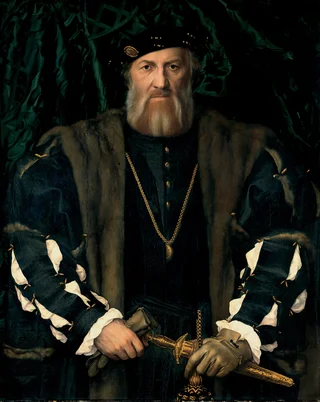
9. Portrait of Charles de Solier, Sieur de Morette — Hans Holbein the Younger, c. 1534–1535
Charles de Solier, Sieur de Morette, was the French ambassador to Henry VIII from April 1534 to July 1535, and that is when the portrait was painted. By then Holbein was already living in London, and he soon became court painter to Henry VIII.
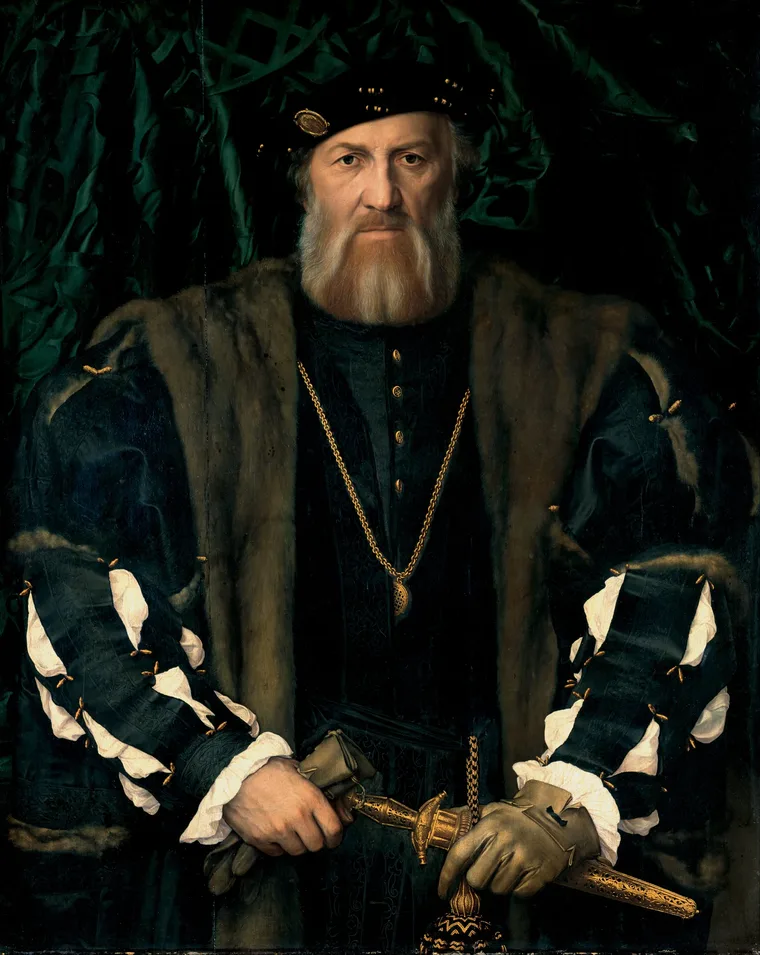
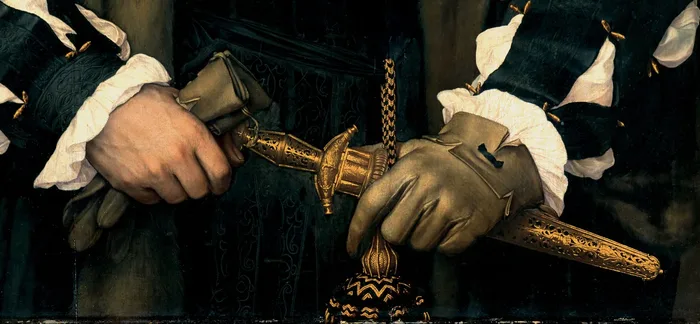
Morette is shown to the waist, filling the whole width of the panel, and faces the viewer with a heavy, level stare. Behind him dark green silk hangs from edge to edge in crumpled folds. Almost everything in the portrait is black: the flat cap pulled low over the brow, the wide gown with a brown fur collar, the doublet, the slashed sleeves with white linen pulled through. The light notes are few. They are the face with its forked beard, reddish in the middle and grey at the sides, the white cuffs, the fur and the scattered gold, pairs of aglets on the cap and on the sleeve slashes, an oval badge with a small relief figure on the cap, buttons with an interlaced monogram, a long chain with a round openwork pendant. At the bottom his bare right hand holds a folded glove and grips the hilt of a dagger, and his left hand, in a pale glove, holds the long gilt sheath.
In the mid-17th century the Marchese Massimiliano Montecuccoli, ambassador of the Este in Parma and Rome, gave the portrait to Francesco I, Duke of Modena. In 1657 the writer Francesco Scanelli, as the Dresden historian Hermann Lücke relates, still called it the work of “an excellent northern painter, a certain Olbeno”. Later, according to Lücke, Moretta turned into Moro, the sitter was taken for Ludovico Sforza, Duke of Milan, known as il Moro, and the painter was said to be Leonardo da Vinci, who had worked at his court. It was under Leonardo's name that the portrait came to Dresden in 1746, among the 100 Modena paintings (the purchase is told in the entry on the Holy Night).
In the first half of the 19th century the art historian Carl Friedrich von Rumohr gave the portrait back to Holbein. He relied on an etching of 1647 by Wenceslaus Hollar inscribed “Mr. Morett”, made after Holbein's preparatory drawing, which Dresden bought in 1860. The inscription was read as a name, and in the 19th century the painting became famous as a portrait of Hubert Morett, jeweller to Henry VIII. In 1881 the scholar Sophus Larpent identified the sitter as the French ambassador. Later a boxwood model for a medal by Christoph Weiditz turned up, carved with the words “Carolus de Solario dominus Morety”, “Charles de Solier, lord of Morette”.
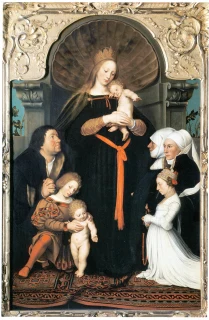
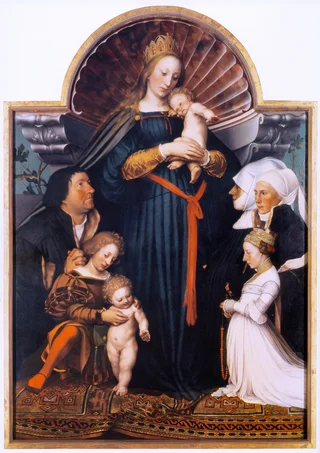
10. Madonna of Burgomaster Meyer (the Dresden “Holbein Madonna”) — Bartholomäus Sarburgh after Hans Holbein the Younger, c. 1635–1637
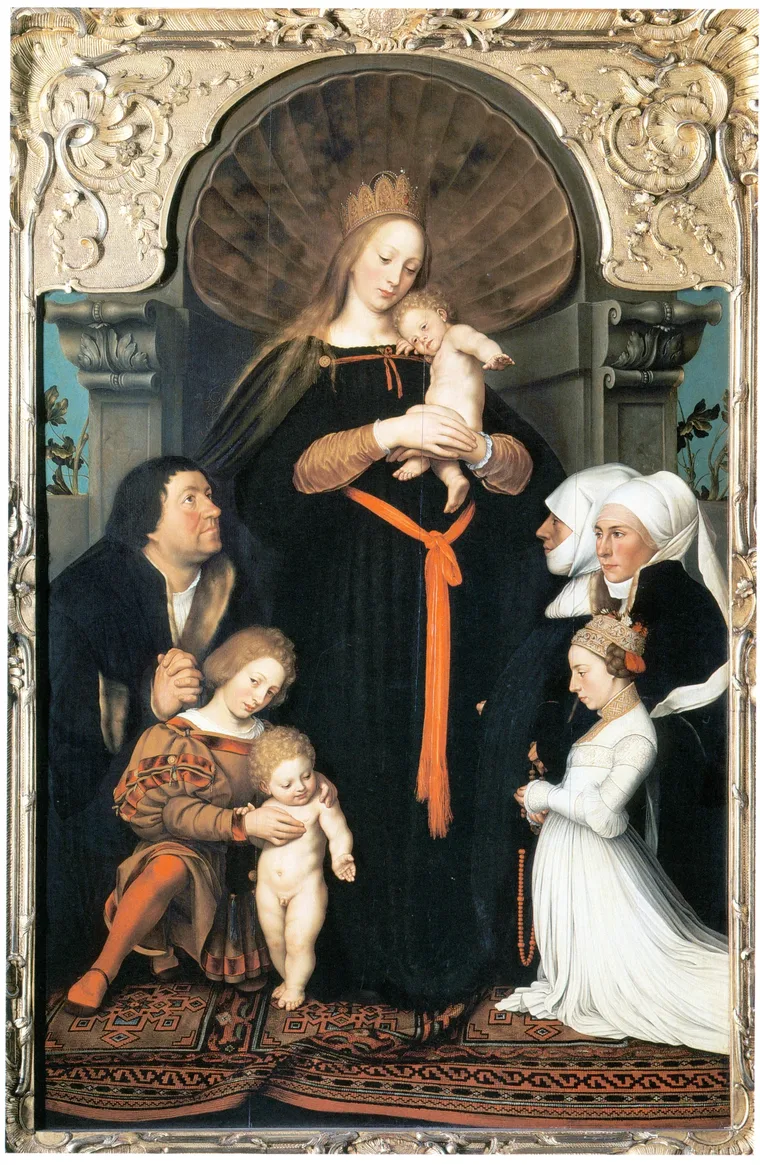
In 1633 Michel Le Blon, an engraver and picture dealer from Frankfurt who lived in Amsterdam, brought Holbein's Madonna, painted for the Basel burgomaster Jakob Meyer zum Hasen, from Basel to Amsterdam and ordered a copy of it from Bartholomäus Sarburgh, a portrait painter from Trier who was then working in The Hague. According to the museum, the dealer ordered the copy to pass it off as the original, and it was painted on a large oak panel like the original's.
Researchers have found no trace of the copy before 1743. On 4 September 1743 Count Algarotti, the man who would later buy The Chocolate Girl, bought it in Venice from Zuan Dolfin for 1,000 gold ducats as an original Holbein, and, as the museum's record has it, he checked the picture's authenticity and provenance against many sources. In Dresden it was revered as the German counterpart to Raphael's Sistine Madonna.
In 1822 a second version appeared. It was bought for Prince Wilhelm of Prussia and later passed by marriage to the Grand Dukes of Hesse-Darmstadt, and from then on people argued over which of the two was the original. In the summer of 1871, at the Holbein exhibition in Dresden, the two versions were hung side by side, a congress of specialists sat there on 1–3 September, and on 5 September a declaration signed by 14 art historians stated that only the Darmstadt picture was the original and the Dresden panel was a free copy. The artists thought otherwise. The gallery's director, the painter Julius Hübner, considered the Dresden picture a later, improved replica by Holbein himself and wrote a sonnet in its defence, the art historian Karl Woermann, who had signed the declaration, answered him with a sonnet of his own, and both poems were struck from the record of the congress. The scholar Gustav Theodor Fechner laid out questionnaires at the exhibition asking which of the two Madonnas was more beautiful, and of 11,842 visitors 113 replied. In 1910 the Swiss scholar Emil Major named the painter of the copy, Sarburgh, and dated it to 1635–1637. According to the museum, the dispute of 1871 is regarded as the birth of academic art history.
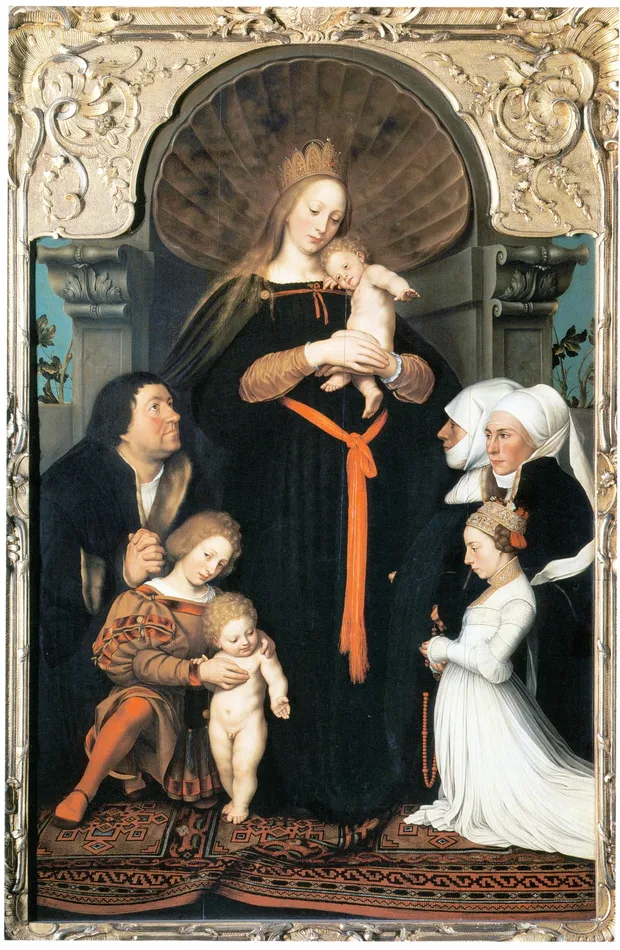
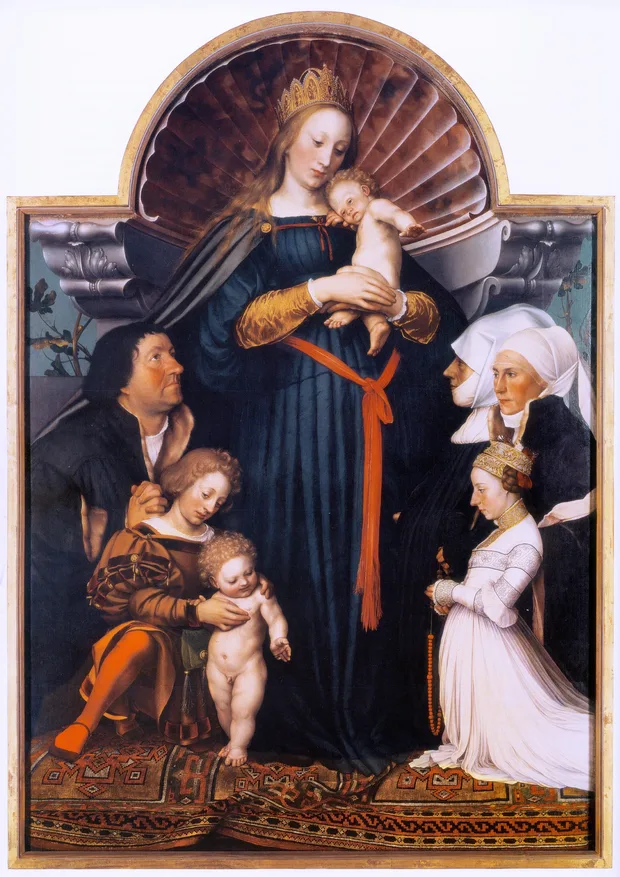
The crowned Virgin stands with the Child in her arms before a shell niche, with Burgomaster Meyer kneeling on the left and on the right his two wives in white headcloths and his daughter with a long coral rosary. The copy is easiest to recognise by the space above the crown. In Sarburgh's picture the shell sits inside a dark arch, there is plenty of free space around and above the figure, and the panel is taller than the original though just as wide, whereas in Holbein's the shell rests directly on the consoles and the whole group sits higher and closer together. The copy is also darker: Mary's gown is almost black, the sash salmon-orange, the carpet dark red, while in Holbein's picture the gown is blue-green and the carpet light, with yellow fields.
The Darmstadt original was bought in 2011 by the collector Reinhold Würth.
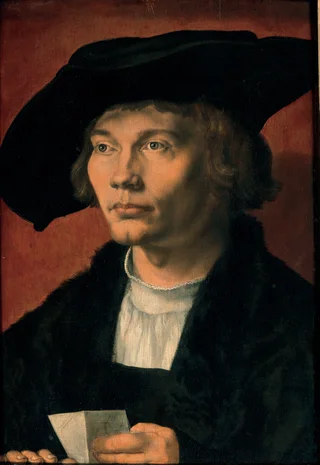
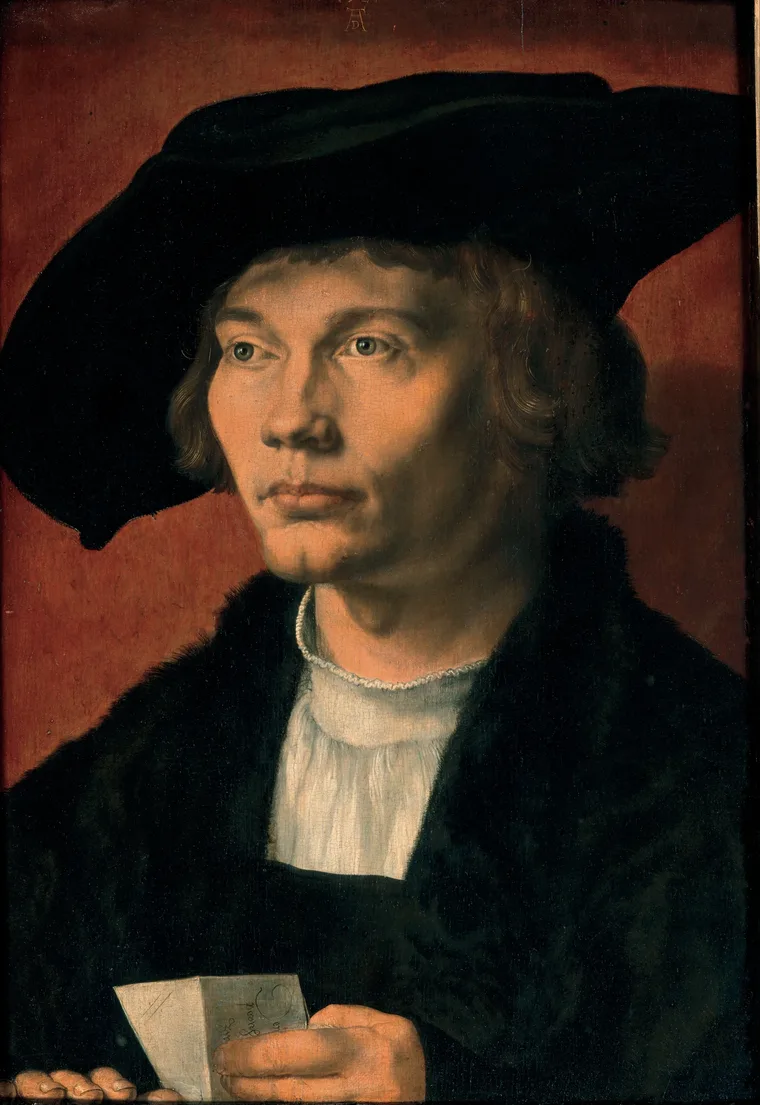
11. Portrait of Bernhard von Reesen — Albrecht Dürer, 1521
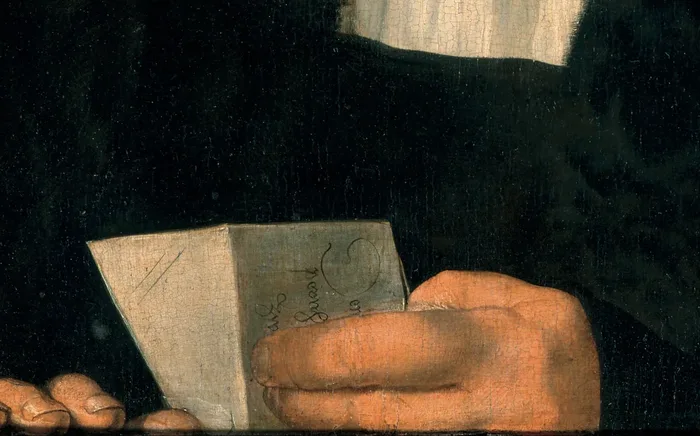
The young man holds a folded letter, and the address line on it runs under his thumb. The museum reads the beginning as “Dem pernh… zw…”, and the rest of the letters are covered by his finger. A huge black beret with a wavy brim, cut off by the left edge of the panel, hangs over his pale face. The background is a flat brick red, he looks past the viewer to the left, and at the top centre Dürer's monogram and the year are written in gold.
By then the Nuremberg painter Albrecht Dürer was the only German artist of his generation whose prints were known all over Europe, and he had been to Italy twice. After the death of the Emperor Maximilian in 1519, Nuremberg stopped paying him his imperial pension of 100 guilders, and Dürer spent 1520–1521 in the Netherlands with his wife Agnes, trying to have the pension confirmed by the new emperor, Charles V. On the road he kept a diary that reads more like an account book, in which he noted his fees, meals, gifts and the people he drew. In Antwerp in 1521 he recorded that he had painted in oils a portrait of Bernhart, whose surname the copies of the diary give in different forms, and that the sitter paid him eight florins and gave his wife a crown.
In 1743 the portrait was bought for Dresden in Paris through the same agent, Le Leu. In the 19th century it was thought to show the Netherlandish painter Bernard van Orley, court painter to Margaret of Austria. Van Orley's portrait is recorded in the same diary, although Dürer made that one in charcoal, in Brussels, in 1520. In the mid-20th century the gallery gave the picture a neutral title, Portrait of a Young Man. In the early 1970s a study by Erna Brand in the yearbook of the Dresden collections identified the sitter as von Reesen, and the gallery now calls him by name.
According to the museum, Bernhard von Reesen, from a Danzig merchant family that traded in Antwerp, was born in 1491 and died in 1521, the year of the portrait.
A bullet, the tunnels and ten years in Moscow (1920–1956)
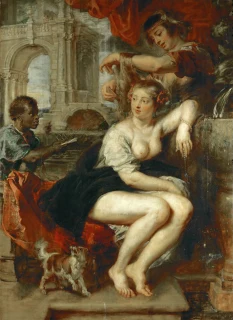
12. Bathsheba at the Fountain — Peter Paul Rubens, c. 1635
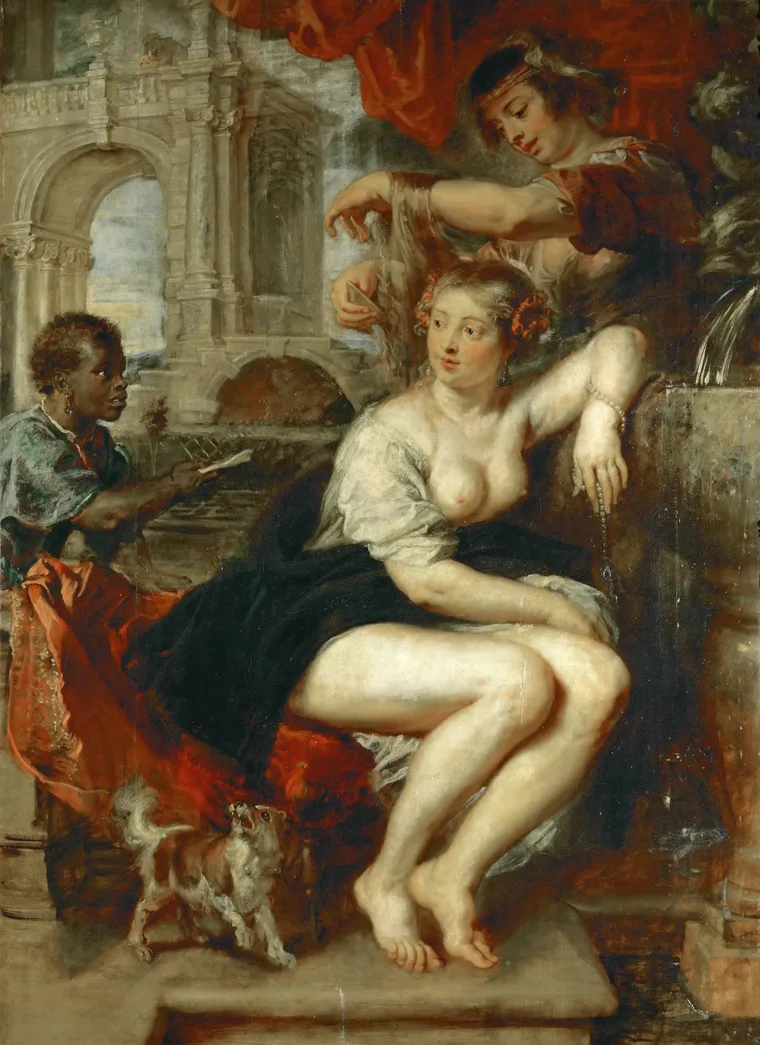
On 15 March 1920, during the Kapp Putsch, a failed attempt at a military coup, there was street fighting on Dresden's Postplatz next to the Zwinger, and 59 people were killed. A bullet flew into the gallery and hit this painting. According to the gallery's report, quoted by Max Seydewitz, director-general of the Dresden collections from 1955 to 1968, it went through the panel in Bathsheba's hair. The restorer Theodor Krause put a wooden plug into the hole and reinforced the panel from behind with a batten, and on 27 March the gallery's director Hans Posse reported that the picture had been fully restored.
Oskar Kokoschka, a professor at the Dresden Academy of Fine Arts since 1919, published an appeal to the people of Dresden. He wrote that a bullet had wounded a painting by Rubens, and he asked everyone who meant to argue their political views with guns, whether of the left, the right or the centre, to hold such exercises away from the gallery, on the shooting ranges, for instance. The Berlin Dadaists George Grosz and John Heartfield answered him with a pamphlet, “Der Kunstlump”, “The Art Scoundrel”, writing that they welcomed with joy the bullets that flew into galleries, palaces and masterpieces by Rubens instead of into the homes of the poor.
Bathsheba sits by a stone fountain in a white chemise slipped down from her shoulder, with a black wrap over her knees and one bare foot laid over the other. A maid behind her has lifted a long strand of her fair hair, twisted through with red ribbons, over her arm and holds a comb. On the left a Black page boy holds out a folded letter, a little dog barks below, and in the upper left corner the tiny figure of King David, who sent the letter, leans on the balustrade of the palace. According to the museum, Rubens probably painted Bathsheba inspired by the beauty of his second wife, Helena Fourment.
In 1945 Soviet search teams went looking for the picture, and the story of how it was found is told by Leonid Volynsky, whose real name was Rabinovich, in his fictionalised memoir Seven Days (more about him and the arguments over his account in the entry on the Sistine Madonna). According to Volynsky, Bathsheba was carried out of the damp part of a limestone quarry near Pockau-Lengefeld with the paint in her hair swollen into a blister, and the restorer Stepan Churakov stuck the first strip of tissue paper over the damage then and there.
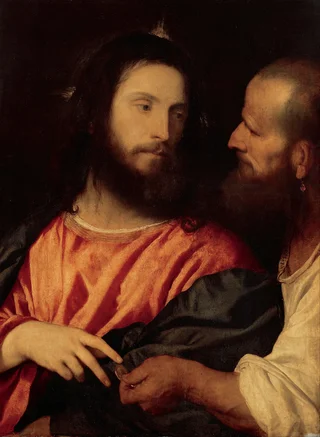
13. The Tribute Money — Titian, c. 1516
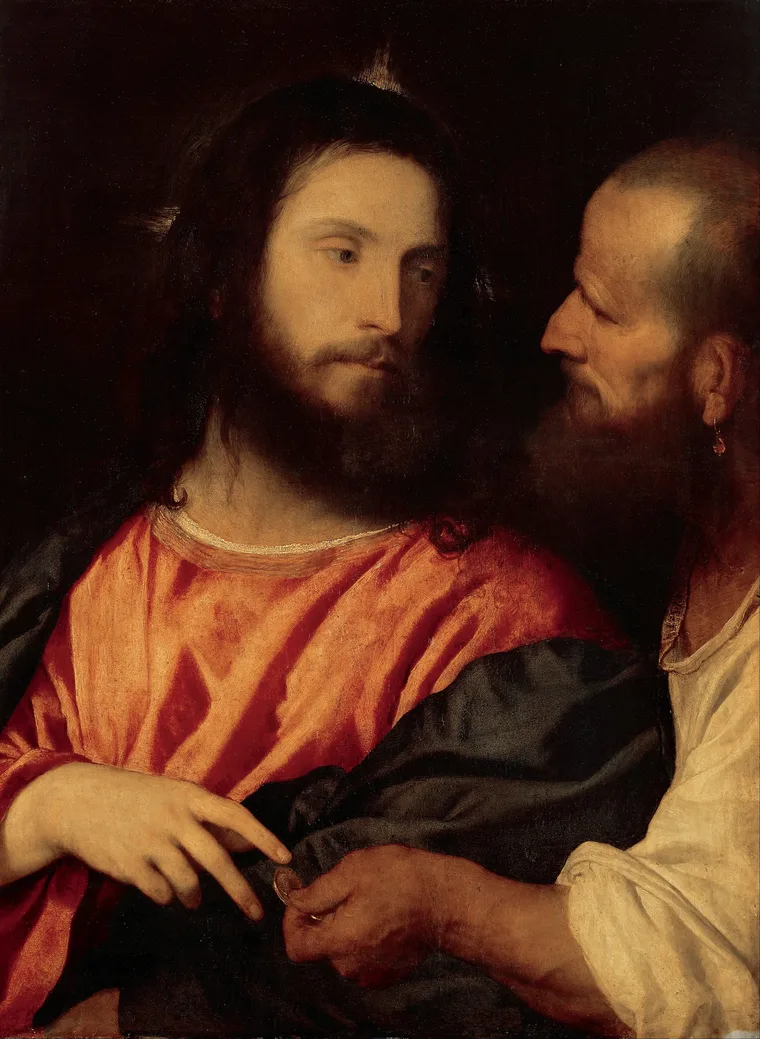
The painter Pavel Korin, head of the restoration workshop of the Pushkin Museum of Fine Arts in Moscow, restored Titian's Tribute Money in 1947 together with his wife Praskovya Korina and the restorer B. M. Shakhov, and the museum has published a photograph of the three of them at work on it. The poplar panel had reached Moscow with the other Dresden paintings on 10 August 1945, damaged in a damp wartime depot. In 1982 the restoration historian N. E. Knorre wrote that the pictures Korin restored himself or under his direction would make up a whole gallery, “from the famous Fornarina of the museum's collection to Titian's Dresden Tribute Money”.
Titian painted the panel around 1516 for Alfonso I d'Este, Duke of Ferrara, when the young Venetian was just beginning to work for Ferrara. The biographer of artists Vasari writes that Titian painted the head of Christ on the door of a cupboard, and a letter from Ferrara of 1559 mentions little drawers behind a door with his portrait of Christ, so the museum thinks it was probably the door of a cabinet for the duke's coin collection. In 1598, when Ferrara passed to the Papal States, the Este took their collection to Modena, and the picture came to Dresden in 1746 among the 100 Modena paintings (the purchase is told in the entry on the Holy Night).
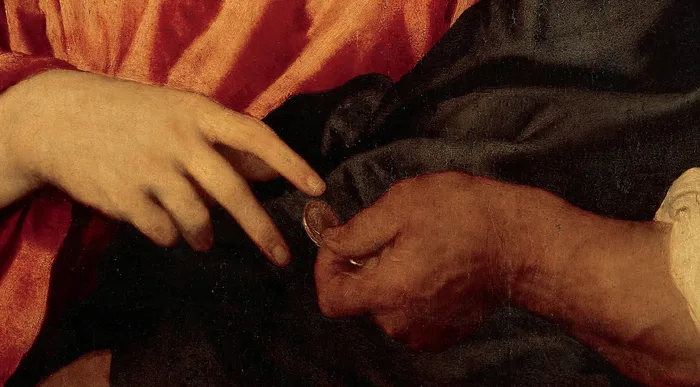
Two half-length figures stand close together against an almost black background. Christ, in a red-orange tunic and a dark mantle, takes up the left two thirds of the panel, and only a few thin gold rays show above his head. From the right a Pharisee leans in profile right up to his face, balding, with tanned, wrinkled skin and a small gold earring. The whole story fits into the bottom centre: the Pharisee's thick tanned fingers hold up a coin, and Christ's long pale finger points at it, almost touching its rim. Up the collar of the Pharisee's shirt run the small pale letters of the signature, TICIANVS F., and this is one of the earliest paintings Titian signed with his full name.
The picture came back to Dresden with the others, and in 1957 the GDR issued a stamp showing it in a series on the return of the paintings from the USSR. Even so, in 1963–1964 the panel had to be treated again, this time in Dresden, and photographs of 1963 in the archive of the restorer Kurt Wehlte show paint that had lifted in sharp ridges being laid back down. In 1964 Wehlte published “Titian's Tribute Money, a Problem Child for Restorers” and “Titian's Tribute Money Restored!” in the journal Maltechnik.
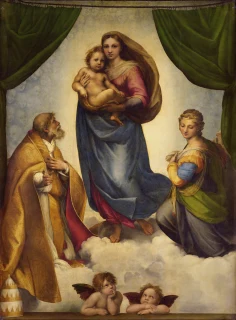
14. Sistine Madonna — Raphael, 1512–1513
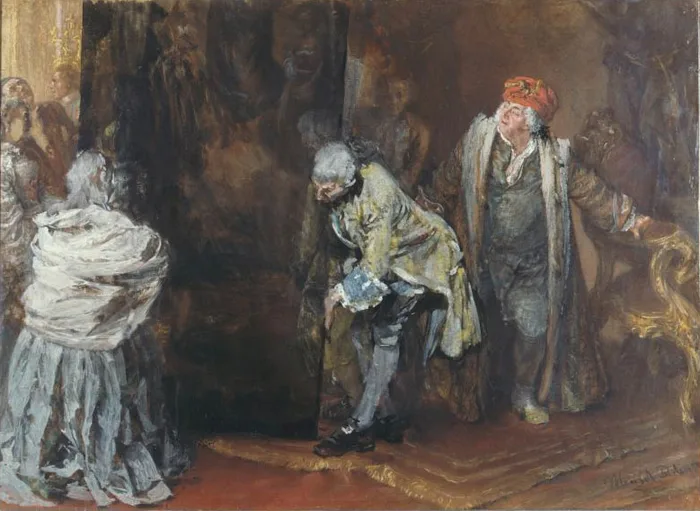
No document confirms the story of how Augustus III received this picture, and it is best known from an 1855 pastel by the German artist Adolph Menzel. As the legend goes, when the painting was brought into the palace the king saw that the best and brightest place was taken by his throne, pushed the throne aside himself and exclaimed, “Make way for the great Raphael!” Menzel, who finished his picture in 1859, described its hero as “the domestic Augustus”, turned furniture-mover for a moment “for the sake of something higher”.
In reality the purchase dragged on for almost two years and more than once nearly fell through. Raphael painted the picture in 1512–1513 for the high altar of the monastery church of San Sisto in Piacenza, most likely, in the museum's view, on a commission from Pope Julius II, and for two and a half centuries hardly anyone in Piacenza paid it any attention. The Benedictine monks of San Sisto sold it because they had debts to pay. The contract was signed on 9 March 1753 with the agent Bianconi as go-between, on 1 December the painting was taken out of its frame and packed upright in a crate, and on 1 March 1754 it arrived at the royal palace in Dresden. A copy by Pier Antonio Avanzini stayed behind in San Sisto. The picture became famous only in Dresden, around 1800.
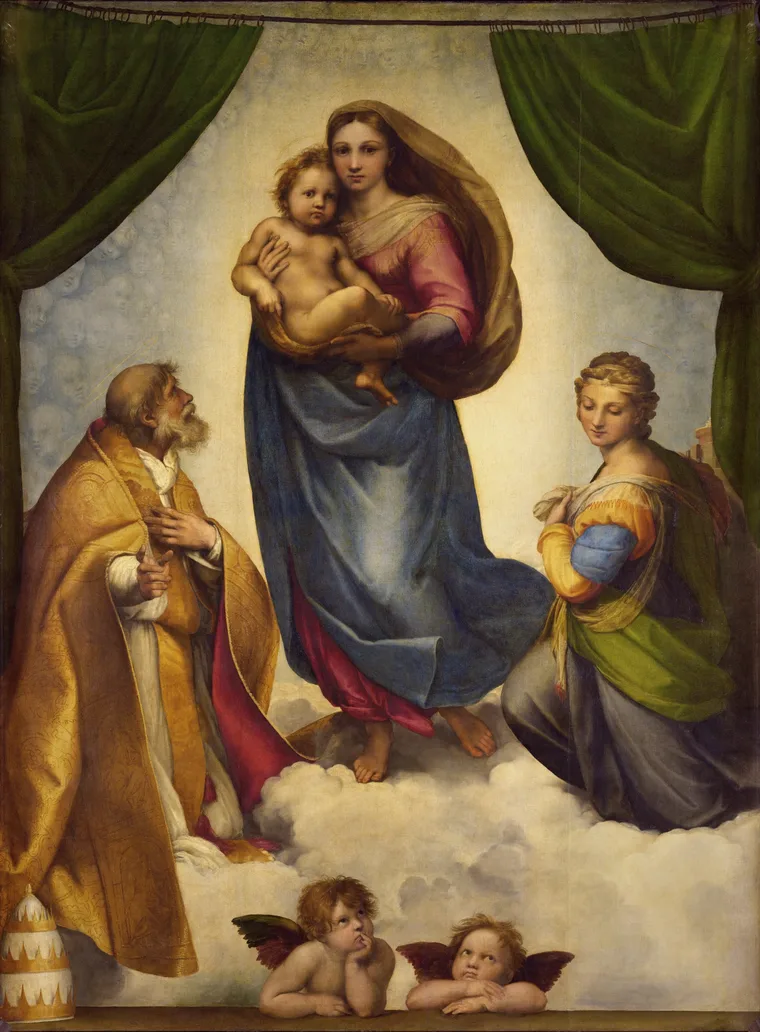
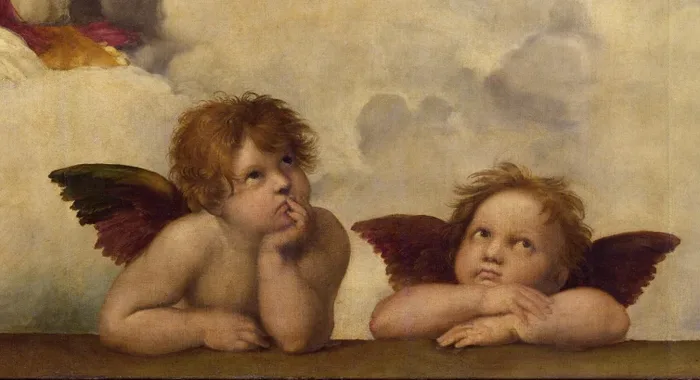
At the top, curtain rings hang from a thin rod, and heavy green curtains are drawn back to right and left. Mary walks barefoot over the clouds straight towards the viewer, and both she and the Child on her arm look us in the eye. On the left Pope Sixtus, kneeling in a gold brocade cope, raises his eyes to her and points outward, out of the picture, and his white tiara with three gold crowns stands in the lower left corner. On the right Saint Barbara has turned away and lowered her eyes towards the bottom edge. Seen up close, the pale sky behind Mary turns out to be filled with faint grey-blue angels' heads. At the bottom two winged boys lean on a narrow dark strip, one with his chin propped on his hand, the other with his chin on his crossed arms, and according to the museum Raphael added them last. In 1803 they were copied on their own for the first time, apart from the Madonna, and since then they have been reproduced on anything at all.
On 11 September 1939 the picture was taken off the wall and moved to the Albrechtsburg castle in Meissen, and on 15 December 1943, in a plywood crate made to its measurements, it was taken to a disused railway tunnel at Rottwerndorf near Pirna.
In Moscow and in Dresden the events of May 1945 are told differently. The Soviet version was written down by Leonid Rabinovich, a junior lieutenant who wrote under the pen name Leonid Volynsky, in his novella Seven Days, which came out as a book in 1958. According to him, at the beginning of May he and his comrades found the tunnel with the help of a coded map. Inside stood a dark red freight wagon, right opposite its door was a flat unpainted crate reaching up to the roof, and in it was the Sistine Madonna. The director Lev Arnshtam based the Soviet-German film Five Days, Five Nights on this novella, in 1984–1985 Mikhail Kornetsky painted a picture of the rescue of the Madonna, and in 2015 the Pushkin Museum called the Dresden paintings “rescued masterpieces”. The Dresden State Art Collections, to which the gallery belongs, called the Soviet story of the Madonna's rescue a “rescue legend” in 2012, for the picture's 500th anniversary. Werner Schmidt, a former director of the gallery, objected in 2005 that the Soviet film had shown a damp mine, whereas the Madonna had stood in the tunnel in a climate-controlled wagon, and the damp depot was the quarry at Pockau-Lengefeld. Uta Neidhardt writes that the Soviet search teams were told about the depots by German museum staff who had stayed on in Dresden, and German historians doubt that the secret map ever existed.
The paintings were gathered at Pillnitz Castle outside Dresden, in July 1945 Soviet trophy brigades took them out of the city, and on 10 August they arrived at the Pushkin Museum, while another part was sent from Pillnitz to Kyiv in February and March 1946. The paintings stayed in Moscow for ten years, and Soviet restorers treated them. On 31 March 1955 the USSR Council of Ministers announced that they would be returned. From 2 May to the end of August 1955 the Pushkin Museum showed about 350 of them, keeping the exhibition open from half past seven in the morning to eleven at night with no days off, and by its own count about 1.2 million people came. The act of transfer was signed on 25 August. According to the gallery, about 1,200 paintings came back to Dresden in 1955–1956, while Russian sources give 1,240. From 27 November 1955, according to The Frame Blog, which writes on the history of picture frames, the Sistine Madonna was shown at the National Gallery in East Berlin, and on 3 June 1956, when the Semper building reopened, it returned to the Dresden gallery.
The restorers remove a later overpaint (2017–2021)
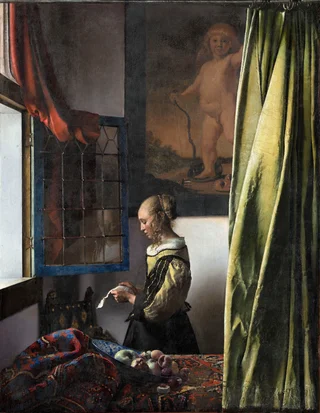
15. Girl Reading a Letter at an Open Window — Johannes Vermeer, c. 1657–1659
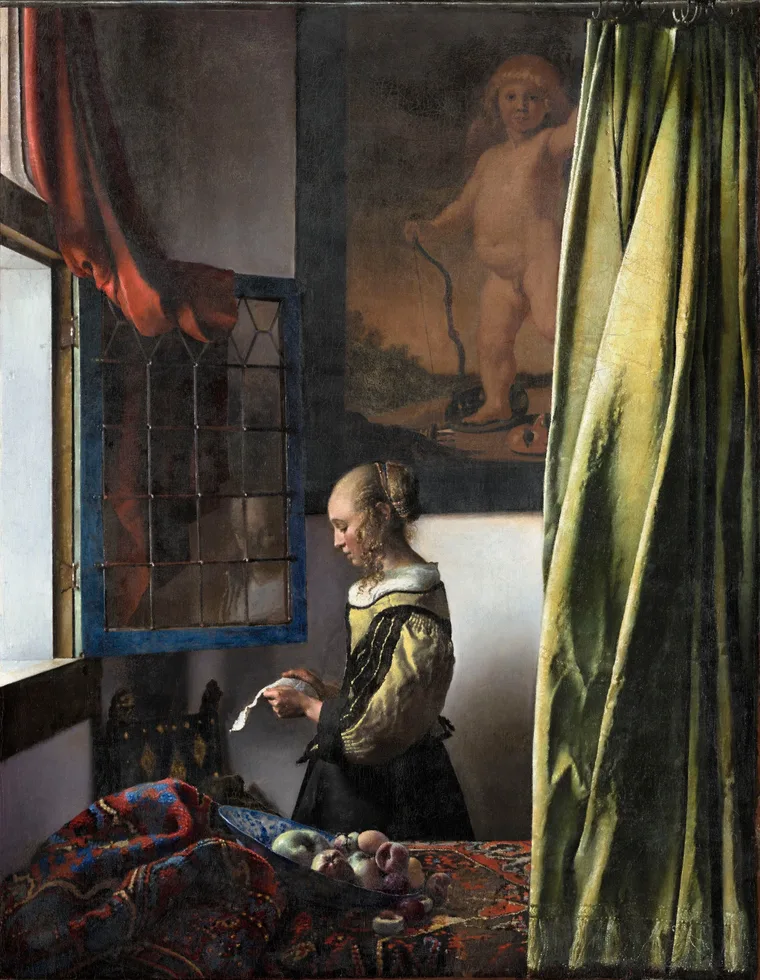
In the spring of 1742 Samuel de Brais, secretary of the Saxon legation in Paris, was buying paintings from the collection of the Prince of Carignan for the minister Brühl. He took 30 pictures, and this one, the museum says, he received as an extra, outside the deal, as a Rembrandt. In Dresden it was then listed as school of Rembrandt (1765) and as Govert Flinck (1783), and from 1826 as Pieter de Hooch. In 1859 the same Thoré-Bürger who had read the date on The Procuress recognised it as a Vermeer, and in 1862 the catalogue entered it under his name.
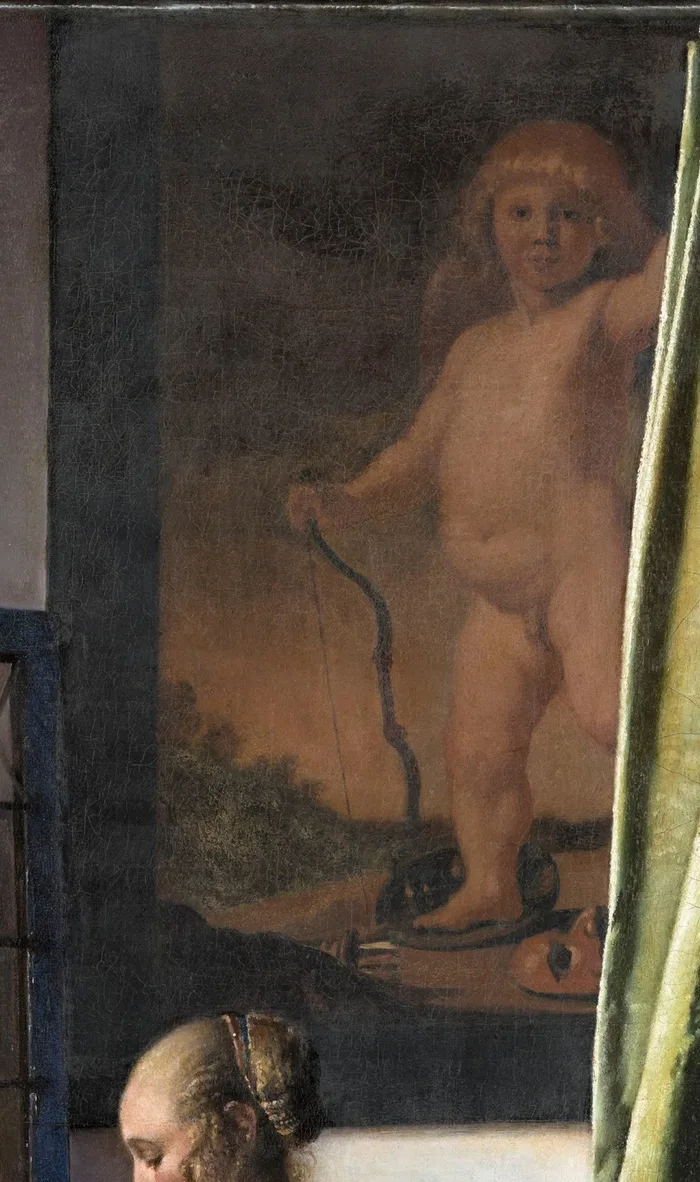
In 1979 an X-ray showed a painted-over picture with a Cupid on the back wall, above the girl's head. The gallery's curator Annaliese Mayer-Meintschel published the image in 1982, and for almost four decades it was assumed that Vermeer himself had painted the Cupid out after changing his mind.
In May 2017 the restorer Christoph Schölzel began removing the yellowed varnish, and it turned out that the overpaint on the wall reacted to solvent differently from Vermeer's paint. Layers of varnish and dirt were found between Vermeer's painting and the overpaint, and the museum concluded that the Cupid had been painted over several decades after the picture was made. The museum could not establish who did it or when. The letters about the 1742 purchase do not mention the Cupid, although he takes up most of the wall, and the museum believes he had already been painted over by the time of the sale. In early 2018 a commission of specialists from several museums approved the decision to remove the overpaint, which was taken off with a scalpel under a microscope, and by 2021 the Cupid was back on the wall. The scholar Gyula Kemény objected that in rooms heated by wood fires and lit by candles, varnish and dirt could have built up within Vermeer's own lifetime.
The girl stands in profile facing the open window and reads a letter she holds in both hands. The casement with its leaded panes has swung open into the room, a red curtain is thrown over the top of the window, on the right a large yellow-green curtain hangs from rings as if in front of the picture itself, and on the table, on a rumpled Turkish carpet, a porcelain dish of peaches and apples has tipped over. Since the restoration a large framed painting hangs above the girl's head, in which a naked fair-haired Cupid stands holding a bow, with masks lying at his feet. The museum reads this as a sign of sincere love overcoming deception and hypocrisy.
The same Cupid hangs on the wall in three more interiors by Vermeer, and the museum suggests that the painting belonged to the artist himself.
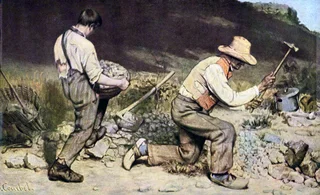
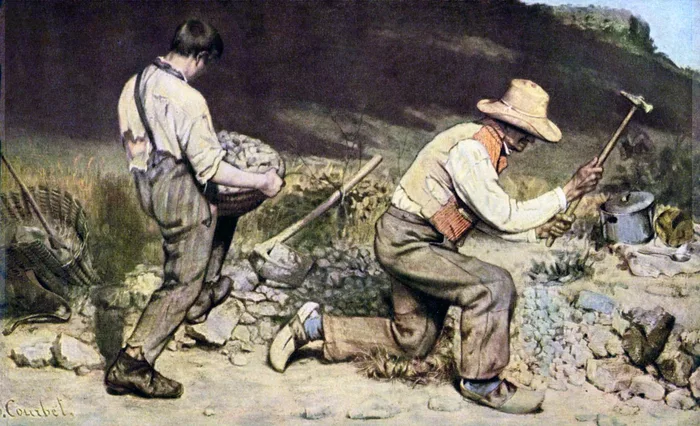
The Procuress, Sleeping Venus, Rembrandt and Saskia and the Sistine Madonna survived the war in the tunnel near Pirna, Girl Reading a Letter in the fortress of Königstein, and Bathsheba, by Volynsky's account, in the quarry at Pockau-Lengefeld. The paintings that stood in the courtyard of Dresden Castle on the night of the bombing, 13–14 February 1945, burned. Uta Neidhardt counts 174 paintings destroyed, while older counts give 154 paintings in a furniture van and 42 in the castle itself. Gustave Courbet's The Stone Breakers, a painting from the modern part of the collection, today's New Masters Gallery, was also lost in February 1945.
What else to see
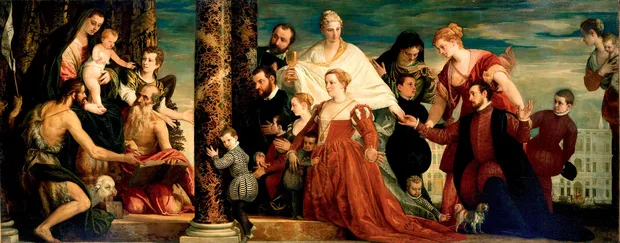
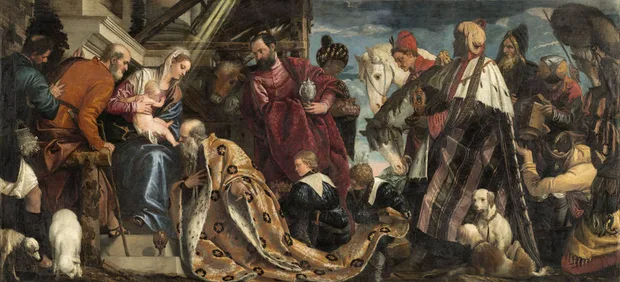
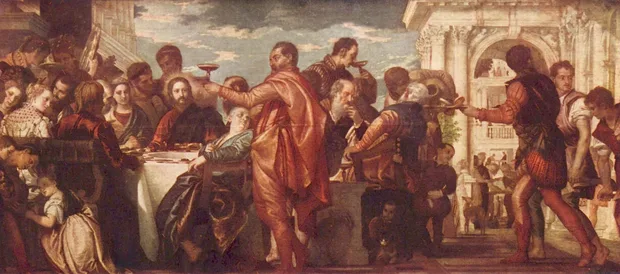
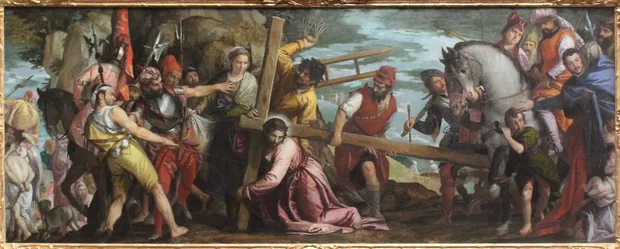
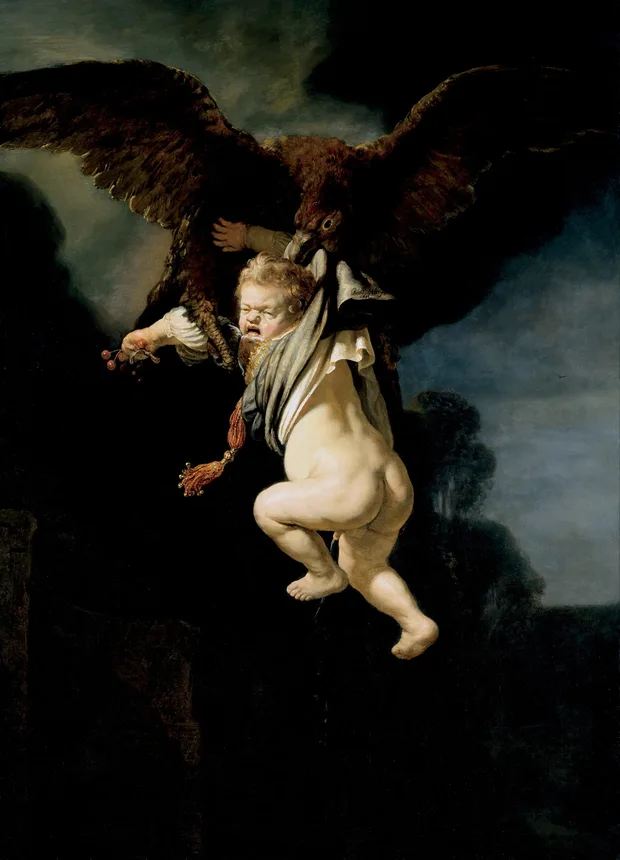
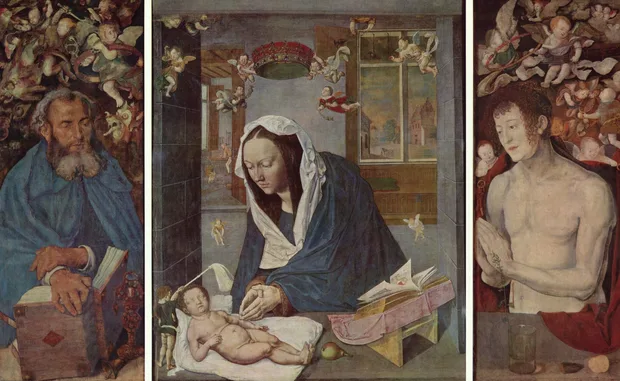
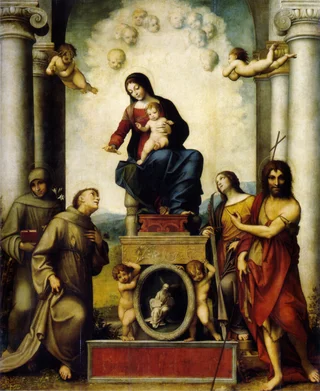
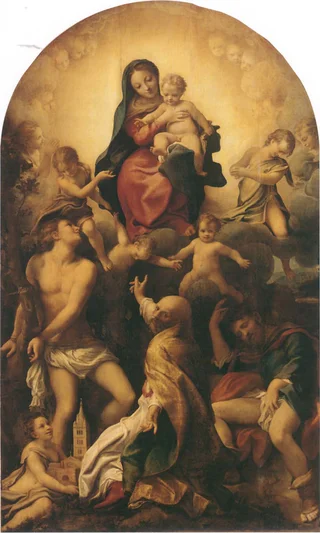
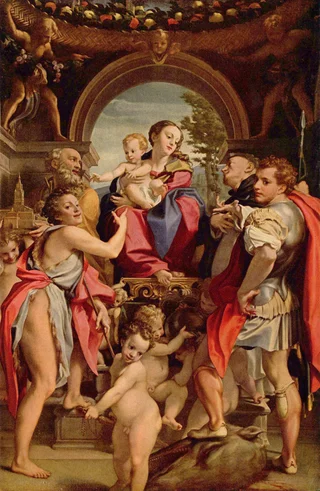
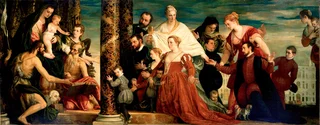
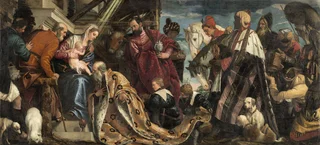
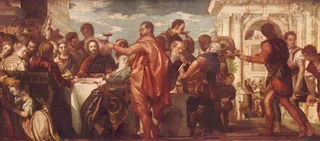
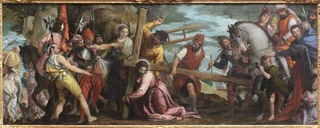
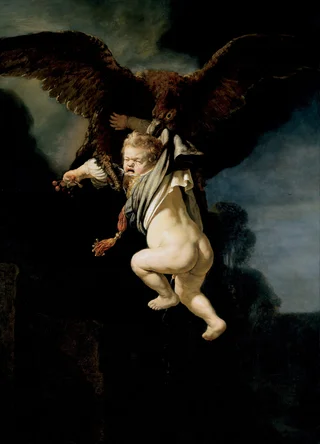
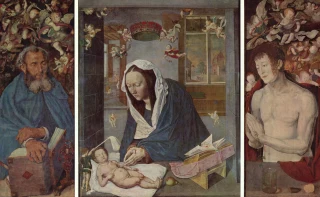
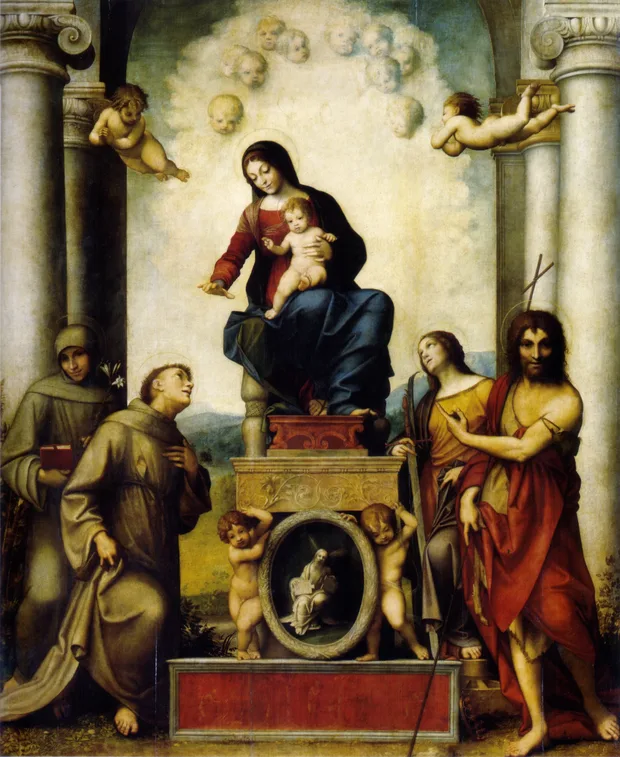
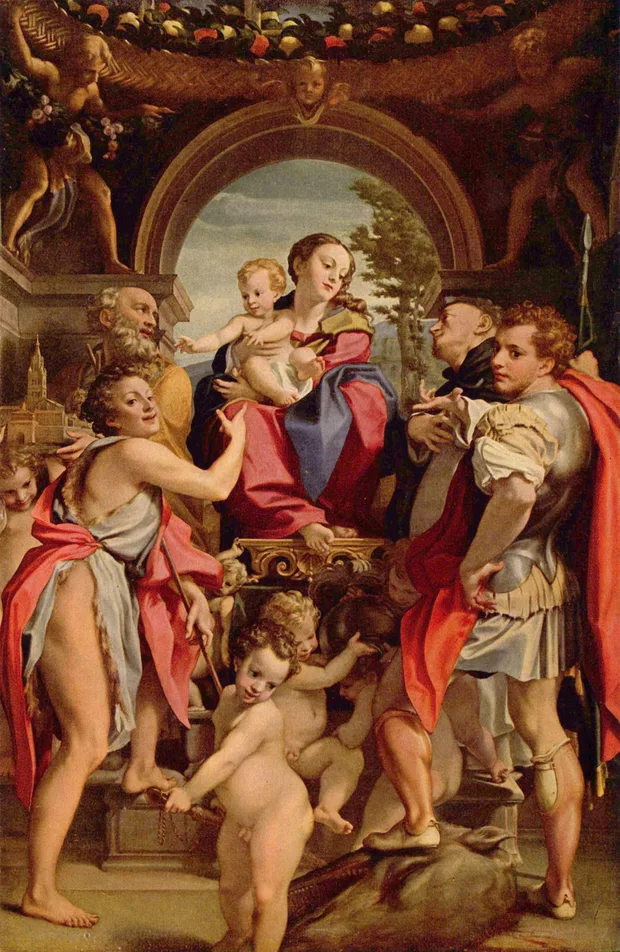
From the same Modena purchase of 1746 as the Holy Night, the gallery holds three more Correggio altarpieces, the Madonna with St. Francis, the Madonna of Saint Sebastian and the Madonna of Saint George, and four canvases by Veronese, painted for the Cuccina family house in Venice and still kept together. Augustus III owned the largest collection of pastels by Rosalba Carriera, the same artist who praised The Chocolate Girl. The gallery also has Bellotto's companion view from the same bank of the Elbe above the Augustus Bridge, dated 1747. Besides Saskia, Rembrandt is represented by The Rape of Ganymede, bought in 1751 through Heinecken. Dürer can also be seen in the Dresden Altarpiece, which was moved in 1687 from the castle church in Wittenberg to the Saxon Kunstkammer, and among the works of Lucas Cranach the Elder the pair of portraits of Henry the Pious and Catherine of Mecklenburg is worth seeking out, the first full-length, life-size portraits in German painting.